

What if the three business day deadline for filing a Suspicious Matter Report wasn’t a source of anxiety, but a predictable, automated part of your firm’s revenue stream? Since the Tranche 2 obligations commenced on 1 July 2026, many accounting firms have felt the pressure of identifying suspicious patterns while managing strict AUSTRAC timelines. You might worry that automated SMR reporting AUSTRAC systems are only for large institutions, leaving your practice vulnerable to manual errors or the $36.4 million maximum civil penalty. We’re here to show you that this transition is a manageable step that actually improves your operational ease.
This guide explains how to achieve 30-day compliance readiness and transform these administrative requirements into a billable professional service. We’ll walk through the latest 2026 reporting forms, strategies to reduce manual hours, and ways to ensure your firm remains a steady, reliable partner for your clients. By the end of this article, you’ll understand how to protect your firm’s profitability while meeting your regulatory duties with absolute confidence.
Key Takeaways
- Master the critical AUSTRAC reporting deadlines, including the 24-hour window for terrorism-related suspicions and the three-day limit for standard matters.
- See how automated SMR reporting AUSTRAC tools bridge the gap between your client intake data and high-quality regulatory submissions.
- Identify the essential features of an SMR tool that tracks compliance as a recoverable activity to protect your firm’s bottom line.
- Evaluate the risk and ROI of manual reporting versus digital, audit-ready documentation to ensure your practice remains beyond reproach.
- Learn how to achieve full compliance readiness within a 30-day timeframe using a platform tailored for the Australian accounting sector.
Why Manual SMR Reporting is a Compliance Bottleneck for SMEs
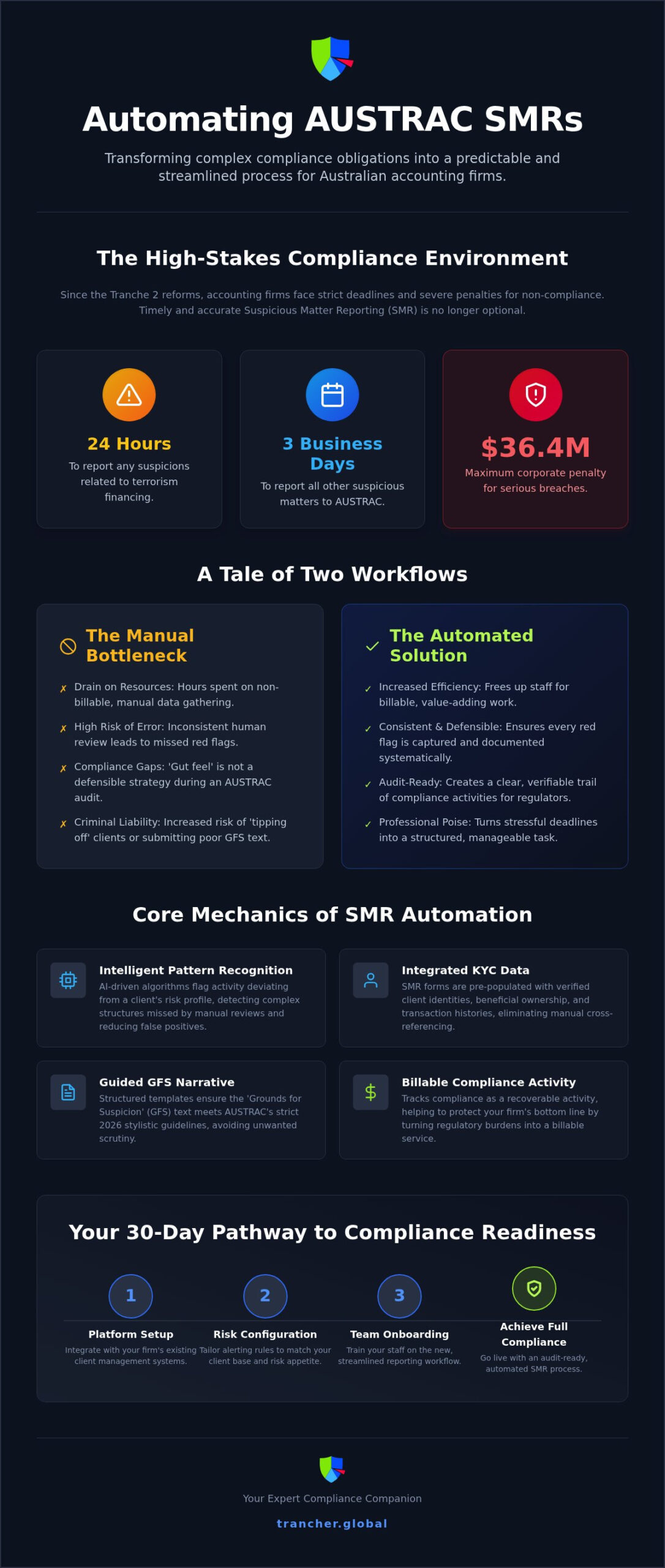
A Suspicious Matter Report (SMR) is a core obligation under the Australian AML/CTF framework. Since the Tranche 2 reforms commenced on 1 July 2026, accounting firms must notify AUSTRAC whenever they form reasonable grounds for suspicion regarding a client or transaction. This isn’t just about obvious criminal activity; it’s about any interaction that seems inconsistent with a client’s profile. Relying on automated SMR reporting AUSTRAC systems has become essential because the timelines are incredibly tight. You have just 24 hours to report suspicions related to terrorism financing and only three business days for all other matters.
The inclusion of accountants in the regulatory net means your reporting frequency will likely increase. AUSTRAC now expects the same level of rigour from a small firm as they do from a major bank. If your process remains manual, you risk ‘tipping off’ a client, which is a criminal offence, or submitting incomplete ‘Grounds for Suspicion’ (GFS) text that triggers unwanted regulatory scrutiny. Automation helps you avoid these pitfalls by providing a structured, guided path for every report.
The True Cost of Manual Compliance
Manual data gathering is a silent drain on your firm’s resources. When staff spend hours trawling through disparate spreadsheets to piece together a client’s history, they aren’t performing billable work. With maximum corporate penalties reaching $36.4 million for serious breaches, the financial risk of a reporting failure far outweighs the cost of modern tools. Transitioning to a digital workflow is a proven way to achieve AML CTF compliance costs reduction while maintaining audit readiness across your entire practice.
Identifying Red Flags Without Automation
Human review is prone to inconsistency. A junior staff member might miss a subtle pattern of ‘structuring’ that a senior partner would spot, yet the firm remains liable for the oversight. Relying on ‘gut feel’ isn’t a defensible strategy during an AUSTRAC audit. Common indicators often missed by manual review include:
- Unusual transaction patterns that don’t align with the client’s known business activity.
- Frequent high-value cash deposits just below the $10,000 reporting threshold.
- Clients who are hesitant to provide updated identification or beneficial ownership details.
Without automated SMR reporting AUSTRAC capabilities, maintaining a consistent standard across a growing team is difficult. Automation ensures that every red flag is captured, documented, and reported with the same level of professional care, turning a high-risk task into a manageable, routine process.
The Mechanics of Automated SMR Reporting: From Detection to Submission
Automation serves as the vital bridge between your initial client verification data and the final submission to the regulator. When your KYC data is properly integrated, the SMR form pre-populates with verified client identities, beneficial ownership structures, and recent transaction histories. This removes the friction of cross-referencing physical files or disparate digital folders. It turns a stressful deadline into a manageable, structured task that your team can complete with professional poise.
Intelligent Pattern Recognition and Alerting
Modern compliance systems use advanced algorithms to flag activity that deviates from a client’s established risk profile. This proactive approach allows your firm to realise the Benefits of AI in AML Compliance, such as detecting complex money laundering structures that are often invisible during manual reviews. By implementing Ongoing risk monitoring software, you can significantly reduce the volume of false positives. This refinement ensures your senior compliance officers don’t waste precious hours on non-suspicious alerts, allowing them to focus their expertise where it is truly needed.
Mastering the ‘Grounds for Suspicion’ (GFS)
Drafting the GFS narrative is typically the most time-consuming aspect of any report. AUSTRAC’s 2026 stylistic guidelines now explicitly require a standard case format, which means you must avoid using ALL CAPS for emphasis or headings. Automated templates guide you through this drafting process using logical headings and structured prompts, ensuring your narrative remains clear and factual for AUSTRAC analysts. Automated tools provide a secure, internal drafting environment that ensures staff can document suspicions without the risk of accidentally tipping off a client before the official submission.
Beyond drafting, automated SMR reporting AUSTRAC tools perform real-time data validation to ensure every field meets the updated 2026 formatting standards. For most SMEs, API-led reporting is the gold standard for efficiency. While manual portal entry requires navigating multiple screens and re-typing data, an API connection allows your compliance software to communicate directly with AUSTRAC’s systems. This ensures that stylistic updates are automatically applied, keeping your firm aligned with the regulator’s evolving expectations without constant manual oversight.
Choosing a partner like Trancher helps you integrate these sophisticated mechanics into your daily workflow without requiring enterprise-level IT support or complex infrastructure.
Manual vs. Automated SMRs: A Risk and ROI Comparison
While manual spreadsheets might seem cost-effective initially, they often become a significant liability during a regulatory review. AUSTRAC’s shift toward operational scrutiny in 2026 means that simply having a written policy isn’t enough; you must prove that your programme works in daily practice. automated SMR reporting AUSTRAC systems provide this proof by default. They move your firm away from fragmented data and toward a cohesive, defensible compliance posture that stands up to the most rigorous independent audits.
One common misconception is that automation replaces the professional judgement of a partner. In reality, it enhances it. A machine doesn’t decide a matter is suspicious; it simply ensures that when you make that determination, the report is filed accurately and on time. This allows you to act as the strategic guide for your clients while the software handles the administrative heavy lifting. It turns a reactive burden into a proactive, manageable workflow.
Submission speed is a direct indicator of your firm’s regulatory standing. Filing an SMR within the mandatory three business day window is the baseline, but filing it with high-quality, structured data demonstrates a commitment to the integrity of the financial system. This proactive approach builds a level of trust with the regulator that manual, last-minute filings simply cannot match. It’s an investment in your firm’s reputation and long-term viability.
Audit-Ready Record Keeping
Automation creates a permanent, timestamped trail of every compliance decision made within your firm. This includes not just the reports you file, but also the ‘near-miss’ investigations where you determined a matter wasn’t suspicious. Maintaining Audit-ready compliance records ensures that when AUSTRAC requests documentation, you can provide a centralised, chronological history in minutes. This level of organisation is nearly impossible to achieve with manual spreadsheets and disparate document folders.
Protecting Your Firm from Tipping Off
Manual reporting often relies on internal email chains or physical files, both of which carry significant security risks. If a client accidentally sees an email subject line or a stray document left on a desk, your firm could inadvertently commit the Tipping off offence in the AML Act. Automated workflows mitigate this risk by restricting SMR data to authorised personnel only through secure, role-based access. This ‘need-to-know’ environment is a hallmark of a mature compliance programme and is far more defensible than any manual system.
Selecting the Right SMR Automation Tool for Your Practice
Selecting a platform for automated SMR reporting AUSTRAC involves more than just evaluating technical specifications. For a small to medium accounting firm, the right tool must act as a seamless extension of your existing practice management ecosystem. A primary criterion is the depth of integration with your current accounting software and client intake systems. When data flows without friction between these platforms, you eliminate the double-handling that often leads to reporting errors. This connectivity ensures that when a suspicion is formed, the necessary client identifiers and transaction histories are already available, allowing you to meet the strict filing windows with professional ease.
Local Australian support is another non-negotiable factor. Regulatory landscapes are nuanced, and having access to an onboarding team that understands the specific triggers for Tranche 2 reporting provides a level of reassurance that offshore help desks cannot match. You need a partner who can offer expert guidance on-call, ensuring your firm remains proactive rather than reactive. Scalability also remains a vital consideration; as your client base grows and regulatory scrutiny intensifies, your compliance infrastructure must be robust enough to handle increased reporting volumes without requiring a proportional increase in administrative staff.
Turning Compliance into a Billable Asset
The most sophisticated tools on the market today distinguish themselves by focusing on your firm’s bottom line. The ‘profitability factor’ is a key differentiator, where the software actively tracks compliance-related tasks as recoverable activities. By using Compliance ROI tracking software, you can transform what was once a non-billable overhead into a transparent, professional service. This approach allows you to justify technology investments to partners while providing clients with a clear understanding of the value provided in protecting their financial integrity. It moves the conversation from cost of compliance to quality of advisory.
Ease of Implementation and Onboarding
With the 1 July 2026 obligations already in effect, your firm doesn’t have the luxury of a prolonged implementation phase. A 30-day compliance-ready guarantee is essential to ensure you are protected without delay. Expert-led onboarding is superior to self-serve models because it provides the steady guidance necessary for a confident transition. Role-based training modules ensure that every member of your team understands their specific reporting duties, from identifying red flags to drafting the final submission. This structured approach builds a culture of compliance that is both sustainable and defensible.
If you are looking for a system that balances regulatory rigour with practice profitability, start a conversation with the Trancher team to see how we can support your firm’s growth.
Trancher: Streamlining Your AUSTRAC Obligations in 30 Days
Trancher is a 100% Australian-owned platform designed to simplify the complexities of the Tranche 2 reforms for SME accounting firms. While enterprise-level software often feels over-engineered for smaller practices, we focus on functional, accessible tools that remove the administrative friction from your daily workflow. Our system for automated SMR reporting AUSTRAC ensures you meet every regulatory standard without needing a dedicated IT department. We offer a 30-day compliance-ready guarantee, giving you the certainty that your firm is protected and ready for the obligations that commenced on 1 July 2026.
To support your transition, we provide a complimentary three-month trial for accounting firms, followed by a 20% discount for the first year. This isn’t just about software; it’s about shifting your perspective. Instead of viewing AUSTRAC requirements as a hurdle, Trancher helps you see them as an avenue for growth. By implementing automated SMR reporting AUSTRAC capabilities, you free up your senior staff to focus on high-value advisory work, turning a perceived burden into a strategic advantage for your practice.
A Steady Hand for the 2026 Transition
Aaron Soh and the Trancher team act as your expert companion, providing the steady guidance needed to manage changing landscapes. We believe that professional standards are best upheld when you feel supported rather than demanded of. Our platform offers an AUSTRAC-aligned AML programme that gives you the peace of mind to focus on your clients. For a deeper look at the requirements, explore our 2026 Guide for SMR reporting to ensure your team is fully informed.
Getting Started with Trancher
Beginning your journey toward operational ease is a straightforward process. Once you enrol in your three-month trial, our local Australian onboarding team will guide you through the setup, ensuring your reporting tools are fully integrated with your existing systems. At the end of the trial, we provide a formal ROI and profitability report. This document clearly outlines the manual hours saved and the billable compliance activity tracked, proving the value of the platform to your partners and your firm’s financial health.
Don’t let the stress of manual reporting hold your firm back. Book a conversation with an AML specialist today to see how we can secure your practice and improve your internal systems.
Securing Your Practice in the Tranche 2 Era
The commencement of Tranche 2 obligations on 1 July 2026 marks a significant shift for the Australian accounting sector. By moving away from manual bottlenecks and adopting automated SMR reporting AUSTRAC systems, your firm can maintain absolute compliance without sacrificing profitability. You’ve seen how digital workflows protect you from tipping-off offences and ensure every report meets the latest 2026 formatting standards. Most importantly, you’ve discovered that these obligations can be transformed into a billable professional service that adds value to your client relationships.
Trancher is 100% Australian owned and operated; we offer a 30-day AML/CTF compliance guarantee to ensure your practice is ready for the road ahead. We act as your steady guide, providing local support and a platform designed specifically for the needs of SMEs. It’s time to replace administrative stress with operational ease and business-minded optimism. Start your complimentary 3-month Trancher trial today and see how we turn regulatory requirements into an avenue for growth. We’re here to help you navigate these changes with confidence and professional poise.
Frequently Asked Questions
Is automated SMR reporting compliant with AUSTRAC’s 2026 standards?
Yes, Trancher’s platform is specifically designed to meet the updated 2026 regulatory standards. The system incorporates mandatory stylistic changes, such as the ‘standard case’ formatting for Grounds for Suspicion text. By using automated SMR reporting AUSTRAC tools, your firm ensures every submission is structured correctly and submitted through secure API connections. This reduces the risk of technical non-compliance that often plagues manual portal entries, keeping your practice aligned with the regulator’s evolving expectations.
Can automated software help prevent the tipping off offence?
Absolutely. Automated workflows prevent tipping off by centralising all suspicious matter documentation within a secure, role-based environment. This eliminates the need for internal email chains or physical files that unauthorised staff or clients might accidentally see. By restricting access to only the AML/CTF Compliance Officer and relevant partners, the software ensures the existence of an SMR remains strictly confidential. It’s a proactive way to protect your firm from serious criminal penalties while maintaining professional standards.
What is the deadline for submitting an SMR to AUSTRAC?
The deadline depends on the nature of the suspicion. If the matter relates to suspected terrorism financing, you must submit the report within 24 hours of forming the suspicion. For all other suspicious matters, the deadline is three business days. Automated SMR reporting AUSTRAC systems are vital for meeting these tight windows. They pre-populate client data and provide guided prompts to speed up the drafting process, ensuring your firm remains compliant even during busy periods.
How does Trancher help accounting firms bill for AML compliance work?
Trancher transforms compliance into a recoverable professional service by tracking every minute spent on designated service activities. The platform generates evidence of the work performed, which can then be used to support client billing. At the end of our complimentary three-month trial, we provide a formal ROI and profitability report. This identifies new advisory revenue streams, ensuring your regulatory duties contribute to the firm’s bottom line rather than acting as a non-billable administrative overhead.
Do I need an AML compliance officer if I use automated reporting software?
Yes, the AML/CTF Act requires every reporting entity to appoint a designated AML/CTF Compliance Officer. While the software automates the administrative heavy lifting, such as data gathering and report formatting, the Compliance Officer remains responsible for the final oversight of the programme. Trancher acts as an expert companion to this individual. We provide the structured workflows and audit-ready records they need to perform their role effectively, ensuring your firm stays on the right side of the law.
What happens if our firm fails to report a suspicious matter to AUSTRAC?
Failing to report can lead to severe consequences, including court-imposed civil penalties of up to $36.4 million per contravention for bodies corporate. Beyond financial fines, AUSTRAC may issue formal directions, require a mandatory independent audit, or pursue criminal investigations in serious cases. Using an automated system mitigates these risks by providing consistent monitoring and alerting. It ensures no red flags are missed by your team, protecting your practice from significant financial and reputational damage.
How quickly can Trancher make my firm AUSTRAC-ready for Tranche 2?
We offer a 30-day compliance-ready guarantee for all accounting firms. This structured onboarding process ensures your AML/CTF programme, client verification tools, and reporting workflows are fully operational within one month. Our goal is to move your practice from manual uncertainty to operational ease as quickly as possible. We ensure you meet the obligations that commenced on 1 July 2026 without disrupting your daily client work, providing a steady hand during the transition period.
Does Trancher provide local Australian support for SME firms?
Yes, Trancher is 100% Australian owned and operated. Founded by compliance specialist Aaron Soh, our team provides dedicated local onboarding and ongoing expert support tailored for the Australian market. We understand the specific pain points of local SME accounting firms and offer on-call guidance to help you navigate complex regulatory transitions. You’ll always speak with a local expert who understands the Australian regulatory landscape, ensuring you feel supported and informed every step of the way. When building your broader due diligence framework, it’s also worth reviewing the critical distinction between understanding source of wealth vs source of funds to ensure your client verification processes meet the full scope of Tranche 2 requirements.