

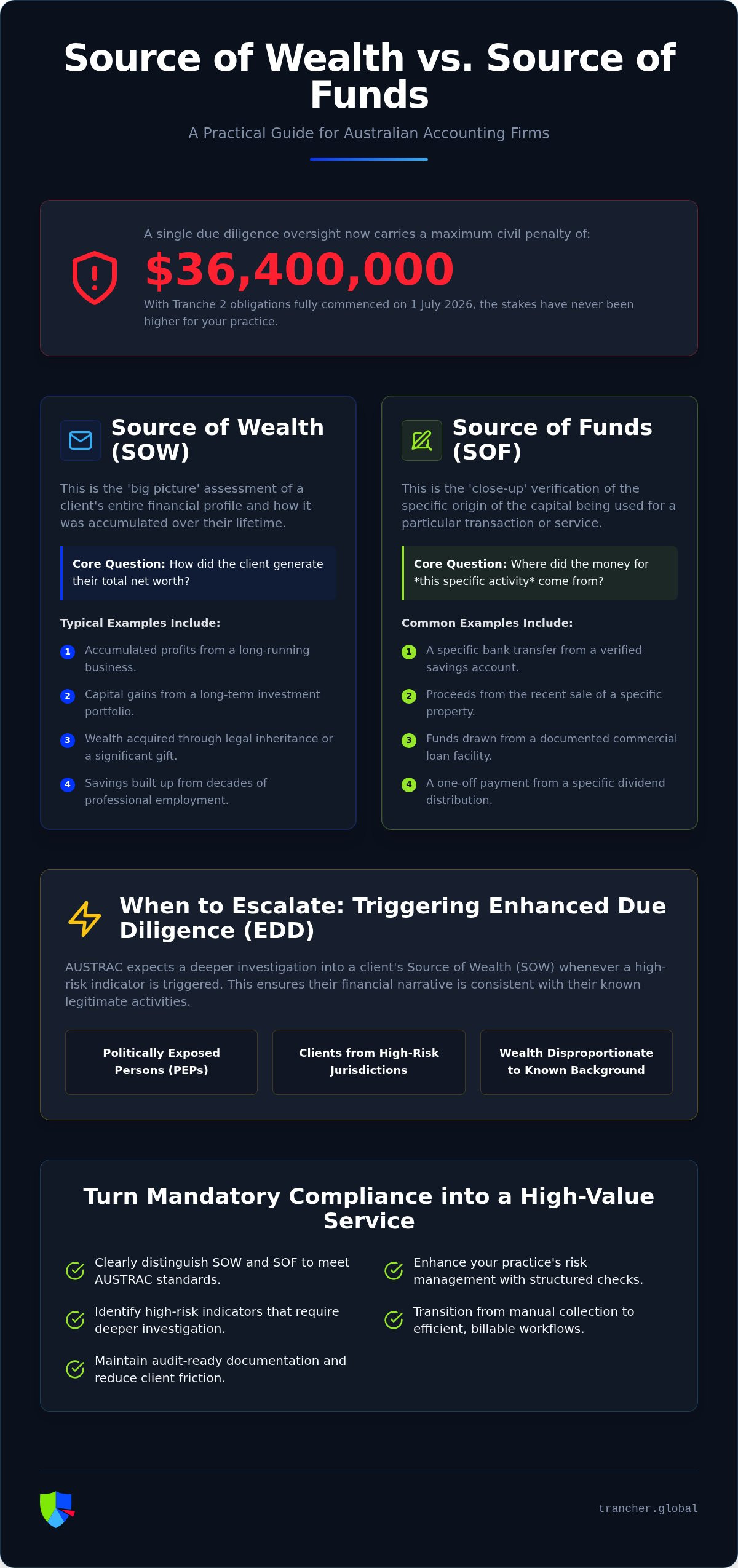
A single administrative oversight in your due diligence process now carries a maximum civil penalty of $36,400,000 for Australian accounting firms. Since the full commencement of Tranche 2 obligations on 1 July 2026, the stakes for your practice have never been higher. We understand that understanding source of wealth vs source of funds can feel like a semantic riddle, especially when you’re already managing a complex caseload. It’s natural to feel the weight of these administrative requirements as you move from policy documentation to active, daily practice.
This guide will help you master the critical distinction between these two AUSTRAC requirements so you can protect your firm and simplify your evidence collection. We’ll provide a clear framework for distinguishing SOW from SOF while demonstrating how to turn these mandatory checks into a billable, high-value advisory service. You’ll gain the confidence to meet the latest standards and the tools to make your compliance workflow both efficient and profitable.
Key Takeaways
- Clearly distinguish between long-term asset accumulation and the specific origin of transaction capital to ensure your firm meets the latest AUSTRAC standards.
- Enhance your practice’s risk management by understanding source of wealth vs source of funds and knowing exactly when to trigger Enhanced Due Diligence.
- Identify the specific high-risk indicators that require a deeper investigation into a client’s total financial profile versus a simple transactional check.
- Transition from manual evidence collection to automated workflows that turn mandatory Tranche 2 compliance into a billable and efficient professional service.
- Maintain audit-ready documentation and reduce client friction by implementing a structured, risk-based approach to financial verification.
Defining Source of Wealth and Source of Funds for Australian Firms
The Australian regulatory environment changed significantly on 1 July 2026. Accounting firms are now fully regulated entities under AUSTRAC supervision, meaning the shift from “paper policies” to “active practice” is mandatory. This transition makes understanding source of wealth vs source of funds a daily operational requirement rather than a theoretical exercise. These checks form the backbone of your firm’s AML/CTF Program, acting as a critical safeguard against financial crime. By mastering the distinction, you ensure your practice remains compliant while positioning your team as trusted, high-level advisors to your clients.
Global Know Your Customer (KYC) regulations provide the foundation for these requirements, but AUSTRAC’s updated 2026 guidance is specific about how they apply to the accounting sector. While both concepts are related to financial transparency, they serve distinct purposes within your risk-based approach. One looks at the client’s past, while the other focuses on the immediate present.
What is Source of Wealth (SOW)?
Source of Wealth represents the “who” and “how” of a client’s financial life. It covers the total body of assets and wealth accumulated over time. When you assess SOW, you’re looking for the activities that generated the client’s total net worth. This is particularly relevant for high-wealth individuals or clients from high-risk jurisdictions where the accumulation of assets needs to be clearly legitimate. Source of Wealth is the holistic financial history of a client.
Typical examples of SOW include:
- Accumulated profits from a long-running family business or commercial enterprise.
- Capital gains generated from a diverse, long-term investment portfolio.
- Wealth acquired through a legal inheritance or a significant gift.
- Savings built up over decades of professional employment or executive bonuses.
What is Source of Funds (SOF)?
Source of Funds is much narrower in scope. It focuses on the “what” and “where” of a specific transaction or service. You’re essentially asking: “Where did the money for this specific activity come from?” SOF is often the first step in a standard due diligence check because it verifies the legitimacy of the money being used for the current engagement. Even if a client has a clear SOW, you still need to verify the origin of the specific funds they’re using today to ensure they haven’t been mixed with illicit capital.
Common examples of SOF include:
- A specific bank transfer from a verified Australian savings account.
- Proceeds from the recent sale of a specific residential or commercial property.
- Funds drawn from a documented and verified commercial loan facility.
- A one-off payment originating from a specific dividend distribution.
By understanding source of wealth vs source of funds, your firm can apply the right level of enquiry at the right time. This clarity reduces administrative friction for your clients and ensures your team isn’t over-collecting data for low-risk transactions while remaining vigilant for high-risk scenarios.
Source of Wealth (SOW): Assessing a Client’s Total Financial Profile
While verifying the origin of specific transaction capital is a baseline requirement, understanding source of wealth vs source of funds becomes particularly vital during Enhanced Due Diligence (EDD). AUSTRAC expects firms to conduct a deeper dive into a client’s total financial profile whenever a high-risk indicator is triggered. This isn’t just about ticking a box; it’s about ensuring the client’s overall wealth is consistent with their known legitimate activities. For many accountants, this means moving beyond simple identity checks to a more comprehensive review of CDD and KYC requirements Australia.
High-risk indicators that mandate an SOW investigation include transactions involving Politically Exposed Persons (PEPs), clients from high-risk jurisdictions, or wealth that appears disproportionate to a client’s known background. Since 1 July 2026, AUSTRAC has prioritised the “quality and detail” of these assessments. You must be able to demonstrate that the client’s financial narrative makes sense. If a client suddenly presents millions in assets without a clear history of corporate earnings or inheritance, the inconsistency serves as a red flag that requires documented resolution.
Common Sources of Wealth in Australia
In the Australian context, wealth accumulation often follows several predictable paths. Recognising these patterns helps your team verify information more efficiently. Common sources include:
- Corporate Earnings: Dividends and profits from private or public companies, often verified through audited financial statements.
- Intergenerational Wealth: Assets passed down through deceased estates or family trusts, requiring a clear link to the original benefactor.
- Real Estate Appreciation: Significant capital gains generated from long-term holdings in the Australian property market.
Evidence Required for SOW Verification
Collecting the right evidence is the most time-consuming part of the process. AUSTRAC provides various Examples of SOW and SOF proof that are acceptable for verification. For SOW, you typically need documents that cover years or even decades of accumulation. This might include tax returns, grants of probate, or public registry filings that confirm property ownership and historical value growth.
Managing this administrative load manually can be overwhelming for busy practices. Many firms find that they can streamline their evidence collection by using automated workflows that prompt clients for the specific documents required based on their risk profile. This approach not only ensures you meet the 2026 standards but also maintains a professional, friction-free experience for your clients.
Source of Funds (SOF): Verifying the Origins of a Specific Transaction
While Source of Wealth provides the broad context of a client’s financial standing, Source of Funds focuses on the immediate. It’s the “receipt” for the specific capital being used in a current engagement. Even if you’ve confirmed a client’s wealth through inheritance or business success, you’re still required to verify where the specific money for your current service originated. Understanding source of wealth vs source of funds is essential here because it helps you realise that a wealthy client can still present a high risk if they use funds from an unverified or illicit source for a specific transaction.
Red flags often appear during this transactional check. You should be particularly vigilant regarding third-party payments where the funds don’t come from the client’s own accounts, or sudden injections of cash that don’t align with the client’s usual banking patterns. These anomalies require documented explanations. Integrating these checks into your simplifying client onboarding for law firms workflow ensures that you capture this data early, preventing delays later in the engagement.
SOF Verification Checklist
Your team needs a standardised approach to gathering evidence. A clear checklist helps keep the process consistent and professional. Typical documentation includes:
- Bank statements that clearly show the accumulation of the specific funds over time.
- Fully executed sale contracts for assets like vehicles, shares, or property.
- Signed loan agreements from regulated Australian financial institutions or reputable lenders.
The Link Between SOF and Suspicious Matters
An unexplained or inconsistent Source of Funds is one of the most common triggers for further regulatory action. If a client is unable or unwilling to provide a logical explanation for the origin of their money, you may need to consult our when to submit a suspicious matter report pillar. This is a delicate stage in the client relationship where your professional judgment is paramount.
You must balance your duty to investigate with the strict legal requirement to avoid the tipping off offence AML Act Australia. Disclosing to a client that they’re under suspicion or that an SMR has been filed is a criminal offence. By maintaining a calm, methodical approach to your SOF enquiries, you can gather the necessary information without alerting the client to your internal reporting obligations. This protects both your firm and the integrity of the broader financial system.
SOW vs SOF: Navigating Enhanced Due Diligence (EDD)
Applying a risk-based approach is the cornerstone of the Tranche 2 regime. Since 1 July 2026, AUSTRAC has expected firms to move beyond a “one size fits all” checklist to a model where the depth of enquiry matches the level of risk. Understanding source of wealth vs source of funds allows your team to apply this proportionality correctly. While every client requires a basic check on the origin of their funds, only those presenting higher risks need the deeper, more historical investigation into their total wealth accumulation. This targeted strategy prevents your practice from becoming bogged down in unnecessary administration while ensuring you remain fully compliant.
The following table outlines the key differences in how these two concepts are applied during your due diligence process:
| Feature | Source of Funds (SOF) | Source of Wealth (SOW) |
|---|---|---|
| Primary Purpose | Verifying the legitimacy of capital for a specific transaction. | Confirming the legitimacy of a client’s entire net worth. |
| Scope of Enquiry | Focused on a single event, bank account, or asset sale. | Focused on long-term activities, career history, and investments. |
| Regulatory Timing | Required during standard onboarding and for most services. | Primarily required during Enhanced Due Diligence (EDD). |
Triggers for SOW and SOF Verification
You don’t need to perform a deep dive into every client’s life story. However, certain triggers mandate an immediate escalation to Enhanced Due Diligence. These include engagements with Politically Exposed Persons (PEPs) or their close associates, and clients originating from high-risk jurisdictions. You should also be alert to transactions that are unusually large for a client’s profile or those that lack a clear economic or legal purpose. In these scenarios, verifying both the specific funds and the broader wealth is a non-negotiable requirement to protect your firm from being used for financial crime.
Documenting Your Findings
Your goal is to reach a level of “reasonable satisfaction” rather than absolute certainty. You must be able to demonstrate to a regulator that you asked the right questions and reviewed the appropriate documents. Maintaining audit-ready compliance records of these findings is essential for your firm’s protection. We recommend using a dedicated aml risk assessment tool Australia to justify why you chose a specific level of enquiry for each client. This creates a defensible audit trail that shows your firm is acting in good faith and following the prescribed risk-based methodology.
Asking for sensitive financial data can feel awkward, but it doesn’t have to be. Frame the request as a shared commitment to security and professional standards. When you automate your EDD workflows, you remove the personal friction from these requests, allowing technology to handle the data collection while you focus on the high-level advisory relationship.
Tranche 2 Readiness: Automating SOW/SOF with Trancher
The administrative weight of manual evidence collection can quickly overwhelm a busy accounting practice. Since the 1 July 2026 commencement of Tranche 2, the shift from theoretical compliance to active operational practice has become a daily reality. We believe that understanding source of wealth vs source of funds shouldn’t be a source of stress for your team. Instead, it represents an opportunity to modernise your internal systems and provide a higher level of security for your clients. Trancher was built to bridge this gap, moving your firm away from fragmented spreadsheets and toward a seamless, automated workflow.
Our platform doesn’t just simplify the collection of documents; it transforms the entire process into a professional service. By using our integrated compliance ROI tracking software, you can track the time spent on these mandatory checks and ensure they’re captured as billable activity. We’re so confident in our ability to streamline your practice that we offer a guaranteed AML/CTF compliance path within 30 days. This allows you to meet your AUSTRAC obligations with total confidence and zero guesswork.
The Trancher Workflow Advantage
Manual data collection is often the primary source of friction in the client relationship. Trancher removes this hurdle by providing guided, intuitive prompts that ask clients for the specific SOW or SOF evidence required based on their unique risk profile. This targeted approach ensures you aren’t over-collecting data while still maintaining absolute audit readiness. Every document is stored in a centralised, secure environment, making it easy to produce a defensible report if AUSTRAC ever requests a review. You’ll also have access to local Australian support and onboarding to ensure your team is fully supported at every step.
Turning Compliance into Opportunity
While these checks are a regulatory necessity, they also provide deep insights into your clients’ financial lives. A thorough Source of Wealth assessment often reveals new wealth management needs, estate planning gaps, or investment advisory opportunities that might otherwise have gone unnoticed. Trancher helps you capitalise on these insights by making the verification process efficient enough to leave room for higher-level strategic conversations. We invite you to claim a complimentary 3-month trial to experience how automation can turn a perceived burden into a strategic advantage for your firm.
Securing Your Practice’s Future in the Tranche 2 Era
The regulatory landscape for Australian accounting firms has shifted permanently since 1 July 2026. Mastering the distinction between accumulation history and transactional origin is no longer just a compliance hurdle; it’s a fundamental part of a modern, secure practice. By understanding source of wealth vs source of funds, you can apply a precise, risk-based approach that protects your firm while respecting your clients’ time. This clarity allows you to move away from administrative friction and toward high-value advisory opportunities.
We’re here to ensure this transition is both manageable and advantageous for your business. You can achieve full AML/CTF compliance-readiness within 30 days while benefiting from local Australian expert support at every stage. We’re also offering a 20% discount on your first 12-month subscription to help you integrate these essential systems into your workflow. Start your complimentary 3-month trial with Trancher today and transform your regulatory obligations into a streamlined, billable asset. We look forward to helping your firm thrive in this new era of professional transparency.
Frequently Asked Questions
Is Source of Wealth the same as Source of Funds in Australian law?
No, they’re distinct regulatory concepts under AUSTRAC guidance. While both relate to financial transparency, Source of Wealth refers to the activities that generated a client’s entire net worth over time. Source of Funds is narrower, focusing specifically on the origin of capital for a single transaction. Understanding source of wealth vs source of funds is crucial for applying the correct level of due diligence to each engagement.
Does Tranche 2 require me to check Source of Wealth for every client?
No, you aren’t required to verify Source of Wealth for every client. Under the risk-based approach, SOW checks are primarily reserved for Enhanced Due Diligence (EDD) scenarios. These include high-risk clients, Politically Exposed Persons (PEPs), or transactions that appear unusual. For standard, low-risk engagements, verifying the Source of Funds is typically sufficient to meet your 2026 Tranche 2 obligations and maintain firm security.
What documents are acceptable as proof for Source of Funds in 2026?
AUSTRAC expects independent evidence to verify the origin of specific transaction capital. Common examples include bank statements showing a history of savings, signed contracts for the sale of property or shares, and formal loan agreements from regulated Australian lenders. The goal is to provide a clear audit trail that links the funds to a legitimate source, ensuring your firm’s records are structured correctly for any future regulatory review.
How do I ask a long-term client for Source of Wealth information without offending them?
We suggest framing the request as a mandatory part of the new 1 July 2026 regulatory framework that applies to all Australian accounting firms. Explain that these checks protect both the client and the firm from financial crime. Using an automated platform like Trancher helps remove the personal nature of the request, as the system prompts the client for necessary documents in a professional, structured manner that feels routine.
What happens if I cannot verify a client’s Source of Wealth?
If you can’t verify the origin of a client’s wealth, you must evaluate the ongoing risk of the relationship. You might choose to apply stricter monitoring or, in some cases, decline to provide the designated service. If the inability to verify wealth leads to a suspicion of money laundering, you’re legally obligated to lodge a Suspicious Matter Report (SMR) with AUSTRAC within three business days of forming that suspicion.
Does AUSTRAC require Source of Wealth for all domestic PEPs?
Not necessarily. While foreign PEPs are always considered high-risk and require SOW verification, domestic PEPs only trigger this requirement if you’ve assessed them as high-risk. You must conduct a thorough risk assessment of every domestic PEP to determine the depth of enquiry needed. Understanding source of wealth vs source of funds ensures you don’t over-service low-risk domestic PEPs while remaining vigilant for those with higher risk profiles.
Can I rely on a client’s verbal explanation for Source of Funds?
A verbal explanation alone is rarely enough to satisfy AUSTRAC’s requirements for “reasonable satisfaction.” While a client’s word provides helpful context, it should be supported by independent evidence. For example, if a client claims funds came from a property sale, you should request a copy of the settlement statement. This documented approach ensures your firm is protected during an audit and provides a defensible record of your due diligence process.
How long must I keep records of SOW and SOF verifications?
You must maintain records of all SOW and SOF verifications for at least seven years. This requirement applies to the documents you’ve collected, the risk assessments you’ve performed, and the conclusions your team has reached. Using a centralised compliance management system ensures these records are easily accessible and structured correctly for AUSTRAC inspections, which is a key priority for firms operating in the post-July 2026 environment.