

What if the regulatory burden you’ve been dreading since the July 1, 2026, deadline passed could actually become your firm’s most reliable revenue stream? We understand that for many Australian accounting firms, the transition to Tranche 2 compliance feels like an uphill battle against mounting paperwork and the constant fear of AUSTRAC penalties. You’ve likely spent hours wondering how to accurately flag suspicious matters in a routine tax return without hiring a dedicated compliance officer or drowning in manual spreadsheets.
By integrating robust ongoing risk monitoring software, you can replace those cumbersome manual processes with a sophisticated, automated system. This shift doesn’t just ensure your documentation is audit-ready at a moment’s notice; it allows you to recover compliance costs through structured client billing. We’ve designed this guide to show you how to streamline your AUSTRAC-mandated tracking and transform these obligations into a high-value advisory service. You’ll learn how to establish a “set and forget” monitoring framework that protects your practice, supports your team, and ultimately strengthens your firm’s financial health.
Key Takeaways
- Understand why the 1 July 2026 deadline marks a permanent shift from one-off identity checks to continuous oversight for all Australian accounting firms.
- Learn how ongoing risk monitoring software eliminates the administrative burden of manual spreadsheets while creating a robust, digital audit trail.
- Discover strategies to integrate mandatory AML checks into your existing workflow without creating friction or disrupting long-term client relationships.
- Explore how to recover compliance costs and transform mandatory tracking into a streamlined, profitable advisory service for your practice.
- Identify the core components of automated monitoring that allow you to transition from reactive reporting to proactive, confident risk management.
The Evolution of AML Compliance: Why Ongoing Risk Monitoring is Non-Negotiable for 2026
The days of verifying a client’s identity once and filing the paperwork away are over. For Australian accounting firms, the Anti-Money Laundering and Counter-Terrorism Financing (AML/CTF) Amendment Act 2024 has fundamentally rewritten the rulebook. By 1 July 2026, firms providing designated services must transition from a static compliance model to a dynamic one. This shift reflects a global move toward continuous oversight, ensuring that the financial system remains resilient against evolving threats. While the change might seem daunting, implementing ongoing risk monitoring software allows your firm to meet these new standards with confidence rather than stress.
Traditional manual reviews often fail to meet AUSTRAC’s expectations for “ongoing” diligence because they are inherently reactive. Relying on annual check-ins or gut feelings leaves a wide window of time where a client’s risk profile could shift dramatically without your knowledge. Failing to identify a suspicious matter within a long-term portfolio doesn’t just invite heavy AUSTRAC penalties; it puts your firm’s hard-earned reputation at risk. Adopting a proactive stance is the only way to ensure your practice stays protected and compliant in this new era.
The Tranche 2 Transition for SME Practices
The expansion of the AML/CTF regime to include “Tranche 2” entities brings accountants, bookkeepers, and tax agents under the direct supervision of AUSTRAC. If your firm provides designated services, such as assisting with the purchase of real estate, managing client money, or creating complex business structures, these obligations apply to you. AUSTRAC has moved beyond the initial phase of providing general guidance and is now focused on active enforcement. Firms that embrace these requirements early don’t just avoid penalties; they signal to their clients that they are sophisticated, secure partners in an increasingly regulated market.
From Onboarding to Ongoing: Closing the Compliance Gap
Compliance starts with the foundational principles of Know Your Customer, but it certainly doesn’t end there. A common pitfall for many professional service firms is the “set and forget” mentality. You might know your client well today, but their risk profile can change in an instant. A long-term client could suddenly be designated as a Politically Exposed Person (PEP), appear on a global sanctions list, or become the subject of adverse media coverage. Manual reviews often fail to catch these shifts in real-time, leaving your practice exposed to significant damage.
Ongoing risk monitoring is a perpetual cycle of assessment rather than a one-off task. By utilising ongoing risk monitoring software, you can automate the background checks that would otherwise take your team hours to perform manually. This technology acts as a silent partner, providing a system that alerts you only when a genuine risk is detected. It ensures your documentation is always audit-ready and your firm remains a steady hand for your clients.
What is Ongoing Risk Monitoring Software for Accounting Firms?
In the context of Australian professional services, ongoing risk monitoring software is a specialised digital framework designed to track changes in a client’s risk profile throughout the life of the business relationship. It’s distinct from general practice management tools or the Managed Extended Detection and Response (MXDR) solutions provided by CyberOne. Instead, it focuses specifically on the “Designated Services” you provide, such as managing client assets or assisting with company formations. This technology acts as a vigilant, automated layer of oversight that ensures your firm remains compliant with the AML/CTF Act without requiring constant manual intervention from your senior partners.
A common point of confusion is the difference between transaction monitoring and client activity tracking. While banks use transaction monitoring to scrutinise every individual dollar movement in real-time, accounting firms typically focus on client activity tracking. This involves monitoring the broader patterns of a client’s engagement, such as sudden changes in business structure, unexpected sources of wealth, or the involvement of new, unverified third parties. Software bridges this gap by cross-referencing your internal client data against external global databases, identifying red flags that might otherwise remain hidden during the standard pressure of tax season.
Core Capabilities of a Compliance-First Platform
Modern platforms provide real-time integration with global watchlists, including Politically Exposed Persons (PEPs) and international sanctions registers. Rather than performing a manual search every few months, the system automatically triggers a re-assessment if a client’s status changes on an external database. This proactive approach ensures your records are always audit-ready. By maintaining digital, timestamped logs of every check and alert, you can prove to AUSTRAC that you have a functional, living monitoring programme in place, rather than a static folder of outdated identity documents. A well-configured AML CTF compliance dashboard gives your team a centralised view of every client’s current risk status, making these real-time checks easy to action and review.
The “Suspicious Matter” Detection Engine
One of the most valuable features of this software is its ability to identify patterns indicative of money laundering or terrorism financing that a human eye might miss. These “detection engines” use logic-based triggers to alert your compliance officer to unusual behaviours. This preparation is vital for Reporting Suspicious Activities to AUSTRAC, as it provides the documented evidence needed to file a report with confidence. Sophisticated systems also work to reduce “false positives,” ensuring your team only spends time investigating genuine risks, which protects both your client relationships and your firm’s billable hours.
Transitioning to these automated systems doesn’t have to be a complex overhaul of your current operations. If you’re looking for a steady hand to guide your firm through these requirements, exploring the solutions at trancher.global can help you find a path that balances regulatory rigour with operational ease.
Manual Spreadsheets vs. Automated Software: A Risk-Based Comparison
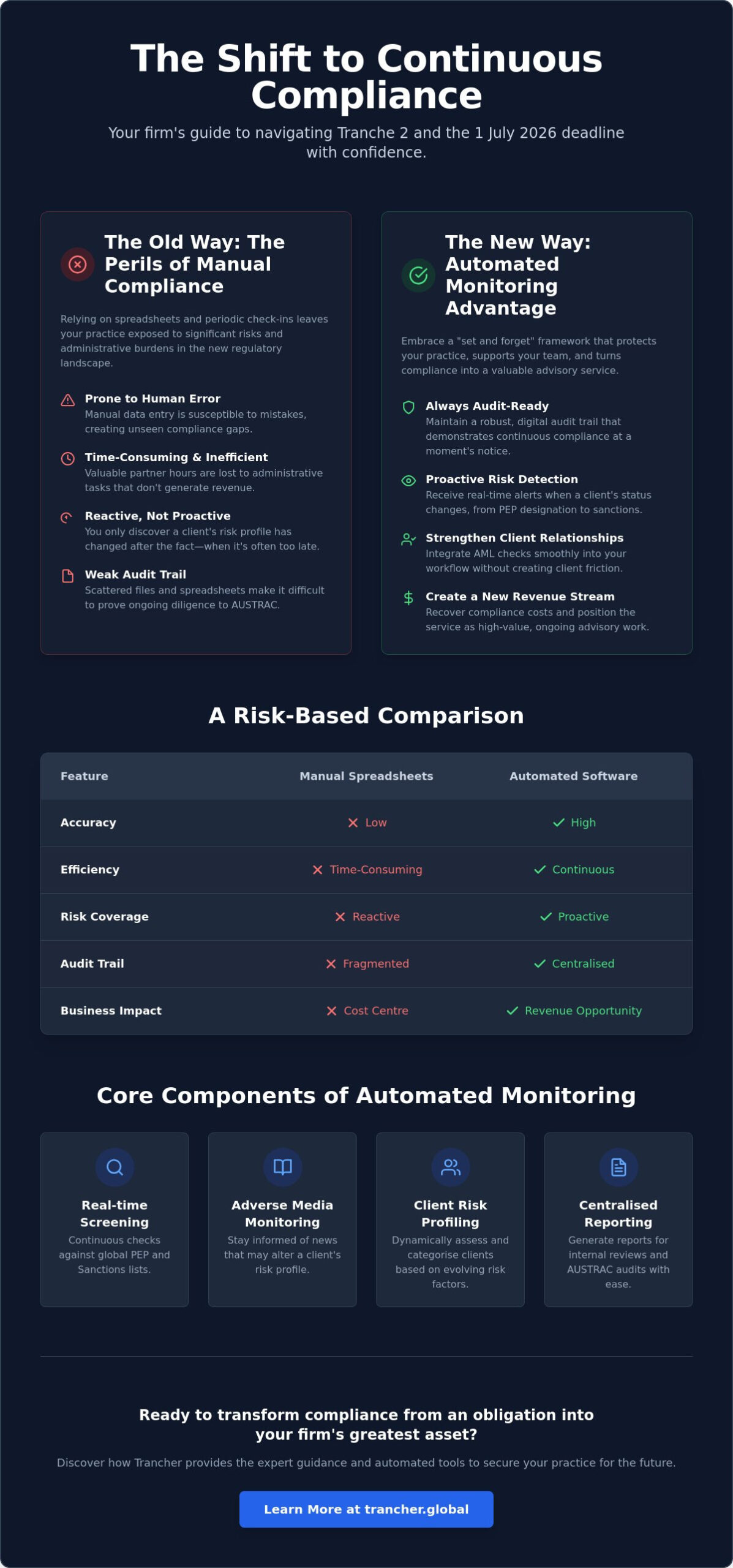
Many firms start their compliance journey with a simple spreadsheet, thinking it’s the most cost-effective path. It isn’t. When you calculate the staff hours poured into data entry and manual cross-referencing, the “hidden cost” of manual compliance quickly outstrips the investment in ongoing risk monitoring software. A senior accountant’s time is far better spent on complex tax strategy or client advisory than on manually verifying a client’s PEP status every quarter. These lost billable hours represent a significant drain on your firm’s potential profitability.
Beyond the financial drain, manual systems are inherently “leaky.” Human error is inevitable when screening hundreds of names against global sanctions lists or adverse media databases. A slight spelling variation or a missed notification can leave your practice exposed to serious regulatory breaches. Software provides a level of precision that manual checks simply can’t match, ensuring that your oversight remains watertight even if your client volume increases by 20% or more. Digital, timestamped logs offer a quality of audit trail that paper files or editable spreadsheets cannot replicate, providing the definitive proof of diligence that AUSTRAC requires.
The 30-Day Compliance Guarantee
Transitioning to an automated platform is far more efficient than most practitioners expect. While building a manual framework from scratch can take months of policy writing and staff training, a digital solution allows you to become AUSTRAC-ready in less than 30 days. This speed is essential for firms looking to secure their operations well before the 1 July 2026 deadline. Manual spreadsheets are often seen as a “red flag” by regulators during independent audits, as they lack the immutable, timestamped logs required to prove a functional monitoring programme is actually in place.
Operational Efficiency and Staff Morale
Removing the “drudge work” of compliance has a profound impact on your team’s culture. When you automate the administrative box-ticking, you free your senior staff to focus on high-value advisory services. This shift turns a perceived regulatory burden into an opportunity for professional growth and improved internal systems. Your team will feel supported by a system that handles the heavy lifting, allowing them to act as strategic guides for their clients rather than data entry clerks. It’s about creating a culture where compliance feels like a natural, effortless part of your daily workflow, fostering a sense of readiness and operational ease across the entire firm.
Implementing an Ongoing Monitoring Framework Without Workflow Friction
Successfully adopting ongoing risk monitoring software isn’t about overhauling your entire practice. It’s about refinement. We believe the most effective frameworks are those that sit quietly in the background, only surfacing when your professional judgment is truly required. By integrating these checks into your existing practice management stack, you ensure that compliance becomes a seamless part of your daily operations rather than a bolt-on distraction. This integration allows your team to maintain their focus on client service while the software handles the repetitive data cross-referencing in the background.
One of the biggest concerns we hear from partners is the fear of annoying long-term clients with repeat verification requests. However, when handled correctly, re-verification becomes a valuable touchpoint. It’s an opportunity to demonstrate that you’re proactively protecting their interests and maintaining the highest professional standards in the Australian market. Clear, automated communications that explain the “why” behind these requests can actually strengthen the trust your clients place in your firm. Role-based staff training ensures every team member knows exactly how to handle these conversations with confidence and warmth.
Step-by-Step Integration into Daily Workflows
Mapping monitoring activities to your standard tax and audit engagement cycles is the most logical way to ensure nothing slips through the cracks. Using centralised dashboards allows your compliance officer to manage escalation workflows for high-risk clients without disrupting the rest of the team’s productivity. You can set threshold-based triggers that match your firm’s specific risk appetite, ensuring you’re only alerted to the matters that truly count. This methodical approach creates a sense of transparency and thoroughness across the entire practice. To ensure your dashboard is configured to capture every required data point, reviewing a comprehensive AML CTF compliance dashboard checklist for Australian accounting firms can help you confirm no critical monitoring element has been overlooked.
Transforming Compliance into a Billable Service
Many practitioners view compliance solely as an overhead, but it’s time to reframe that perspective for a more profitable future. By using compliance ROI tracking software, you can identify exactly how many hours are recovered from administrative tasks. This data allows you to communicate AML fees to clients as a transparent, value-add professional service that ensures their business remains on the right side of AUSTRAC regulations. Creating “Compliance ROI” reports for your partners helps justify the investment by showing how automation removes friction and improves your firm’s financial health.
If you’re ready to see how these systems can work for your specific practice, we invite you to explore our workflow automation solutions today.
Trancher: The Expert Companion for Australian Accounting Compliance
Trancher isn’t just another software provider; we act as a strategic partner for Australian SME accounting firms facing the complexities of Tranche 2 reforms. We’ve built our platform to address the specific pain points of local practitioners, moving beyond generic risk management to offer a tailored solution for the professional services sector. By implementing our ongoing risk monitoring software, you can shed the administrative weight of manual compliance and focus on what you do best: providing high-value advice to your clients. Our team of local compliance specialists is always on hand to provide the steady guidance you need to navigate this transition with total confidence.
We understand that the shift toward continuous oversight requires more than just a digital tool; it requires a change in how your firm captures value. Trancher helps you reframe these regulatory obligations as a professional advisory service, allowing you to turn a perceived hurdle into a new stream of advisory revenue. With our 30-day guarantee, your firm can achieve AUSTRAC readiness with the assurance that your systems are robust, your team is trained, and your practice is protected against the risks of non-compliance.
A Complete End-to-End AML/CTF Solution
Our platform brings automated KYC, global screening, and continuous activity tracking together in one unified interface. This integration ensures that your documentation is always audit-ready, turning what used to be a stressful AUSTRAC inspection into a routine, friction-free process. You won’t have to jump between different databases or maintain disconnected spreadsheets. If you encounter a complex scenario, our expert support team is available to help you navigate the nuances of “Suspicious Matter” reporting, ensuring your firm remains protected while upholding the highest professional standards. We provide the technical infrastructure so you can focus on the human side of your practice.
Start Your 3-Month Complimentary Trial Today
We believe in the value we provide, which is why we offer a three-month complimentary trial to help your firm prepare well ahead of the 1 July 2026 deadline. You’ll experience the full capabilities of the platform with no obligation, receiving a comprehensive ROI report at the conclusion of the trial period. This report allows you to see exactly how the system recovers billable hours and supports your firm’s financial health. It’s a transparent way to justify the transition to your partners and staff. By joining the limited group of firms adopting these systems early, you’ll also secure a 20% discount on your first year’s subscription, ensuring your practice is both compliant and profitable from the moment you go live.
Securing Your Firm’s Future in the Tranche 2 Era
The transition to the Tranche 2 regime represents a significant milestone for the Australian accounting profession. By moving away from manual spreadsheets and embracing ongoing risk monitoring software, your firm can eliminate up to 80% of the administrative burden associated with these new obligations. This shift doesn’t just protect you from AUSTRAC penalties; it provides a structured pathway to transform compliance into a profitable, high-value advisory service that strengthens your client relationships.
We’ve designed our platform to be your steady hand through this change. With a system built by Australian compliance specialist Aaron Soh, you can feel confident that your practice is meeting the highest regulatory standards while maintaining operational ease. It’s time to stop viewing compliance as a hurdle and start seeing it as an avenue for internal growth and improved client trust. We’re ready to support you every step of the way as you navigate this new landscape.
Start your 3-month complimentary trial of Trancher and get AUSTRAC-ready in 30 days with our exclusive 30-Day AML/CTF Compliance Guarantee. We’re here to help you navigate the regulatory requirements of 2026 with clarity, confidence, and professional pride.
Frequently Asked Questions
What is the primary difference between KYC and ongoing risk monitoring?
Know Your Customer (KYC) is the initial process of verifying a client’s identity at the start of a relationship, whereas ongoing risk monitoring is the continuous oversight of that client’s profile over time. While KYC provides a static snapshot, ongoing monitoring ensures you catch changes in PEP status, sanctions, or adverse media in real-time. It’s the difference between checking a driver’s licence once and monitoring their driving record regularly to ensure they remain a safe bet.
Do small accounting firms really need automated monitoring software for Tranche 2?
Yes, small firms need automation because the administrative cost of manual tracking often exceeds the price of ongoing risk monitoring software. With the Tranche 2 reforms now in full effect, AUSTRAC expects a level of consistency and record-keeping that is nearly impossible to maintain using spreadsheets alone. Automation ensures your small team can focus on client advisory work instead of getting bogged down in repetitive, high-risk administrative data entry.
How often should an accounting firm re-assess a client’s risk profile?
You should re-assess client risk profiles based on their initial risk rating, typically ranging from annually for high-risk clients to every two or three years for low-risk ones. However, automated systems shift this from a periodic chore to a continuous process. The software monitors global databases daily, meaning you only need to perform a formal manual review when a significant trigger or “red flag” is identified by the system.
Can ongoing risk monitoring software help with AUSTRAC annual reporting?
Absolutely, the software simplifies the AUSTRAC annual reporting process by providing centralised, accurate data on your client base and monitoring activities. Instead of spending days pulling information from various files, you can generate reports that show exactly how many clients you’ve screened and any suspicious matters identified. This digital audit trail ensures your annual compliance report is evidence-based and submitted with total confidence in its accuracy.
Is it possible to bill clients for the cost of AML compliance monitoring?
Yes, many Australian firms now include a compliance or “regulatory oversight” fee as a standard part of their engagement terms. By positioning this as a value-add service that protects the client’s own reputation and ensures their business meets national standards, you can recover the costs of your ongoing risk monitoring software. This approach turns a mandatory regulatory requirement into a transparent, billable asset that supports your firm’s financial health.
What happens if the software flags a long-term client as a “suspicious matter”?
If a client is flagged, your first step is to review the alert to determine if it represents a genuine risk or a false positive. You should document your findings within the platform to maintain an audit-ready trail. If the matter is indeed suspicious, you must follow your internal AML/CTF programme’s escalation process, which may include submitting a Suspicious Matter Report (SMR) to AUSTRAC within the required statutory timeframes.
Does Trancher integrate with common practice management tools like Xero or MYOB?
Trancher is designed to integrate seamlessly with the leading practice management stacks used by Australian accountants, including Xero and MYOB. This integration ensures that your client data flows directly into the compliance monitoring engine without the need for manual double-handling. By removing this friction, your firm can maintain a single source of truth for both your accounting workflows and your mandatory regulatory obligations.
How long does it take to get a firm fully compliant using Trancher?
Most firms can become AUSTRAC-ready and fully operational on the Trancher platform within 30 days. We provide a structured onboarding process that includes setting up your AML/CTF programme, integrating your client data, and training your staff on the new monitoring workflows. This rapid deployment ensures you can meet your obligations quickly and with the reassurance of our 30-day compliance guarantee, allowing you to focus back on your clients.