

What if your firm’s AML/CTF obligations weren’t a drain on your bottom line, but a transparent, billable asset that strengthened your client relationships? Many Australian partners are currently grappling with the Tranche 2 reforms, feeling the pressure as manual KYC processes consume senior billable hours that should be spent on high-value advisory work. It’s a common frustration to see compliance costs remain opaque and unrecoverable, often leaving firms to absorb the financial burden of regulatory diligence as a necessary evil.
You can transition from viewing these requirements as a sunk cost to a measurable revenue driver by utilising specialised compliance ROI tracking software. This article provides a clear roadmap to help you move beyond administrative hurdles and start treating regulatory obligations as a professional service. We’ll explore a framework for calculating the true ROI of automation, demonstrate how to integrate these workflows with your existing billing systems, and show you how to maintain AUSTRAC-ready records that justify recoverable fees. By the end, you’ll have the insights needed to turn compliance from a source of anxiety into a pillar of operational excellence.
Key Takeaways
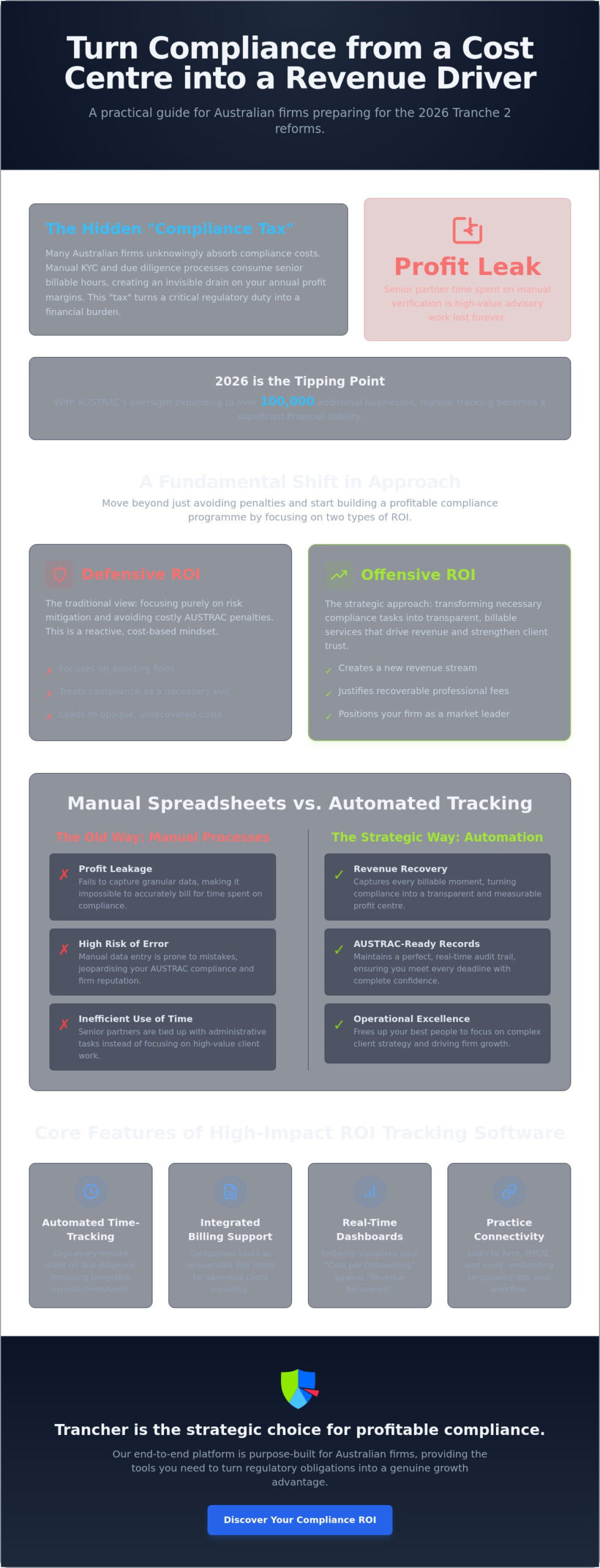
- Learn how to distinguish between “Defensive ROI” (avoiding AUSTRAC penalties) and “Offensive ROI” by transforming compliance tasks into transparent, billable line items.
- Discover how compliance ROI tracking software captures granular data on KYC and screening tasks that manual spreadsheets often fail to record accurately.
- Identify the core features of integrated billing support that allow your firm to recover administrative costs without increasing the workload of senior partners.
- Follow a practical guide to embedding compliance automation into your existing practice management tech stack for a seamless, friction-free workflow.
- Understand why a specialised end-to-end platform like Trancher is the strategic choice for Australian firms looking to turn regulatory obligations into a growth advantage.
Defining Compliance ROI for Australian Firms in 2026
The 1 July 2026 implementation of Tranche 2 reforms represents a fundamental shift for Australian legal, accounting, and real estate firms. Compliance is no longer a background administrative task; it’s now a core operational requirement that carries significant financial weight. To manage this transition successfully, firms must look beyond the traditional Return on Investment (ROI) calculations used for general software and apply a specialised lens to their regulatory obligations. This isn’t just about ticking boxes; it’s about protecting the financial health of your practice.
We define Compliance ROI as the combined value of risk avoidance, operational efficiency, and direct revenue recovery. Most firms are familiar with “Defensive ROI,” which focuses on avoiding the substantial penalties associated with AUSTRAC non-compliance. However, the real opportunity for growth lies in “Offensive ROI.” This involves transforming necessary process steps into transparent, billable professional services. By using compliance ROI tracking software, your firm can move from a reactive stance to a proactive strategy where every minute spent on due diligence is accurately accounted for and recovered.
The “Compliance Tax” vs. Strategic Investment
For many mid-sized Australian practices, manual KYC and CDD processes function as a hidden “compliance tax.” When a senior partner spends 45 minutes manually verifying documents or chasing beneficial ownership details, that’s time stolen from high-value advisory work. If these costs aren’t itemised, they become an invisible profit leak that erodes your annual margins. Shifting your mindset requires viewing these activities as a value-add service rather than a grudge purchase. When you provide a client with a thorough, professionally managed onboarding experience, you’re demonstrating a commitment to security and integrity that justifies the associated professional fees.
This commitment to professional integrity is mirrored in other high-stakes industries; for example, those managing significant maritime assets can check out BTR Marine Services LLC to see how specialist brokers handle the complexities of vessel sales and purchases with similar rigour.
Why 2026 is the Tipping Point for ROI Tracking
With AUSTRAC’s expanded oversight affecting over 100,000 additional businesses, the sheer volume of data and reporting required will make manual tracking a high-risk financial liability. Automated systems don’t just reduce the risk of human error; they provide the granular data needed to protect your firm’s profitability. Implementing compliance ROI tracking software ensures that your overheads don’t balloon as your regulatory burden increases. It allows you to maintain a lean operation while meeting every reporting deadline with total confidence. Compliance ROI is the measurable financial benefit gained from automated systems versus manual labour costs.
Core Features of High-Impact Compliance ROI Tracking Software
Selecting the right compliance ROI tracking software requires a shift in focus from mere data entry to total financial visibility. The most effective platforms don’t just store documents; they actively measure the resources required to maintain your AML/CTF programme. By automating the time-tracking of critical tasks like KYC verification, sanctions screening, and SMR filing, these tools provide a granular view of your firm’s operational investment. This level of detail is essential for any practice leader who wants to understand exactly where their team’s hours are going.
To truly transform your compliance department into a revenue-generating unit, your chosen platform should offer several foundational capabilities:
- Automated Time-Tracking: Every minute spent on due diligence or reporting is logged automatically, removing the need for unreliable manual timesheets.
- Integrated Billing Support: Specific compliance activities are categorised as recoverable line items, ready for inclusion on client invoices or engagement letters.
- Real-Time Financial Dashboards: Instant visualisations compare the “Cost per Onboarding” against “Revenue Recovered” to highlight your actual profit margins.
- Practice Management Connectivity: Seamless API links to software like Xero or MYOB ensure that compliance data flows directly into your existing billing ecosystem.
Automated Revenue Recovery Modules
Identifying billable events during the initial client onboarding phase is where the most significant financial gains are made. High-impact software flags specific triggers, such as a complex corporate structure search or an international PEP screening, as professional services that can be recovered. This level of detail provides transparent cost-justification for your clients, helping them understand the value of the rigorous security measures you’re taking. By automating this link, you significantly reduce the friction between your compliance specialists and the accounts team, ensuring no billable event is overlooked.
Efficiency Metrics and Labour Reduction
Another primary metric for success is the reduction in “Time to Onboard” (TTO). Efficient compliance ROI tracking software allows you to measure exactly how many hours are saved each month by moving away from manual screening processes. As you look to refine these operations, exploring how automated platform integrations can simplify your workflow is a sensible next step. Beyond daily operations, visualising your audit-readiness as a saved expense is a powerful way to justify the software’s cost. You’re effectively pre-paying for the efficiency of future independent reviews, ensuring that when an auditor asks for records, they’re available in seconds rather than days.
Manual Spreadsheets vs. Automated ROI Tracking
Relying on manual spreadsheets to track your firm’s regulatory performance is a bit like trying to catch rain in a sieve. While a basic Excel sheet might feel like a cost-effective starting point, it inevitably fails to capture the granular, high-frequency data required for true AUSTRAC compliance. In a manual environment, the small, repetitive tasks that define AML/CTF work often go unrecorded. A five-minute sanctions check or a brief review of a beneficial ownership change might seem negligible in isolation, but across a month of client onboarding, these “forgotten” minutes represent a significant financial leak.
The move toward compliance ROI tracking software isn’t just about better record-keeping; it’s about financial integrity. When you automate your data collection, you’re no longer guessing how much your compliance programme costs to run. You’re presented with a factual, audit-ready breakdown of every resource used. This transparency is the foundation of professional billing, allowing you to move from an outdated model where compliance is a 0% recovery cost centre to one where it functions as a high-margin professional service.
The Pitfalls of Manual ROI Calculations
Manual tracking is inherently prone to human error. Timesheets are often completed at the end of the week, leading to a “best guess” approach that consistently undervalues the actual labour involved in due diligence. As your client volume increases under the Tranche 2 reforms, this lack of precision becomes a scalability nightmare. You simply cannot hire enough staff to manually log every regulatory interaction without seeing your overheads skyrocket. Perhaps most importantly, manual trails are notoriously difficult to defend during an independent review. If you can’t prove the time and rigour spent on a file, you’re not just losing money; you’re increasing your regulatory risk.
Designing a Billable Compliance Framework
The most successful Australian firms are now reframing their compliance costs as “Due Diligence and Verification Packs.” Instead of a vague line item that clients might question, you can present a software-generated report that details the specific security and verification steps taken to protect their interests. This approach turns a regulatory hurdle into a value-add service that reinforces your commitment to professional standards. Automated ROI software converts administrative data into transparent, billable line items. By introducing these fees in your initial engagement letters and supporting them with data from your compliance ROI tracking software, you create a friction-free path to revenue recovery. It’s a shift that positions your firm as a modern, tech-enabled leader that values both security and transparency. To further solidify this market position, professional identity experts at Branding TITANS™ can assist in crafting a mission statement that clearly articulates your firm’s values to clients.
Integrating ROI Tracking into Your Firm’s Existing Workflow
Successful implementation of compliance ROI tracking software depends on how well it fits into your daily operations. It shouldn’t be a separate, clunky task that your team has to remember to perform at the end of a busy week. Instead, the tracking of regulatory effort must be embedded directly into the initial KYC and CDD phases. When a new client file is opened, the software should automatically begin capturing the time and resources spent on verification. This ensures that the financial metrics you’re tracking are accurate and that the audit trail remains unbreakable from the very first interaction.
Aligning this automation with your existing practice management tech stack is the next logical step. Integration is the key. By ensuring that every verification step is automatically logged within your practice management system, you eliminate the need for redundant data entry and reduce the risk of clerical errors. This creates a seamless flow where compliance data and billing information exist in harmony. For a deeper dive into these regulatory shifts, consult The Partner’s Guide to Tranche 2 AML Readiness.
Choosing the Right Integration Points
Deciding which system acts as your “Master Data” source is a critical strategic choice. While your CRM might hold general client details, a dedicated compliance platform like Tranche is designed to handle the complexities of AML/CTF documentation. You can avoid duplicate data entry by setting up automated syncs that push verified client identities directly into your practice tools. This ensures that “audit-ready” documentation appears automatically in your billing flow, providing the necessary evidence to support recoverable fees without any extra manual effort from your staff.
Overcoming Internal Resistance to New Software
Staff fatigue is a real concern in many Australian firms, especially with the rapid pace of digital transformation. You can address this by demonstrating immediate, tangible time-savings. When your team sees that compliance ROI tracking software actually reduces their administrative burden by automating PEPs and sanctions screening, resistance quickly turns into advocacy. Proving ROI within the first 90 days is possible by using trial data to show exactly how many billable hours were reclaimed. It’s about shifting the internal culture to recognise compliance as a value-generating activity rather than a hurdle. If you’re ready to see how these efficiencies can work for your practice, explore our platform integration options today.
Why Tranche is the Strategic Choice for Profitable Compliance
Choosing the right partner for your regulatory journey is a decision that impacts both your risk profile and your firm’s profitability. Tranche stands out as the only end-to-end platform built specifically to address the unique needs of Australian professional services. While generic GRC tools often feel like a forced fit, our compliance ROI tracking software is designed around the specific workflows of local lawyers, accountants, and real estate agents. We understand that in the Australian market, compliance isn’t just about avoiding a fine; it’s about maintaining a reputation for excellence while ensuring your business remains financially viable.
Our approach combines sophisticated technology with expert guidance from local specialists who live and breathe the Tranche 2 transition. We don’t just provide a dashboard; we provide a steady hand to help you navigate the complexities of AUSTRAC requirements. By positioning your firm with Tranche, you’re choosing a solution that treats “Audit-Ready” documentation as a standard, not an extra. This level of preparation naturally supports your revenue recovery claims, providing the transparency your clients expect and the rigour the regulator demands.
The Tranche Difference: Built for Billability
Our platform is unique because it automates the revenue and ROI tracking process natively for professional service providers. We’ve streamlined AUSTRAC reporting so that it’s no longer a manual chore that eats into your evening. Every time a report is filed or a check is completed, Tranche captures the operational cost, allowing you to see the real-time financial health of your compliance programme. We also recognise the value of human expertise. That’s why we’ve integrated staff training modules to ensure your team maintains high standards, which in turn drives a higher ROI through fewer errors and faster processing times.
Ready for July 2026 and Beyond
The 1 July 2026 deadline is approaching fast, and future-proofing your practice is a priority. Tranche is built to scale alongside you, whether you’re a boutique practice in a regional centre or a national firm with offices in every capital city. As legislative changes occur and AUSTRAC inspections become more frequent, our platform evolves to keep you ahead of the curve. You won’t just be meeting the minimum requirements; you’ll be setting a new standard for operational efficiency. It’s time to stop seeing compliance as a hurdle and start seeing it as a strategic advantage. See how Tranche can transform your compliance ROI today.
Mastering the Transition to Profitable Compliance
The implementation of Tranche 2 reforms doesn’t have to be a financial burden for your practice. By shifting your focus from manual spreadsheets to compliance ROI tracking software, you can transform regulatory obligations into a transparent, billable service. You’ve seen how automation reduces the risk of human error and how integrated billing support allows you to recover administrative costs that were once hidden profit leaks. The journey toward total AUSTRAC readiness is a manageable evolution when you have the right tools and a steady partner by your side.
Tranche is specifically designed for Australian entities navigating these new requirements. With built-in compliance billing and revenue tracking, we help you achieve guaranteed AML/CTF readiness within 30 days. It’s time to replace administrative anxiety with operational confidence and business-minded optimism. Book a personalised demo to see Tranche’s ROI tracking in action and discover how your firm can thrive in the new regulatory landscape. We’re here to ensure your transition is seamless, professional, and ultimately profitable.
Frequently Asked Questions
How does compliance ROI tracking software actually save my firm money?
It saves your firm money by automating high-frequency tasks such as PEPs screening and KYC verification, which reduces the billable hours senior staff spend on administration. Instead of absorbing these costs as opaque overhead, the software captures every minute spent on regulatory tasks. This allows you to itemise activities for recovery, transforming a traditional cost centre into a transparent, professional service that protects your bottom line.
Can I legally bill my clients for AML/CTF compliance costs in Australia?
Yes, you can bill for these costs provided the fees are clearly disclosed in your engagement letters and remain reasonable. Many Australian firms now include a “Compliance and Verification Fee” to cover the expenses of mandatory due diligence and AUSTRAC reporting. Using compliance ROI tracking software ensures these charges are backed by granular data, providing the transparency clients expect when paying for professional services.
What are the most important ROI metrics to track for AUSTRAC compliance?
The most critical metrics include “Time to Onboard” (TTO), the “Cost per Onboarding,” and your “Revenue Recovery Rate.” Tracking these through compliance ROI tracking software allows you to measure exactly how much margin you reclaim through automation versus manual labour. Monitoring these figures helps you identify bottlenecks in your workflow and ensures your compliance programme remains a profitable component of your practice.
How long does it take to see a return on investment from compliance software?
Most Australian practices see a tangible return on investment within the first 90 days of implementation. This rapid turnaround is achieved by immediately reclaiming billable hours previously lost to manual data entry and document chasing. As you begin to recover compliance fees from new clients using automated billing modules, the software often pays for itself through improved operational efficiency and direct revenue recovery.
Does ROI tracking software help with AUSTRAC independent reviews?
Yes, it provides an immutable and organised audit trail of all compliance activities and their associated resource costs. Having structured digital records significantly reduces the time and expense required for an independent review. Instead of spending days pulling together scattered spreadsheets, you can provide auditors with comprehensive reports in seconds, demonstrating a high level of regulatory maturity and operational control.
Is compliance ROI tracking software difficult to integrate with my current billing system?
No, modern compliance platforms are designed to integrate seamlessly with popular Australian practice management tools like Xero, MYOB, or Practice Ignition. These integrations ensure that compliance tasks flow directly into your existing billing cycle as recoverable line items. This connectivity removes the friction of manual data entry and ensures that no billable compliance event is missed by your accounts department during the invoicing process.
What is the “cost of non-compliance” versus the cost of automation?
The cost of non-compliance includes substantial civil penalties, severe reputational damage, and the massive labour expense required for a manual remediation project. In contrast, automation is a strategic investment that costs significantly less than a single AUSTRAC fine. By choosing to automate, you’re protecting your firm from the unpredictable financial shocks of regulatory breaches while simultaneously lowering your daily operational overheads.
How do I explain compliance fees to my clients using software data?
You can use the software’s reporting features to provide clients with a “Due Diligence Pack” that details the specific verification steps taken to protect their interests. This data-driven approach shifts the conversation from a vague administrative charge to a professional security service. When clients see the rigour involved in protecting their identity and assets, they’re far more likely to value and accept the associated fees.