

What if the 1 July 2026 deadline wasn’t a looming overhead burden, but your firm’s newest revenue stream? For many Australian accounting practices, the transition to Tranche 2 obligations feels like a recipe for unrecoverable non-billable hours and administrative friction. You’re likely feeling the weight of manual KYC processes and the anxiety of AUSTRAC penalties that can reach $36.4 million for corporate breaches. It’s completely natural to see these requirements as a hurdle to your efficiency. However, achieving genuine AML CTF compliance costs reduction is entirely possible when you stop viewing compliance as a drain on resources and start treating it as a streamlined, value-add professional service.
We’re here to help you navigate this transition with a sense of calm, solution-oriented confidence. This guide provides a clear roadmap to transform your mandatory obligations into a profitable part of your practice. You’ll discover how to automate labour-intensive tasks, reduce manual verification from two hours to just sixty seconds, and implement a framework that ensures you’re audit-ready well before the deadline. We’ll explore practical strategies to bill for these activities, ensuring your firm remains both compliant and commercially resilient as the regulatory landscape evolves.
Key Takeaways
- Understand the 2026 AUSTRAC landscape and why proactive preparation prevents the significant financial drain of emergency, last-minute implementation.
- Identify the hidden labour drivers, such as manual KYC and administrative re-work, that are essential to address for effective AML CTF compliance costs reduction.
- Discover how end-to-end automation can slash client verification times from hours to minutes, removing friction and freeing your team for higher-value advisory work.
- Learn to pivot your firm’s mindset by transforming mandatory obligations into recoverable, billable professional services that support your bottom line.
- Establish a clear roadmap to becoming fully audit-ready by the 2026 deadline using a structured implementation plan designed specifically for the Australian accounting sector.
The Economic Impact of AUSTRAC Tranche 2 on SME Practices
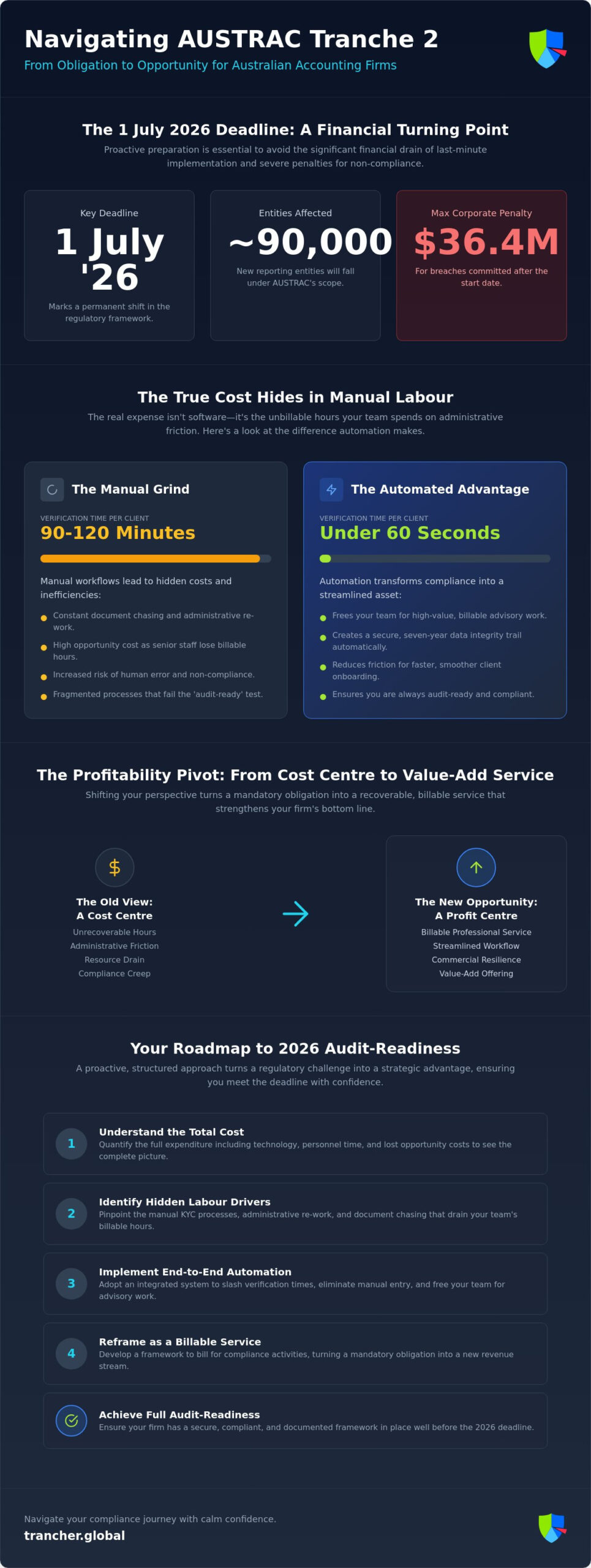
From 1 July 2026, the regulatory framework for Australian accounting firms shifts permanently. Approximately 80,000 to 90,000 new reporting entities will fall under AUSTRAC’s scope, requiring a robust and documented approach to Anti-money laundering (AML). For many SME practices, this isn’t just a legal shift; it’s a significant economic one. We define AML CTF compliance costs as the total expenditure on technology, personnel, and opportunity cost required to meet AUSTRAC obligations. Understanding this total cost is the first step toward effective AML CTF compliance costs reduction.
Many firms are currently tempted by a “wait and see” strategy. This approach is often the most expensive path a partner can choose. Research suggests that emergency, last-minute implementations frequently lead to inflated costs due to high consultant fees and the disruption of rushed staff training. By contrast, proactive firms are already integrating systems to ensure they aren’t caught in a bottleneck of demand as the deadline nears. It’s helpful to distinguish between direct software costs and the more insidious indirect labour-hour drains. While a software invoice is visible, the true cost of compliance often hides in the dozens of hours staff spend on manual data entry and document chasing.
The July 2026 Deadline: A Financial Turning Point
The 1 July 2026 start date represents a hard line in the sand for any firm providing designated services. Enrolment with AUSTRAC opens on 31 March 2026, with a final deadline of 29 July 2026. Failing to meet these requirements exposes your practice to Commonwealth penalty units, which are valued at $364 each for offences committed after the start date. For corporations, the maximum penalty for a breach can reach a staggering $36.4 million. Preparing early doesn’t just provide peace of mind; it reduces the long-term cost of compliance programmes by allowing you to allocate resources methodically rather than reactively.
Why Traditional Accounting Workflows Struggle with AML
Standard accounting workflows weren’t designed for the rigorous record-keeping and monitoring required by AUSTRAC. Fragmented manual verification processes create friction that slows down client onboarding and frustrates your team. Manual spreadsheets, while familiar, fail the “audit-ready” test because they don’t provide the secure, seven-year data integrity and transaction monitoring trails required by law. The opportunity cost is the most significant factor here. Every hour a senior accountant spends on administrative compliance tasks is an hour of high-value, billable advisory work that’s lost to the firm’s bottom line. Moving toward AML CTF compliance costs reduction means reclaiming these hours through smarter, integrated systems.
Identifying the Hidden Drivers of AML Compliance Expenditure
To achieve long-term AML CTF compliance costs reduction, firms must look beyond the initial setup fee. The most significant financial drain often comes from the friction of manual labour. When your team spends hours chasing a single certified copy of a passport, those are billable hours you can’t recover. This ‘re-work’ occurs when documentation is non-standardised or incomplete, forcing staff to repeat steps multiple times. Following the AUSTRAC guidance for accountants requires precision, but without a system, that precision costs a fortune in time.
Training presents another recurring expense. As staff move on or regulations shift, the cost of keeping your team up to speed can escalate. Similarly, ongoing monitoring acts as a silent cost. It’s not enough to verify a client once; you must track activity over years. This persistent oversight, while necessary, frequently leads to ‘compliance creep’ where administrative tasks slowly erode your profit margins. We see many firms struggle with these invisible drains because they haven’t yet quantified the time spent on non-core activities.
Manual vs. Automated Client Verification
Manual verification is remarkably slow. Research indicates that manual ID checks can take between 90 and 120 minutes per client. In contrast, automated systems complete this in seconds. When dealing with complex trust and company structures, the risk of human error increases significantly. Missing a single Politically Exposed Person (PEP) or a sanctioned entity can lead to severe consequences. Understanding the nuances of CDD and KYC requirements Australia is vital for protecting your bottom line from these invisible labour traps. For a comprehensive overview of your obligations under the new regime, our guide to AML compliance for accountants Australia provides a structured roadmap to full 2026 readiness.
The Administrative Weight of Regulatory Reporting
Preparing a Suspicious Matter Report (SMR) manually is a labour-intensive exercise. It requires gathering data from disparate sources, which is difficult if your records aren’t centralised. Maintaining audit-ready compliance records in a fragmented environment makes independent reviews much more expensive. Auditors charge more when they have to hunt through physical files or various digital folders. By centralising these functions, you can significantly lower the overhead associated with regulatory scrutiny. For many firms, adopting workflow automation is the most direct path to reclaiming lost time.
Leveraging Automation to Slash Compliance Labour Costs
Transitioning from manual spreadsheets to a unified platform is the most effective way to secure AML CTF compliance costs reduction. When your firm relies on disconnected tools, your team spends more time managing data than actually analysing risk. End-to-end platforms eliminate this fragmentation by housing client verification, risk monitoring, and reporting in one secure location. This shift doesn’t just save money; it restores the professional focus of your staff. Industry data shows that automation can reduce manual compliance labour by up to 70% in SME practices.
The efficiency gains are most visible during the initial client screening. While manual verification often drags on for 90 to 120 minutes per client, automated screening reduces this to a mere 60 seconds. This 95% reduction in time spent on KYC tasks allows your team to move clients through the onboarding phase with unprecedented speed. Success lies in AML compliance workflow integration, which ensures your regulatory checks aren’t a separate, clunky chore but a natural part of your client lifecycle. By embedding these checks into your existing processes, you remove the friction that typically slows down a busy practice.
Streamlining Onboarding and Risk Assessment
Digital identity verification is a game-changer for modern firms. It removes the need to handle, copy, and store physical passports or utility bills, which significantly lowers your administrative overhead. Automated risk scoring then applies standardised, AUSTRAC-aligned frameworks to every client instantly. This ensures consistency across your entire practice, removing the subjective guesswork that often leads to over-compliance or costly errors. Once onboarded, risk monitoring software continues to protect the firm with minimal manual input, alerting you only when a genuine change in risk profile occurs.
Centralising Documentation for Audit Readiness
Audit-ready status isn’t about a frantic search for documents before a deadline. It’s about having a system that creates a permanent, secure record of every check and monitoring event as it happens. Centralising this documentation eliminates the “paper trail” search that often plagues firms during annual AUSTRAC reporting cycles. It acts as a permanent insurance policy against fines by ensuring your records are always complete and accessible. Furthermore, providing auditors with structured data access significantly reduces the billable hours they spend on your independent reviews, further supporting your AML CTF compliance costs reduction goals.
The Profitability Pivot: Recovering Costs as Billable Services
Shifting your practice’s perspective from viewing compliance as an unavoidable tax to seeing it as a premium professional service is the cornerstone of AML CTF compliance costs reduction. For too long, accounting firms have absorbed the cost of regulatory checks as a general overhead. By professionalising these obligations, you transform a perceived administrative burden into a transparent value-add that clients respect and are willing to pay for. You aren’t just ticking boxes; you’re actively protecting your client’s financial integrity and reputation.
Communicating this value to your clients is simpler than it sounds. Most business owners understand the risks of financial crime and appreciate the rigorous standards your firm maintains to keep their entities safe. Providing evidence-based billing reports for compliance activities makes these fees justifiable and easy to digest. Using compliance ROI tracking software allows partners to see exactly where labour is allocated and how much of that time is recoverable. This visibility is essential for moving compliance from a cost centre to a revenue-generating department.
Transforming AML into an Advisory Offering
Many of your clients may also be reporting entities under the new Tranche 2 regulations. This creates a unique opportunity to provide structured AML advisory services, guiding them through their own obligations using the workflows you’ve already mastered. By using these compliance processes to identify new client needs or gaps in their corporate structures, you can offer more targeted, high-value advice. We recommend the “Recoverable Activity” model, where mandatory checks are billed as a specific service item, ensuring your firm is fairly compensated for the high-level due diligence it performs.
Measuring ROI: Time Saved vs. Revenue Generated
To truly understand the benefit of automation, you must calculate the net benefit of your new workflows. It’s about comparing the manual labour hours previously lost to the revenue now generated through billable compliance tasks. Tracking these hours often reveals that the revenue recovered quickly offsets the cost of any software subscriptions. This data allows you to create a “Profit Centre” report for practice partners, demonstrating that AML CTF compliance costs reduction isn’t just about spending less; it’s about earning more from the work you’re already doing. To see how your firm can turn these obligations into a sustainable revenue stream, explore our compliance billing support tools.
Achieving Compliance Readiness and ROI with Trancher
Trancher stands apart because it’s engineered specifically for the Australian accounting landscape. We understand that your practice operates differently from a bank or a large financial institution. Our platform reflects this reality by providing a structured, logical pathway to meeting your Tranche 2 obligations without upending your existing service models. By choosing a partner that speaks the language of Australian tax and advisory, your firm achieves AML CTF compliance costs reduction through purpose-built efficiency rather than complex, generic workarounds. We’re here to act as your expert compliance companion, ensuring your transition is both smooth and commercially sound.
Our 30-day guarantee ensures your practice moves from zero to AUSTRAC-ready with complete confidence. We provide the steady guidance needed to navigate the enrolment process and implement your AML/CTF program well before the 2026 deadline. This isn’t just about software; it’s about a comprehensive support system. You’ll have access to local Australian experts who understand the nuances of the local regulatory environment and are ready to assist your team at every step. This local presence ensures that you’re never navigating complex requirements in isolation.
A Complete System for SME Accounting Firms
Trancher offers an end-to-end management suite that covers everything from initial KYC to complex regulatory reporting. We’ve removed the administrative friction by automating the most labour-intensive tasks, allowing your team to focus on their core professional strengths. To ensure firm-wide consistency, the platform includes role-based staff training. This means every team member, from graduates to partners, understands their specific responsibilities and can execute them with precision. It’s a holistic approach that turns compliance from a fragmented chore into a seamless, unified workflow that supports your firm’s growth.
Start Your 3-Month Complimentary Trial
We invite you to experience the Trancher difference in your own accounting environment with a three-month complimentary trial. This is a no-obligation opportunity to see how our platform integrates with your daily operations and protects your practice. At the end of the trial period, we provide a formal ROI report. This document clearly outlines the time saved and the potential revenue recovered, giving you the data needed to justify the transition to practice partners. Join the forward-thinking Australian firms that are already preparing for 2026 by transforming their regulatory burdens into strategic professional advantages.
Future-Proof Your Practice for the 2026 Deadline
The 1 July 2026 deadline represents a significant shift for Australian accountants, but it doesn’t have to be a source of financial strain. By moving away from fragmented manual checks and embracing automated workflows, your practice can achieve a permanent AML CTF compliance costs reduction. You’ve seen how shifting the mindset from a compliance tax to a billable professional service enhances your firm’s profitability while meeting strict AUSTRAC standards. This transition is an opportunity to refine your internal systems and offer even greater value to your clients through high-level due diligence.
We’re ready to act as your expert companion throughout this journey. Trancher offers a guaranteed path to full compliance readiness within 30 days, backed by dedicated Australian-based support. Our specialised ROI reporting ensures you can track billable compliance hours with precision, turning mandatory tasks into measurable practice assets. It’s time to replace administrative friction with operational ease and solution-oriented confidence. Start your complimentary 3-month trial with Trancher today and lead your firm into the new regulatory landscape with total peace of mind.
Frequently Asked Questions
Is it possible to reduce AML CTF compliance costs without increasing regulatory risk?
Yes, it’s absolutely possible to achieve AML CTF compliance costs reduction while simultaneously lowering your firm’s risk profile. By replacing manual, error-prone spreadsheets with automated systems, you ensure a higher degree of accuracy in PEP and sanctions screening. This transition removes the possibility of human oversight and provides a consistent, audit-ready trail that manual processes simply cannot match, ensuring your practice remains secure and efficient.
Can Australian accounting firms bill clients for AML compliance activities?
Yes, firms can and should bill clients for the professional due diligence required by AUSTRAC. Many forward-thinking practices are now structuring this as a “Compliance Onboarding Fee” or a periodic “Risk Review Service.” This approach ensures that the cost of mandatory regulatory work is recovered as a professional service rather than being absorbed as a non-billable administrative overhead.
How much does manual AML compliance typically cost an SME practice?
Government estimates suggest that setup costs for Tranche 2 compliance range from $4,460 for smaller businesses to $85,550 for larger ones. These figures represent the initial implementation phase and don’t include the ongoing labour drain of manual monitoring. If you choose to use external consultants for setup, you could face additional fees between $10,000 and $50,000 depending on the complexity of your practice.
What are the most effective ways to automate KYC and CDD for accountants?
The most effective automation involves integrating digital identity verification directly into your client onboarding workflow. This technology allows you to verify documents and check global watchlists in under a minute, compared to the hours required for manual checks. Using a centralised platform that handles screening, risk scoring, and record-keeping ensures that your data remains structured and accessible for any future AUSTRAC reviews.
How does Tranche 2 change the cost structure for Australian accounting firms?
Tranche 2 shifts the cost structure from a negligible administrative task to a significant, ongoing operational requirement for firms providing designated services. It introduces the need for persistent client activity tracking and suspicious matter reporting. Without a strategic approach to efficiency, these new obligations can quickly erode profit margins through a significant increase in non-billable labour hours across your entire staff.
What is the expected ROI of switching from manual to automated AML software?
Moving from manual to automated software typically delivers a 95% reduction in the time spent on client verification tasks. Instead of spending 90 to 120 minutes chasing and checking documents, your team can complete the process in roughly 60 seconds. This reclaimed time, combined with the ability to bill for compliance activities, creates a rapid and measurable return on your technology investment.
Can I use general accounting software to manage my AUSTRAC obligations?
General accounting software lacks the specialised features required to meet AUSTRAC’s rigorous standards. These platforms don’t offer real-time PEP and sanctions screening, automated risk scoring, or the specific reporting formats required for suspicious matter reports. Relying on them leaves significant gaps in your compliance framework and increases the risk of regulatory breaches because they aren’t designed for financial crime monitoring.
What happens if my firm is not compliant by the July 2026 deadline?
Firms that fail to comply by the 1 July 2026 deadline face significant civil penalties and potential reputational damage. The value of a single Commonwealth penalty unit is $364 for offences committed on or after this date. Corporations can face maximum penalties of up to 100,000 units, which equates to $36.4 million, making non-compliance an unacceptable financial risk for any practice.