

Could a subtle “gut feeling” about a long-term client be the only thing standing between your firm’s reputation and a $36.4 million civil penalty? Since the full commencement of Tranche 2 obligations on 1 July 2026, the stakes for Australian accounting practices have never been higher. You likely value the trust you’ve built with your clients, so the anxiety surrounding “tipping off” or the pressure of meeting a strict 24-hour deadline is completely understandable. It’s common to worry that these requirements will simply add more administrative friction to your already busy day.
This guide helps you master the “when” and “how” of AUSTRAC reporting, providing a clear threshold for when to submit a suspicious matter report without disrupting your practice. You’ll gain the confidence to meet every regulatory standard while transforming compliance into a structured professional safeguard. We’ll break down the objective “reasonable grounds” standard, clarify the latest 2026 submission timelines, and outline a repeatable process that ensures your firm remains both protected and profitable.
Key Takeaways
- Define the critical timelines for compliance, including the urgent 24-hour window for terrorism financing and the standard three business day rule for other matters.
- Recognise the specific triggers and “reasonable grounds” that dictate exactly when to submit a suspicious matter report to AUSTRAC.
- Navigate the “tipping-off” offence with confidence to protect your practice while maintaining a professional “business as usual” relationship with your clients.
- Transform reporting obligations into a recoverable professional service by integrating automated tracking and workflow tools into your existing systems.
- Ensure your practice is fully prepared for the Tranche 2 standards that commenced on 1 July 2026 with an audit-ready, repeatable process.
What is a Suspicious Matter Report (SMR) in the Tranche 2 Era?
An SMR is a formal notification submitted to AUSTRAC when a professional suspects that a transaction or interaction may involve criminal activity, money laundering, or the financing of terrorism. Globally, this obligation is often known as a Suspicious Activity Report (SAR), and it serves as a frontline defence for the financial system. Since the Tranche 2 reforms commenced on 1 July 2026, Australian accountants have joined the ranks of banks and casinos as “reporting entities.” This shift means your firm is no longer just a service provider; it’s a vital gatekeeper. A Suspicious Matter Report is a proactive risk management tool for the modern Australian accountant.
Many practitioners feel anxious about the word “suspicion,” fearing they need a “smoking gun” or absolute proof before acting. However, the law doesn’t require you to be a private investigator or to have certainty that a crime has occurred. If your professional judgement suggests something isn’t quite right, the obligation is triggered. Understanding when to submit a suspicious matter report is about recognising these early red flags while aligning with updated CDD and KYC requirements Australia.
The Legal Threshold of “Reasonable Grounds”
The decision to report rests on the objective standard of “reasonable grounds.” This means you must consider whether a peer with your level of training and experience would form the same suspicion in the same circumstances. While a “gut feeling” is often your first warning sign, it needs to be backed by documented observations. You don’t need to prove the client is laundering money; you only need to show why their behaviour or transaction patterns are unusual or lack an apparent lawful purpose. Moving from a subjective worry to an objective, AUSTRAC-aligned suspicion is a structured process that clarifies when to submit a suspicious matter report while protecting both you and your firm.
Why SMRs are Critical for Firm Integrity
SMRs are about more than just avoiding fines; they’re about ensuring your practice isn’t used as a conduit for illicit funds. By utilising a robust AML risk assessment tool Australia, you can spot anomalies in client behaviour that might otherwise go unnoticed. These reports contribute to the integrity of the broader “clean economy,” ensuring that the Australian business environment remains transparent and fair. When you treat SMRs as a professional safeguard rather than an administrative hurdle, you strengthen your firm’s reputation for excellence and ethical conduct.
Identifying the Triggers: When Do Reasonable Grounds Exist?
Identifying the specific moment when to submit a suspicious matter report requires a blend of professional scepticism and technical vigilance. You aren’t looking for a confession or absolute proof; you’re looking for anomalies that don’t fit a client’s established profile. According to the official AUSTRAC guidance on SMRs, suspicion arises when there’s a possibility that a matter is connected to a crime. This threshold is lower than many practitioners realise, making it easier to fulfil your obligations without overstepping your role as an advisor.
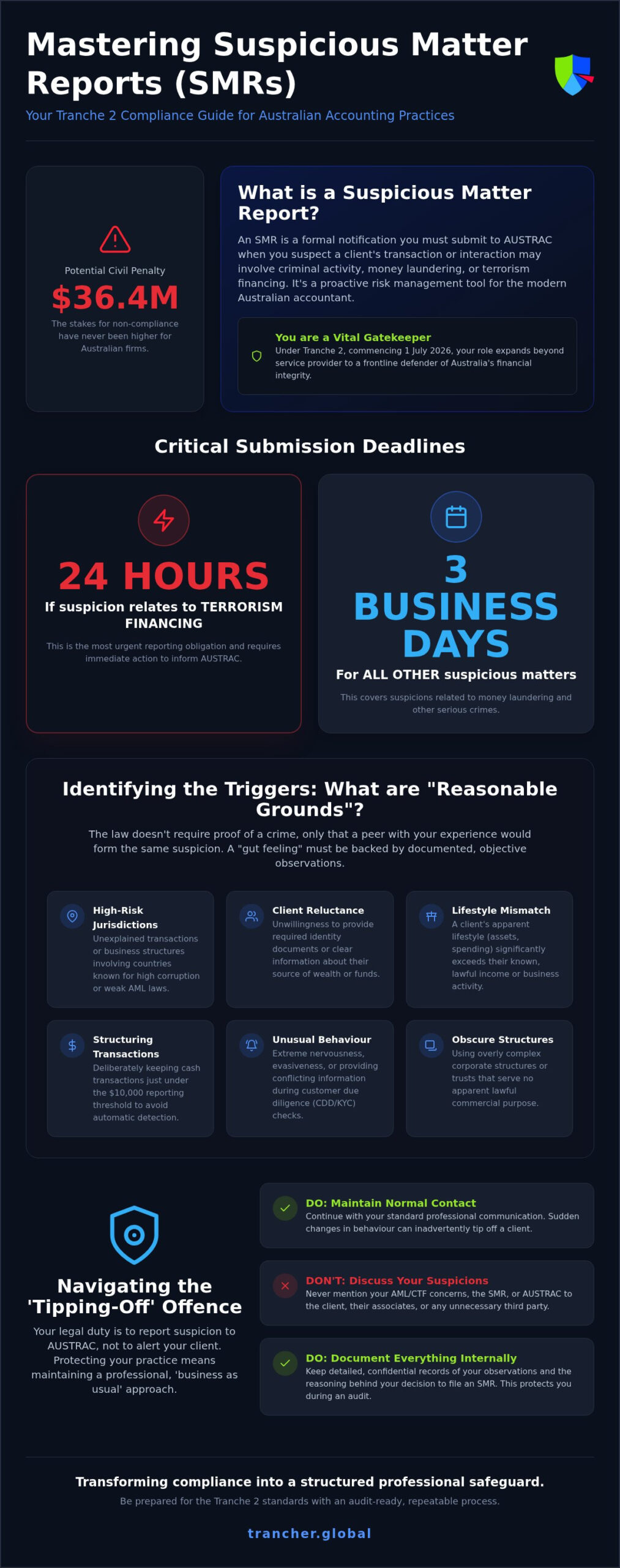
Common triggers often begin with inconsistencies during initial verification. If a client provides conflicting details or struggles to meet CDD and KYC requirements Australia, your internal alarm should sound. This is particularly true if they show extreme reluctance to disclose their source of wealth or if you notice “structuring.” Structuring involves a client deliberately keeping cash transactions just under the $10,000 reporting limit to avoid detection, a common tactic that warrants immediate attention.
Accounting-Specific Red Flags for 2026
Accountants see the “engine room” of a business, which reveals unique risks that other sectors might miss. Complex corporate structures or trusts that serve no clear commercial purpose are classic red flags in the post-Tranche 2 landscape. You might also notice requests to facilitate transactions involving high-risk jurisdictions or sanctioned individuals. Sometimes, the trigger is as simple as a client’s lifestyle suddenly eclipsing their reported income without a logical explanation. Recognising these patterns early allows you to act before your firm becomes unintentionally complicit.
The Role of Ongoing Risk Monitoring
Manual oversight is often insufficient for modern firms dealing with high volumes of data. This is where ongoing risk monitoring software becomes essential, shifting your firm from one-off onboarding checks to a state of perpetual vigilance. To ensure your report is effective, you must document the “Why” using the six essential elements: Who is involved, What occurred, Where it happened, When it took place, Why it’s suspicious, and How the activity was conducted. By using a structured compliance platform, you can automate these detections and focus on your high-value advisory work with total peace of mind.
Critical Submission Deadlines and AUSTRAC Reporting Timelines
The regulatory clock for an SMR is precise and unforgiving. Under the AML/CTF Act, there are two primary timelines you must observe once you’ve formed a suspicion. For general matters such as money laundering, identity fraud, or tax evasion, you have three business days to submit your report. However, if the suspicion relates to terrorism financing or national security, the deadline shrinks to just 24 hours. A common misconception is that the clock starts at the time of the transaction; in reality, the timer begins the moment you form the suspicion on reasonable grounds. This distinction is critical for understanding when to submit a suspicious matter report.
Failing to meet these deadlines can lead to significant regulatory friction. AUSTRAC has the power to secure civil penalties of up to $36.4 million for corporations and $7.28 million for individuals per contravention, based on the penalty unit value of $364 effective from 1 July 2026. Beyond the financial impact, late filings often trigger targeted audits and increased supervisory scrutiny. These administrative burdens can disrupt your practice’s daily operations and damage the trust you’ve built with your professional network.
Managing the 24-Hour Terrorism Financing Deadline
Suspicions involving terrorism financing are treated with the highest level of urgency. These reports must take priority over all other administrative tasks within your firm. To manage this effectively, you need a clear internal escalation process so that the moment a staff member identifies a risk, the compliance officer is notified. If you suspect a link to prohibited groups, your immediate steps should be to document the findings and prepare the submission without delay. Readiness is your best tool for navigating these high-pressure windows with calm confidence.
The SMR Submission Process via AUSTRAC Online
The actual filing takes place through the AUSTRAC Online portal. The regulator provides a specific quick reference guide on how to submit an SMR, which outlines the digital steps required. Accuracy is just as important as speed. High-quality reports include detailed descriptions of the suspicious activity and the reasons for your suspicion, ensuring law enforcement has actionable data.
Maintaining audit ready compliance records is your strongest defence if AUSTRAC ever questions a filing timeline. By using automated prompts and structured workflows, you can ensure that every report meets the regulator’s standards while staying well within the mandatory windows. This methodical approach removes the anxiety of the “ticking clock” and allows your practice to focus on delivering value to your clients.
How to Submit an SMR Without the Risk of Tipping Off
Tipping off is one of the most significant risks for accountants in the Tranche 2 era. Disclosing that an SMR has been filed, or even that a suspicion has been formed, is a criminal offence under the AML/CTF Act. With penalties reaching up to two years imprisonment or fines of $43,680, the consequences are severe. Understanding when to submit a suspicious matter report is only half the battle; you must also manage the information with absolute discretion to avoid prejudicing a potential law enforcement investigation. For a deeper understanding of exactly where the legal boundaries lie, our comprehensive guide on the tipping off offence AML Act Australia breaks down the common myths and clarifies the 2026 “prejudice” test in plain language. The stakes are undeniable.
The most effective strategy is maintaining a “Business as Usual” facade. If you suddenly cease all communication or freeze a client’s accounts without a clear, non-compliance reason, you risk alerting them. Instead, continue providing services as normal while the report is being processed. This approach protects the integrity of the investigation. It also ensures your firm remains compliant with its confidentiality obligations without raising unnecessary alarm.
Your internal record-keeping must reflect this heightened level of security. SMR details, including the report itself and any internal deliberations, should never be stored in the general client file where they might be accessed by unauthorised staff or accidentally shared. Use a secure, restricted compliance folder to keep these records separate from daily operational data. Establishing clear protocols for when to submit a suspicious matter report ensures that only authorised personnel, typically the AML Compliance Officer and the reporting staff member, are involved in the process.
Managing the Client Relationship Post-Report
Deciding whether to end a client relationship after filing an SMR requires careful professional judgement. AUSTRAC guidance doesn’t mandate immediate termination; in fact, firing a client too abruptly can constitute tipping off. If you must delay a transaction, use your internal AML/CTF programme to justify the wait. Citing standard verification procedures or technical reviews provides a “defensible position” that feels like a routine administrative process rather than a criminal suspicion.
Staff Training: The Best Defence Against Tipping Off
Your junior staff are often on the front line of client interactions, making them the most vulnerable point for accidental disclosure. Educate your team on the gravity of the tipping-off offence through regular role-playing scenarios. Practise responses for when a client asks, “Why are you asking so many questions?” or “Why is my tax return taking longer than usual?” By ensuring the AML Compliance Officer is the sole point of contact for AUSTRAC, you create a controlled environment that minimises risk. You can simplify your staff training and reporting workflows with our purpose-built compliance platform, ensuring your firm stays protected without the administrative burden.
Streamlining Your SMR Workflow: From Burden to Professional Service
Manual reporting is a hidden drain on your firm’s profitability. Many partners spend hours agonising over when to submit a suspicious matter report, leading to non-billable “admin creep” that pulls talent away from high-value advisory work. If your team is still manually cross-referencing spreadsheets and drafting reports from scratch, you’re not just losing time; you’re increasing the risk of human error. Shifting from a reactive panic to a proactive, automated workflow ensures that compliance becomes a seamless part of your firm’s operational DNA. A comprehensive AML program checklist Australia can serve as the foundation for building this kind of structured, repeatable system across your practice.
A strategic approach allows for AML CTF compliance costs reduction by treating these obligations as a recoverable professional service. Trancher automates the “busy work” of data collection and client screening, identifying triggers that a manual process might overlook. Our platform tracks the exact hours spent on compliance tasks, providing you with clear data to recover costs that were previously swallowed by overhead. This structured workflow ensures you hit every AUSTRAC deadline with precision, eliminating the need for weekend overtime or last-minute rushes.
Transforming Compliance into Opportunity
Compliance shouldn’t be a cost centre; it’s a chance to demonstrate your firm’s commitment to security and transparency. By utilising ROI reporting on billable compliance hours, you can turn a regulatory requirement into a profitable arm of your practice. Using compliance health checks allows you to show clients the depth of your due diligence, which builds significant trust. In the 2026 market, positioning your firm as a high-integrity partner is a competitive advantage that attracts premium clients who value professional rigour and ethical standards.
Getting Ready in 30 Days
The commencement of Tranche 2 obligations on 1 July 2026 doesn’t have to be a source of anxiety for your leadership team. We provide a 30-day compliance-ready guarantee to ensure your systems are finalised and audit-ready before the regulator begins their initial focus on newly regulated entities. You can also claim a complimentary 3-month trial to stress-test your internal processes for when to submit a suspicious matter report without any financial commitment. This trial allows you to experience how automation removes friction from your daily workflow while keeping your practice completely secure.
Start your 30-day journey to AUSTRAC readiness with Trancher today.
Securing Your Firm’s Future in the Tranche 2 Landscape
Mastering the nuances of AUSTRAC reporting is no longer just a regulatory hurdle; it’s a strategic move that protects your firm’s integrity and long-term profitability. By identifying red flags early and understanding exactly when to submit a suspicious matter report, you ensure that your practice remains a high-integrity partner in the Australian economy. You’ve now seen how a structured approach to deadlines and the “tipping off” offence can transform a complex obligation into a manageable, repeatable professional service.
We’ve designed our platform to make this transition seamless and stress-free. Join the Trancher 3-month trial and get audit-ready by 2026. Designed by Aaron Soh, a leading Australian AML specialist, Trancher includes a 30-day compliance guarantee and sophisticated ROI reporting to help you track billable hours effectively. This ensures your compliance programme isn’t just a safety net, but a value-adding asset for your business. You don’t have to navigate these shifting requirements alone. We’re here to provide the steady guidance and automated tools you need to lead your firm with absolute confidence.
Frequently Asked Questions
How long do I have to submit a suspicious matter report to AUSTRAC?
You have two distinct windows based on the nature of the suspicion. For matters involving money laundering or tax evasion, the deadline is three business days. If you suspect terrorism financing, you must report within 24 hours. The timer starts the moment you form a suspicion on reasonable grounds. It’s vital to have a structured process to determine when to submit a suspicious matter report so you don’t miss these strict regulatory deadlines.
What happens if I submit an SMR and I am wrong about the suspicion?
You are legally protected from civil and criminal liability when you submit a report in good faith. The law doesn’t require you to be right; it only requires that you have “reasonable grounds” for your suspicion. AUSTRAC encourages reporting even if you aren’t certain a crime has occurred. Documenting your thought process within a secure platform ensures you can demonstrate your good-faith efforts during any future regulatory review or audit.
Do I have to stop working for a client if I submit an SMR?
You aren’t required to cease providing services immediately after filing a report. Abruptly ending a relationship can actually lead to a tipping-off offence if the client becomes suspicious of your actions. AUSTRAC often recommends maintaining a “business as usual” approach while you continue to monitor the client’s activity. This strategy allows law enforcement to conduct their investigations without the client being alerted to the fact that they’re under official scrutiny.
Can I tell my client that I have filed a report with AUSTRAC?
No, you must never disclose the existence of an SMR to the client or any unauthorised third party. This action is known as “tipping off” and is a serious criminal offence in Australia. Doing so can jeopardise active law enforcement investigations and lead to a maximum penalty of two years imprisonment. You should manage all SMR-related communications through your firm’s AML Compliance Officer and keep these records entirely separate from your standard client files.
What is the penalty for not submitting a suspicious matter report?
The financial consequences for failing to report are substantial and can threaten a firm’s viability. As of 1 July 2026, the Federal Court can impose civil penalties of up to $36.4 million for corporations and $7.28 million for individuals per contravention. These figures are based on the Commonwealth penalty unit value of $364. Beyond these fines, your firm could face mandatory audits, formal directions, or even the cancellation of your AUSTRAC registration.
What information must be included in a quality SMR?
A high-quality report provides law enforcement with actionable intelligence by covering the six essential elements: who, what, where, when, why, and how. You should include a detailed description of the suspicious activity and clearly explain the “reasonable grounds” that led to your suspicion. Using a structured digital workflow helps ensure your reports meet AUSTRAC’s 2026 data quality standards, making it easier for authorities to identify and disrupt potential criminal or terrorist networks.
Does a suspicious matter report apply to prospective clients I turn away?
Yes, the obligation to report exists even if you haven’t formally engaged the client. If a prospective client’s behaviour or transaction request triggers a suspicion during the initial KYC or onboarding phase, you must file an SMR. Turning a suspicious person away doesn’t discharge your legal duty. It’s important to understand when to submit a suspicious matter report during the pre-engagement stage to ensure your firm meets its full Tranche 2 obligations.
How do I submit an SMR if I am a sole practitioner?
Sole practitioners must submit reports directly through the AUSTRAC Online portal. In a sole practice, you fulfil the role of the AML/CTF Compliance Officer, meaning you’re responsible for identifying triggers and managing the submission process. While you don’t have a wider team to manage, the reporting deadlines remain just as strict. Using automated tools can help you maintain audit-ready records and track your billable compliance hours without adding significant administrative overhead to your practice.