

Could a simple slip of the tongue really lead to a $43,680 fine or two years in prison? For many Australian accountants preparing for the 1 July 2026 Tranche 2 deadline, the tipping off offence AML Act Australia feels like a legal minefield where one wrong word could end a career. It’s completely natural to feel anxious about balancing your reporting duties to AUSTRAC with the need to maintain professional client relationships. You want to protect your firm, but you don’t want to live in constant fear of a clerical error or a misunderstood conversation.
We’re here to help you move past the myths and master the 2025 “prejudice” test so you can manage high-risk interactions with total confidence. This guide provides a clear path through the complexities of reformed disclosure rules, ensuring you know exactly where the “safe zones” are. We’ll explore practical scripts for client interactions, explain how the prejudice model actually works in practice, and show you how to build a defensible compliance program that turns regulatory hurdles into a strategic advantage for your practice. By the time you finish reading, you’ll have the tools to handle even the most sensitive SMR filings with professional ease.
Key Takeaways
- Master the 2025 prejudice-based model to understand exactly when disclosure becomes a risk and when it’s a protected professional action.
- Bust common myths surrounding the tipping off offence AML Act Australia so you can stop living in fear of accidental non-compliance.
- Identify the specific legal safe zones that allow you to consult with solicitors and internal teams without breaching your reporting duties.
- Learn practical communication scripts that help you request sensitive information from high-risk clients while maintaining a calm, professional atmosphere.
- Discover how automated workflows provide a reliable safety net to prevent staff errors and ensure your firm meets the July 2026 Tranche 2 deadline.
What is the Tipping Off Offence in Australia?
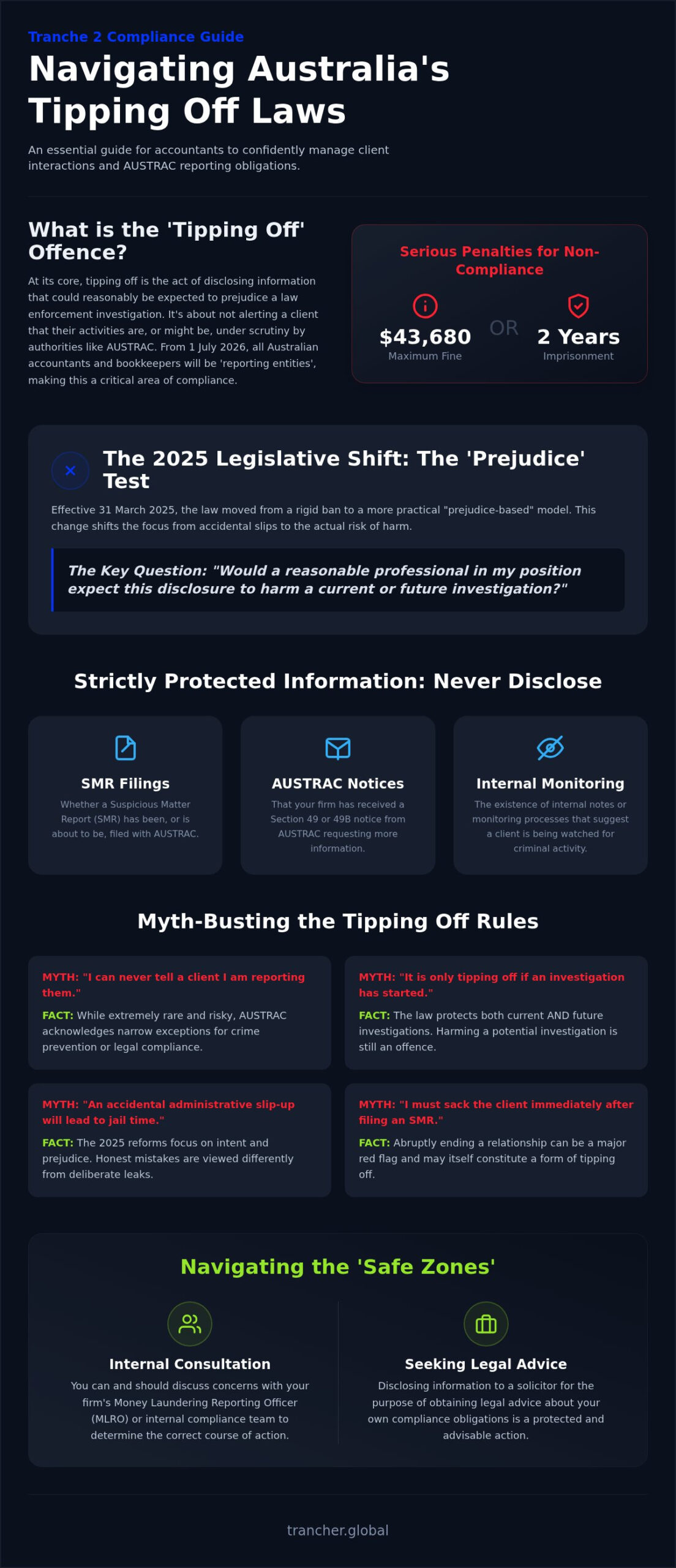
The tipping off offence AML Act Australia is a concept that often keeps practitioners awake at night, but it’s simpler than the legal jargon suggests. At its heart, tipping off occurs when a reporting entity or one of its employees discloses information that could reasonably be expected to prejudice a law enforcement investigation. It’s essentially the legal version of “don’t alert the suspect.” This rule is a cornerstone of global anti-money laundering frameworks; if a person knows they’re under the microscope, they can quickly move funds, destroy digital trails, or flee the jurisdiction before AUSTRAC or the police can intervene.
While this used to be a worry primarily for big banks, the landscape is shifting. From 1 July 2026, the accounting sector officially enters the Tranche 2 era. This means every accountant, bookkeeper, and even third-party compliance contractor becomes a “reporting entity” under the law. You’ll be on the front line of financial intelligence gathering. Understanding where the line is drawn isn’t just about avoiding a criminal record; it’s about maintaining the professional integrity of your entire organisation.
The 2025 Legislative Shift: The ‘Prejudice’ Test
Until recently, the rules were incredibly rigid, making it difficult for firms to operate without fear of a technical breach. That changed on 31 March 2025. The law shifted from a near-total ban on disclosure to a more sensible “prejudice-based” model. Now, it’s only an offence if the information you share would, or could, reasonably be expected to harm an investigation.
What does “reasonable expectation” mean in plain English? It means that if a sensible professional in your position would realise that speaking up might tip the client off to an investigation, you must stay silent. This change is actually great news for honest practitioners. It moves the focus away from accidental administrative slips and onto the actual risk of harm. It allows for more practical, risk-based judgements rather than forcing you into total silence during every client interaction.
Protected Information: What You Can’t Share
Even with the new prejudice test, certain pieces of information are strictly off-limits. You must never let a client know that:
- A Suspicious Matter Report (SMR) has been, or is about to be, filed with AUSTRAC.
- Your firm has received a Section 49 or 49B notice, which is AUSTRAC’s way of asking for more information about a specific transaction.
- Internal compliance notes exist that suggest a client is being monitored for potential criminal activity.
It’s not just about what you say; it’s about what you record. If a client sees a file note on your desk that says “Suspicious activity detected, filing SMR,” you’ve tipped them off. This is why automated systems are becoming the standard for modern firms. They keep these sensitive records tucked away in secure workflows, far from the eyes of the clients you’re currently servicing.
Myth-Busting the Tipping Off Rules for 2026
As we head toward the July 2026 deadline, it’s vital to clear up the confusion surrounding the tipping off offence AML Act Australia. Many practitioners still rely on “old world” rules that were far more rigid than today’s prejudice-based model. These misconceptions can lead to unnecessary stress or, worse, risky decisions that actually increase your firm’s exposure. Let’s look at the four most common myths currently circulating in the accounting sector.
- Myth 1: ‘I can never tell a client I’m reporting them.’ While it’s almost always unwise to mention an SMR, AUSTRAC’s official guidance on tipping off now acknowledges specific, narrow exceptions where disclosure is necessary for crime prevention or legal compliance.
- Myth 2: ‘It’s only tipping off if an investigation has already started.’ This is a dangerous assumption. The law protects both current and future investigations. If your disclosure could reasonably be expected to harm a potential investigation down the track, you’re still at risk.
- Myth 3: ‘I’ll go to jail for a simple administrative slip-up.’ While the maximum penalty is two years in prison, the 2025 reforms shifted the focus to intent and reasonable prejudice. Honest mistakes are viewed differently than deliberate leaks.
- Myth 4: ‘I have to sack the client the moment I file an SMR.’ Abruptly terminating a long-term relationship the second a report is filed is a major red flag. If your sudden exit alerts the client that something is wrong, you might have inadvertently prejudiced an investigation.
The ‘Accidental Disclosure’ Myth
There’s a significant difference between a deliberate leak to a client and a workflow error. AUSTRAC looks favourably on firms that have established strong “information barriers” and comprehensive staff training. If a staff member mentions a report by accident, the legal outcome often hinges on whether the firm had systems in place to prevent it. In the context of the 2025 reforms, prejudice is defined as any disclosure that is reasonably likely to hinder, interfere with, or provide an advantage to a person under investigation by law enforcement.
Myth: Tipping Off is Only an Individual Crime
It’s a mistake to think that only the person who speaks up is at risk. While an individual can face the $43,680 fine or prison time, the accounting firm itself faces corporate liability. A single staff member’s mistake can trigger firm-wide AUSTRAC audits and significant reputational damage. Your AML Compliance Officer plays a critical role here, supervising all disclosures and ensuring that internal communication doesn’t spill over into client-facing interactions. Implementing a structured approach to these interactions can simplify your day-to-day work, and tools like automated compliance platforms are designed to help your team stay within the safe zones.
The Safe Zones: When is Disclosure Allowed?
Understanding the tipping off offence AML Act Australia doesn’t mean you have to work in total isolation. The legislation provides clear “safe zones” where sharing information is not only permitted but often necessary for good governance. Knowing these exceptions allows you to seek support and maintain your professional duties without the fear of regulatory blowback.
One of the most critical safe zones is seeking legal advice. You’re fully entitled to discuss a Suspicious Matter Report (SMR) or an AUSTRAC notice with your solicitor to understand your obligations. Similarly, internal sharing is protected. You can and should discuss suspicions with your firm’s AML Compliance Officer or relevant members of your parent entity. This internal dialogue ensures your firm makes informed, collective decisions rather than leaving individual staff members to carry the burden of reporting alone.
There are also practical exceptions for crime prevention and the “ordinary course of business.” If disclosure is necessary to prevent a specific, imminent criminal act, the law provides a pathway for action. More commonly, you’ll rely on the business-as-usual exception. Asking a client standard Know Your Customer (KYC) questions or requesting updated “Source of Wealth” documentation isn’t tipping off, provided you don’t reveal that an SMR has been filed or is under consideration.
Managing Third-Party Disclosures
Your compliance ecosystem often involves external partners. Sharing data with your AML software provider, such as Trancher, is a protected and necessary part of modern reporting. The same applies to disclosures made to external auditors or AML consultants during a review of your systems. The key to staying safe is documentation. Always record the “why” behind any disclosure. By documenting that a conversation was for the purpose of legal advice or system auditing, you create a defensible trail that proves your intent was never to prejudice an investigation.
The 2026 Tranche 2 Readiness Standard
As the 1 July 2026 deadline approaches, accounting firms must ensure their internal policies are current. It’s no longer enough to tell staff “never say anything.” Your training must reflect the 2025 prejudice test, teaching team members how to exercise professional judgement regarding the tipping off offence AML Act Australia. Updating your manual is the first step toward a resilient practice. To help you get started, we’ve developed a comprehensive AML program checklist Australia to guide your Tranche 2 preparations. Transitioning your firm to these new standards now will remove friction well before the regulatory clock starts ticking.
How to Manage High-Risk Clients Without Tipping Them Off
Navigating the tipping off offence AML Act Australia requires a delicate touch and a steady hand. It’s about maintaining a “business as usual” atmosphere even when your internal compliance triggers are firing. If you suddenly change your tone, stop returning calls, or become overly formal, you risk alerting the client that something has changed. The goal is to keep interactions professional and calm, ensuring your firm’s internal processes remain invisible to the outside world.
What happens if a client asks point-blank if you’re reporting them to AUSTRAC? You don’t have to lie, but you must not confirm a specific report. A prepared, neutral response is your best tool. You might say: “Our firm, like all Australian accounting practices, follows strict regulatory protocols for all transactions to ensure we’re compliant with current standards.” This deflects the specific suspicion toward a general firm-wide policy. If the risk eventually becomes too high to manage, consider a “quiet exit” strategy. Avoid a dramatic termination of the relationship immediately after filing an SMR. Instead, offboard the client over a period of weeks based on a general change in your firm’s risk appetite or service focus.
Scripts for Enhanced Due Diligence
Asking for “Source of Wealth” information can feel intrusive, but it’s a necessary part of your 2026 obligations. The key is to frame these questions as standard regulatory requirements rather than personal suspicions. Use the upcoming Tranche 2 deadline as your external driver. Tell the client: “As part of our updated compliance framework for the 2026 legislative changes, we’re refreshing documentation for all our high-value accounts.” This shifts the focus away from the specific transaction and toward a broad, industry-wide shift in how all accounting firms must operate. It’s a proactive way to get the data you need without sounding like a detective.
Training Your Frontline Staff
Your compliance program is only as strong as its weakest link. Often, the biggest risk of tipping off comes from receptionists or junior staff who might accidentally mention an “extra compliance check” or a “report being filed” during a casual chat. You must implement strict “Information Barriers” within the firm. Only the AML Compliance Officer and necessary partners should be aware of sensitive filings. Ensuring your team knows when to submit a suspicious matter report is just the first step; the second is ensuring that knowledge stays within a secure circle. Trancher provides the expert support and automated prompts needed to guide your team through these high-stakes conversations safely.
Protecting Your Firm with Automated Compliance
While staff training is a vital pillar of compliance, human error remains a persistent vulnerability when managing the tipping off offence AML Act Australia. Trancher’s automated platform provides a robust digital safety net, ensuring that sensitive information remains isolated from general client files. Our workflow is designed to prevent accidental mentions by hiding SMR-related data from staff who don’t need to see it, effectively removing the risk of a slip-up during routine client interactions.
Compliance should feel like a strategic advantage rather than a scary burden. By using our platform, you can transform mandatory obligations into structured, billable services that enhance your firm’s professional value and internal efficiency. Our local Australian support team is always on hand to help you navigate the specific nuances of AUSTRAC reporting, ensuring you’re never left guessing. We’re so confident in our approach that we offer a 30-day AML/CTF compliance-ready guarantee, making sure your practice is audit-ready well before the 1 July 2026 deadline.
The Trancher Advantage for SME Accountants
Our platform features role-based training modules that educate your team on tipping off risks in just minutes, ensuring everyone from the front desk to the senior partners knows their boundaries. Trancher also generates audit-ready records that prove your firm followed the prejudice test for every disclosure made. This level of documentation is essential for maintaining a defensible AML program. For firms looking to eliminate manual errors and meet strict AUSTRAC timelines, our automated SMR reporting AUSTRAC system ensures every filing is handled accurately and on time. You can test these automated workflows in your own firm with our 3-month free trial, allowing you to refine your processes without any financial risk.
Securing Your 20% Subscription Discount
Joining our early-adopter program for Tranche 2 is a proactive move that positions your firm as a leader in regulatory readiness. At the conclusion of your trial, we’ll provide a formal ROI report that demonstrates the efficiency gains and administrative savings our platform delivers. Early adopters who secure their 2026 readiness now also receive a 20% discount on their first 12-month subscription. It’s time to move from reactive stress to proactive control. Start your 3-month trial with Trancher and gain the confidence of having an expert compliance companion by your side.
Mastering Your Compliance Journey for 2026 and Beyond
Transitioning into the Tranche 2 era doesn’t have to be a source of stress for your practice. You’ve seen how the 2025 prejudice test shifts the focus from total silence to informed professional judgement. By maintaining a business-as-usual atmosphere and utilising legal safe zones, you can manage high-risk clients with absolute confidence. Protecting your firm from the tipping off offence AML Act Australia is ultimately about having the right systems and support in place before the July 2026 deadline arrives.
We’re here to act as your steady guide through every regulatory change. With our local Australian expert support and a 30-day AML/CTF compliance-ready guarantee, you’ll have the peace of mind that your firm is fully defensible. Early adopters also benefit from a 20% discount on their first 12-month subscription after the trial ends. Secure your firm’s 2026 readiness with a complimentary 3-month Trancher trial and turn these complex obligations into a seamless part of your firm’s growth. It’s time to move forward with clarity and professional ease.
Frequently Asked Questions
What is the maximum penalty for a tipping off offence in Australia?
The maximum penalty for a tipping off offence in Australia is two years imprisonment, a fine of 120 penalty units, or both. As of 1 July 2026, the value of a Commonwealth penalty unit is $364, making the maximum fine $43,680. These penalties apply to individuals and highlight the serious nature of the tipping off offence AML Act Australia. Maintaining a defensible compliance program is the best way to ensure your firm avoids these severe regulatory consequences.
Can I tell my client I need more info because of Tranche 2 rules?
Yes, you can absolutely inform your clients that you require additional information due to the commencement of Tranche 2 obligations on 1 July 2026. This is considered part of the “ordinary course of business” for customer due diligence. Framing your requests as standard regulatory updates for all clients avoids single-out suspicion. It’s a proactive way to gather necessary data while keeping your compliance activities transparent and professional without risking a breach.
Is it tipping off if I tell my boss about a suspicious transaction?
No, disclosing suspicions to your internal team or the firm’s AML Compliance Officer is a protected safe zone. The law encourages internal communication to ensure that suspicious matters are properly evaluated and reported to AUSTRAC. This internal dialogue is vital for maintaining a robust AML program. It doesn’t constitute tipping off because the information remains within the reporting entity’s secure environment, allowing the firm to meet its obligations collectively and safely.
What should I say if a client asks if I’m filing an SMR?
If a client asks directly, you should provide a neutral, firm-wide response rather than confirming or denying a specific report. You might explain that your firm has a policy of conducting regular regulatory reviews for all clients to meet Australian standards. This approach avoids providing any information that could prejudice an investigation. Having a clear, scripted response ensures that your staff don’t feel pressured into making an accidental disclosure during high-stakes client interactions.
Does the tipping off offence apply if no crime was actually committed?
Yes, the tipping off offence applies regardless of whether a crime was actually committed or if an investigation had already begun. The law focuses on the potential to prejudice current or future law enforcement efforts. If your disclosure could reasonably be expected to hinder AUSTRAC’s intelligence gathering, it is a criminal offence. This is why the tipping off offence AML Act Australia is treated with such high priority by regulators, even in cases where no underlying criminal activity is found.
How did the tipping off law change in March 2025?
On 31 March 2025, the legislation shifted to a “prejudice-based” model. Previously, the law was a near-total ban on disclosure, but it now only considers it an offence if the disclosure would, or could reasonably be expected to, prejudice an investigation. This reform allows for more practical information sharing between reporting entities. It encourages a risk-based approach where practitioners use professional judgement to determine if their communication might harm law enforcement efforts.
Can I stop acting for a client immediately after reporting them?
Abruptly ending a client relationship immediately after filing a Suspicious Matter Report is risky and could be seen as tipping off. If the sudden termination alerts the client that they’re under suspicion, it may prejudice an investigation. A “quiet exit” strategy is often safer. You might gradually offboard the client based on changes to your firm’s risk appetite or service focus. This keeps the transition professional and avoids raising unnecessary alarms that could lead to a breach.
How can AML software like Trancher help prevent tipping off?
Trancher prevents tipping off by using automated AUSTRAC SMR reporting workflows that hide sensitive SMR data from staff who don’t need access. Our platform includes role-based training and guided prompts that help your team navigate high-risk interactions safely. By centralising your records in a secure, audit-ready environment, we remove the friction of manual reporting. This structured approach ensures that suspicious matter filings remain confidential, protecting your firm from human error while meeting the 1 July 2026 deadline.