

Did you know that a single serious oversight in your compliance framework could now lead to civil penalties of up to $36.4 million for your firm? With the 1 July 2026 commencement date now behind us, implementing a robust AML program checklist Australia is no longer a future project but a daily operational necessity for over 100,000 businesses. It’s understandable if the administrative weight of these obligations feels like an overwhelming, non-billable burden on your practice. You shouldn’t have to choose between regulatory safety and operational efficiency.
This guide provides a comprehensive, step-by-step approach to help you manage your obligations with confidence and clarity. We’ll walk through the essential steps to verify clients, train your team, and transform these requirements into a streamlined, profitable part of your advisory service. By following this structured path, you can ensure your firm remains a defensible, compliant partner for your clients while reclaiming your peace of mind. Let’s look at how you can turn this regulatory transition into a strategic advantage for your business.
Key Takeaways
- Understand why the 1 July 2026 commencement marks a permanent shift for accountants and how to align your firm with the latest AUSTRAC reporting standards.
- Utilise a comprehensive AML program checklist Australia to build a defensible framework that covers both Part A general procedures and Part B customer due diligence.
- Discover how to transition from manual, error-prone spreadsheets to automated systems that eliminate administrative friction and protect your firm from heavy penalties.
- Learn how to integrate compliance into your existing service model, making regulatory obligations a billable and profitable component of your client advisory work.
- Establish a clear roadmap to reach full compliance readiness within 30 days, ensuring your documentation is audit-ready and your staff are properly trained.
Understanding the Tranche 2 Regulatory Landscape for 2026
Tranche 2 is the expansion of AML/CTF laws to designated non-financial businesses and professions. The 1 July 2026 commencement date marked a fundamental paradigm shift for the Australian accounting sector, moving compliance from a peripheral concern to a core operational pillar. For many firms, the transition hasn’t been simple. Now that we’ve crossed that threshold, the Australian Transaction Reports and Analysis Centre (AUSTRAC) expects every firm providing ‘designated services’ to have a fully functional program in place from day one.
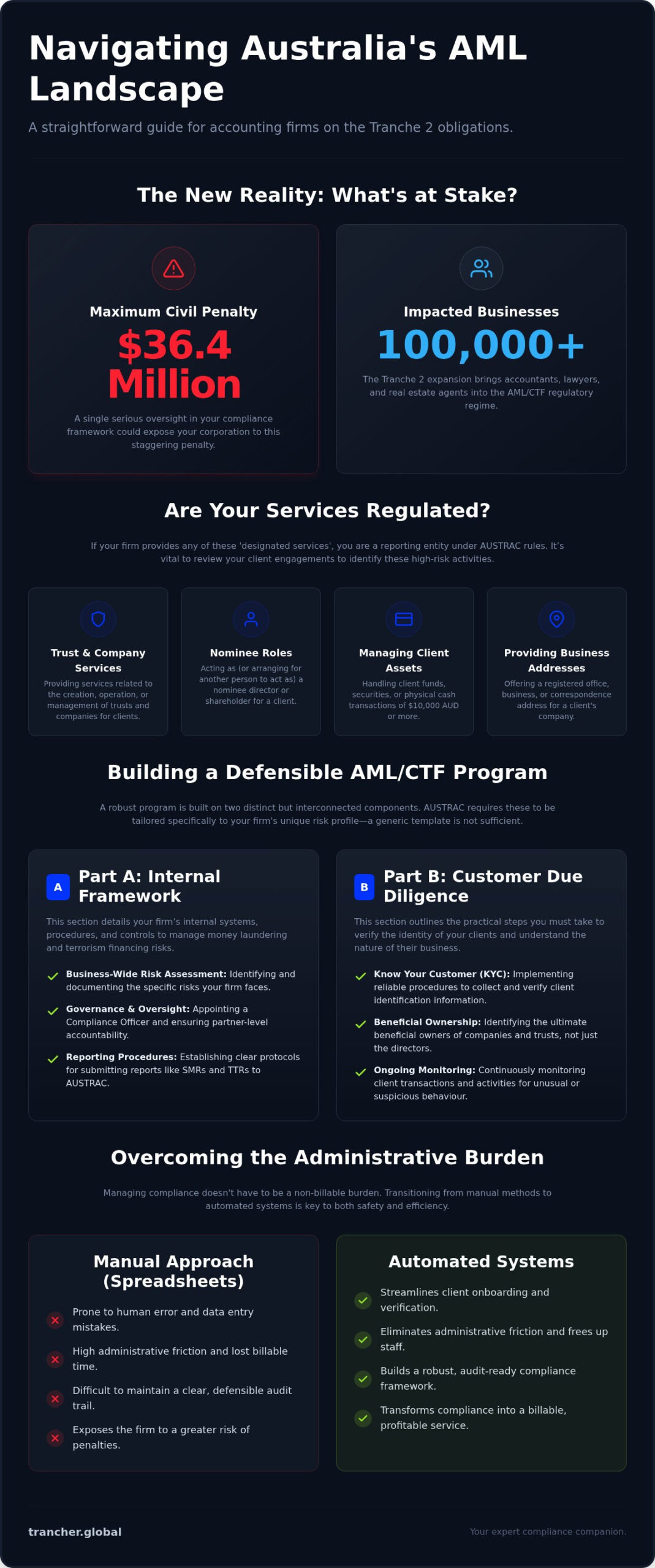
A designated service isn’t just a high-level banking transaction. For an accountant, it includes providing trust or company services, acting as a nominee shareholder, or managing client funds. If your firm performs any of these tasks, you’re officially a reporting entity. Using a comprehensive AML program checklist Australia ensures you don’t miss the granular requirements that AUSTRAC auditors look for during a review. Procrastination during the first half of the year led to a ‘compliance crunch’ for many; early and ongoing refinement is the only way to stay ahead of the curve and maintain your firm’s integrity.
Which Accounting Services are Now Regulated?
Identifying high-risk activities is the first step in your internal audit. The regulator focuses on the nature of the service rather than the size of your firm. Key activities that trigger obligations include:
- Trust and company service provision.
- Acting as a nominee director or shareholder.
- Managing client assets or physical cash transactions of $10,000 or more.
- Providing a registered office or business address for a client.
Review your client engagement letters carefully to ensure no service is overlooked. It’s also vital to document why certain services are excluded from your program. This ‘negative’ documentation proves to AUSTRAC that you’ve actively considered your risks rather than simply ignoring them. Don’t leave it to guesswork; a clear audit trail is your best defence.
The Consequences of Non-Compliance
The stakes are remarkably high under the new regime. For serious contraventions occurring after 1 July 2026, corporations face civil penalties of up to $36.4 million. While AUSTRAC has stated its initial focus is on those who wilfully ignore the law, an investigation alone can devastate a firm’s reputation. Beyond the financial hit, you might face enforceable undertakings or be forced to pay for a mandatory independent audit. These audits are deep dives into your internal systems that can cost tens of thousands of dollars in professional fees and hundreds of hours in lost billable time. Staying proactive isn’t just about avoiding fines; it’s about protecting the practice you’ve worked so hard to build and ensuring you remain a trusted advisor.
The Five Pillars of a Defensible AML/CTF Program
A defensible AML/CTF program is built on two distinct yet interconnected components. Part A focuses on your firm’s internal systems, including risk management, reporting procedures, and governance. Part B covers your Customer Due Diligence (CDD) and Know Your Customer (KYC) obligations. AUSTRAC requires these programs to be “tailored” to your specific practice. A generic template simply won’t suffice. Your AML program checklist Australia must reflect the actual risks your firm faces every day, from the types of clients you onboard to the specific jurisdictions where you operate.
Your governance framework is equally critical. You must appoint an AML/CTF Compliance Officer who has the authority and resources to manage the program effectively. This isn’t a role for a junior staff member; it requires someone who can speak directly to partners and senior management. The partners must take ultimate responsibility for the program’s success. By establishing a culture where compliance is discussed at the highest levels, you ensure that regulatory safety is woven into the firm’s identity rather than treated as a checkbox exercise.
Risk Assessment: The Foundation of Your Program
Conducting a Business-Wide Risk Assessment (BWRA) is your first priority. You need to evaluate the risk profile of your clients, the nature of the services you provide, and the geographic locations where you operate. For example, a firm managing complex international trusts faces a vastly different risk profile than one focused on local small business tax returns. For a deeper dive into managing these client-specific risks, see our guide on CDD and KYC Requirements Australia: The 2026 Accountant’s Guide. This foundation allows you to apply simplified or enhanced due diligence where appropriate, saving your team valuable time while maintaining safety.
Employee Due Diligence and Training
Compliance is a team effort. You must implement an employee due diligence program to screen staff and mitigate internal risks. This is paired with role-based training that ensures everyone from the receptionist to the senior partner knows how to spot a red flag. AUSTRAC inspectors will look for training records that prove your team is regularly updated on the latest threats and internal procedures. Maintaining these records manually is a common pain point for many practices. However, streamlining your documentation through a dedicated platform can make this process effortless. When your team feels confident and supported, compliance becomes an asset to your firm’s reputation rather than a burden.
The Essential AML Program Checklist for Australian Firms
Moving from a high-level understanding of the law to daily operational compliance requires a structured roadmap. This AML program checklist Australia is designed to help you navigate the practical steps of building a defensible framework. It’s not just about drafting a document. It’s about embedding these steps into your firm’s DNA to ensure you meet AUSTRAC’s rigorous standards while maintaining your efficiency.
- Step 1: Enrolment. You must register as a reporting entity through the AUSTRAC Online portal.
- Step 2: Compliance Officer. Designate a senior leader with the authority to manage your AML/CTF obligations.
- Step 3: Drafting. Create a formalised program document that covers Part A (risk management) and Part B (KYC).
- Step 4: KYC Implementation. Deploy verification procedures for all new clients and perform remediation on existing ones.
- Step 5: Reporting Workflows. Establish clear triggers for Suspicious Matter Reports (SMRs) and Threshold Transaction Reports (TTRs).
Phase 1: Governance and Enrolment
Your journey starts with formal enrolment. To complete this, you’ll need your ABN, business address, and details of your designated Compliance Officer. This individual must sit high enough in your organisation’s structure to influence decision-making and access necessary resources. Once your program is drafted, it isn’t “live” until your governing body, such as your partners, formally approves and signs off on the document. This step is a non-negotiable requirement that proves management’s commitment to the regulator. It ensures that compliance isn’t just an administrative task but a strategic priority for the practice.
Phase 2: Operational Client Onboarding
Onboarding is where most firms feel the administrative pressure. You need a clear process for Standard Due Diligence (SDD) and Enhanced Due Diligence (EDD). For high-risk clients, you must dig deeper into their “Source of Wealth” to understand how they acquired their assets. Verifying beneficial owners in complex trust structures is a common hurdle for accountants, but it is essential for uncovering the real person behind an entity. Finally, your program must include an ongoing monitoring system. This isn’t a “set and forget” task. You need to catch changes in client behaviour, such as unusual transaction patterns, and report suspicious matters within 24 hours for terrorism financing or three business days for other crimes. Establishing these workflows early prevents the stress of a last-minute scramble when an issue arises.
Overcoming the Administrative Burden: Manual vs Automated Compliance
For many Australian firms, the initial reaction to new regulations is to reach for a spreadsheet. While this might feel like a cost-effective way to tick off your AML program checklist Australia, manual systems often hide significant operational costs. Spreadsheets are static. They don’t alert you when a client’s risk profile changes or when an identity document expires. Under AUSTRAC scrutiny, a manual log can quickly fall apart if it lacks a clear, time-stamped audit trail. Automation solves this by creating audit-ready compliance records automatically, ensuring your firm remains defensible without the need for constant manual data entry. Beyond internal efficiency, automated KYC processes significantly reduce friction for your clients. A smooth, digital onboarding experience reflects a modern, professional practice and prevents the delays associated with chasing physical paperwork.
The Risk of Human Error in Manual Systems
Human error is the most common cause of compliance breaches in SME firms. It’s incredibly easy to miss a Politically Exposed Person (PEP) or a match on a global sanctions list when performing manual checks. These lists change daily, making manual oversight a full-time task that most partners simply don’t have time for. Managing ongoing monitoring across hundreds of clients is equally daunting without help. To see how technology simplifies this, you can review our Ongoing Risk Monitoring Software Guide. By removing the guesswork, you protect your firm from the reputational and financial damage of an accidental oversight. Reliable systems act as a steady hand, ensuring your AML program checklist Australia remains fully up to date with minimal intervention.
The Profitability Opportunity for Accountants
It’s time to stop viewing compliance as a drain on your resources. Instead, frame AML as a professional service that adds value to your client relationships. When you provide rigorous due diligence, you’re protecting your clients’ interests as much as your own. Many firms now successfully bill for this activity, transforming a perceived overhead into a recoverable revenue stream. Using ROI reporting allows you to demonstrate this value directly to your partners. Trancher tracks compliance hours to support client billing, ensuring every minute spent on verification is accounted for. This shift in perspective turns a regulatory hurdle into a strategic avenue for growth. To start making your compliance processes profitable, book a demo with the Trancher team today and see how automation can work for you.
Achieving 30-Day Readiness with the Trancher Framework
Establishing a defensible position doesn’t have to be a multi-month consulting project that drains your firm’s resources. The Trancher framework is designed to move your practice from uncertainty to audit-ready status in just 30 days. By providing a structured, AUSTRAC-aligned workflow from day one, the platform ensures you tick off every item on your AML program checklist Australia without the usual administrative friction. We understand that for many accounting firms, the transition period following the 1 July 2026 commencement has been a steep learning curve. Our 30-day compliance guarantee is built on this understanding, offering a clear, methodical path to meeting your obligations with confidence.
Having local Australian support led by Aaron Soh means you aren’t just buying software; you’re gaining a strategic partner. We provide expert guidance during the onboarding phase to ensure your internal policies reflect your specific risk profile. This proactive approach helps you avoid the reactive stress that often follows a regulatory shift. When you have a knowledgeable companion to guide you through the complexities of the new regime, compliance becomes a manageable and even advantageous part of your business operations.
A System Designed Specifically for Accountants
Disruption is the enemy of a busy practice. Trancher integrates seamlessly with existing accounting workflows, ensuring that your team can verify clients and monitor risks without leaving their familiar environment. We provide standardised templates for client notifications and fee disclosures, which are essential for maintaining transparency and professionalism. Additionally, our role-based training modules satisfy AUSTRAC’s educational requirements, ensuring your staff are competent and your training records are always audit-ready. This ensures that your team feels supported and informed, rather than burdened by new requirements.
Your Road to July 2026 Starts Here
If your firm is still relying on manual processes or feels the need to strengthen its post-July 2026 framework, the time to act is now. Waiting for an AUSTRAC inquiry is a high-risk strategy that can lead to significant penalties and reputational damage. By starting a conversation today, you can transform compliance from a burden into a billable, value-add service for your clients. We invite you to begin with a complimentary 3-month trial to experience the Trancher difference first-hand. After your trial, you’ll also be eligible for a 20% subscription discount to ensure your ongoing compliance remains cost-effective. Prepare your firm for Tranche 2 with a complimentary trial and secure your practice’s future today.
Future-Proof Your Practice with Confidence
The regulatory landscape for Australian accountants changed permanently on 1 July 2026. By now, your firm should have moved beyond the initial readiness phase into active, operational compliance. Implementing a comprehensive AML program checklist Australia is the most effective way to ensure your practice remains protected against AUSTRAC scrutiny while maintaining high standards of client service. We’ve explored how shifting from manual spreadsheets to automated systems not only reduces the risk of human error but also unlocks new revenue streams through billable compliance advisory work.
You don’t have to manage this complex transition alone. Designed by local Australian compliance specialist Aaron Soh, Trancher offers a clear, methodical path to full regulatory safety. We provide a 30-day compliance guarantee and precise ROI reporting that turns a mandatory overhead into a billable asset. Secure your firm’s future with a complimentary 3-month Tranche 2 trial and experience how seamless integration can transform your workflow. We’re here to act as your steady guide, ensuring you stay ahead of regulatory shifts with ease and professional pride.
Frequently Asked Questions
What is an AML program checklist for Australian businesses?
An AML program checklist Australia is a structured document that outlines the specific regulatory steps a firm must take to meet its obligations under the AML/CTF Act. It serves as an operational roadmap for identifying risks, verifying client identities, and reporting suspicious activity to AUSTRAC. For accounting firms, this includes enrolling as a reporting entity, appointing a compliance officer, and establishing robust customer due diligence procedures to prevent financial crime and ensure total regulatory safety.
Does my small accounting firm really need a formal AML/CTF program by 2026?
Yes, if your firm provides any designated services as defined by AUSTRAC, you are legally required to have a formal program. The 1 July 2026 commencement date applied to all firms regardless of their size or client volume. Small practices often face the same scrutiny as larger entities if they manage trusts, company formations, or large transactions. Having a documented program is your primary defence against penalties and demonstrates your firm’s commitment to professional standards.
What are the minimum requirements for an AUSTRAC-compliant program?
An AUSTRAC-compliant program must consist of two main parts. Part A focuses on identifying, managing, and mitigating money laundering and terrorism financing risks across your entire practice. Part B details your Customer Due Diligence (CDD) procedures, specifically how you verify the identity of your clients and their beneficial owners. You also need a designated Compliance Officer, ongoing staff training, and a system for reporting suspicious matters within the required legislative timeframes to ensure total transparency.
Can I use a generic AML program template for my accounting practice?
While templates can provide a starting point, AUSTRAC explicitly requires your program to be tailored to your firm’s specific risk profile. A generic document doesn’t account for your unique client base, the jurisdictions you operate in, or the specific services you offer. If an auditor finds that your program doesn’t reflect your actual business operations, it may be deemed non-compliant. Your AML program checklist Australia should guide you in customising these essential internal policies.
How much does it cost to implement an AML program in Australia?
Costs vary significantly depending on whether you choose manual or automated systems. Manual implementation involves high non-billable staff hours for research, documentation, and ongoing monitoring of client lists. Conversely, specialised platforms often involve a subscription fee but reduce administrative overhead by automating KYC and reporting tasks. Many firms now find that by using efficient systems, they can recover these costs by billing compliance as a professional service to their clients, turning overhead into profit.
What happens if we miss the 1 July 2026 Tranche 2 deadline?
Since the 1 July 2026 deadline has passed, any firm providing designated services without a program is currently in breach of the law. This exposes the practice to significant civil penalties, which can reach $36.4 million for corporations. Beyond financial hits, you risk enforceable undertakings and damage to your professional reputation. If you haven’t yet formalised your program, it’s critical to begin the process immediately to show AUSTRAC a good-faith effort toward full compliance.
Who can be appointed as the AML/CTF Compliance Officer in a small firm?
In a small firm, the Compliance Officer is typically a partner or a senior manager with significant decision-making authority. This person doesn’t need to be an AML specialist, but they must have regular access to the board or partners and enough resources to manage the program. They are responsible for overseeing daily compliance, reporting to AUSTRAC, and ensuring that all staff are properly trained and following the firm’s internal procedures to maintain professional standards.
How often do I need to review and update my AML program?
You should review your AML/CTF program regularly to ensure it remains effective against evolving financial risks. While there is no fixed statutory timeframe, best practice suggests an annual review or an update whenever your business undergoes significant changes. This includes offering new services, expanding into new geographic regions, or when AUSTRAC updates its reporting forms. Regular reviews ensure your documentation remains audit-ready and reflects your current operational reality, giving you peace of mind during inspections.