

Most Australian accounting firms view the July 2026 AUSTRAC deadline as a looming administrative headache, but the most profitable practices are already framing it as a premium service opportunity. You’ve likely felt the weight of the upcoming reforms, worrying about which specific services are “designated” and how much non-billable time your team will lose to manual paperwork. It’s a valid concern, especially when the threat of heavy penalties feels like an unnecessary distraction from your core advisory work. This guide provides a comprehensive Tranche 2 readiness checklist designed to strip away the uncertainty and provide a clear, step-by-step roadmap to full compliance.
We’ll show you exactly how to navigate the enrolment process starting 31 March 2026 and meet your obligations by the 1 July commencement date with minimal disruption to your daily operations. You’ll learn how to move beyond simple box-ticking to implement a risk-based AML/CTF programme that protects your firm’s reputation and financial health. By the end of this article, you’ll have the tools to transform these new requirements into a transparent, billable asset, ensuring your compliance costs are recovered while your firm stays ahead of the regulatory curve.
Key Takeaways
- Identify which of your firm’s specific accounting activities are classified as “designated services” to ensure full alignment with the 1 July 2026 commencement date.
- Utilise a comprehensive Tranche 2 readiness checklist to develop a tailored AML/CTF programme that addresses both general governance and specific customer risk.
- Standardise your Know Your Customer (KYC) and due diligence procedures to manage complex client structures with confidence and minimal administrative friction.
- Establish clear protocols for reporting suspicious matters and threshold transactions to maintain a transparent, audit-ready record for AUSTRAC.
- Discover how to transform compliance from a non-billable overhead into a revenue-generating asset by tracking billable activity and recovering costs effectively.
Understanding the Tranche 2 Timeline and Your Firm’s Obligations
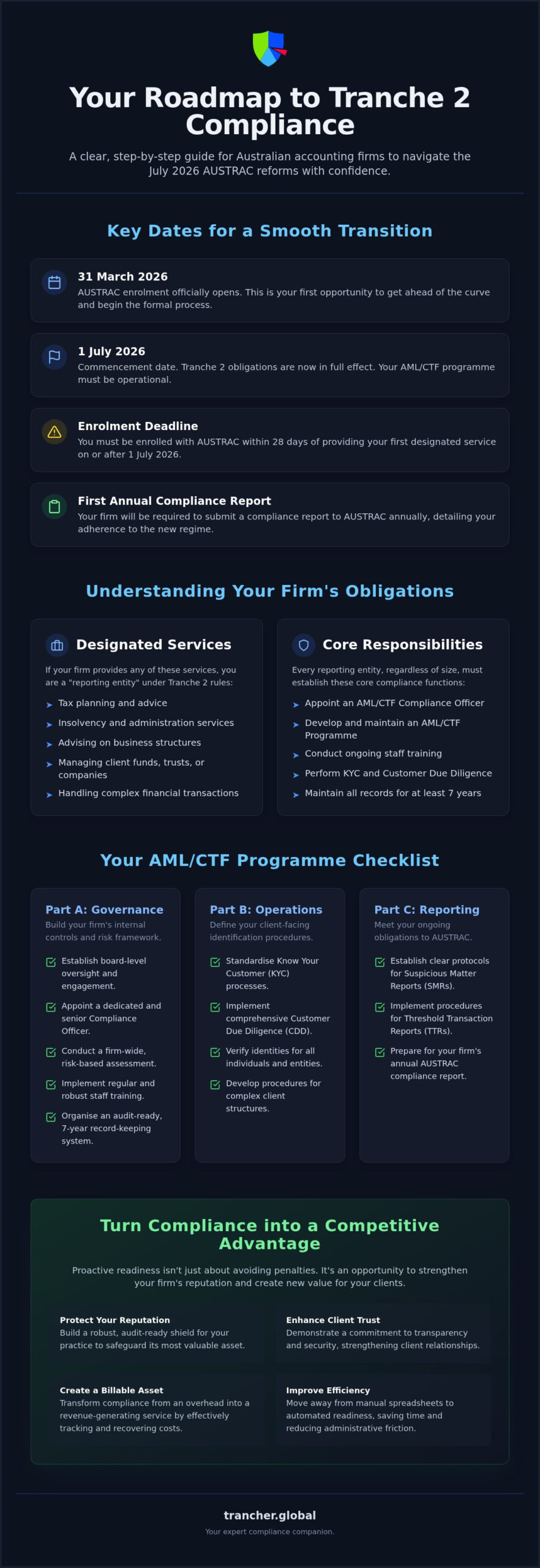
The 1 July 2026 deadline isn’t just a date on the calendar; it’s the day the Australian accounting profession enters a new era of regulatory oversight. For many practitioners, the shift toward AML/CTF compliance feels like a mountain of paperwork. However, early preparation is the difference between a panicked scramble and a smooth transition. Your Tranche 2 readiness checklist should begin with a clear understanding of what the Australian Transaction Reports and Analysis Centre (AUSTRAC) expects from your firm. Waiting until June 2026 to start your journey is a high-risk strategy that leaves your practice vulnerable to more than just administrative errors.
The core of these reforms lies in “designated services.” In an accounting context, this covers everything from tax planning and insolvency services to providing advice on business structures or managing client funds. If your firm helps a client set up a company, manage a trust, or handle complex financial transactions, you’re likely providing a designated service. Failing to prepare for these obligations carries significant risks. Beyond the threat of heavy financial penalties, the reputational damage of being linked to non-compliant activity can be terminal for a professional services firm. Moving away from manual spreadsheets to automated readiness isn’t just about saving time; it’s about building a robust, audit-ready shield for your practice.
Key Dates for the 2026 Transition
The road to compliance has several critical milestones you need to track. Enrolment with AUSTRAC officially opens on 31 March 2026. You must ensure your firm is enrolled within 28 days of providing your first designated service after the 1 July commencement date. While the new Threshold Transaction Report (TTR) and Suspicious Matter Report (SMR) forms go live on 1 July, firms that enrol early can benefit from a more structured transition period. We recommend scheduling your first internal review of your AML/CTF programme six months after commencement to catch any operational gaps before your first formal AUSTRAC annual compliance report is due.
Who is Captured Under Tranche 2?
Whether you run a large city practice or a boutique suburban firm, size doesn’t grant an exemption. If you provide any designated service, you’re classified as a “reporting entity.” This means you must appoint an AML/CTF Compliance Officer who has the seniority to manage your firm’s obligations effectively. This role is central to your governance, acting as the primary lead for the regulator and ensuring your staff are trained to spot red flags. Even if you’re a sole practitioner, you’re responsible for maintaining these standards and ensuring your record-keeping is impeccable for at least seven years.
The Governance Checklist: Building Your AML/CTF Programme
Your firm’s compliance journey begins with a robust AML/CTF Programme. This isn’t a single document, but rather a dual-structured framework consisting of Part A and Part B. Part A focuses on your internal controls, covering your risk assessment, staff training, and the ongoing monitoring of your systems. Part B addresses your client-facing obligations, specifically how you identify and verify the individuals and entities you serve. Including these components in your Tranche 2 readiness checklist ensures that your governance is both comprehensive and compliant with the Act’s specific requirements.
Establishing board-level oversight is crucial for a successful transition. Compliance shouldn’t live in a silo; it requires the active engagement of your firm’s leadership to foster a culture of transparency. This involves appointing a dedicated compliance officer who has the authority to implement changes and report directly to the partners. When your leadership team views compliance as a strategic priority, it trickles down to every level of the firm. Organising your record-keeping now is equally vital. You need to ensure that every decision, training session, and client verification is documented and retrievable. AUSTRAC expects you to maintain these records for seven years, so having audit-ready documentation support can significantly reduce the administrative burden on your team.
Designing a Risk-Based Approach
A risk-based approach allows you to focus your resources where they are needed most. You should categorise your client base into low, medium, and high-risk buckets based on factors like their industry, location, and the services they require. For example, a local retail business may be low risk; conversely, a foreign-owned entity with a complex trust structure might sit in the high-risk category. Identifying red flags, such as unusual cash transactions or clients who are reluctant to provide identification, is a core part of this methodology. Documenting your specific reasoning for these categories is essential for passing an AUSTRAC review.
Staff Training and Compliance Culture
Compliance is a team effort. Every staff member needs to understand their role in protecting the firm from financial crime. This means implementing role-based training that teaches your team how to recognise suspicious activity and when to escalate concerns. It’s not enough to run a one-off session; you must maintain a training register as evidence for future audits. When your team feels confident in identifying suspicious matters, compliance becomes a seamless part of their workflow rather than an extra hurdle. By integrating these steps into your Tranche 2 readiness checklist, you’re not just meeting a requirement; you’re building a more informed and capable workforce.
The Operational Checklist: Mastering KYC and CDD
Once your governance framework is settled, the focus shifts to daily execution. This is where your Tranche 2 readiness checklist becomes a practical tool for your frontline staff. Standardising your Know Your Customer (KYC) procedures ensures that every new client engagement begins with a clear, compliant foundation. It’s about moving beyond simple identity checks to a deeper understanding of who you’re doing business with. Implementing robust CDD and KYC requirements Australia is particularly vital when dealing with complex corporate or trust structures that are common in Australian tax and advisory work.
Screening for Politically Exposed Persons (PEPs) and international sanctions is no longer optional for accounting firms. You need a reliable system to check clients against global watchlists, ensuring you aren’t inadvertently facilitating financial crime. If a client’s risk profile escalates, your team must know when to trigger Enhanced Due Diligence (EDD). This might involve deeper investigations into a client’s background or more frequent monitoring of their transactions. Having these operational triggers clearly defined prevents small risks from becoming significant regulatory liabilities.
Verifying Trust and Company Structures
Navigating the “look-through” requirements for beneficial owners is often the most time-consuming part of onboarding. You’re required to identify the natural persons who ultimately own or control an entity; this can be challenging with multi-layered trust arrangements. Collecting evidence for the source of wealth and source of funds is equally important for high-risk clients. Automating these identity verification steps doesn’t just improve accuracy. It significantly reduces the friction for your clients, making the onboarding experience feel professional rather than intrusive.
Ongoing Risk Monitoring
Compliance isn’t a “set and forget” exercise. Using ongoing risk monitoring software allows your firm to track changes in a client’s status, such as new directorships or changes in shareholding, in real time. High-risk profiles require periodic re-verification to ensure your records remain current and accurate. By integrating these monitoring tools into your existing practice management workflow, you ensure your Tranche 2 readiness checklist remains active and effective without disrupting your core billable work.
The Reporting Checklist: Suspicious Matters and Annual Compliance
The final component of your Tranche 2 readiness checklist involves the active reporting of financial activity to the regulator. This is where your internal monitoring systems translate into regulatory transparency. Suspicious Matter Reports (SMRs) are a critical part of this. If you form a suspicion that a transaction or client interaction relates to a crime, you must lodge an SMR within three business days. For matters related to terrorism financing, this window shrinks to just 24 hours. While these timelines are tight, they’re manageable when your internal escalation processes are clear and well-documented.
Threshold Transaction Reports (TTRs) are equally vital. You’re required to report any cash transaction involving $10,000 or more within 10 business days. While most accounting firms don’t handle large volumes of physical cash, it’s essential to have a protocol in place for when these situations arise. Preparing for your first AUSTRAC annual compliance report submission should also be on your radar. This report provides a high-level summary of your compliance activity over the year. Keeping audit ready compliance records that are easily accessible will make this annual task a straightforward exercise rather than a year-end crisis.
Identifying Suspicious Activity
Spotting red flags requires a keen eye for detail and an understanding of common money laundering indicators. In the accounting sector, this might look like a client providing vague information about their business activities or insisting on using complex structures without a clear commercial purpose. It’s vital to remember the “tipping off” rule. It is a criminal offence to disclose to a client that you’ve lodged an SMR about them. This requires a careful balance in your client communications, ensuring you remain professional while upholding your legal duties.
Independent Review Preparation
Your AML/CTF programme must undergo an independent review at least every three years. An auditor will look for evidence that your programme is actually being followed, not just sitting on a shelf. They’ll check your risk assessments, staff training registers, and reporting history. Common pitfalls often involve inconsistent record-keeping or failing to update risk profiles as client circumstances change. Using automation to generate a “compliance trail” is a smart way to provide reviewers with the evidence they need. If you’re looking to streamline this process, you can automate your reporting workflows to ensure every action is logged and ready for inspection.
Achieving Compliance in 30 Days: The Trancher Roadmap
Completing your Tranche 2 readiness checklist doesn’t have to be a multi-month project that drains your firm’s resources. While the regulatory requirements are detailed, the path to meeting them is significantly shorter when you use a platform designed specifically for the Australian accounting landscape. Trancher automates the heavy lifting of your AML/CTF obligations, from the initial risk assessment to the final documentation required for an audit. This automation allows you to move from a state of uncertainty to full readiness in just 30 days, backed by our 30-day compliance guarantee. It’s a structured approach that provides peace of mind for busy partners who need to focus on their clients while ensuring their practice remains protected.
The transition to the new regime is often viewed as a sunk cost, but the right technology can change that narrative. By using compliance ROI tracking software, your firm can identify exactly how much time is spent on these essential tasks. This visibility allows you to treat compliance as a professional service rather than a hidden overhead. To help you begin this journey without immediate financial pressure, we offer a complimentary 3-month trial for accounting firms. This period gives you ample time to integrate the platform into your workflow and see the operational benefits first-hand before the 1 July 2026 deadline arrives.
From Overhead to Advisory Service
Billing for compliance is a matter of transparency and value. When you provide a secure, professional onboarding experience, clients recognise the importance of the work being done to protect their interests. You can use the data gathered during your Tranche 2 readiness checklist activities to offer higher-value advisory services, such as deeper risk analysis or business structure optimisations. This approach actively assists in reducing AML CTF compliance costs through workflow automation, ensuring that every minute your team spends on regulation is accounted for and contributes to the firm’s bottom line.
Why Local Support Matters
Navigating Australian regulations requires a partner who understands the local context. Trancher is 100% Australian-owned, providing you with direct access to local experts who can guide you through the nuances of AUSTRAC’s expectations. Our platform is designed to integrate seamlessly with your current accounting tech stack, ensuring that your data flows smoothly without the need for manual re-entry. Starting a conversation now ensures your firm is ready well before 1 July 2026. By choosing a partner that acts as an expert compliance companion, you turn a regulatory hurdle into a lasting strategic advantage.
Secure Your Firm’s Regulatory Future Today
The transition to the new AML/CTF regime represents a significant shift for Australian practitioners, but it doesn’t have to be a source of stress. By addressing your governance, operational, and reporting obligations early, you transform a complex regulatory hurdle into a streamlined, strategic asset. Your Tranche 2 readiness checklist is more than just a list of tasks; it’s a roadmap to a more resilient and modernised practice. The goal isn’t just to satisfy AUSTRAC, but to protect your firm’s reputation while creating new avenues for billable advisory work.
We’ve built our platform specifically for the needs of Australian accountants, ensuring that every feature aligns with your existing workflows. With our 30-day compliance guarantee and the ability to track billable compliance hours automatically, you can move forward with absolute confidence. Don’t let the July 2026 deadline catch you off guard. Get your firm Tranche 2 ready in 30 days with a complimentary 3-month trial of Trancher and see how easily compliance integrates into your daily operations. We’re here to guide you every step of the way toward a more secure and profitable future.
Frequently Asked Questions
What is the Tranche 2 deadline for Australian accounting firms?
The official commencement date for Tranche 2 obligations is 1 July 2026. You should also note that AUSTRAC enrolment for newly covered entities opens on 31 March 2026. Meeting these specific dates is essential for any firm providing designated services, including tax and business advisory. Starting your preparations early ensures you have a robust framework in place well before the regulator begins its first oversight cycle.
Do I need a formal AML/CTF programme if I only do basic tax returns?
Yes, providing tax services is classified as a “designated service” under the Act. Even if your practice focuses solely on basic tax returns, you’re required to develop and maintain a formal AML/CTF programme. This includes appointing a senior compliance officer and conducting regular risk assessments of your client base. It’s a universal requirement designed to ensure all gatekeeper professions maintain the same high standards of financial transparency.
How long does it take to become Tranche 2 compliant?
Achieving full compliance typically takes about 30 days when using a structured Tranche 2 readiness checklist and an automated platform. Manual implementation can often take several months of policy drafting and staff training. Our roadmap is designed to fast-track this process, allowing you to move from initial enrolment to an audit-ready state with minimal disruption to your daily client work and practice management.
Can I use manual spreadsheets for my AUSTRAC record-keeping?
While manual spreadsheets aren’t strictly prohibited, they represent a significant operational risk for AUSTRAC record-keeping. Spreadsheets lack the automated audit trails and version controls that regulators look for during an independent review. Transitioning to a dedicated digital system ensures your records are permanent, searchable, and secure for the required seven-year retention period. This level of organisation is much harder to maintain through manual entry alone.
What are the penalties for non-compliance with Tranche 2 obligations?
Non-compliance can result in severe civil penalties, which AUSTRAC scales based on the nature and duration of the breach. Beyond financial fines, your firm faces significant reputational damage and the potential for court-enforceable undertakings. Proactive compliance is the most effective way to mitigate these risks, ensuring your practice remains a trusted partner for your clients and remains in good standing with the broader financial system.
How do I identify a “beneficial owner” in a complex family trust?
Identifying a beneficial owner in a family trust involves a “look-through” process to find the natural persons who ultimately control the entity. You must identify any individual who owns or controls 25% or more of the trust. This includes trustees, certain beneficiaries, or any person who has the power to appoint or remove trustees. Verifying these individuals is a core part of your customer due diligence obligations.
What is the difference between standard and enhanced due diligence?
Standard due diligence involves verifying a client’s identity using reliable, independent documents like a passport or driver’s licence. Enhanced Due Diligence (EDD) is required when a client is identified as high-risk, such as a Politically Exposed Person. EDD requires you to take extra steps, such as verifying the client’s source of wealth and source of funds, to ensure the money involved is not linked to criminal activity.
Is there a way to charge my clients for the cost of AML compliance?
Many Australian firms are successfully recovering their compliance costs by introducing a transparent compliance or regulatory fee. You can also incorporate these activities into your high-value advisory services. By using a Tranche 2 readiness checklist that includes ROI tracking, you can accurately measure the time spent on these tasks. This allows you to bill clients fairly for the essential work performed to secure their financial transactions.