
What if the looming July 2026 deadline wasn’t a threat to your firm’s productivity, but the catalyst for your most efficient year yet? Most practitioners feel the weight of manual data collection and the pressure of avoiding AUSTRAC penalties. It’s frustrating to watch billable hours vanish into administrative tasks while trying to manage the complex CDD and KYC requirements Australia expects from the accounting sector. You deserve a process that supports your growth rather than slowing it down.
This guide provides a clear roadmap to help you master the evolving compliance landscape with confidence. You’ll learn how to turn mandatory obligations into a seamless part of your workflow while protecting your firm’s reputation. We will explore how to implement automated systems that save time, reduce client friction, and allow you to recover compliance costs through smarter billing. It’s time to move beyond simple box-ticking and transform these requirements into a strategic advantage for your practice.
Key Takeaways
- Prepare for 2026. Understand the critical regulatory changes arriving in July 2026 and how they redefine the AML/CTF landscape for Australian accounting firms.
- Master the core pillars. Implement the essential CDD and KYC requirements Australia expects, ensuring you verify client identities through reliable and independent digital sources.
- Apply a risk-based rubric. Distinguish between simplified and enhanced due diligence to streamline onboarding for your low-risk clients.
- Automate ongoing monitoring. Establish efficient cycles for re-verification to ensure your client records remain audit-ready without increasing non-billable hours.
- Maximise practice value. Discover the framework for turning mandatory compliance into a recoverable, profitable activity that supports your firm’s growth.
Navigating the 2026 AML/CTF Landscape: CDD and KYC Requirements Australia
The Australian regulatory landscape is undergoing its most significant transformation in nearly two decades. For years, the accounting profession has operated largely on the periphery of formal Anti-Money Laundering and Counter-Terrorism Financing (AML/CTF) obligations. That era is ending. Understanding the CDD and KYC requirements Australia mandates is no longer an optional exercise for the forward-thinking practitioner. It is now a core requirement for professional practice.
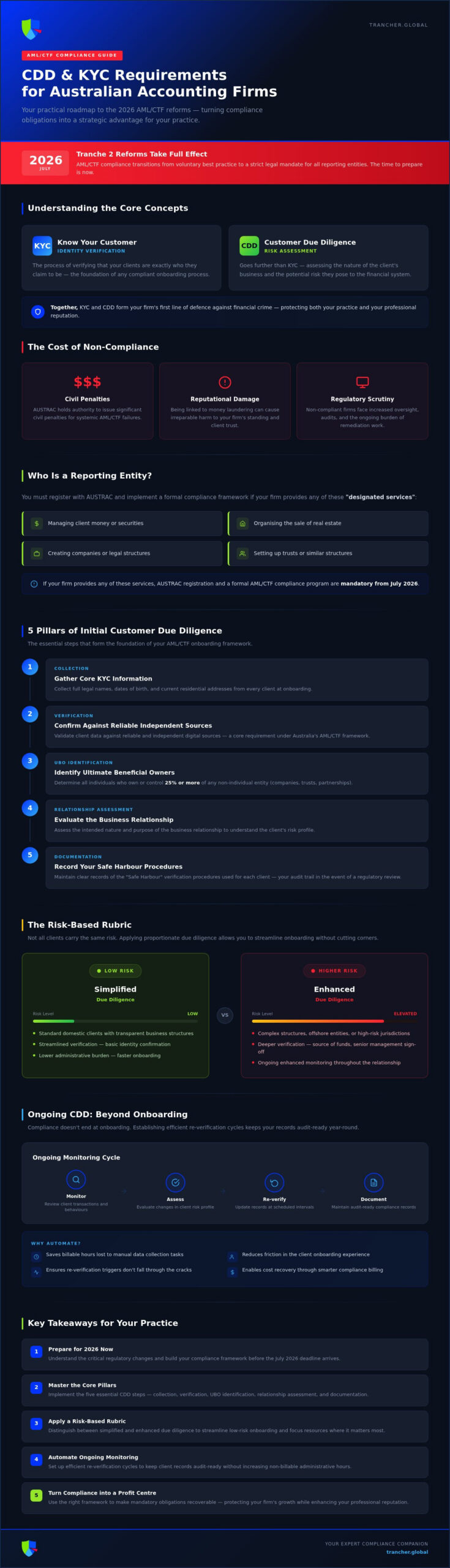
At its heart, KYC (Know Your Customer) is the process of verifying that your clients are exactly who they claim to be. CDD (Customer Due Diligence) goes a step further. It involves assessing the nature of the client’s business and the potential risk they pose to the financial system. Together, these processes act as the first line of defence against financial crime. While these obligations might feel like a new administrative weight, they are designed to protect your firm from being exploited by criminal elements. Managing these requirements effectively ensures your practice remains a trusted pillar of the Australian economy.
Non-compliance carries heavy stakes. AUSTRAC, the national regulator, has the authority to issue significant civil penalties for systemic failures. Beyond the financial impact, the reputational damage of being linked to money laundering can be irreparable. By adopting a proactive approach now, you can turn these obligations into a refined internal system that enhances your firm’s professional standing.
The Tranche 2 Deadline: Why July 2026 Matters
The Australian Government has confirmed that the “Tranche 2” reforms will take full effect in July 2026. This marks the end of the transition period where accounting firms could treat AML/CTF protocols as voluntary best practice. From this date, compliance becomes a strict legal mandate. This shift is designed to close existing gaps in the financial system that criminals often exploit. Becoming a compliance-ready firm before the deadline isn’t just about avoiding fines; it’s about ensuring your onboarding processes are modern, digital, and ready for the future of professional services.
Who is a Reporting Entity? Determining Your Obligations
You become a “reporting entity” under the AML/CTF Act if you provide specific “designated services.” In the accounting sector, this generally includes activities such as managing client money or securities, organising the sale of real estate, or creating legal structures like companies and trusts. If your firm provides any of these services, you must register with AUSTRAC and implement a formal compliance framework. A critical component of this is robust AML program design and implementation. This ensures your governance is not just a document on a shelf, but a living part of your firm’s daily operations that provides clear oversight and protection for every partner and staff member.
Initial Customer Due Diligence: The Core Pillars of KYC Verification
Translating regulatory theory into practice begins with a robust onboarding framework. For most firms, the primary challenge isn’t just knowing the rules, but applying the CDD and KYC requirements Australia mandates without creating friction for long-term clients. It’s a balance of technical precision and professional empathy that ensures your firm remains compliant while maintaining a premium client experience.
The initial verification process follows five essential pillars designed to create a clear profile of your client’s identity and risk level. These steps provide the foundation for your entire AML/CTF program:
- Collection: Gathering core KYC information including full names, dates of birth, and residential addresses.
- Verification: Confirming this data against reliable and independent sources to satisfy the CDD and KYC requirements Australia has established for reporting entities.
- UBO Identification: Determining the Ultimate Beneficial Owners who own or control 25% or more of a non-individual entity.
- Relationship Assessment: Evaluating the intended nature and purpose of the business relationship.
- Documentation: Maintaining a clear record of the “Safe Harbour” procedures used to verify the client.
Verifying Complex Entities: Trusts, Companies, and SMSFs
Accounting practices frequently deal with layered structures that require more than a simple driver’s licence check. For Australian Proprietary Companies, you must verify the company name, ACN, and director details through ASIC records. Discretionary trusts require a “look-through” approach to identify those with significant control, while SMSF verification must account for all individual or corporate trustees. This ensures you understand exactly who you’re doing business with, regardless of the entity’s complexity.
Reliable and Independent Data: Digital vs. Manual Verification
The traditional method of collecting certified paper copies is increasingly viewed as a high-friction, high-risk approach. Digital verification, powered by the Australian Government’s Document Verification Service (DVS), offers a more secure and efficient alternative. It allows you to cross-reference identity documents against government records in real-time. By leveraging automated client verification Australia, your firm can significantly reduce human error and eliminate the need for clients to visit your office with physical documents.
Adopting these digital standards doesn’t just protect your practice from fraud; it signals to your clients that you prioritize their security and time. If you’re ready to modernize your onboarding, you might consider how workflow automation can integrate these essential checks directly into your existing practice management systems.
The Risk-Based Rubric: Simplified vs. Enhanced Due Diligence
Compliance is not a one-size-fits-all exercise. AUSTRAC mandates a “risk-based approach,” which means the level of scrutiny you apply must be proportionate to the money laundering or terrorism financing risk a client poses. This flexibility is actually an advantage for your practice. It allows you to fast-track low-risk clients while dedicating your expertise to the complex cases that require a closer look. By mastering this rubric, you ensure your CDD and KYC requirements Australia protocols are both effective and efficient.
For many clients, Simplified Customer Due Diligence (SCDD) is appropriate. This applies to entities with high levels of transparency, such as Australian government bodies or companies listed on the ASX. In these instances, the verification process is streamlined because the entity’s ownership and control are already matters of public record. Recognising when you can apply simplified measures saves significant administrative time, allowing you to focus on high-value advisory work.
However, when a client profile falls outside these transparent categories, you must apply standard or enhanced measures. The goal is to build a comprehensive risk profile that protects your firm’s integrity. This involves screening for Politically Exposed Persons (PEPs) and checking names against the Department of Foreign Affairs and Trade (DFAT) Consolidated List for sanctions. These checks aren’t just about ticking boxes; they’re about ensuring your firm isn’t inadvertently facilitating financial crime.
When to Dig Deeper: Triggers for Enhanced Due Diligence
Enhanced Due Diligence (EDD) is required when you identify high-risk factors during the initial onboarding or throughout the business relationship. Common red flags in an accounting context include:
- Complex ownership structures that appear to lack a clear commercial purpose.
- Clients or beneficial owners based in high-risk foreign jurisdictions.
- Transactions or wealth levels that are inconsistent with the client’s known background.
In these cases, you must verify the “Source of Wealth” and “Source of Funds.” This means going beyond identity documents to understand how the client’s total net worth was accumulated and where the specific money for a transaction originated. If a risk is deemed too high, your AML/CTF program should have a clear escalation process for partner review.
Screening for PEPs and Sanctions in the Australian Market
PEPs are individuals who hold prominent public positions, making them higher risk for potential involvement in bribery or corruption. You must distinguish between Domestic PEPs (local politicians), Foreign PEPs (overseas officials), and International Organisation PEPs (leaders in groups like the UN). While a domestic PEP might only require standard checks if they are low risk, foreign PEPs automatically trigger EDD. Additionally, you have a strict legal obligation to screen all clients against the DFAT Consolidated List to ensure you aren’t providing services to sanctioned individuals. For high-risk clients, this screening shouldn’t be a one-off event; regular re-screening ensures you remain compliant as global circumstances change.
Ongoing CDD: Maintaining Compliance Beyond the Onboarding Horizon
Compliance isn’t a one-off event. It’s a continuous process that evolves as your client’s business grows. Once you’ve satisfied the initial CDD and KYC requirements Australia mandates, the focus shifts to Ongoing Customer Due Diligence (OCDD). This ensures your risk assessments remain accurate and your firm stays protected throughout the life of the professional engagement.
You’re required to keep KYC information up-to-date. This means establishing regular re-verification cycles based on the client’s risk profile. High-risk clients might require an annual review, while low-risk entities can be monitored on a more extended cycle. If a client undergoes a significant change, such as a new director, a shift in beneficial ownership, or a change in business activity, your records must reflect these developments promptly. This proactive approach ensures you’re never caught off guard during an independent review.
Transaction Monitoring for Accounting Firms
As an accountant, you have a unique vantage point over your clients’ financial health. While you aren’t expected to monitor every dollar like a bank, you must be alert to “Suspicious Matters” during your standard tax and advisory work. If a transaction feels inconsistent with a client’s known history or lacks a clear commercial purpose, it may trigger the need for a Suspicious Matter Report (SMR). Implementing ongoing risk monitoring software is the most reliable way for SME practices to manage this without increasing their manual workload. It allows you to flag unusual activity and file reports with AUSTRAC through a structured, confidential workflow.
Audit-Ready Record Keeping: The 7-Year Rule
The AML/CTF Act is clear about documentation standards. You must retain all identity records, risk assessments, beneficial ownership charts, and monitoring logs for seven years after the client relationship ends. Storing these in a physical filing cabinet or across disparate local drives is risky and inefficient. Transitioning to secure, cloud-based storage ensures you have audit ready compliance records that are easily accessible. This level of organisation transforms an AUSTRAC review from a stressful event into a routine demonstration of your firm’s professional standards.
If you’re looking to automate these cycles and secure your firm’s future, explore how our platform manages your ongoing obligations with ease and precision.
Transforming Compliance into a Profit Centre: The Trancher Approach
The most common objection to new regulation is that it creates a non-billable overhead. Many practitioners fear that meeting the CDD and KYC requirements Australia mandates will simply eat into their margins. We view this transition differently. By shifting your perspective, you can transform mandatory compliance from a hidden cost into a “Recoverable Compliance Activity” that strengthens your firm’s financial health.
Automation is the key to this transformation. When you replace manual data collection with a streamlined, digital workflow, you drastically reduce the cost per client onboarding. This efficiency allows you to maintain your professional standards without sacrificing your team’s capacity. The July 2026 deadline serves as a perfect catalyst to refresh your client engagement letters, clearly outlining the value of the rigorous security and verification protocols you now have in place. It’s an opportunity to signal to your clients that you’re a modern, secure, and highly professional practice.
Tracking Billable Compliance Hours and ROI
Professional expertise has value. When you perform a complex risk assessment or verify a layered trust structure, you’re providing a sophisticated service that protects the client’s interests. Trancher includes specific features designed to help you track the time spent on these “Designated Service” events. This transparency makes it easier to communicate AML fees to your clients. Most clients value security and are happy to pay a fair fee when they understand it covers the cost of keeping their data safe and their business compliant. This shift moves your firm away from absorbing administrative burdens and toward providing a premium advisory service.
30 Days to Readiness: The Trancher Guarantee
We understand that the path to 2026 can feel daunting, but you don’t have to navigate it alone. Our platform is built specifically for Australian accountants, ensuring you can meet every regulatory hurdle with confidence. We provide a structured, 30-day implementation roadmap that takes the guesswork out of your transition. To ensure the system fits your practice perfectly, we offer a 3-month complimentary trial for real-world testing. This allows you to experience the benefits of automated workflows and ROI tracking before making a long-term commitment. Don’t wait for the deadline to arrive; start your 30-day compliance journey with Trancher today and turn your regulatory obligations into a strategic asset.
Future-Proofing Your Practice for July 2026
The transition to the mandatory CDD and KYC requirements Australia expects is more than a regulatory hurdle; it’s a chance to refine your firm’s operational excellence. By moving away from manual data collection and embracing automated, risk-based verification, you’re building a more resilient and professional practice. You now have the framework to shift these requirements from a non-billable burden into a transparent, recoverable part of your service delivery.
Setting up these systems doesn’t have to be a complex or lengthy process. We’re here to guide you through every step with a 30-day compliance guarantee and built-in ROI reporting to ensure your firm remains profitable. Take advantage of our complimentary 3-month trial to test these workflows in your own environment and see how seamless compliance can truly be.
Get AUSTRAC-ready in 30 days with a complimentary Trancher trial. We’re ready to help you navigate this change with ease and turn regulatory readiness into your competitive advantage.
Frequently Asked Questions
What are the core CDD and KYC requirements for Australian accountants in 2026?
The core CDD and KYC requirements Australia mandates involve a multi-step process to verify a client’s identity and assess their risk profile. You must collect basic information like full names, dates of birth, and residential addresses, then verify these details using reliable, independent data. Additionally, you’re required to identify ultimate beneficial owners and understand the nature of the business relationship to ensure your firm isn’t used for financial crime.
How long do I need to keep KYC and CDD records under AUSTRAC rules?
You must retain all identity verification and due diligence records for seven years after your business relationship with a client ends. This rule applies to all documents collected during the initial onboarding and any records generated during ongoing monitoring. Maintaining these files in a secure, audit-ready digital format is the best way to ensure you meet this legal obligation without cluttering your physical office space.
Do I need to re-verify existing clients when Tranche 2 starts in July 2026?
Yes, once you become a reporting entity, you must apply your AML/CTF program to all clients for whom you provide designated services. While you don’t necessarily need to re-verify everyone on day one, you must have a risk-based plan to bring your existing client base up to current standards. Many firms find it’s most efficient to update these records during the next scheduled tax or advisory engagement.
What is the difference between KYC and CDD in Australia?
KYC, or Know Your Customer, refers specifically to the initial identity verification of an individual or entity. CDD, or Customer Due Diligence, is a broader term that encompasses KYC but also includes assessing the client’s risk level and identifying beneficial owners. Think of KYC as the first step of the process and CDD as the comprehensive framework that ensures you understand who you’re dealing with throughout the entire relationship.
Who is considered a Politically Exposed Person (PEP) in the Australian context?
A PEP is someone who holds a prominent public position that may increase their susceptibility to bribery or corruption. In Australia, this includes domestic politicians, foreign government officials, and leaders of international organisations. You’re also required to consider the immediate family members and close associates of these individuals, as they often fall under the same enhanced due diligence requirements.
What happens if my firm fails to meet AUSTRAC’s CDD requirements?
Failing to meet the CDD and KYC requirements Australia enforces can result in severe civil penalties and significant fines from AUSTRAC. Beyond the financial impact, your firm faces substantial reputational risks that could lead to the loss of clients and professional standing. Proactively implementing an automated compliance program is a practical way to mitigate these risks and ensure your practice remains protected.
Can I use a third party to perform KYC verification for my accounting firm?
You can certainly use third-party platforms or agents to conduct verification, but your firm remains legally responsible for the results. It’s essential to use a provider that integrates directly with reliable data sources like the Document Verification Service (DVS). Choosing a dedicated partner ensures your process is efficient and accurate while allowing you to maintain full oversight of your compliance obligations.
How do I identify the Ultimate Beneficial Owner (UBO) of a discretionary trust?
Identifying the UBO of a discretionary trust involves looking through the structure to find the individuals who exercise ultimate control. This usually includes the appointer, who has the power to remove trustees, or any individual trustee who holds significant influence. You must identify any person who owns or controls 25% or more of the entity to satisfy your due diligence obligations and ensure full transparency.