

What if the 1 July 2026 deadline wasn’t a threat to your firm’s productivity, but the catalyst for a more profitable advisory model? We know that preparing for AUSTRAC supervision can feel like an overwhelming hurdle. Many partners are currently balancing the fear of heavy penalties with the reality of mounting non-billable hours. It’s completely natural to feel some uncertainty when first assessing the obligations for Tranche 2 entities. However, this regulatory shift is a manageable transition that offers a unique opportunity to refine your internal systems and add genuine value to your client engagements.
You can turn this administrative requirement into a streamlined professional service. This guide will help you master the new rules and transform compliance from a cost centre into a defensible, revenue-generating arm of your practice. We’ll provide a clear overview of designated services, explain the new $364 penalty unit impact, and outline the steps to ensure your firm is audit-ready well before the 29 July enrolment deadline. By the end of this article, you’ll have a practical roadmap to achieve operational ease and total peace of mind.
Key Takeaways
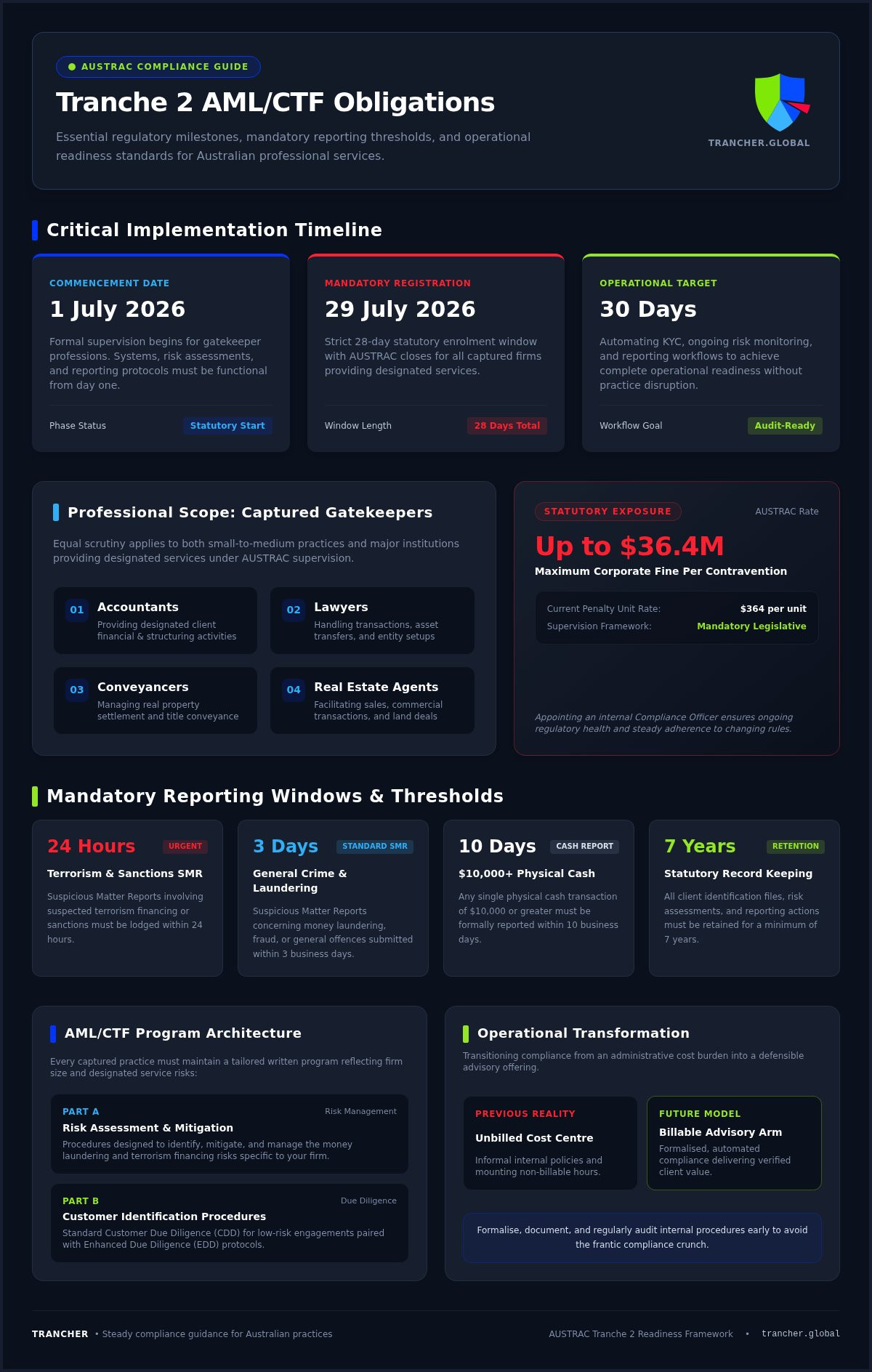
- Recognise the significance of the 1 July 2026 commencement date and the mandatory 28-day enrolment window for firms providing designated services.
- Identify exactly which activities trigger obligations for Tranche 2 entities so you can focus your compliance efforts where they are legally required.
- Shift your firm’s mindset to treat AML/CTF requirements as a billable professional service, helping you recover costs and improve internal efficiency.
- Achieve full operational readiness within 30 days by automating KYC, risk monitoring, and reporting workflows to remove administrative friction.
Understanding the Tranche 2 Regulatory Shift in 2026
The 1 July 2026 commencement date marks a definitive shift for Australian professional services. While the Anti-Money Laundering and Counter-Terrorism Financing (AML/CTF) regime has historically focused on the banking and gaming sectors, the new legislation brings “gatekeeper” professions under formal supervision. This expansion is a vital step in protecting the Australian financial system from exploitation. By closing these gaps, the Australian Transaction Reports and Analysis Centre (AUSTRAC) aims to ensure that professional services aren’t used to facilitate illicit activities. Understanding the specific obligations for Tranche 2 entities is the first step toward a successful and stress-free transition.
Moving from a voluntary ethical standard to a mandatory legislative framework requires a change in firm culture. Previously, many firms managed risk through informal internal policies. From mid-2026, these processes must be formalised, documented, and regularly audited. Starting your preparation now prevents the frantic “compliance crunch” that often occurs when major deadlines approach. Early adopters can refine their workflows at a steady pace, ensuring that new requirements don’t overwhelm their teams or disrupt client service delivery.
The 1 July 2026 Deadline: Why Timing Matters
Establishing a clear project timeline for operational readiness is essential for any SME practice. Reactive compliance often leads to rushed processes and administrative errors, which can attract unwanted regulatory attention. Proactive implementation allows you to integrate new workflows without disrupting your daily operations. AUSTRAC expects all firms to have their systems fully functional from day one. This means your risk assessments and reporting protocols must be ready to go by 1 July 2026 to meet the obligations for Tranche 2 entities without missing a beat.
Who is Impacted? The Professional Services Scope
The scope of Tranche 2 covers accountants, lawyers, conveyancers, and real estate agents who provide specific “designated services.” It’s a common misconception that smaller practices might fly under the radar. In reality, small to medium firms are under the same level of scrutiny as major financial institutions because they handle similar transaction risks. Appointing a dedicated Compliance Officer is a proactive way to manage this transition. This role ensures that your firm stays ahead of changing requirements and maintains a high standard of regulatory health, acting as a steady hand for the rest of the team.
Core AML/CTF Obligations for Tranche 2 Entities
Meeting the obligations for Tranche 2 entities involves more than just a box-ticking exercise. It requires a structured approach to risk management that protects both your firm and the broader financial system. Your first priority is enrolling with AUSTRAC. If you are providing designated services on 1 July 2026, you have 28 days to register, making 29 July 2026 your statutory deadline. Failing to enrol can lead to significant penalties, with corporate fines reaching up to $36.4 million per contravention under the current $364 penalty unit rate.
Beyond registration, you must report physical cash transactions of $10,000 or more within 10 business days. Suspicious Matter Reports (SMRs) are even more time-sensitive. You have only 24 hours to report suspicions related to terrorism financing or sanctions, and three business days for other crimes like fraud or money laundering. All these actions, including your risk assessments and client identification records, must be kept for a minimum of seven years. Reviewing AUSTRAC’s AML/CTF reform guidance is a great way to stay informed about these specific reporting windows and regulatory expectations.
The Foundation: Your AML/CTF Program
Every captured firm needs a written AML/CTF Program. This document is split into Part A, which focuses on identifying and mitigating your firm’s specific risks, and Part B, which details your customer identification procedures. It shouldn’t be a generic template. It must be tailored to your firm’s size and the nature of the services you provide. To ensure you haven’t missed a critical component, you can use an AML program checklist Australia to verify your coverage and build a defensible framework.
KYC and CDD: Knowing Your Clients
Customer Due Diligence (CDD) is your primary defence against financial crime. Standard due diligence is sufficient for most low-risk clients, but you must apply Enhanced Due Diligence when dealing with complex trust structures or politically exposed persons. Verifying beneficial ownership is particularly vital in Australia, where complex legal arrangements can obscure the true individuals in control. Integrating these CDD and KYC requirements Australia into your existing digital onboarding process ensures a frictionless experience for your clients while maintaining high standards of compliance.
Managing these moving parts doesn’t have to be a source of stress or a drain on your resources. By using automated compliance management, you can ensure every obligation is met with precision while keeping your focus on high-value client relationships.
Identifying Designated Services: Is Your Firm Captured?
Determining whether your firm is captured by the new regime requires a close look at your service menu. It isn’t about your professional title, but the specific tasks you perform for your clients. Under the Anti-Money Laundering and Counter-Terrorism Financing Act 2006, certain activities are classified as “designated services.” If your firm provides any of these, you become a reporting entity. This status brings with it the mandatory obligations for Tranche 2 entities, regardless of your firm’s total staff count. The “Geographical Link” requirement is also a key factor; if you provide these services through a permanent establishment in Australia, you’re in scope.
It’s helpful to remember that many routine accounting tasks remain outside this framework. Standard tax return preparation, basic bookkeeping, and general high-level tax advice aren’t designated services on their own. The trigger only occurs when you step into roles that facilitate transactions or legal structures. We’ve found that many firms provide a mix of captured and non-captured services, so the first step is always a clear, service-by-service assessment to ensure you’re only applying these new controls where they’re legally required.
Designated Services for Accountants and Lawyers
Many common professional functions now fall under the regulatory umbrella. Trust and Company Service Provider (TCSP) activities are a primary trigger. This includes creating companies, structuring trusts, or acting as a nominee shareholder or trustee. If your firm manages client funds, securities, or crypto assets, you’re likely providing a designated service. Real estate transactions and business buy-sell advisory are also key areas of focus. Even if you’re only planning or executing the transfer of a business entity, AUSTRAC considers this a regulated activity because it involves the movement of significant value.
The Threshold Test for SMEs
We recommend conducting a thorough audit of your service list to identify any potential triggers. It’s a frequent challenge to assume that “one-off” or “incidental” advice won’t count. Actually, providing a designated service just once is enough to capture your firm under the regime. You don’t need a high volume of transactions to be a reporting entity. For services you determine are not captured, it’s wise to document your reasoning. This creates a defensible record for your obligations for Tranche 2 entities, showing you’ve proactively assessed your position. This level of documentation provides a steady hand during any future regulatory reviews and ensures you aren’t over-complicating your standard compliance work.
Operationalising Compliance: From Administrative Burden to Billable Service
Many firms view the obligations for Tranche 2 entities as an unavoidable drain on their resources. This perspective overlooks the genuine value of the security and integrity you provide to your clients through rigorous due diligence. By shifting to a “Compliance as a Service” mindset, you can transform these administrative tasks into a billable professional offering. Clients today expect transparency and security in their financial dealings. Providing a robust, AUSTRAC-compliant onboarding process is a premium service that protects their interests and warrants professional fees. Tracking the hours your team spends on KYC and risk assessments ensures that these essential tasks are recognised as part of your firm’s value proposition rather than hidden overheads.
Communicating these costs to your clients requires confidence and clarity. When you explain that these checks are a mandatory part of the Australian financial landscape, most clients will appreciate the professional standard you maintain. Transparency regarding the time and technology required to meet these standards builds trust. It positions your firm as a steady, reliable partner that takes regulatory health seriously. Using automation to handle the heavy lifting of data entry allows you to keep these costs manageable while ensuring your team stays focused on high-level advisory work.
Transforming Costs into Recoverable Activities
Integrating compliance into your firm’s revenue model starts with your engagement letters. You can introduce clear frameworks for adding compliance line items that cover the specific costs of identity verification and risk profiling. This approach justifies the value of the secure onboarding process you maintain for every new engagement. Leveraging compliance ROI tracking software allows you to see the real numbers behind your efforts. It helps you identify exactly where time is being spent and ensures your practice remains profitable while meeting the obligations for Tranche 2 entities with precision.
Reducing Friction with Automation
The transition from manual spreadsheets to a centralised compliance hub is the most effective way to reduce operational friction. Manual background checks are not only time-consuming but also prone to human error. Implementing ongoing risk monitoring software saves hours per client by automating the screening of sanctions lists and politically exposed persons. This automated approach significantly improves the client experience by making the onboarding process faster and more professional. It removes the need for repetitive data requests, allowing you to provide a seamless service from the very first interaction.
Ready to see how your firm can turn regulatory requirements into a strategic advantage? Start your complimentary 3-month trial and begin tracking your compliance ROI today.
Achieving Operational Readiness with Trancher
Navigating the obligations for Tranche 2 entities doesn’t have to be a solo journey or a drain on your practice’s time. We’ve built Trancher specifically to help Australian SME accounting firms bridge the gap between regulatory theory and operational reality. Our platform acts as a central nervous system for your firm’s compliance, bringing together KYC, suspicious matter reporting, and staff training into one intuitive interface. With our 30-day compliance-ready guarantee, you can move from uncertainty to full AUSTRAC readiness in just one month. You’ll have access to local Australian support every step of the way, providing a steady hand as you organise your internal systems and prepare for the 1 July 2026 commencement. We’re here to ensure the transition is seamless, professional, and entirely manageable for your team.
A Complete Compliance Ecosystem
Maintaining a defensible program requires more than just onboarding checks; it demands a culture of ongoing awareness. Trancher integrates role-based staff training directly into your daily workflow, ensuring your team meets AUSTRAC standards without needing external workshops or complex scheduling. When it comes to regulatory reviews, you can generate audit-ready compliance records with a single click. This level of transparency gives you total control over your data and removes the stress of manual record-keeping. Your appointed leader can also access the compliance officer toolkit, which provides the essential resources and templates needed for daily management and long-term oversight. It’s about having everything you need in one place, ready when you are.
Start Your Conversation with Trancher
We’re committed to proving that compliance can be a profitable venture for your practice rather than a sunk cost. That’s why we offer a complimentary 3-month trial for accounting firms, which includes a formal ROI Efficiency and Profitability Report. This report helps you see exactly how much time you’re saving through automation and how much revenue you’re recovering from client verification activities. We want you to feel confident in the financial health of your compliance program before you commit. Once you’ve seen the value firsthand, you can claim a 20% discount on your first 12-month subscription following the trial. It’s a risk-free way to join a community of forward-thinking Australian firms that are already turning the obligations for Tranche 2 entities into a strategic advantage. Let’s work together to make your firm ready for 2026 and beyond.
Preparing Your Practice for a Profitable Future
The transition to AUSTRAC supervision represents a significant milestone for the Australian professional services sector. By identifying your specific designated services and integrating automated workflows, you can successfully manage the obligations for Tranche 2 entities while protecting your firm’s bottom line. Compliance is no longer a hidden overhead; it’s a valuable professional service that strengthens client trust and justifies transparent recovery of costs. Starting your journey early ensures your team is confident and your systems are audit-ready well before the July 2026 deadline.
Trancher offers a complete ecosystem designed specifically for Australian SME firms. Our AUSTRAC-aligned reporting tools and 30-day compliance-ready guarantee remove the friction from your daily operations, allowing you to focus on high-value advisory work. You don’t have to navigate these regulatory shifts alone. Our local support team acts as your steady guide, providing the tools and expertise needed for a seamless transition.
Start your complimentary 3-month trial of Trancher and be compliance-ready in 30 days.
We’re here to help you turn these new requirements into a long-term strategic advantage for your practice.
Frequently Asked Questions
What are the main obligations for Tranche 2 entities starting in 2026?
The primary requirements for Tranche 2 entities involve a structured approach to financial crime prevention. You must enrol with AUSTRAC, develop a written AML/CTF Program, and perform rigorous Customer Due Diligence (CDD). Additionally, firms are required to monitor client activity for suspicious matters and report threshold transactions of $10,000 or more. Maintaining audit-ready records for seven years is also mandatory to ensure your practice remains defensible during any future regulatory reviews.
Does my small accounting firm really need to enrol with AUSTRAC?
Yes, enrolment is mandatory if your firm provides any “designated services” as defined by the AML/CTF Act. This includes activities like setting up trusts, managing client funds, or acting as a nominee shareholder. Even if you’re a sole practitioner or a small boutique firm, providing these services just once triggers your status as a reporting entity. It’s the nature of the service, not the size of the firm, that determines your regulatory capture.
What happens if we miss the 1 July 2026 deadline?
Missing the 1 July 2026 commencement date exposes your firm to significant regulatory risk and potential civil penalties. For a body corporate, these fines can reach up to $36.4 million per contravention under current penalty unit rates. AUSTRAC prioritises enforcement for entities that fail to take active steps toward enrolment. Ensuring your systems are operational before the 29 July statutory deadline is essential to avoid formal directions or mandatory independent audits.
Can I charge my clients for the time spent on AML/CTF compliance?
You can and should charge for the professional expertise required to maintain a compliant environment. Many forward-thinking firms now include compliance line items in their engagement letters to recover the costs of identity verification and risk profiling. This shift transforms these requirements into a billable professional service. Clients generally value the added security of a robust onboarding process when the benefits of protecting their interests and financial integrity are clearly communicated.
How often do we need to conduct an AML risk assessment?
Your AML/CTF risk assessment should be a living document that’s reviewed at regular intervals or whenever your business model changes. While there’s no fixed statutory timeframe, best practice suggests an annual review or a refresh when you introduce new designated services or target different client sectors. Keeping your risk profile current ensures your internal controls remain proportional to the actual threats your firm faces, providing a steady hand for your compliance governance.
What is the difference between KYC and CDD under Tranche 2?
While often used interchangeably, Know Your Customer (KYC) is actually a subset of the broader Customer Due Diligence (CDD) process. KYC focuses specifically on verifying the identity of a client. CDD goes further by assessing the purpose of the business relationship and identifying the beneficial owners of complex structures. Under the obligations for Tranche 2 entities, you must perform both to ensure you truly understand the risks associated with every client you onboard.
How long do I need to keep compliance records in Australia?
In Australia, you’re legally required to maintain all AML/CTF records for a minimum of seven years. This includes client identification documents, transaction records, risk assessments, and evidence of staff training. These records must be stored in a way that allows them to be retrieved quickly for an AUSTRAC audit. Using a centralised digital hub ensures your documentation remains audit-ready and protected against data loss, providing long-term security for your firm’s regulatory standing.
Is there a simplified compliance program for low-risk firms?
Every firm must have a formal program, but the AML/CTF Act allows for a proportional approach. If your firm is determined to be low-risk, your program can be more streamlined than that of a major financial institution. However, it must still cover all mandatory components, including Part A (risk mitigation) and Part B (customer identification). We focus on helping SMEs build these tailored frameworks quickly, ensuring you meet all obligations for Tranche 2 entities without unnecessary complexity.