

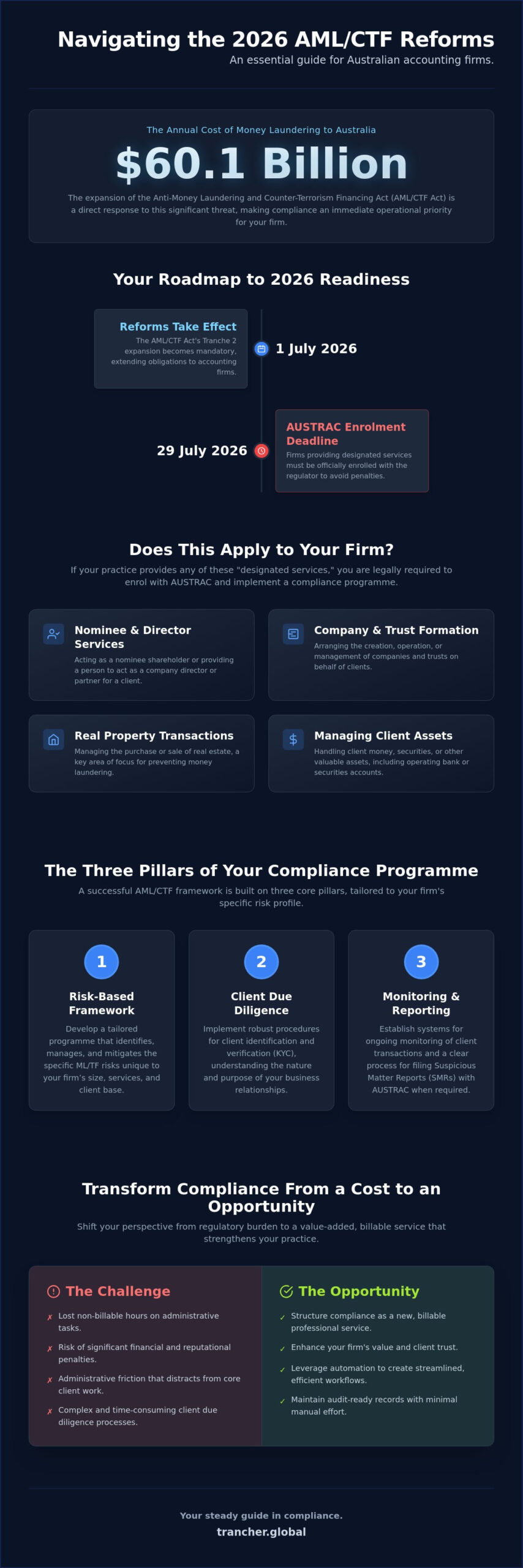
Money laundering costs the Australian community up to $60.1 billion annually, a reality that has transformed the 1 July 2026 expansion of the AML/CTF Act from a distant regulatory update into an immediate operational priority for your firm. You’re likely feeling the weight of the upcoming AUSTRAC enrolment deadline on 29 July 2026, perhaps worrying about how many non-billable hours will be lost to administrative tasks and complex client due diligence. It’s a common concern among SME partners who want to protect their practice without sacrificing their margins or risking significant penalties.
We’re here to act as your steady guide through this transition. This guide will help you master the essentials of the legislation and show you how to turn these new obligations into a streamlined, billable professional service that enhances your firm’s value. We’ll explore the specific legal triggers for accountants, provide a clear roadmap for 2026 readiness, and outline a path to making compliance both efficient and profitable for your practice.
Key Takeaways
- Identify the specific “designated services” that trigger your obligations under the aml ctf act, ensuring your firm is correctly enrolled with AUSTRAC before the July 2026 deadline.
- Master the three pillars of a risk-based compliance programme to create a tailored framework that fits your firm’s unique size and client risk profile.
- Navigate the Tranche 2 transition with a phased roadmap designed to minimise administrative friction and keep your team focused on core client work.
- Learn practical strategies to turn regulatory requirements into a billable professional service, ensuring your compliance efforts contribute to your firm’s bottom line.
- Discover how to leverage automation for client verification and ongoing monitoring to maintain audit-ready records with minimal manual effort.
What is the AML/CTF Act 2006? Understanding the 2026 Landscape
The Anti-Money Laundering and Counter-Terrorism Financing Act 2006, commonly known as the aml ctf act, serves as Australia’s primary legislative shield against financial crime. It isn’t just a set of rules; it’s a comprehensive legal framework designed to stop the flow of illicit funds that support serious organised crime and terrorism. For nearly two decades, this regime has primarily focused on the financial and gambling sectors. However, the 2026 reforms, often referred to as Tranche 2, bring a significant shift for the professional services sector.
These changes expand the definition of “reporting entities” to include gatekeeper professions, specifically accounting firms. If your practice provides certain high-risk services, you’ll soon be required to identify, manage, and mitigate money laundering and terrorism financing (ML/TF) risks. It’s a move that brings Australia into line with international standards, ensuring our financial system remains resilient against increasingly sophisticated criminal tactics.
The Role of AUSTRAC and the Home Affairs Department
The Australian Transaction Reports and Analysis Centre (AUSTRAC) is the regulator responsible for overseeing compliance. They don’t just watch from the sidelines. AUSTRAC has the power to receive reports, such as Suspicious Matter Reports (SMRs), and enforce strict penalties if firms fail to meet their obligations. While AUSTRAC handles the day-to-day regulation, the Department of Home Affairs manages the broader legislative policy and the rollout of the 2026 reforms.
It’s helpful to recognise that this hasn’t been a top-down mandate. A “co-design” approach was taken, involving industry bodies like CA ANZ and CPA Australia. This collaboration ensures the requirements are practical for the accounting profession, balancing regulatory rigour with the realities of running a modern practice. This means the rules are designed to be functional, not just theoretical.
Why the 2026 Reforms Matter for Your Practice
The deadline of 1 July 2026 marks a fundamental shift from a voluntary compliance environment to a mandatory one. For many firms, anti-money laundering checks were previously seen as “best practice” or something only required for specific high-value transactions. Under the updated aml ctf act, these obligations become a legal necessity for anyone providing “Professional Designated Services.”
Waiting until the last minute creates a risk of “regulatory lag.” This happens when firms scramble to update their systems, leading to administrative bottlenecks and potential errors. By organising your processes now, you avoid the stress of the deadline. Proactive firms are already looking at these requirements as a way to improve their internal systems. Instead of a hurdle, see this as an opportunity to strengthen your firm’s integrity and protect your reputation in an increasingly transparent global market. Early preparation ensures you remain in control of the transition.
Designated Services: Identifying Your Regulatory Triggers
Determining whether your firm falls under the aml ctf act depends entirely on the specific activities you perform for your clients rather than your job title. In the regulatory world, these activities are known as “designated services.” If your practice provides even a single designated service, you’re legally classified as a reporting entity. This classification requires you to enrol with AUSTRAC and implement a formal compliance programme. Many firms inadvertently risk non-compliance simply because they haven’t realised that their standard service offerings now act as regulatory triggers.
The master list of these triggers is found in Section 6 of The Anti-Money Laundering and Counter-Terrorism Financing Act 2006. While this list was originally designed for banks and casinos, the 2026 reforms have expanded it to capture the “gatekeeper” roles that accountants play in the financial system. It’s no longer just about high-level wealth management; it’s about the everyday corporate and trust work that forms the backbone of Australian SME accounting.
Common Accounting Activities Under the AML/CTF Act
Understanding which of your workflows are now regulated is the first step toward a calm and organised transition. Some of the most common activities that trigger obligations include:
- Nominee and Director Services: Acting as a nominee shareholder or providing a person to act as a company director or partner.
- Asset Management: Managing client money, securities, or other assets as part of your professional engagement.
- Registered Office Services: Providing a registered office or business address for a company, trust, or legal arrangement.
- Transaction Assistance: Helping a client plan or execute the purchase or sale of a business entity or real estate.
If these services are part of your firm’s DNA, you’ll need to ensure your CDD and KYC requirements Australia are fully integrated into your onboarding process. Identifying these triggers early allows you to build them into your engagement letters seamlessly.
The “Geographical Link” Requirement
The aml ctf act applies to any designated service provided at or through a permanent establishment in Australia. This means that if your firm is based in Sydney or Melbourne, the rules apply regardless of where your client is physically located. For firms that use offshore processing centres or have international client bases, this link remains critical. You must maintain the same standard of due diligence for a client in London as you would for one in Brisbane if the service is being managed by your Australian practice.
To keep your practice secure and your team focused on billable work, it’s helpful to use a platform that automatically flags these triggers during the client intake phase. You can explore how to simplify this process with end-to-end AML/CTF program management, which ensures that every new engagement is checked against the latest regulatory triggers without adding to your administrative burden.
The Three Pillars of an AML/CTF Compliance Programme
An AML/CTF programme is effectively your firm’s internal “law” for preventing financial crime. Under the aml ctf act, every reporting entity must develop and maintain a written version of this document. It isn’t a generic template you can simply download and forget. It must be risk-based, meaning it’s specifically tailored to your firm’s size, the nature of your clients, and the specific types of services you provide. This ensures your resources are focused where the risks are highest, rather than being spread thin across low-risk activities.
The framework is structured into two distinct parts. Part A focuses on your practice-wide procedures, including how you identify and manage money laundering and terrorism financing risks across the firm. Part B is more granular, detailing the specific processes for customer identification and verification. Together, these pillars provide a clear roadmap for your team, ensuring everyone knows their role in protecting the practice from illicit activity.
Risk Assessment and AML/CTF Policies (Sections 26C and 26F)
You can’t manage a risk you haven’t identified. Sections 26C and 26F of the Act require you to conduct a formal ML/TF risk assessment. This involves looking closely at your delivery channels, such as whether you meet clients face-to-face or digitally, and the jurisdictions where your clients operate. Once these risks are mapped, you’ll need to develop robust policies that guide your staff through their daily compliance tasks.
It’s important to remember that compliance isn’t just an administrative task for the front office. Section 26H emphasises the necessity of “governing body” oversight. This means Partners and Directors must be actively involved in approving and reviewing the programme. Having this high-level support ensures that a culture of compliance is embedded throughout the firm, making the transition to mandatory reporting much smoother for everyone involved.
Customer Due Diligence (KYC) and Ongoing Monitoring
Knowing your client is the heart of any effective programme. For most standard engagements, standard Customer Due Diligence (CDD) will suffice. However, if you encounter high-risk clients or Politically Exposed Persons (PEPs), the Act requires you to perform Enhanced Due Diligence (EDD). This isn’t a one-off task completed at onboarding. You’re required to keep this information updated through ongoing risk monitoring software to track any significant changes in a client’s risk profile or behaviour over time.
Record-keeping is the final, vital component of this pillar. You must store all compliance data and customer identification records for seven years. This ensures that your firm remains audit-ready and can demonstrate its history of due diligence if requested by the regulator. By automating these records, you ensure that your compliance history is always organised and accessible, without taking up valuable physical or digital storage space in an unmanaged way.
Navigating the July 2026 Tranche 2 Transition
The countdown to 1 July 2026 is a significant milestone for the Australian accounting profession. Transitioning your firm to full compliance under the aml ctf act shouldn’t be a source of anxiety. It’s a process that benefits from a phased approach to avoid operational friction and ensure your team remains focused on high-value client work. One of the most notable changes in the 2026 amendments is the introduction of new powers for the AUSTRAC CEO. These powers allow for the prohibition of specific high-risk delivery channels, making it essential for firms to have a clear, documented view of how they onboard and interact with every client.
To meet these evolving standards, your practice must move beyond manual spreadsheets and fragmented email chains. Relying on paper-based systems or basic digital folders creates gaps that are difficult to defend during a regulatory review. Transitioning to a unified digital environment ensures you maintain audit-ready compliance records that stay updated in real time. This shift protects your practice from administrative errors and provides peace of mind for your partners and staff alike.
Reporting Obligations: SMRs, TTRs, and Annual Reports
Your firm’s daily workflows will now involve specific reporting triggers that help AUSTRAC combat financial crime. Suspicious Matter Reports (SMRs) are required when you have a reasonable suspicion that a transaction or client interaction is linked to illicit activity. It’s often a gut feeling backed by evidence, such as unusual complexity in a simple tax structure or a client’s reluctance to provide identification. Additionally, Threshold Transaction Reports (TTRs) must be filed for any physical cash payments of $10,000 or more. Finally, you’ll need to submit the AUSTRAC Annual Compliance Report, which acts as a mandatory yearly summary of your programme’s health and effectiveness.
A 5-Step Roadmap to 2026 Readiness
Preparing your practice for the July deadline is a manageable task when broken down into clear, actionable steps. We suggest following this roadmap to ensure your systems are integrated and your team is ready well before the commencement date:
- 1. Audit your services: Review your current offerings against the Section 6 “Designated Services” list to identify your specific triggers.
- 2. Appoint a Compliance Officer: In SME firms, this is typically a Partner who oversees the programme’s integrity and acts as the primary contact for AUSTRAC.
- 3. Automate your KYC: Implement a digital solution for client verification and screening to remove manual bottlenecks from your onboarding process.
- 4. Train your team: Ensure all staff members can identify “red flags” and understand their reporting obligations during standard tax and advisory work.
- 5. Formalise your documents: Complete your written AML/CTF Programme and formal Risk Assessment to reflect your firm’s specific risk profile.
If you’re looking to simplify this transition, you can secure your firm’s future and achieve 30-day readiness with end-to-end AML/CTF program management today.
Transforming Compliance from a Burden to a Billable Service
Viewing the aml ctf act as a purely administrative burden is a missed opportunity for the modern Australian practice. While the initial focus often lands on the complexity of the requirements, it’s vital to recognise that the legislation does not prohibit firms from recovering the costs associated with mandatory compliance. In fact, when implemented correctly, these processes provide a new layer of security and transparency that many clients value. By moving beyond manual checks, your firm can achieve a significant AML CTF compliance costs reduction while maintaining the high standards AUSTRAC expects.
Modern compliance is, at its heart, an advisory opportunity. The deep insights gained during the enhanced due diligence process allow you to help your clients understand their own risks, particularly in complex corporate structures or international dealings. It transforms a “tick-box” exercise into a high-value service that protects both your firm and the client’s business interests. Trancher provides the necessary framework to track these activities, ensuring they are recorded as recoverable professional services rather than lost administrative hours.
The Trancher Advantage: 30 Days to Compliance
We’ve designed Trancher to automate the end-to-end AML/CTF workflow specifically for the nuances of Australian accounting. Our platform removes the friction of manual setup, allowing you to reach full AUSTRAC readiness through our 30-Day Guarantee. Instead of spending months building policies from scratch, you can deploy a pre-configured system that integrates directly into your existing practice management stack. This seamless integration ensures that compliance checks become a natural, automated part of your client onboarding rather than a separate, disruptive event.
Recovering Costs and Generating ROI
To ensure your compliance efforts contribute to your firm’s financial health, it’s essential to identify and log every hour spent on these mandatory tasks. Using compliance ROI tracking software allows you to turn regulatory obligations into billable assets with precision. We provide professional templates to help you communicate this value to your clients, explaining why these procedures are a legal necessity that ensures the integrity of their financial affairs.
We want you to feel completely confident in this new workflow before you commit. That’s why we offer a complimentary 3-month trial, giving you ample time to prove the efficiency of the platform and see the ROI first-hand. It’s a proactive way to ensure your firm is ready for the 1 July 2026 deadline without any upfront financial pressure.
Securing Your Firm’s Future for July 2026
The transition to the expanded aml ctf act is more than a regulatory hurdle; it’s a strategic opportunity to refine your internal systems and add a new layer of professional value to your client relationships. By identifying your specific service triggers and automating the three pillars of compliance, you ensure your practice remains protected and productive. This journey doesn’t have to be a solo effort or a drain on your firm’s resources. Proactive preparation allows you to stay ahead of the curve and maintain your focus on high-value advisory work.
Trancher acts as your expert companion throughout this process. Our platform is designed by Australian compliance specialists specifically to help SME firms achieve AUSTRAC-ready status in just 30 days. We’ve built the framework so you can focus on your clients while we handle the administrative heavy lifting. You can start your complimentary 3-month Trancher trial today to experience this efficiency firsthand, and trial participants will also receive a 20% discount. We’re here to help you turn these new obligations into a streamlined, billable asset that supports your firm’s growth. Let’s make 2026 your most organised year yet.
Frequently Asked Questions
Who is regulated by the AML/CTF Act in Australia?
Any business providing a “designated service” as defined in the aml ctf act is regulated. From 1 July 2026, this includes “gatekeeper” professions like accountants, lawyers, and real estate agents. If your firm assists with company formation, manages client assets, or provides registered office addresses, you’re likely a reporting entity. It’s the activity you perform that determines your status, ensuring the regime captures all points of potential financial risk.
What are the penalties for non-compliance with the AML/CTF Act?
Non-compliance can lead to significant civil penalties and reputational damage. AUSTRAC has the power to apply for court-ordered fines, which for corporate entities can reach millions of dollars. Beyond financial costs, the regulator may issue infringement notices or enforceable undertakings. These require your firm to overhaul its systems under strict supervision, often leading to increased administrative costs and a loss of client trust during the remediation period.
Do small accounting firms really need an AML/CTF programme?
Yes, if your firm provides even one designated service, you’re legally required to have a written AML/CTF programme. The regulation is risk-based, so a small firm’s programme will be much simpler than a large bank’s framework. It must be tailored to your specific client base and service offerings. This ensures you have a steady hand on your firm’s unique risk profile while meeting your legal obligations without unnecessary complexity.
What is a “designated service” under the 2026 reforms?
A designated service is a specific business activity that triggers your obligations under the aml ctf act. For accountants, this typically includes acting as a nominee shareholder, managing client money, or providing registered office addresses. It also covers assisting with the purchase or sale of real estate or business entities. The focus remains on the nature of the service provided rather than your professional title, ensuring all high-risk financial gateways are monitored.
How long do I need to keep AML compliance records?
You must keep all relevant compliance records for a period of seven years. This includes customer identification documents, risk assessments, and any reports submitted to AUSTRAC. Maintaining these records in an organised, digital format ensures your practice is always audit-ready. If the regulator requests information regarding a past transaction, you must be able to produce these documents quickly to demonstrate your firm’s history of due diligence and compliance.
What is the difference between Tranche 1 and Tranche 2?
Tranche 1 refers to the original group of reporting entities, such as banks and casinos, regulated since 2006. Tranche 2 refers to the 2026 expansion that brings accountants, lawyers, and real estate agents into the regime. These professions are now recognised as vital gatekeepers. The shift ensures that Australia meets international standards, closing gaps that criminals previously exploited to move illicit funds through professional services and the property market.
Can I use manual spreadsheets to manage my AML obligations?
While the law doesn’t explicitly ban spreadsheets, relying on manual processes is risky and inefficient for modern practices. Spreadsheets lack the automated screening and version control required to manage ongoing risk monitoring effectively. Using a dedicated digital platform ensures your records are centralised and secure. This approach saves your team significant non-billable hours and provides the peace of mind that your data is accurate and ready for any future AUSTRAC review.
How do I enrol my firm with AUSTRAC?
You can enrol your firm through the AUSTRAC Online portal. For firms newly regulated under the Tranche 2 reforms, the enrolment deadline is 29 July 2026. You’ll need to provide business details, identify your designated services, and nominate a compliance officer. Once enrolled, you’ll receive a unique ID for all future reporting. Completing this early ensures you’re ready for the 1 July commencement date and avoids any last-minute administrative stress.