

What if the July 2026 deadline wasn’t a source of administrative dread, but the exact moment your practice finally achieved seamless, automated client onboarding? You’ve likely felt the pressure of the upcoming Tranche 2 reforms, searching for a reliable kyc verification checklist australia to balance rigorous compliance against a friction-free client experience. We understand the concern that manual verification might lead to an overwhelming paperwork burden or leave your firm vulnerable to significant AUSTRAC penalties.
This guide provides the definitive framework you need to turn regulatory obligations into a repeatable, audit-ready process. We’ll help you master your requirements with confidence, ensuring your firm is fully prepared well before the 1 July 2026 commencement date. We’ll explore the essential documentation for diverse client structures, practical risk-based assessment strategies, and the automation tools that make compliance a strategic advantage. By the end of this article, you’ll have a clear roadmap to navigate these changes with ease and professional poise.
Key Takeaways
- Understand how the July 2026 Tranche 2 reforms expand AUSTRAC obligations to include all Australian accounting practices.
- Access a comprehensive kyc verification checklist australia covering essential identity documents for individuals, companies, and complex trust structures.
- Learn the precise requirements for identifying beneficial owners under the 25% rule and managing high-risk profiles such as Politically Exposed Persons (PEPs).
- Discover how to integrate biometric verification and digital onboarding to eliminate manual administrative burdens and reduce client friction.
- Ensure your firm is audit-ready and compliant within 30 days while transforming regulatory obligations into a scalable, billable service.
Mastering KYC Verification in Australia: Why 2026 Changes Everything
KYC isn’t just a box to tick; it’s the first line of defence for your practice. Standing for Know Your Customer, it’s a core component of the Anti-Money Laundering and Counter-Terrorism Financing (AML/CTF) Act 2006. While based on global KYC principles, the Australian application is becoming increasingly specific for the accounting sector. By verifying the identity of your clients, you aren’t just following the law. You’re protecting your firm from becoming an unwitting conduit for financial crime.
The regulatory landscape shifts significantly on 1 July 2026. This marks the commencement of the “Tranche 2” reforms, which extend full AML/CTF obligations to accountants, lawyers, and real estate agents. By 29 July 2026, all newly regulated entities must be enrolled with AUSTRAC. This transition moves KYC from a “best practice” suggestion to a mandatory requirement for many of your daily activities. It’s a significant change, but with the right kyc verification checklist australia, it’s a manageable one.
Ignoring these changes carries heavy consequences. Beyond the threat of civil penalties, which can reach tens of millions of dollars for serious breaches, firms face the granular disruption of AUSTRAC audits. A single compliance failure can lead to lasting reputational damage, making it harder to attract high-value clients who prioritise security and professionalism. We see these reforms not as a hurdle, but as an opportunity to modernise your client relationships.
AUSTRAC expects a “risk-based approach.” This means your verification process shouldn’t be a rigid, one-size-fits-all barrier. Instead, your kyc verification checklist australia should scale based on the specific risk a client presents. A long-standing local individual requires different scrutiny than a complex foreign trust or a company with a web of overseas beneficial owners. It’s about applying the right level of due diligence to the right risk profile, ensuring safety without sacrificing the client experience.
What are Designated Services for Accountants?
Not every tax return triggers these rules. Obligations apply when you provide “designated services.” This includes acting as a formation agent for trusts or companies, managing client funds, or facilitating real estate transactions. You must trigger your checklist at the “point of engagement,” before the service is provided. This ensures you’ve verified the client before any financial activity occurs, distinguishing high-risk advisory work from standard compliance tasks.
The Cost of Manual Compliance
Many firms struggle with the “admin heavy” nature of manual document collection. Chasing scanned passports and utility bills via email is slow, insecure, and prone to error. Fragmented processes often result in inconsistent records that fail an audit. Instead of viewing this as a lost overhead, savvy firms use compliance ROI tracking software to turn these administrative hurdles into transparent, billable assets that prove your firm’s value.
The Essential KYC Checklist for Individuals and Entities
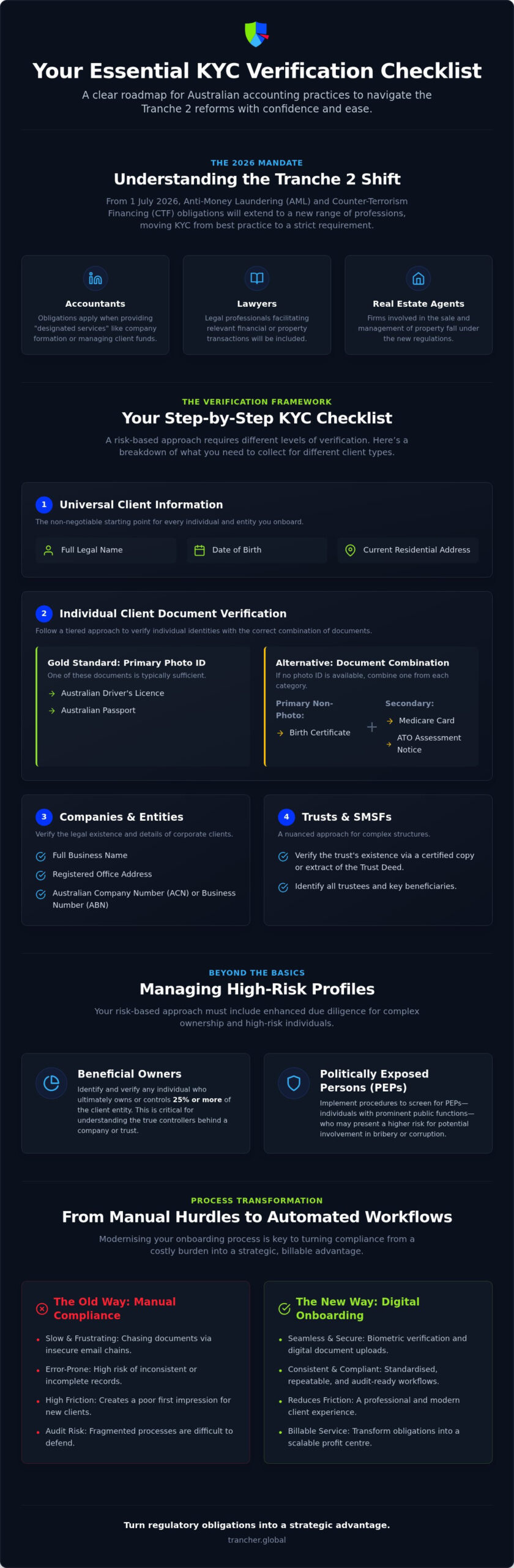
Building a reliable kyc verification checklist australia starts with capturing high-quality, standardised data. Every client, regardless of their structure, requires three non-negotiable data points: their full legal name, date of birth, and current residential address. For entities, this extends to the full business name, registered office address, and unique identifiers like an ACN or ABN. Accuracy at this stage is vital. It prevents downstream errors and ensures your screening processes remain effective.
Verification requirements vary based on the document type. Primary photographic identification, such as a current Australian Driver’s Licence or an Australian Passport, is the gold standard because it confirms both identity and appearance. If these aren’t available, you must pivot to a combination of primary non-photographic documents, like a birth certificate, and secondary documents, such as a Medicare card or a recent ATO assessment notice. This tiered approach ensures you can verify almost any client while remaining compliant.
Complex structures like Discretionary Trusts and Self-Managed Super Funds (SMSFs) require a more nuanced approach than a simple company. You must verify the trust’s existence through a certified copy or extract of the trust deed. This allows you to identify the trustees and the class of beneficiaries. Many generic checklists fail here, leaving firms exposed to significant regulatory gaps. We recommend treating these structures with the same rigour as corporate entities to maintain a consistent compliance standard.
Individual Client Verification Checklist
For individuals, your focus is on the “safe harbour” procedure. This procedure is a prescribed set of steps that provides your practice with regulatory certainty that you have met your identity verification obligations. You should prioritise:
- Primary Photo ID: Australian Passport (current or expired within 2 years) or a current Driver’s Licence.
- Secondary ID: Medicare card or utility bills less than 3 months old.
- Digital Links: Confirmation that the document matches the person presenting it.
Entity and Company Verification (KYB)
Verifying a company involves more than just recording an ABN. You must perform an ASIC search to obtain a current company extract, which confirms the registered office and the names of all directors. This process helps you identify the “Mind and Management” of the business, ensuring you know exactly who is making the strategic decisions. For more complex corporate groups, following established CDD and KYC requirements Australia is the best way to ensure no subsidiary or parent company is overlooked. If your current process feels heavy, you might consider how Trancher can automate these searches for you.
Beyond the Basics: Managing Beneficial Owners and High-Risk Profiles
Once you’ve verified an entity’s legal existence, the next critical phase of your kyc verification checklist australia involves identifying the natural persons who truly pull the strings. This is known as identifying Ultimate Beneficial Owners (UBOs). Under the AML/CTF Act, you’re required to identify any individual who owns or controls 25% or more of a business. It’s a step that moves your practice beyond simple data collection and into the territory of genuine risk management, ensuring you aren’t inadvertently facilitating business for masked interests.
High-risk profiles require a more sophisticated level of scrutiny known as Enhanced Due Diligence (EDD). This process is mandatory when you encounter Politically Exposed Persons (PEPs) or when a client’s risk rating is elevated due to their industry or location. In these instances, simply verifying an ID isn’t enough. You must investigate the “Source of Funds” and “Source of Wealth” to ensure the money entering your ecosystem is legitimate. While this sounds intensive, it’s a vital safeguard that protects your firm’s integrity and professional standing.
Sanctions screening adds another layer of security to your onboarding process. You must cross-reference every client against the Australian Sanctions Consolidated List and other global prohibited lists. This ensures you aren’t providing services to individuals or entities subject to international restrictions. By integrating these checks into your standard workflow, you transform a complex legal requirement into a reliable safety net for your practice’s daily operations.
Identifying Ultimate Beneficial Owners (UBOs)
Tracing UBOs often requires looking through multiple layers of holding companies or trust structures to find the individual at the top. In a trust environment, your focus should be on the trustees, but also the appointors and protectors who have the power to change those trustees. Even if an individual’s ownership falls below the 25% threshold, you must document them if they exercise significant control over the entity’s financial and operating policies. This level of detail is what makes your compliance program truly audit-ready for AUSTRAC.
PEPs and Sanctions Screening Workflows
Manual checks against global lists are notoriously inefficient and prone to human error. Relying on quarterly manual reviews leaves a significant window of risk between checks. The most effective firms use automation to perform daily screening, which silently monitors your entire client base for changes in PEP status or new sanction listings. Implementing ongoing risk monitoring software allows you to manage “false positives” quickly without bothering your clients, ensuring your compliance remains robust without creating unnecessary friction in the relationship.
From Manual Hurdles to Automated Workflows: Implementing Your Checklist
Transitioning your practice to meet the July 2026 standards doesn’t have to mean hiring more administrative staff. It’s about moving from a paper-based mindset to a digital-first workflow. By embedding your kyc verification checklist australia directly into your digital engagement letters, you ensure compliance happens at the exact moment a client decides to work with you. This proactive approach removes the need for awkward follow-up emails and keeps your onboarding momentum high. It turns a regulatory hurdle into a seamless part of your professional service.
Biometric verification is the key to modernising this process. Instead of asking a client to find a Justice of the Peace to certify a passport copy, you can use “link to person” technology. A simple smartphone “selfie” matched against a digital scan of their ID provides a higher level of security than a physical sighting ever could. This isn’t just about speed; it’s about providing a superior, secure experience that reflects the professional standard of your firm. It protects both your practice and your clients from identity fraud.
True efficiency comes when you automate the heavy lifting of data retrieval. Your workflow should automatically pull current ASIC company extracts and ABN details the moment an entity name is entered. This data then populates your audit-ready compliance records, creating a single source of truth. When everything is centralised, you’re not just compliant; you’re prepared for any AUSTRAC inquiry with total confidence. We believe that an organised firm is a profitable firm, and automation is the bridge to that reality.
Reducing Client Friction
Client onboarding should be a celebration of a new partnership, not an interrogation. Using “selfie” tech replaces the need for certified paper copies, allowing clients to complete their verification in seconds from their own lounge room. You can further reduce friction by pre-filling forms with known data, which saves the client time and significantly improves your conversion rates. When clients ask why this is necessary, frame it as a security benefit that protects their financial identity. This builds trust from day one.
Audit Readiness and Record Keeping
AUSTRAC requires you to keep all KYC and transaction records for seven years. This isn’t just a suggestion; it’s a core legal obligation that often trips up firms during an inspection. You should organise your files so they are “inspection-ready” in under five minutes, with every verification step time-stamped and linked to the relevant staff member. Don’t forget to link your staff training records to your KYC workflows. This proves to regulators that your team isn’t just following a checklist, but understands the logic behind it. If you’re ready to see how this looks in practice, you can start your 3-month complimentary trial with Trancher today.
Trancher: Transforming Your Compliance Checklist into a Profit Centre
Trancher isn’t just another software tool; it’s a dedicated partner designed to help you navigate the complexities of the 2026 reforms with absolute certainty. While many platforms offer generic identity checks, Trancher automates the specific requirements of the kyc verification checklist australia within a single, unified environment. We’ve built this system to handle the unique nuances of Australian accounting, from complex discretionary trusts to the specific reporting obligations required by AUSTRAC. This means your team spends less time on manual data entry and more time on the high-value advisory work that defines your firm.
We believe that compliance should be a driver of growth, not a drain on your internal resources. By automating activity tracking, Trancher captures every minute spent on verification, screening, and due diligence. This allows you to turn what was previously “dead time” into transparent, billable activity. It’s about shifting the narrative from a cost of doing business to a professional service that adds tangible value to your clients’ security. Leading Australian firms are already choosing this local expertise over generic, overseas tools that don’t understand our specific regulatory climate.
The 30-Day Compliance Guarantee
We understand that the lead-up to July 2026 can feel daunting for SME accounting practices. To alleviate this stress, we offer a 30-day compliance-ready guarantee. Our structured onboarding process is led by Aaron Soh and our local Australian team, who provide hands-on support to ensure your systems are fully aligned with the new regulations. We remove the guesswork by providing the templates, workflows, and training your staff need to feel confident from day one. You aren’t just buying software; you’re gaining a steady hand to guide your practice through this transition.
Maximising Your ROI
Achieving a genuine return on your compliance investment is a core part of the Trancher philosophy. Our platform generates detailed ROI reports that identify recoverable hours, allowing you to bill for AML compliance effectively and fairly. This transparency builds trust with your clients, as they can see the rigorous security measures you’re taking on their behalf. To help you get started without any entry friction, we’re offering a complimentary 3-month trial and a 20% subscription discount for early adopters. It’s time to stop viewing your kyc verification checklist australia as a burden and start seeing it as the foundation of a modern, resilient practice.
Securing Your Firm’s Future Readiness
The transition to the 2026 regulatory environment is a significant milestone for the Australian accounting profession. It’s an opportunity to modernise your internal systems and strengthen client trust. By adopting a robust kyc verification checklist australia, you aren’t just avoiding AUSTRAC penalties; you’re building a more efficient, tech-forward practice. We’ve explored how identifying beneficial owners and automating document collection can remove the administrative weight from your team’s shoulders, turning a complex requirement into a streamlined workflow.
Now is the time to move from preparation to action. Our local Australian experts are ready to provide the steady guidance you need to navigate the Tranche 2 journey with confidence. You can achieve full AML/CTF compliance within 30 days while enjoying the peace of mind that comes with audit-ready documentation. It’s a manageable transition when you have the right partner by your side.
Start your complimentary 3-month Trancher trial and get AUSTRAC-ready in 30 days to secure a 20% discount for all trial participants. We’re here to help you transform these obligations into a strategic advantage for your firm’s growth.
Frequently Asked Questions
What is the minimum KYC information required for an individual in Australia?
You must collect and verify a client’s full legal name, date of birth, and current residential address. These three data points form the foundation of any kyc verification checklist australia. To satisfy AUSTRAC, these details are typically confirmed using primary photographic identification, such as a driver’s licence or passport, which provides a high level of assurance regarding the person’s identity.
Do I need to verify the identity of all directors of a company?
You are required to identify all directors, but you only need to verify those who exercise significant control over the company. This is part of identifying the “Mind and Management” of the entity. While your records should list every director’s name as per the ASIC extract, your verification efforts should focus on the individuals who have the authority to make strategic and financial decisions.
How often should I re-verify my existing accounting clients?
Re-verification should be triggered by a change in a client’s risk profile or at intervals determined by your risk-based approach. High-risk clients typically require an annual review, while lower-risk clients might only be reviewed every three to five years. Regular ongoing monitoring is the most effective way to ensure your client data remains accurate without creating constant administrative friction.
Can I rely on KYC performed by another accountant or lawyer?
Yes, you can rely on verification performed by another reporting entity, but you remain legally responsible for any compliance failures. This “third-party reliance” requires a formal written agreement and a high degree of confidence in the other party’s processes. Most Australian firms prefer to use their own automated systems to ensure they have direct control over their audit-ready documentation.
What happens if a client refuses to provide KYC documentation?
You must not provide a designated service if you cannot complete the required identity verification. The AML/CTF Act is very clear that providing services without proper KYC is a serious breach of your professional and legal obligations. It’s best to explain the regulatory necessity to the client early in the engagement; if they still refuse, you should politely decline the work.
Is biometric ‘selfie’ verification legally acceptable to AUSTRAC?
Biometric verification is a legally acceptable and highly recommended method for confirming a “link to person” remotely. AUSTRAC supports the use of digital technology that matches a live person’s image to their government-issued ID. This method often provides a more robust audit trail than manual document sighting and is a core feature of a modern kyc verification checklist australia.
What are the record-keeping requirements for KYC in Australia?
You are legally required to store all KYC and transaction records for a minimum of seven years. These records must be kept in a format that allows them to be retrieved and presented to AUSTRAC quickly during an inspection. Centralising these files in a secure, digital environment ensures your practice remains organised and audit-ready without the need for physical storage space.
Does the July 2026 Tranche 2 deadline apply to sole practitioners?
The July 2026 deadline applies to all accounting practices that provide designated services, including sole practitioners. If you act as a formation agent for companies, manage client funds, or provide certain advisory services, you must be enrolled with AUSTRAC by 29 July 2026. Size doesn’t exempt you from these obligations, so it’s vital to have your compliance program ready well in advance.