

For years, Australian accounting firms have viewed compliance as a necessary drain on resources, but in 2026, the right technology is turning that burden into a billable asset. You likely feel the pressure of the now-active Tranche 2 reforms and the constant administrative weight of maintaining an impeccable program. Finding a robust AML CTF risk assessment tool Australia firms can trust is no longer just about avoiding AUSTRAC penalties. It’s about reclaiming your time and protecting your firm’s long-term profitability.
We understand that manual risk ratings and inconsistent workflows create unnecessary friction in your daily operations. This guide provides a clear roadmap to selecting a solution that ensures you’re audit-ready within 30 days while providing the billable evidence needed to offset your overheads. We’ll examine how automated workflows and professional ROI tracking can shift compliance from a hidden cost to a transparent, value-added service for your clients. By the end of this guide, you’ll know exactly how to transform regulatory obligations into a strategic advantage for your practice.
Key Takeaways
- Understand why 2026 is a pivotal year for Australian accounting firms under the Tranche 2 reforms and how to maintain total AUSTRAC readiness.
- Learn to identify the essential features of an AML CTF risk assessment tool Australia professionals use to automate KYC data and dynamic risk scoring.
- Discover the hidden costs of manual spreadsheets and why a living, automated system is necessary for modern practice management and audit peace of mind.
- Shift your perspective on compliance by using ROI tracking and billable activity evidence to transform non-billable overheads into a professional service.
- Achieve full compliance within 30 days by partnering with an expert companion that prioritises the specific operational needs of Australian SME firms.
Understanding the AML CTF Risk Assessment Landscape in 2026
An AML/CTF risk assessment is more than a simple checklist; it’s a documented process designed to identify, manage, and mitigate money laundering and terrorism financing threats specific to your practice. By pinpointing where your firm is most vulnerable, you can direct your resources effectively and protect your reputation. This process forms the bedrock of your entire compliance program.
The year 2026 marks a historic shift for the Australian professional services sector. With the Tranche 2 reforms fully operational as of 1 July 2026, accountants and other “gatekeeper” professions are now under the direct supervision of AUSTRAC. This isn’t a transition period anymore. It’s a period of active enforcement. To meet these standards, most firms have moved away from manual checks toward a dedicated Anti-money laundering (AML) software solution to ensure accuracy and consistency.
You must distinguish between your firm-wide risk assessment and individual client risk assessments. The firm-wide assessment examines your overall service offerings, delivery channels, and geographic reach. In contrast, client-level assessments focus on the specific risks posed by the person or entity across the desk from you. AUSTRAC now demands documented evidence of these assessments rather than a simple “best effort” verbal assurance. Using a specialised AML CTF risk assessment tool Australia provides the digital audit trail necessary to prove your due diligence occurred in real-time.
The Core Components: Inherent vs Residual Risk
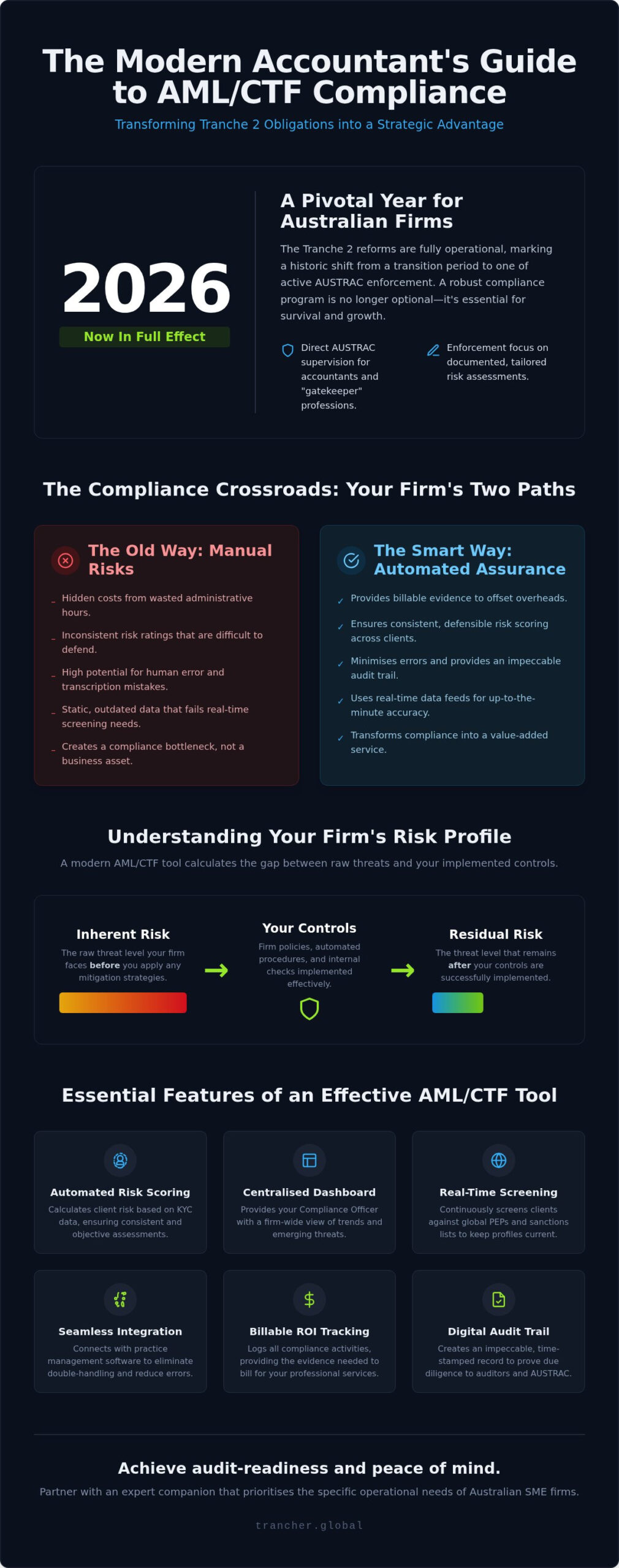
Inherent risk represents the raw threat level your firm faces before you apply any mitigation strategies. It considers the nature of your clients, such as high-net-worth individuals or foreign entities, without accounting for your internal checks. Residual risk is the threat level that remains after your firm’s policies, procedures, and controls are successfully implemented. A modern AML CTF risk assessment tool Australia calculates the gap between these two by weighing the effectiveness of your controls against the severity of the initial threat. Manual calculations often fail here, leading to inconsistent residual ratings that are difficult to defend during an independent audit.
Regulatory Expectations for SME Accounting Practices
AUSTRAC’s focus is on “designated services.” For accountants, this includes activities like managing client money, assisting with the purchase of real estate, or setting up complex trust structures. Providing these services triggers the requirement for a tailored risk assessment. A generic, “one-size-fits-all” document is no longer sufficient. If your assessment is found to be inadequate, your firm could face significant penalties or intensive audits. The regulator expects a proactive approach that reflects the unique nuances of your client base and operational model. It’s about showing that you truly understand who you’re doing business with.
Essential Features of an Effective Risk Assessment Tool
Selecting the right AML CTF risk assessment tool Australia firms use to manage their obligations requires looking beyond basic digitisation. A truly effective solution acts as a central nervous system for your practice, connecting client data to regulatory requirements without manual intervention. By choosing a robust AML CTF risk assessment tool Australia practitioners trust, you ensure a seamless transition from data collection to risk rating, keeping your firm compliant without sacrificing operational speed.
Modern tools must feature intuitive dashboards that allow your AML/CTF Compliance Officer to monitor firm-wide trends at a glance. Instead of digging through individual files, they can identify emerging risks across your entire client base. Integration with your existing practice management software is equally vital. By reducing the double-handling of data, you don’t have to worry about the transcription errors that frequently trigger red flags during independent audits. If you’re looking to streamline these processes, you can explore our platform integrations designed specifically for SME accounting firms.
Automation of Client Verification and Screening
In 2026, manual screening for Politically Exposed Persons (PEPs) and sanctions is no longer a viable strategy for professional services. The global financial landscape shifts too rapidly for static lists to remain accurate. Real-time data feeds ensure that your risk profiles are always current, reflecting the most recent regulatory updates. This automation is a core pillar of meeting the latest CDD and KYC requirements Australia has implemented. By feeding this live data directly into your risk assessments, you maintain a “living” compliance document that AUSTRAC expects from modern reporting entities.
Structured Workflow and Methodology
A high-quality tool provides a structured methodology that guides your team through the assessment process. This is particularly beneficial for junior staff, as guided prompts ensure they capture all necessary information without needing deep regulatory expertise. These workflows should also include “trigger events,” such as a significant change in a client’s shareholding or the introduction of a new high-value service. These events should prompt a mandatory risk re-assessment automatically. By following an AUSTRAC-aligned methodology, your firm ensures that every assessment is consistent, defensible, and thorough, regardless of who completes the task.
Manual Spreadsheets vs. Dedicated Compliance Automation
While spreadsheets were once the standard for small practices, they’ve become a significant regulatory risk in the current landscape. Relying on Excel for your compliance obligations introduces “hidden costs” that often outweigh the initial price of a software subscription. These costs manifest as hundreds of non-billable hours spent on manual data entry, the high probability of human error, and the immense stress of preparing for an AUSTRAC audit with fragmented records. A dedicated AML CTF risk assessment tool Australia firms use today provides a “single source of truth,” ensuring that every staff member is working from the same real-time data.
The primary weakness of a spreadsheet is its static nature. Once a risk rating is entered, it remains there until someone manually remembers to update it. In contrast, an automated tool acts as a “living” document. It constantly pulls from updated data feeds, ensuring your risk profiles reflect current realities rather than historical snapshots. Maintaining a version-controlled audit trail in Excel is also notoriously difficult. Without a clear, tamper-proof log of who modified a risk rating and the rationale behind it, you’re left vulnerable during an independent audit. Automation removes this friction by logging every change automatically.
The Risk of Fragmented Data
Manual processes often lead to “compliance silos,” where critical risk data is trapped in individual email threads or local folders. This fragmentation makes it dangerously easy to miss a suspicious matter report (SMR) trigger. When your data isn’t connected, you lose the ability to see patterns across your client base that might indicate systemic risk. Integrating Ongoing risk monitoring software ensures that these red flags are surfaced automatically. This connectivity protects your firm from the severe penalties associated with reporting failures and ensures no detail slips through the cracks.
Scalability for Growing Firms
Manual systems typically reach a breaking point once a firm manages more than 50 clients. At this scale, the administrative burden of tracking re-assessment dates and updating KYC documents becomes overwhelming for a small team. A dedicated AML CTF risk assessment tool Australia allows you to scale your practice without the need to hire additional administrative staff just to manage paperwork. When you project the long-term savings over a 3-year period, the efficiency gains and reduced error rates of automation offer a significantly higher return on investment than the “free” but labour-intensive spreadsheet approach. It’s about building a firm that grows with confidence, not just more admin.
Maximising ROI: Turning Compliance into a Billable Asset
Many Australian accounting firms treat their regulatory obligations as a “sunk cost,” viewing them as a necessary financial drain to avoid the wrath of AUSTRAC. This perspective overlooks the significant commercial potential inherent in your data. By utilising a sophisticated AML CTF risk assessment tool Australia practices can transform their compliance department from a cost centre into a billable professional service. When you provide high-quality due diligence, you aren’t just ticking boxes; you’re performing a valuable risk management service for your clients that warrants a professional fee.
Justifying software investments to firm partners becomes effortless when you can present clear ROI reporting. Instead of compliance remaining an abstract overhead, it becomes a transparent, quantifiable part of your firm’s revenue stream. This transition allows you to maintain the highest standards of integrity while ensuring your practice remains financially healthy. It’s about moving from a defensive posture to a proactive, value-driven approach.
Tracking Billable Compliance Hours
The administrative burden of manual assessments often goes unrecorded and unbilled. A modern AML CTF risk assessment tool Australia changes this by generating precise evidence of the time spent on client due diligence and verification. This documentation allows you to communicate your fees transparently, showing clients the exact value provided in terms of security and regulatory safety. By using Compliance ROI tracking software, your practice can capture every minute of activity, ensuring that the work your team performs is reflected on the client’s invoice. This shift helps recover the costs of the technology and the labour involved, turning a regulatory hurdle into a sustainable business model.
Identifying Advisory Opportunities
A deep, thorough risk assessment does more than satisfy a regulator; it reveals critical insights into a client’s corporate governance and operational structure. When you identify gaps in a client’s internal controls or shareholding transparency, you’re uncovering an opportunity to offer high-value advisory services. You can position your firm as a strategic partner that helps clients navigate complex regulatory environments safely. Trancher identifies these potential revenue streams automatically by flagging specific risk factors that require professional intervention. This proactive approach ensures your firm stays ahead of client needs while strengthening your position as a trusted advisor. To start turning your compliance requirements into a profitable service, book a demo of our ROI-focused platform today.
Selecting Your Partner: Why Trancher is the SME Choice
Choosing a partner for your compliance journey is a significant decision that moves beyond simple software procurement. You need a solution that acts as a strategic guide, not just a digital filing cabinet. Trancher stands apart as the premier AML CTF risk assessment tool Australia SME firms rely on, specifically because we offer a 30-day compliance-ready guarantee. This commitment reflects our confidence in removing the administrative friction that often plagues growing practices. We don’t believe in faceless, global platforms that ignore local context. Instead, we position ourselves as your expert compliance companion, providing a steady hand as you manage the complexities of AUSTRAC regulation.
A Platform Built Specifically for Australian Accountants
Generic AML tools often fail because they don’t account for the specific “designated services” that trigger obligations within the Australian accounting sector. These global solutions frequently lack the nuance required to distinguish between simple bookkeeping and complex trust management. Trancher was designed by Australian AML specialist Aaron Soh to bridge this gap. By focusing on the local regulatory landscape, we help you achieve AML CTF compliance costs reduction through targeted automation. Our platform ensures that your risk assessments are relevant to your specific service offerings, preventing the “over-compliance” that wastes billable hours.
Ready for an Independent Audit?
The true test of any AML CTF risk assessment tool Australia provides is its performance during an independent audit. You shouldn’t have to scramble for documents or justify inconsistent risk ratings when an inspector arrives. Trancher ensures your Audit ready compliance records are always structured, timestamped, and defensible. This methodical organisation replaces the stress of uncertainty with a calm, solution-oriented confidence. By maintaining every version of your risk assessment in a secure, centralised environment, you can demonstrate a proactive approach to financial crime prevention that satisfies even the most rigorous regulatory scrutiny.
Our support doesn’t end with a software login. We provide local Australian onboarding and expert guidance to ensure your team feels supported from day one. We understand that changing internal systems can feel daunting, so we’ve made our transition process as seamless as possible. To experience the difference a specialised partner makes, we invite you to start a complimentary 3-month trial. It’s an opportunity to see how compliance can become a manageable and even advantageous part of your firm’s growth strategy.
Transform Your Compliance into a Strategic Advantage
The regulatory landscape of 2026 demands a shift in how Australian accounting firms approach their obligations. Moving away from manual spreadsheets isn’t just about avoiding AUSTRAC penalties; it’s about building a more efficient, profitable practice. By implementing a specialised AML CTF risk assessment tool Australia firms can trust, you ensure that your compliance records are always audit-ready while uncovering new billable opportunities. You’ve seen how automation removes administrative friction and provides a clear path to practice growth.
Trancher is here to act as your expert compliance companion through every step of this transition. We’re proud to be a 100% Australian-owned and operated partner, offering local support that understands your specific operational needs. To help you get started with confidence, we provide a 30-day compliance-ready guarantee and a full ROI report at the end of your initial period. Start your complimentary 3-month Trancher trial today and see how easily you can turn a regulatory burden into a valuable professional asset. We look forward to helping your firm navigate the future with total certainty.
Frequently Asked Questions
What is an AML CTF risk assessment tool and why does my firm need one?
An AML CTF risk assessment tool is a specialised software platform designed to identify and manage money laundering and terrorism financing threats. Your firm needs one to automate complex regulatory checks and replace manual systems that are prone to human error. It ensures you meet AUSTRAC’s strict documentation standards while protecting your practice’s reputation. By using a digital solution, you can maintain a “living” compliance program that adapts to new risks automatically.
Can I still use manual spreadsheets for AUSTRAC compliance in 2026?
While AUSTRAC doesn’t strictly ban spreadsheets, they’re no longer considered best practice in 2026. Manual files lack the real-time data feeds and version-controlled audit trails necessary to satisfy a modern inspection. Relying on static documents creates a high risk of missing “trigger events” that require a mandatory re-assessment. Most SME firms have transitioned to automated systems to ensure their records remain accurate, secure, and ready for an independent audit.
How does a risk assessment tool help with AUSTRAC Tranche 2 obligations?
A dedicated AML CTF risk assessment tool Australia firms use ensures that all “designated services” are correctly identified and rated. Under the Tranche 2 reforms, accountants must prove they’ve assessed the risks associated with every client and service they provide. The tool provides a structured methodology that guides your team through these requirements, ensuring you meet the 1 July 2026 deadline for full program implementation without disrupting your daily operations.
Is it possible to bill clients for the time spent on AML compliance?
It’s absolutely possible to bill for compliance activity when you have the right evidence. High-quality tools track the time spent on KYC, CDD, and risk profiling, allowing you to present a transparent breakdown of work to your clients. This transforms compliance from an internal overhead into a recoverable professional service. By providing this as a value-added risk management service, you can recover technology costs while ensuring your firm remains financially sustainable.
What is the difference between a firm-wide and a client-level risk assessment?
A firm-wide assessment evaluates the overall risk landscape of your entire practice, including your service delivery channels and geographic reach. In contrast, a client-level assessment focuses on the specific threats posed by an individual entity or person. Both are essential for a compliant program. Your firm-wide assessment sets the policy framework, while client-level assessments apply that framework to the real-world interactions you have with your diverse client base.
How long does it take to implement an AML risk assessment tool?
Implementation times can vary, but we prioritise speed and operational ease. Our platform offers a 30-day compliance-ready guarantee, ensuring your SME firm is fully equipped to meet its obligations within a single month. This includes the initial setup, staff training, and the creation of your first risk assessments. We provide local Australian support to ensure the onboarding process is seamless and doesn’t pull your team away from their billable work.
Does the tool automatically report suspicious matters to AUSTRAC?
The tool flags suspicious behaviour and prepares the necessary data, but it doesn’t submit the final report. Final review and submission of a Suspicious Matter Report (SMR) must always be performed by your firm’s designated AML/CTF Compliance Officer. This ensures a human expert verifies the findings before they’re sent to AUSTRAC. The software acts as an early-warning system, identifying red flags that might otherwise go unnoticed in a manual environment.
What happens if my firm fails an AUSTRAC independent audit?
Failing an audit can lead to heavy financial penalties, public reputational damage, or intensive regulatory oversight. AUSTRAC takes a dim view of firms that lack documented, consistent risk identification processes. Using a robust AML CTF risk assessment tool Australia practitioners trust helps you avoid these outcomes by maintaining a permanent, timestamped audit trail. This gives you the peace of mind that your firm can defend its compliance decisions during any formal inspection.