
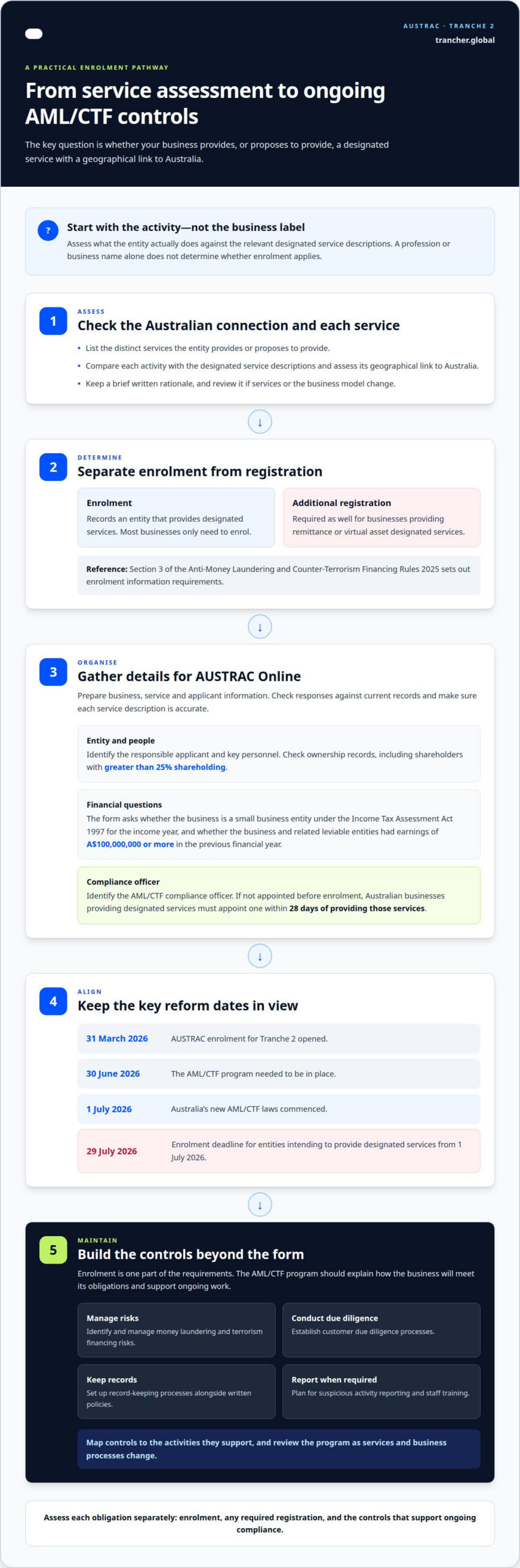
The decisive question is whether your business provides, or proposes to provide, a designated service with a geographical link to Australia. AUSTRAC enrolment for Tranche 2 opened on 31 March 2026; businesses intending to provide designated services from 1 July 2026 had to enrol by 29 July 2026. The deadline is only one part of the assessment: your Australian business connection and the services you provide determine whether the requirements apply.
It can be difficult to assess the change, particularly if your business operates in professional services, property or another newly regulated area. This guide explains how to assess your Australian connection, identify whether your activities are designated services and prepare for the information AUSTRAC Online requests during enrolment. It also covers practical preparation, including your AML/CTF program and the business information you’ll need.
Key Takeaways
- Start by assessing whether your business provides, or proposes to provide, a designated service with a geographical link to Australia.
- Use the service descriptions and your business activities to determine whether enrolment requirements apply.
- AUSTRAC enrolment is completed through AUSTRAC Online, which asks about your business, its services and applicant details.
- Prepare for enrolment by organising business information and planning how you’ll manage AML/CTF risks and obligations.
- Keep the key dates in view: enrolments opened on 31 March 2026, and the new AML/CTF laws commenced on 1 July 2026.
AUSTRAC opens enrolments but are Tranche 2 entities ready?
Use the enrolment window to organise business details, officer information and compliance work. Enrolment opened on 31 March 2026, and eligible entities need more than a completed form to prepare.
The governing Australian law is the Anti-Money Laundering and Counter-Terrorism Financing Act 2006, as amended, according to the Federal Register of Legislation.
After enrolment, prepare to identify and manage money laundering and terrorism financing risks, conduct customer due diligence, keep records and report suspicious activity when required. Your AML/CTF program should explain how the business will meet these obligations.
Penalties depend on the nature of the failure and the legal provisions that apply. Failing to enrol and failing to manage risks, conduct due diligence or report suspicious activity are separate compliance issues. Assess each obligation rather than treating enrolment as the entire requirement.
-
Prepare business and officer details
Gather your entity’s business details and identify the people responsible for the enrolment application. AUSTRAC’s key personnel information includes shareholders with greater than 25% shareholding, so check ownership records before entering details.
Identify the person who will act as AML/CTF compliance officer. If you haven’t appointed one before enrolment, Australian businesses providing designated services must appoint an officer within 28 days of providing those services.
-
Get ready for the enrolment forms
Prepare to enrol through AUSTRAC Online, which requests information about the business, its services, the applicant and other business details. Check each response against current records, and make sure service descriptions accurately reflect what the entity provides or proposes to provide.
Review the financial questions before starting. The form asks whether the business is a small business entity under the Income Tax Assessment Act 1997 for the income year. It also asks whether the business and related leviable entities had earnings of A$100,000,000 or more for the previous financial year.
-
Check reform timing and ongoing obligations
Align preparation with the commencement dates. Australia’s new AML/CTF laws commenced on 1 July 2026. Entities intending to provide designated services from that date had to enrol by 29 July 2026, while their AML/CTF program needed to be in place by 30 June 2026.
Build your program around the entity’s risks, customer due diligence and suspicious activity reporting. Establish staff training and record-keeping processes alongside written policies. Enrolment is one step; the program and related controls need to support ongoing AML/CTF obligations.
AUSTRAC enrolment requirements
Assess the entity’s enrolment obligation separately from any registration requirement. Enrolment records an entity that provides designated services; registration is an additional step for services that require it.
The deadline depends on when the entity plans to provide designated services. For services planned from reform commencement, follow the deadline explained in the timing section above, rather than the date enrolment opens.
When considering enrolment costs, distinguish the AUSTRAC process from your internal preparation. Staff time, gathering business records and preparing compliance processes affect the work involved, but these internal costs are not an AUSTRAC fee.
- Identify the designated services the entity provides or proposes to provide. Assess the actual work, not just the business label or profession. For example, list the distinct services the firm offers and assess each activity against the relevant designated service descriptions.
Assessing services individually gives the entity a practical basis for its enrolment decision. Keep a brief written rationale showing which activities you assessed and how you reached your conclusion. Review it if the entity changes its service model or adds an activity.
- Use Section 3 of the Anti-Money Laundering and Counter-Terrorism Financing Rules 2025 as the reference for enrolment information requirements. Compare the information being prepared with that section, and organise the answers so each relates to the correct entity and service.
Distinguish enrolment from any additional registration step. Most businesses only need to enrol. Businesses providing remittance or virtual asset designated services must enrol and apply for registration, so identify whether either service is part of the entity’s operations.
- Plan the internal work without assuming every business needs the same level of preparation. The effort depends on how clearly existing services are documented, how many activities need assessment and whether compliance processes are already recorded.
For example, a firm with clear service descriptions can use them to support its assessment. If teams describe the same activity differently, first align the internal terminology. Keep this work separate from any registration application.
- Connect enrolment planning with the entity’s operating controls. Activities involving designated services need processes to support customer due diligence, risk management and reporting where applicable. Map each control to the activity it supports, so staff can follow a consistent workflow.
Review the program as services and business processes change. For help organising the related compliance workflow, consider AML/CTF program management as part of your preparation.
Enrolment records an entity that provides designated services, while AUSTRAC registration is an additional step for certain services. Most businesses only need to enrol. Entities providing remittance or virtual asset designated services must enrol and apply for registration.
Geographical link to Australia
Assess the Australian connection alongside each designated service. AUSTRAC’s enrolment process asks whether the entity carries out, or proposes to carry out, designated services at or through a permanent establishment in Australia.
- Map each service before deciding whether the geographical link applies. Record what the business does, who performs the work and where the activity takes place. For example, distinguish a proposed service from an existing one rather than describing both as general business activity.
Then compare each activity with the designated services your entity provides or proposes to provide. An industry name alone may not describe the activity clearly. Record the actual service, such as a transaction-related task, and assess it against the applicable service descriptions.
- Identify the Australian permanent establishment relevant to each service. Use business records to establish which location or operation connects the service to Australia. Record the address and explain how the service is carried out at or through that establishment.
For example, if staff at an Australian office perform part of a service, document their role and the work completed there. If the service is proposed, record the intended operating arrangement. This evidence helps the business answer AUSTRAC’s establishment question consistently.
- Trace how each service moves through the business, from the first customer interaction to the work performed and its outcome. Note which people, teams and Australian operations are involved. This practical map can show where a service is delivered more clearly than a broad description.
Support examples with evidence, such as a workflow, service agreement or internal process record. A single customer interaction may involve several business functions. Explain the entity’s role in plain language, then connect it to the Australian establishment identified in your assessment.
- Document the reasoning for each service, including proposed activities. Record the service description, the relevant Australian establishment and the facts supporting the connection. If services use different operating arrangements, assess each separately instead of giving one general answer for the entity.
Use this record to support enrolment and future risk assessments. If the business changes how it delivers a service, update the activity map and review the geographical link. Clear records also help staff explain reporting decisions and keep service descriptions consistent across internal processes.
Questions asked during enrolment through AUSTRAC Online
Prepare your answers in sequence before opening AUSTRAC Online. The form asks about the entity, its services, the applicant and specified financial information.
- First, assemble the entity’s core details and service descriptions. AUSTRAC Online asks about the business and the designated services it provides or proposes to provide. Write a concise description of each service and compare it with your operating records. For example, distinguish a service already offered from one the business plans to introduce.
Keep the wording consistent throughout the application. A clear description explains what the entity does without relying on a broad industry label. Include the Australian establishment connection in your preparation, as the form asks whether services are carried out at or through a permanent establishment in Australia.
- Identify the applicant and check their details against business records. The enrolment form requests applicant and business information, so gather the relevant details before entering your answers. Use the same entity name and service descriptions throughout. If several people prepare the application, agree on one accurate account of the business’s activities.
Review key personnel information as part of that preparation. AUSTRAC’s information includes shareholders with greater than 25% shareholding. Compare ownership records with the proposed answers, so the application reflects the entity’s actual ownership structure.
- Answer the small business question for the correct income year. AUSTRAC Online asks whether the entity is a small business entity under the Income Tax Assessment Act 1997 for the income year. Read the wording carefully and prepare the response for that year, rather than relying on an older classification or an informal description.
Keep the reasoning behind your answer with the enrolment working papers. This gives the person completing the form a consistent reference if business records use different terminology. The question concerns the defined tax-law category, not simply whether the entity seems small compared with competitors.
- Check the previous financial year earnings question separately. The form asks whether the business and its related leviable entities had earnings of A$100,000,000 or more for the year ending in the previous financial year.
Gather the figures for the business and related leviable entities before answering. If the question includes related leviable entities, assess them together rather than considering the business alone. Record the financial year used and how you arrived at the combined answer.
- Use a final review to test each response against the form’s wording. Confirm that the service description, applicant details, ownership information and financial answers refer to the same entity. Then check that each answer matches the records used to prepare it.
Keep the application focused on the information AUSTRAC requests. For example, describe a service in practical terms rather than adding unrelated business background. Accurate answers give AUSTRAC a clearer picture of the entity and its exposure to money laundering risks.
When do Tranche 2 AML/CTF reforms start in Australia?
For a business preparing for the reforms, clear decision points make timing easier to manage. Sequence the work around when each service will be offered, who is responsible for its controls and how the business will maintain them.
- Start with a Tranche 2 project plan. List the designated services your business provides or plans to provide, then identify what must be operational before each service begins. This separates immediate priorities from work connected to a later service launch.
For example, if a firm plans to introduce a service after reviewing existing operations, make that service a separate readiness decision. Record its owner, required process and evidence of completion. This creates a practical timeline without assuming every activity needs the same preparation.
- Set internal milestones according to dependencies, not just task lists. A procedure cannot be tested until its owner understands it, and staff cannot check a workflow until its steps are documented. Sequence the work accordingly, then review progress at each decision point.
Use a shared tracker to show what is drafted, approved, tested or awaiting an owner. For instance, a policy marked complete is not yet operational if staff have not practised the process it describes.
- Set a review point for business changes. A new service, revised workflow or change in customer handling can affect the assumptions behind existing compliance arrangements. Assign someone to identify changes and decide whether internal documents need updating.
Keep a brief record of each review: the change considered, the decision made and any follow-up task. This helps teams explain why a procedure remains suitable or what needs attention before a revised activity proceeds.
- Test readiness with a realistic customer journey. Ask staff to walk through the relevant workflow, from initial contact to service delivery, and note where they use instructions, approvals and records. Gaps are easier to address when linked to a specific process rather than a general deadline.
After making changes, schedule a follow-up to test the updated process in practice. Assign someone to maintain the tracker and raise unfinished work through the business’s usual governance arrangements.
To organise this work into a practical operating plan, explore AML/CTF program management support.
Australia’s AML/CTF reforms may apply to legal professionals, accountants, conveyancers, real estate professionals, and dealers in precious metals, stones or related products that provide designated services. Use a service-by-service review to assess whether planned activities include a designated service. Then assign someone to confirm relevant controls are ready before the service is offered.
Newly regulated businesses should be prepared to identify and report suspicious activity when required. Include this capability in your readiness test: staff should understand the business’s process and who is responsible for the next step. Keep the process aligned with the services offered, and review it when workflows or service plans change.
Trancher: End-to-End AML/CTF Program Management
Trancher helps Australian businesses turn AML/CTF requirements into practical compliance processes. Its End-to-End AML/CTF Program Management helps organise program responsibilities, while Client Verification & Due Diligence (KYC/CDD + Screening) supports customer checks. Ongoing Risk Monitoring & Client Activity Tracking and Regulatory & Suspicious Matter Reporting support further parts of the compliance workflow.
Consider Trancher when your business has identified designated services and needs coordinated processes for customer due diligence, ongoing monitoring or reporting. It offers a practical next step from understanding enrolment requirements to managing the related compliance work.
To discuss how Trancher can support your AML/CTF processes, contact Trancher.
Make compliance part of your operating plan
Use your enrolment assessment as a starting point for stronger internal processes. For businesses reviewing AUSTRAC enrolment for Tranche 2, the next practical step is to assign responsibility for customer checks, monitoring and program upkeep. Clear ownership helps make compliance part of everyday service delivery, rather than a task revisited only when forms or deadlines arise.
Trancher supports this work through End-to-End AML/CTF Program Management, Client Verification & Due Diligence (KYC/CDD + Screening), and Ongoing Risk Monitoring & Client Activity Tracking. These capabilities connect documented procedures with customer onboarding and ongoing activity, helping your team manage AML/CTF processes in a coordinated way.
Build a compliance approach that fits your services and operating model. Explore AML/CTF support with Trancher and take a considered next step for your business.
Frequently Asked Questions
What is AUSTRAC Tranche 2 and which businesses will be covered?
Tranche 2 is the expansion of Australia’s AML/CTF regime to additional designated services. AUSTRAC estimates about 80,000 reporting entities will fall within the broadened regime. The practical point is to assess activities, not assume an entire business is covered because of its sector. A business may need to examine each service it provides and how that work is delivered.
Which services and professions must enrol with AUSTRAC under Tranche 2?
The enrolment requirement depends on whether a business provides a designated service, not just on its professional title. This matters for practices offering different kinds of work: assess each activity separately, as services within one practice may have different regulatory treatment. Map what staff actually do for customers, then use that description to assess whether the service falls within the regime.
How do businesses enrol with AUSTRAC for Tranche 2 online?
Submit the application through AUSTRAC Online and save its confirmation details with your compliance records. After submission, the applicant receives a confirmation message and email containing a receipt number and AUSTRAC Account Number. AUSTRAC sends another confirmation when enrolment is complete. Keep both communications to distinguish proof of submission from confirmation that enrolment is complete.
What information and documents are needed for AUSTRAC enrolment?
Keep the records that support your application answers together, rather than relying on someone’s recollection. Useful working documents can include ownership records, service descriptions and financial-year records. These also help the business maintain a clear evidence trail after enrolment. AML/CTF records must be retained for a minimum of 7 years, so organise supporting material in a way that allows staff to retrieve it when needed.
What are the AUSTRAC enrolment fees or costs for Tranche 2 businesses?
Internal costs include staff time, gathering business records and preparing compliance processes. These are separate from any AUSTRAC fee.