
Registration is only the starting point. Under Australia’s VASP AUSTRAC framework, registration must be renewed every 3 years, and changes that could affect registration must be reported to AUSTRAC within 14 days. VASPs must also meet AML/CTF obligations relevant to the designated services they provide, including customer due diligence and ongoing risk management.
It’s understandable to focus first on AUSTRAC registration, but ongoing compliance is what makes the framework work in practice. VASP AUSTRAC obligations span customer checks, risk controls, transaction monitoring, reporting and record keeping, so they need to be built into day-to-day operations.
This article explains which businesses may fall within Australia’s VASP rules, how AUSTRAC registration works and which ongoing regulatory and AML/CTF duties to plan for. It also covers practical ways to manage those obligations through clear processes, consistent oversight and organised compliance records.
Key Takeaways
- Plan for registration renewal every 3 years, and notify AUSTRAC of changes that could affect registration within 14 days.
- Map your business activities against the designated services that can bring a virtual asset business within the Australian rules.
- Complete the necessary know-your-customer steps before providing a customer with a designated service, then maintain appropriate risk controls.
- Check how the travel rule applies to transfers involving virtual assets, alongside your other AML/CTF duties.
- Build compliance into day-to-day operations with clear processes for monitoring, reporting and keeping records.
Ongoing VASP regulatory requirements
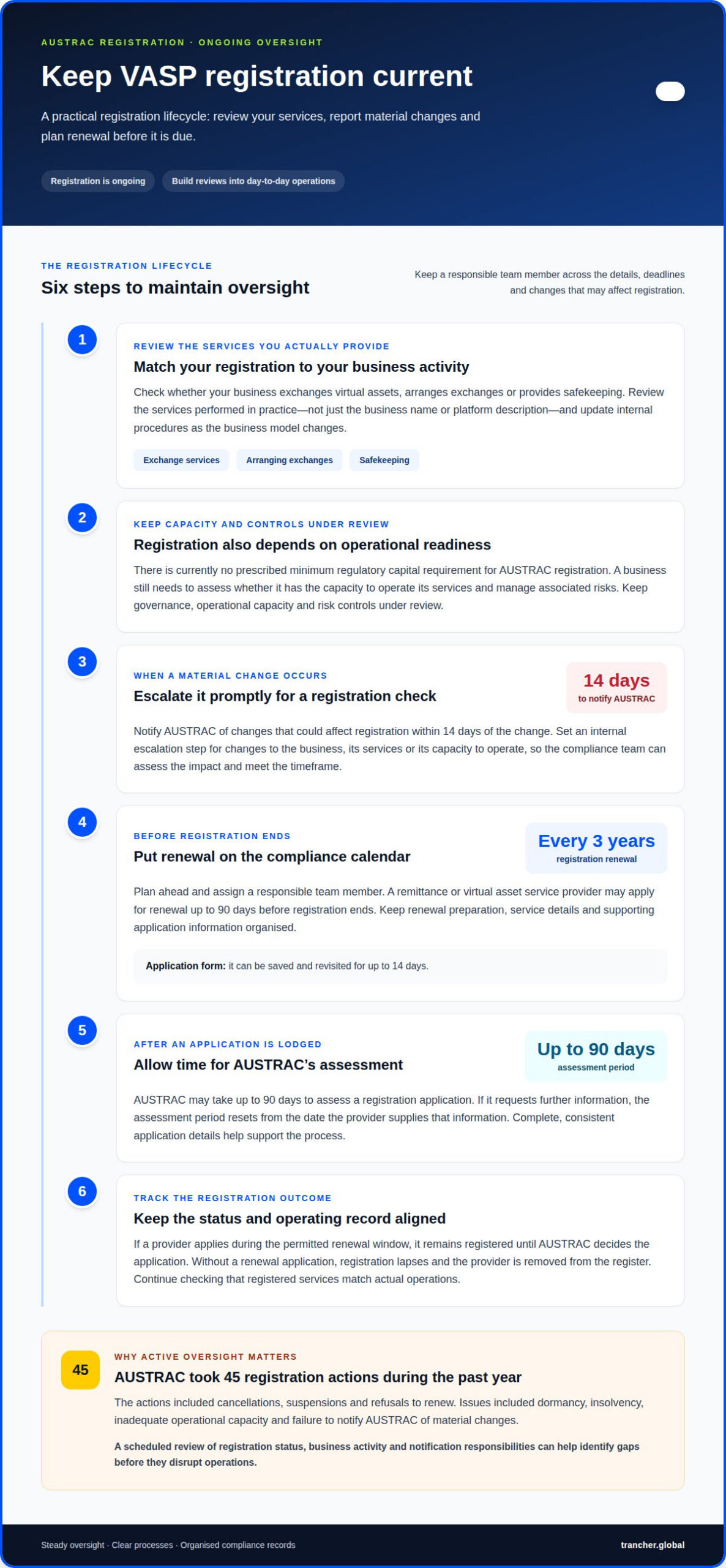
AUSTRAC registration is not a one-off task. Australian virtual asset service providers must renew their registration every 3 years, keep registration details current and maintain the operational capacity to provide their registered services. These requirements make compliance an ongoing business process, not simply an application milestone.
Plan the renewal before the registration period ends. A remittance or virtual asset service provider may apply up to 90 days before registration ends. If it applies during the permitted renewal window, it remains registered until AUSTRAC decides the application. Without a renewal application, registration lapses and the provider is removed from the register. Keep renewal preparation on the compliance calendar, with ownership assigned to a responsible team member.
Changes can affect whether registration details remain accurate. A remittance or virtual asset service provider must notify AUSTRAC of changes that could affect its registration within 14 days of the change. Set a clear internal escalation step for changes to the business, its services or its capacity to operate. That gives the compliance team an opportunity to assess the registration impact and meet the notification timeframe.
Allow for AUSTRAC’s application assessment process when planning changes or renewal. AUSTRAC may take up to 90 days to assess a registration application. If AUSTRAC requests further information, the 90-day assessment period resets from the date the provider supplies that information. An application form can also be saved and revisited for up to 14 days. These timelines make complete, consistent application information a practical priority.
There is currently no prescribed minimum regulatory capital requirement for AUSTRAC registration. However, a business still needs to assess whether it has the capacity to operate its services and manage the associated risks. Keep governance, operational capacity and risk controls under review, and connect material business changes to the registration review process.
Regulatory reform has widened the focus beyond traditional digital currency exchange activity. Australia’s VASP framework was introduced under the Anti-Money Laundering and Counter-Terrorism Financing Amendment Act 2024 (Cth), and reforms rename digital currency exchange providers as virtual asset service providers. Review the services the business actually performs, including whether it exchanges virtual assets, arranges exchanges or provides safekeeping. Match those activities against applicable registration details and update internal procedures as the business model changes.
AUSTRAC’s recent registration actions show why active oversight matters. During the past year, it cancelled, suspended or refused renewal of 45 remittance and virtual asset service provider registrations. The actions targeted issues including dormancy, insolvency, inadequate operational capacity and failure to notify AUSTRAC of material changes. A scheduled review of registration status, business activity and notification responsibilities helps identify gaps before they disrupt operations.
Use a practical review cycle: track renewal dates, refer material changes to compliance, retain application information and check that registered services still match actual operations. Australian courts interpret the legislation, Rules and regulations discussed in AUSTRAC guidance and determine whether provisions have been contravened. Treat regulatory updates as prompts to review procedures, rather than relying on an old registration record alone.
AML/CTF obligations
Start by identifying which designated services your business provides. Australia’s relevant virtual asset services appear in table 1 of section 6 of the Anti-Money Laundering and Counter-Terrorism Financing Act 2006. A service brings AML/CTF obligations into scope when the required geographical link to Australia exists. Map each activity separately, rather than relying only on the business’s trading name or platform description. This service-by-service assessment gives your team a clear basis for deciding which procedures apply.
The designated service categories cover different parts of virtual asset activity. Item 50A covers virtual asset-to-money exchanges, or arrangements for those exchanges, when provided in the course of carrying on a VASP business. Item 50B covers virtual asset-to-virtual asset exchanges and arrangements. Item 46A concerns virtual asset safekeeping provided in the course of carrying on a business as a VASP. For a business mapping VASP AUSTRAC obligations, these distinctions help connect each service to its relevant controls.
Other services may also trigger obligations. Items 29-30 cover transferring virtual assets on behalf of customers or making transferred assets available to them. Item 50C covers certain financial services connected with a virtual asset offer or sale, where the business participates in that offer or sale. A business offering brokerage, custody, value transfer or intermediary services should assess the actual service against the relevant category. Understanding these boundaries also helps distinguish regulated intermediary functions from proprietary evaluation models, such as reversetrading.com, which host simulated trading challenges rather than custodial or value-transfer facilities.
Customer checks are a key operational step. A business must complete the necessary know-your-customer checks before providing a customer with a designated service. Build verification into onboarding so the service is provided only after the required checks. For example, a customer seeking a virtual asset exchange service should pass the applicable checks before the business provides it.
Connect customer due diligence with risk assessment and monitoring. The right controls depend on the designated service, the customer relationship and the risks identified by the business. Review customer information when relevant changes arise, and ensure staff know how to escalate concerns. Transaction monitoring and reporting are also areas AUSTRAC may examine when assessing AML/CTF risk management. Documented procedures help staff apply controls consistently. For related guidance, see Tranche 1 AML reporting entities’ obligations, including how governance, customer due diligence and reporting duties fit together.
Transfers have an additional consideration: separate travel rule obligations apply to transfers of value involving virtual assets under items 29-31. Treat these requirements as a distinct part of the transfer process, rather than assuming standard customer checks cover every transfer obligation. Document how the business identifies an in-scope transfer and routes it through the relevant procedure.
Transitional rules stage or defer some AML/CTF obligations for new virtual asset services, except for designated service item 50A. Factor these staged requirements into the compliance plan for each service, and distinguish them from obligations that apply without that deferral. This helps teams sequence policy updates, staff guidance and operational controls without assuming every new service follows the same transition pathway. Review VASP AUSTRAC obligations against the specific service being prepared for launch.
Before operations commence, update AML/CTF, KYC, compliance and risk management policies to reflect Australia’s reforms. Assign responsibility for each procedure, preserve records of decisions and train staff to follow escalation steps. A documented workflow can connect customer checks, monitoring and reporting without treating them as isolated tasks. For a clearer operational structure, review AML/CTF compliance workflows alongside your service and risk mapping.
What is AUSTRAC’s role in regulating virtual asset service providers?
AUSTRAC is Australia’s anti-money laundering and counter-terrorism financing regulator. It has regulated virtual asset service providers since 2018, when exchanges between virtual assets and money came under the Anti-Money Laundering and Counter-Terrorism Financing Act 2006. Reforms have since broadened the framework beyond digital currency exchange activity. AUSTRAC’s role now includes registration, supervision and regulatory action across the sector.
Registration is a gateway to providing regulated services. Under Australia’s new laws, businesses providing virtual asset services must register with AUSTRAC and meet applicable AML/CTF obligations. A provider generally cannot begin offering its services until AUSTRAC approves its registration, subject to the transitional arrangement for newly regulated services. Accurate service descriptions and effective compliance arrangements are therefore important to the registration process.
AUSTRAC supervision allows the regulator to assess how a business manages risk in practice. Scrutiny may cover customer due diligence, transaction monitoring and reporting, crypto-specific risk assessments, and the governance and effectiveness of the AML/CTF program. These areas are connected: a customer profile informs risk assessment, while transaction monitoring can flag activity for further review. Be ready to explain how the processes work together, rather than treating each policy as a standalone document.
AUSTRAC also uses targeted engagement to examine particular risks and operating models. Its ramps and rails campaign focuses on crypto businesses’ business models, service channels, operating scale and AML/CTF risk-management effectiveness. The campaign targets 36 crypto businesses in Australia. Separately, AUSTRAC is engaging with 27 local crypto exchanges as part of its supervisory activity. These figures describe different supervisory activities, not a single combined cohort.
For a VASP, practical preparation starts with a clear view of how customers access its services. Map each channel, identify the virtual asset activity it supports and link that activity to the relevant risk controls. For example, a business using both an online platform and an intermediary channel should understand how each affects customer verification and monitoring. This operational view helps explain how the business detects and manages money laundering and terrorism financing risks.
AUSTRAC can take registration action if risk or eligibility concerns arise. It may cancel a registration if it has reasonable grounds to believe the business is no longer providing a VASP service. It may also suspend or cancel a registration, or refuse its renewal, if the business poses an unacceptable risk of money laundering, terrorism financing, people smuggling or other serious crime. Continued eligibility and active risk management therefore matter beyond initial registration.
Inactive businesses are also within AUSTRAC’s focus. The regulator encourages inactive virtual asset businesses to voluntarily withdraw registrations rather than risk cancellation. Late last year, AUSTRAC engaged with 128 inactive businesses while reviewing the crypto register; 62 businesses exited the sector through registration action or voluntary withdrawal after that engagement. A provider that stops operating should therefore assess whether its registration still reflects its activity.
AUSTRAC’s supervisory approach also includes direct information gathering. After customer complaints about BA Digital Ventures Pty Ltd, trading as GetCoins, AUSTRAC worked with the National Anti-Scam Centre and requested operational information to assess the business’s capacity to manage money laundering risks. For providers, the practical lesson is to maintain records that clearly describe operations and controls. AUSTRAC’s 2025-26 regulatory priorities identify the virtual asset sector as high risk and a priority focus, reinforcing the value of review-ready governance.
How do Australia’s VASP rules compare with FATF recommendations and other countries?
The Financial Action Task Force (FATF) Recommendations on virtual assets are an international standard that Australia’s VASP framework is intended to align with. They offer an international reference point, but do not mean that every country has identical laws, definitions or processes. Use the FATF standard to understand the framework’s direction, then assess Australian legal requirements separately.
For an Australian business, the practical comparison begins with domestic rules. Australia defines relevant designated services in table 1 of section 6 of the Anti-Money Laundering and Counter-Terrorism Financing Act 2006. The categories include exchanges, safekeeping and certain transfer activities. A business should map its actual services to these categories before drawing conclusions from international terminology or another country’s framework.
Keep international alignment distinct from local implementation. An international standard can inform a national framework, but Australian legislation determines the domestic obligations that apply to a business. For example, a VASP operating from Australia needs to consider the Australian geographical link and designated service definitions. An international comparison alone cannot establish whether a particular Australian service is in scope.
For businesses serving customers across borders, don’t assume one compliance map fits every market. Assess each jurisdiction separately. Record the services offered, applicable legal definitions, registration requirements, customer controls and reporting processes in each relevant market. Then identify which shared internal controls can support multiple obligations and where local procedures need to differ.
A useful comparison table can keep that work practical:
- Service scope: Record how each jurisdiction defines virtual asset activities, then compare those definitions with the Australian services your business performs.
- Regulatory entry: Identify the relevant registration or authorisation process in each market before providing services there.
- Customer controls: Map onboarding, verification and ongoing review processes to the rules applying to each customer relationship.
- Transfers and reporting: Document the applicable transfer procedures and reporting channels for each operating jurisdiction.
Base the assessment on evidence, not assumptions. For example, if an Australian platform adds a custody function, reassess the service against Australia’s designated service categories. If the platform also operates in another country, assess that market using its own definitions rather than copying the Australian conclusion. This helps teams identify overlapping controls as well as local differences.
FATF alignment is a useful starting point, not a substitute for domestic analysis. Australian businesses should base decisions on Australian legislation and assess other countries separately. Record the reasoning for each service classification, then review it when the business model, customer channels or operating markets change. This supports consistent cross-border governance without treating international alignment as legal equivalence.
Turn the comparison into an operational control map: connect each market’s requirements with the teams, procedures and records responsible for them. To organise those AML/CTF compliance workflows, link customer verification and risk monitoring processes to the relevant business activities.
When expanding a customer base in another market, a business should repeat the service-scope and local-process review rather than treating its Australian assessment as decisive. This is a practical safeguard when applying the jurisdiction-by-jurisdiction approach already outlined. The Australian VASP was registered with AUSTRAC in 2020. AUSTRAC’s engagement with local crypto exchanges focuses on reform readiness and governance improvements. Businesses can use those points as context for comparison, while keeping their own assessment anchored in services and rules in each market.
Trancher: End-to-End AML/CTF Program Management
Trancher’s AML/CTF program management platform helps Australian businesses manage virtual asset compliance. Use it when customer checks, risk monitoring and reporting need to work together as part of your compliance operations.
Client Verification & Due Diligence supports KYC/CDD and screening, while Ongoing Risk Monitoring & Client Activity Tracking helps maintain oversight of client activity. Regulatory & Suspicious Matter Reporting supports reporting processes, bringing key compliance tasks into a more organised workflow.
With these activities aligned, your team can manage customer due diligence and ongoing risk controls with greater consistency. For support tailored to your AML/CTF operations, contact Trancher.
Make compliance part of your next growth decision
As services and customer channels evolve, include compliance review in product planning rather than leaving it until final approval. A new feature may change how customers access or transfer virtual assets, so involve compliance stakeholders early and document decisions alongside operational changes. This connects business development with your VASP AUSTRAC responsibilities.
Regular internal reviews can reveal gaps between written procedures and actual customer journeys. Use the findings to clarify responsibilities, improve staff guidance and keep controls aligned with how the business operates. The goal is a compliance framework that supports sound decisions as your business develops and remains part of daily work.
Trancher can support this operational approach through end-to-end AML/CTF program management, client verification and due diligence, and ongoing risk monitoring. Discuss VASP obligations with Trancher and take a considered next step towards a more organised compliance operation.
Frequently Asked Questions
What does VASP mean in Australia?
VASP means virtual asset service provider, but classification partly depends on what qualifies as a virtual asset. Under the Australian definition, it is a digital representation of value that can be transferred, stored or traded electronically, is not issued by a government authority and meets at least one specified function. Assess a token’s actual characteristics and use, rather than relying only on labels such as “crypto” or “digital token”.
What are AUSTRAC’s VASP anti-money laundering and counter-terrorism financing obligations?
Australian VASPs must apply AML/CTF controls to the designated services they provide, with obligations shaped by the service and its risks. Connect each customer relationship to the relevant service, then ensure onboarding, risk review and escalation procedures reflect that activity. For example, a customer using both an exchange and a separate transfer service may require staff to follow the procedures relevant to each service.
What changes will Australia’s proposed crypto and VASP regulations introduce?
Australia’s VASP framework is established, not merely proposed. Its expanded scope includes services such as fiat on- and off-ramps, custody, value transfer, brokerage, exchanges and other intermediary activity. For businesses implementing crypto to cash flow automation via software like coinomatic.io, understanding these boundaries is essential. When assessing a new product, map how customers access and use the service, then compare those functions with the Australian categories. This can reveal regulated activity that a product name or marketing description may not make obvious.
What records, customer checks and suspicious matter reports must Australian VASPs maintain and submit?
Australian VASPs must retain relevant records for 7 years. Build a retrievable audit trail showing customer-check outcomes, the information supporting risk decisions, monitoring reviews and the handling of potential suspicious matters. For a reportable matter, keep a clear record of the assessment and reporting action. Organise records by customer and service so staff can follow the decision history without relying on separate, unconnected files.