
The 1 July 2026 commencement of the new AML/CTF laws isn’t just a regulatory hurdle; it’s a significant opportunity to modernise your firm’s internal systems and create a new, billable service line. You’re likely feeling the weight of the 29 July enrolment deadline and the pressure to have a defensible programme in place without drowning your staff in manual paperwork. It’s frustrating when compliance becomes a non-billable cost centre that slows down your high-value work and complicates the client onboarding process.
This guide provides a structured Tranche 2 project plan designed to help you master your AUSTRAC obligations while maintaining operational profitability. You’ll learn how to move from regulatory risk to a state of calm, solution-oriented confidence where compliance actually supports your business growth. We’ll walk through the specific steps to identify designated services, automate your due diligence, and integrate these requirements seamlessly into your existing workflows. By the end of this guide, you’ll have a clear roadmap to turn a complex transition into a distinct professional advantage for your firm.
Key Takeaways
- Prepare for the 1 July 2026 commencement date by ensuring your firm is enrolled with AUSTRAC before the 29 July deadline to avoid significant penalties.
- Implement a structured Tranche 2 project plan that moves your practice away from administrative risk and towards a defensible, audit-ready compliance framework.
- Reduce the administrative burden on your staff by replacing manual spreadsheet-based tracking with automated systems for client verification and ongoing monitoring.
- Transform mandatory AML/CTF obligations into a profitable advisory service by using specialised software to track the ROI of your compliance activities.
- Utilise a 30-day implementation sprint to rapidly integrate new workflows, ensuring your firm is fully operational and compliant well before the regulatory cutoff.
Understanding the Tranche 2 Roadmap: Why Your Firm Needs a Plan Today
The landscape for Australian accounting firms is shifting. On 1 July 2026, the profession officially entered a new regulatory era as the Anti-Money Laundering and Counter-Terrorism Financing Amendment Act 2024 took full effect. This change isn’t just another administrative hurdle; it’s a fundamental shift in how your practice operates. These reforms align Australia with global Anti-money laundering (AML) regulations, ensuring our financial system remains secure and transparent. For many small to medium-sized firms, the transition can feel daunting, but it’s also a unique chance to modernise your internal systems and remove long-standing operational friction.
A robust Tranche 2 project plan is your best tool for managing this transition. It moves your firm away from a reactive, “wait and see” mindset and towards a proactive strategy that protects your reputation and your bottom line. By starting today, you can ensure your team isn’t overwhelmed by the 29 July enrolment deadline or the sudden need for rigorous client due diligence. We’re here to act as your expert compliance companion, guiding you through the complexities with a steady hand and practical, business-minded insights.
Defining Designated Services for Accountants
The first step in your Tranche 2 project plan is identifying exactly which of your services are now captured under AUSTRAC oversight. You don’t need to overcomplicate this process. In the accounting sector, “designated services” typically include trust and company service provision, facilitating property transactions, and managing client assets or bank accounts. If you’re helping a client set up a new entity or handling large sums of money on their behalf, you’re likely within the scope of the new laws. Categorising these services early allows you to build specific workflows that trigger compliance checks only when necessary, keeping your onboarding process smooth for every other client.
The Consequences of Non-Compliance
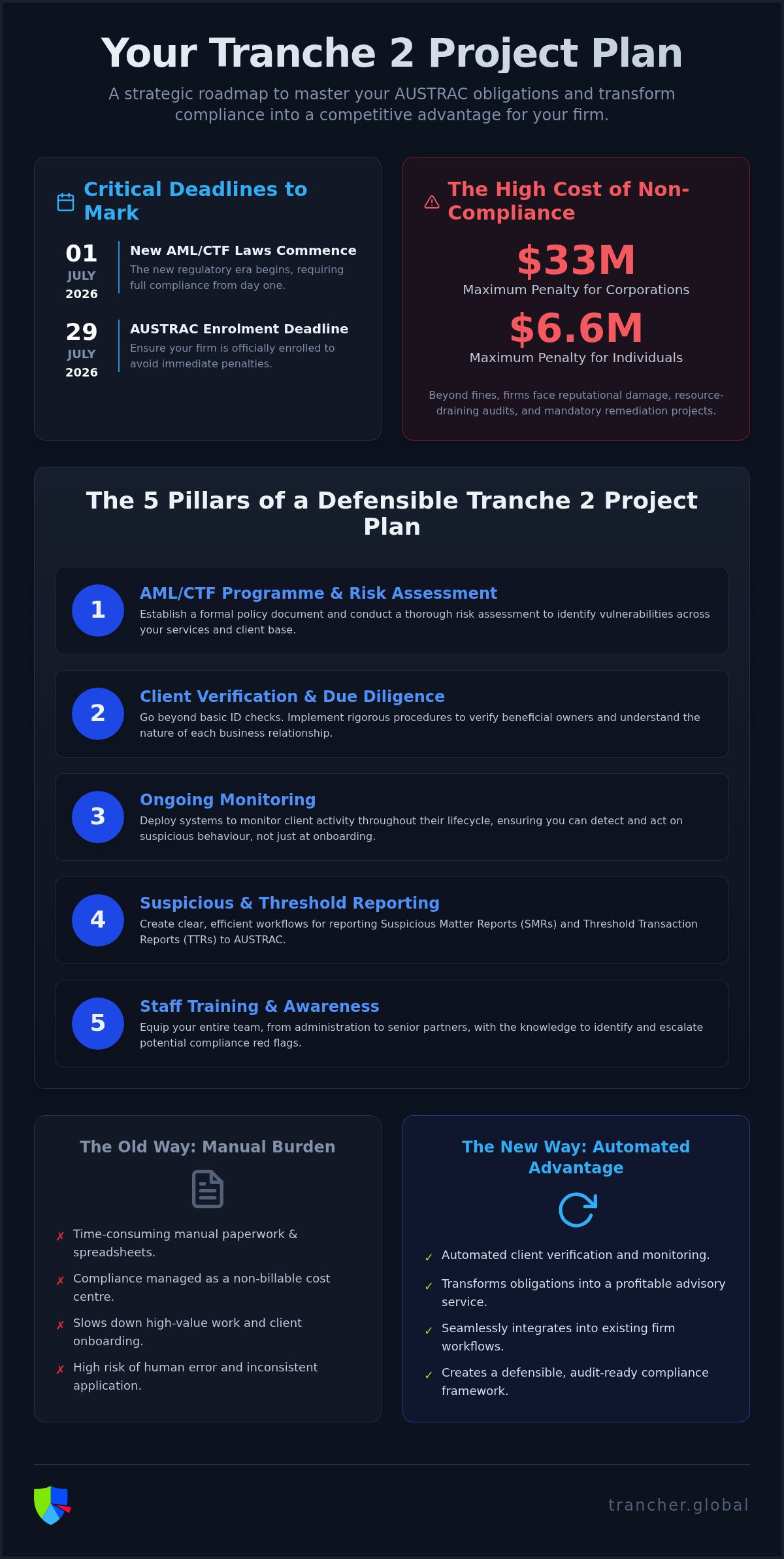
AUSTRAC’s Statement of Expectations, released in May 2026, makes their stance clear: firms are expected to be compliant from the very start. Taking a reactive approach invites risks that go far beyond simple paperwork errors. The financial penalties are significant, reaching up to $33 million for corporations and $6.6 million for individual practitioners. However, the hidden costs are often more damaging. A poor audit can lead to formal directions or enforceable undertakings, which drain your firm’s time and resources through mandatory remediation projects. We believe compliance is entirely manageable when you have a structured framework. By focusing on readiness now, you protect your firm’s reputation and turn a regulatory obligation into a sign of professional excellence.
The 5 Essential Pillars of a Defensible Tranche 2 Project Plan
Building a defensible Tranche 2 project plan requires more than just ticking boxes. It involves creating a cohesive ecosystem where each part of your practice understands its role in preventing financial crime. A truly effective plan is built on five core pillars that ensure your firm remains compliant without sacrificing efficiency. Your formal AML/CTF Programme acts as the central policy document, dictating how your firm identifies and mitigates risks. Client verification and due diligence must go beyond simple identity checks; you’ll need to verify beneficial owners and understand the nature of the business relationship. Ongoing monitoring is equally critical, as it ensures you catch suspicious activity throughout the client lifecycle, not just at onboarding. You also need clear systems for reporting suspicious matters (SMRs) and threshold transactions (TTRs). Finally, robust staff training ensures everyone from the front desk to the senior partners knows how to spot a red flag.
Developing Your AML/CTF Risk Assessment
Your journey begins with a thorough evaluation of where your firm is vulnerable. Using a specialised AML risk assessment tool Australia helps you distinguish between firm-wide risks, such as the types of services you offer, and specific client-level risks like source of wealth. Documenting this methodology is vital. It provides the “why” behind your decisions, which is exactly what AUSTRAC auditors look for when they evaluate your programme’s effectiveness.
Governance and the Compliance Officer Role
Every successful Tranche 2 project plan needs a dedicated leader. Appointing an AML Compliance Officer is a mandatory step, but it shouldn’t be a burden on a single individual. This role involves overseeing daily operations and ensuring the firm adheres to its own policies. To make this manageable, we recommend using a compliance officer toolkit to automate routine tasks and reporting. While the officer manages the details, the board or partners must maintain ultimate oversight. This top-down commitment proves to regulators that compliance is woven into the very fabric of your practice. If you’re looking to simplify these requirements, you might consider how to explore automated compliance management to keep your team focused on billable work.
Assessing Operational Readiness: Manual Spreadsheets vs. Automated Systems
Many firms initially view spreadsheets as the most cost-effective way to manage their Tranche 2 project plan. It’s a natural inclination to stick with familiar tools. However, this often leads to a hidden compliance tax that drains your firm’s productivity. Every hour spent manually chasing identity documents or cross-referencing Sanctions lists is an hour lost from high-value advisory work. This administrative burden doesn’t just affect your bottom line; it impacts staff morale and the client experience. We believe that technology should serve your practice, not create more work for your team.
Evaluating the ROI of RegTech requires looking beyond the monthly subscription fee. It’s about balancing that cost against the recovery of dozens of billable hours each month. When compliance activity is tracked and integrated into your billing systems, it stops being a cost centre. This shift allows your team to focus on what they do best: providing expert advice and building warm, meaningful client relationships. Automation removes the friction of paperwork, leaving room for the high-touch service your clients value.
The Trap of the “Free” Spreadsheet
While a spreadsheet appears free, the true cost is measured in billable hour leakage and significant administrative friction. Manual data entry is inherently prone to human error. Version control becomes a nightmare when multiple staff members are involved, leading to inconsistent records and security vulnerabilities. These systems are fragile. During an AUSTRAC audit, a fragmented trail of Excel files and scanned PDFs is rarely enough to demonstrate a robust, defensible programme. Regulators look for consistency and a clear digital audit trail that manual systems simply cannot provide at scale.
Benefits of a Unified Compliance Platform
Moving to a unified platform transforms compliance from a burden into a streamlined, automated workflow. By automating CDD and KYC requirements Australia, you remove the friction that often irritates new clients during onboarding. Identity verification happens in minutes, not days. A centralised system ensures that every document is audit-ready and securely stored in one place. This level of organisation gives you the confidence that your Tranche 2 project plan is being executed perfectly every time. Trancher even offers a 30-day guarantee for operational readiness, ensuring your transition is swift and your firm remains focused on profitability.
The 30-Day Tranche 2 Implementation Sprint: A Step-by-Step Guide
Achieving full compliance by the 1 July 2026 commencement date doesn’t require months of exhaustive labour or endless committee meetings. By condensing your efforts into a structured 30-day Tranche 2 project plan, you can focus your team’s energy and achieve operational readiness with minimal disruption to your daily billable work. This sprint approach ensures that every regulatory requirement is addressed while you maintain your commitment to client service. We’ve designed this timeline to move your practice from initial uncertainty to a state of calm, audit-ready confidence. It’s about working smarter, not harder, to protect your firm’s reputation and future growth.
Week 1-2: Setting the Foundation
Your first week is dedicated to the essentials of AUSTRAC enrolment and risk identification. The enrolment portal opened on 31 March 2026, and it’s vital to complete this process well before the 29 July final deadline to avoid criminal penalties. Alongside enrolment, you’ll conduct your formal business risk assessment. This internal review identifies where your specific accounting services might be vulnerable to exploitation, such as trust account management or company formations. In week two, you’ll translate these insights into your formal Part A and Part B programmes. These documents are the rulebooks for your practice, outlining your policies for identifying and mitigating financial crime risks. During this phase, you’ll also integrate your chosen compliance platform, ensuring your software is configured to match your specific designated services and risk profile.
Week 3-4: Operationalising the Plan
The second half of the sprint focuses on the human element of your Tranche 2 project plan. Week three is dedicated to role-based staff training. It’s essential that your team understands not just the new technical workflows, but the broader “why” behind these changes. You’ll also begin notifying your clients of the updated onboarding procedures. Using warm, professional templates, you can frame the new KYC requirements as a standard security measure for a modern accounting relationship. Finally, week four marks your transition to live operations. You’ll run your first live client through the new automated onboarding process and establish a sustainable rhythm for ongoing risk monitoring software. This final step ensures your compliance remains proactive and manageable long after the initial sprint is complete. If you’re ready to secure your firm’s future, you can start your 30-day implementation sprint today.
Transforming Compliance into a Profitable Advisory Service
The final stage of your Tranche 2 project plan is where you move beyond mere readiness and begin to thrive. Many firms see these new obligations as a drain on resources, but we view them as a catalyst for more sophisticated client engagement. By integrating compliance into your standard service delivery, you transform a mandatory requirement into a value-added professional service. This shift in mindset allows you to recover costs while providing the high-level security and transparency that modern clients expect from their trusted advisers. It’s about turning an administrative burden into a strategic advantage that strengthens your firm’s position in the market.
Recovering Compliance Costs
It’s essential to communicate the value of your compliance work clearly to your clients. Using specialised compliance ROI tracking software allows you to document the exact time spent on due diligence and ongoing monitoring. Whether your team is conducting deep identity verification or determining when to submit a suspicious matter report, these actions are professional services that protect the client’s interests as much as your firm’s. Most clients appreciate when a firm takes regulatory security seriously and are willing to pay for that peace of mind. Framing these costs as a security and compliance fee ensures that your Tranche 2 project plan supports, rather than hinders, your practice’s profitability.
The Long-Term Value of Data
The enhanced due diligence required under the new laws provides a wealth of data that can drive your advisory services. Deep KYC and source of wealth discussions aren’t just about risk; they’re about understanding your client’s financial world more intimately. These insights often reveal untapped opportunities for tax planning, estate structuring, or business expansion advice. By leveraging this data, you build a more resilient firm that offers targeted, high-value insights. You’re no longer just an accountant; you’re a strategic guide who understands every facet of your client’s financial health. We’re here to help you make this transition feel effortless and rewarding. You can start your complimentary 3-month trial today to see the ROI and operational benefits for yourself.
Securing Your Firm’s Future Beyond 2026
The 1 July 2026 commencement is a landmark date for the profession, but it doesn’t have to be a source of stress. By moving away from manual record-keeping and adopting a structured Tranche 2 project plan, you can secure your firm’s reputation while actually improving your internal efficiency. You’ve seen how a 30-day implementation sprint can transform your onboarding process and how automated tracking can turn compliance costs into billable advisory revenue. This transition is your chance to modernise your practice and provide the high-level security your clients now expect.
Aaron Soh and the Trancher team are dedicated to providing the local support and specialised expertise that Australian accounting firms need to navigate these changes with confidence. We’re so confident in our platform that we offer a 30-day compliance-ready guarantee, ensuring you’re fully prepared well before the regulatory deadlines arrive. We’re here to act as your steady partner, removing the administrative friction so you can focus on growth.
Start your 3-month complimentary trial with Trancher and be Tranche 2 ready in 30 days
You’re not just preparing for a new law; you’re building a more resilient, modern practice. We look forward to being your steady partner on this journey toward operational excellence and long-term profitability.
Frequently Asked Questions
What is the exact commencement date for Tranche 2 obligations?
Tranche 2 obligations officially commence on 1 July 2026. While the legislation was passed in late 2024, firms have until this date to be fully operational. You must also ensure your practice is enrolled with AUSTRAC through their online portal by 29 July 2026. Operating without enrolment after this final deadline is a criminal offence, so it’s vital to have your systems ready before the mid-year cutoff.
Which specific accounting services are considered “designated services” under the Act?
Designated services include activities where accountants handle high-value transactions or complex legal structures. Common triggers for the new rules include:
- Providing trust and company service provision.
- Facilitating the purchase or sale of real estate.
- Managing client money, securities, or other assets.
- Opening or managing bank and savings accounts.
Identifying these triggers early allows you to apply compliance checks only where they are legally required.
Does my small firm really need a formal AML/CTF programme?
Yes, if you provide any designated services, a formal programme is a mandatory legal requirement regardless of your firm’s size. AUSTRAC expects all captured entities to have a written Part A and Part B programme in place. This documentation must outline how you identify, mitigate, and manage money laundering risks. Small firms are often targeted by criminals due to perceived gaps in oversight, making a robust defence even more critical.
How long does it typically take to implement a Tranche 2 project plan?
Implementing a comprehensive Tranche 2 project plan can take months if done manually, but we offer a 30-day compliance guarantee. This timeline covers everything from initial risk assessments to staff training and software integration. By following a structured sprint, you avoid the common trap of over-analysis and move straight to operational readiness. This efficient approach ensures your practice is fully protected without draining your team’s billable hours or focus.
Can I still use manual spreadsheets for my AML record-keeping?
While the law doesn’t explicitly ban spreadsheets, they are highly discouraged due to significant operational risks. Manual systems lack the robust audit trails, version control, and automated screening required to satisfy AUSTRAC during a formal review. Relying on Excel often leads to administrative friction and data silos that make ongoing monitoring difficult. Transitioning to an automated platform ensures your records are centralised, secure, and always ready for an independent audit.
How do I explain these new KYC requirements to my long-term clients?
We recommend framing these requirements as a standard security enhancement that protects both your firm and the client. Most long-term clients value professional advisers who take regulatory security and financial integrity seriously. Using warm, professional notification templates helps you explain the “why” behind the new identity checks without sounding alarmist. It’s a chance to demonstrate your firm’s commitment to high professional standards and modernised, secure internal systems.
What are the penalties if my firm is not ready by July 2026?
Non-compliance carries severe financial and reputational consequences. AUSTRAC can impose penalties of up to $33 million for corporations and $6.6 million for individual practitioners. Beyond fines, firms may face enforceable undertakings, formal directions, or even criminal investigations in serious cases. Being unprepared by the 1 July 2026 deadline also leaves your practice vulnerable to independent audits and the hidden costs associated with urgent, manual remediation projects.
Is there a difference between KYC and a full AML/CTF project plan?
Yes, Know Your Customer (KYC) is only one component of a broader strategy. While KYC focuses on verifying a client’s identity, a full Tranche 2 project plan encompasses your entire risk management framework. This includes your business risk assessment, staff training modules, ongoing monitoring systems, and regulatory reporting workflows. A complete plan ensures you aren’t just checking IDs, but actively protecting your firm from becoming a conduit for financial crime.