
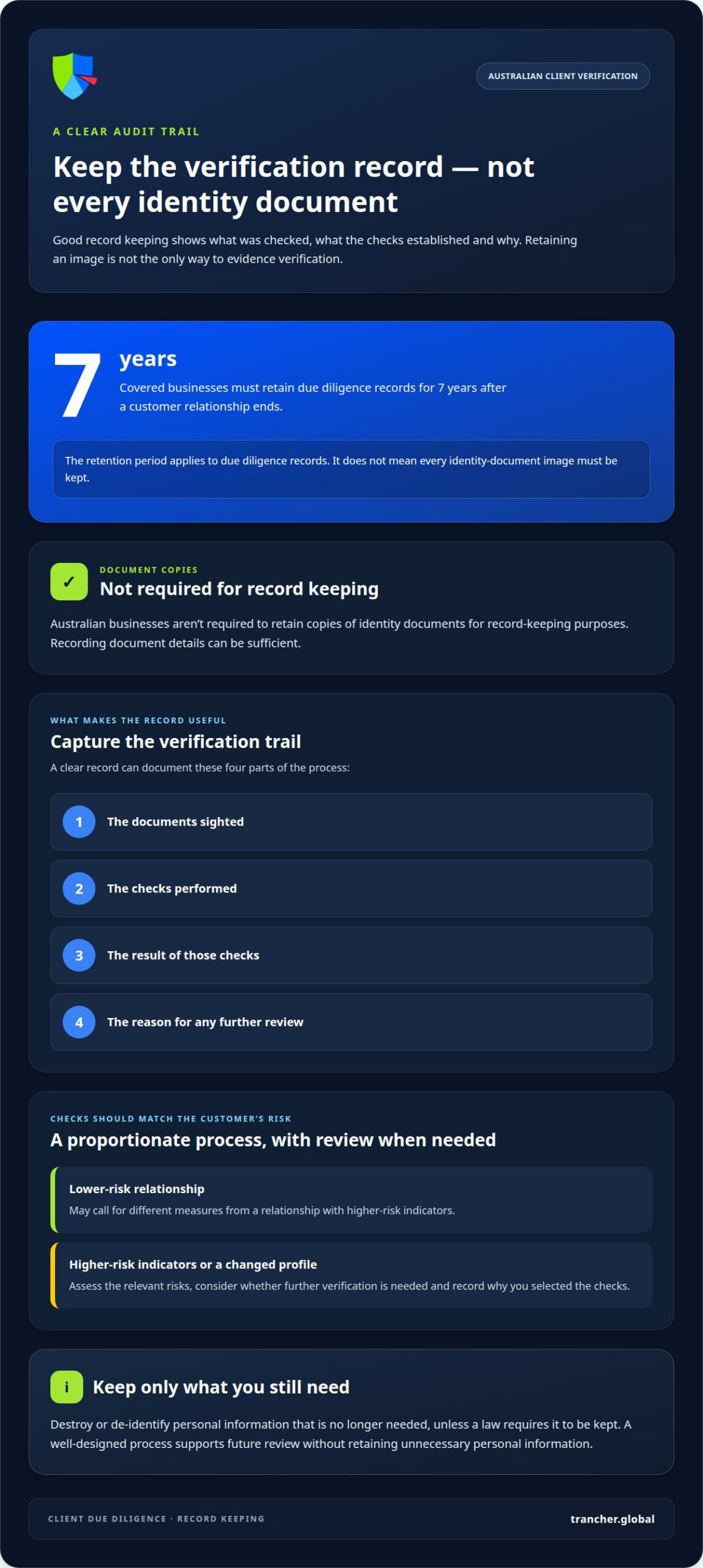
Do digital client verification tools mean you need to keep a copy of every identity document? No. Australian businesses aren’t required to retain copies for record-keeping purposes; recording document details can be sufficient. What matters is keeping a clear record of the checks performed and their outcome.
It’s understandable to assume that retaining an image is the simplest way to show what was verified. But good record keeping is about documenting the verification process, not keeping personal information without a continuing need. Covered businesses must retain due diligence records for 7 years after a relationship ends, and destroy or de-identify personal information they no longer need unless a law requires them to keep it.
This article explains how digital client verification tools can support Australian customer due diligence, AML, PEP and sanctions screening, document checks and record keeping. You’ll learn what to consider when choosing a professional verification process, how risk informs the checks performed, and what makes a verification record useful for future review. The aim is to make compliance clearer and more manageable, with a practical focus on building a reliable audit trail from the outset.
Key Takeaways
- Understand how customer due diligence fits into an Australian compliance process, with checks shaped by each client’s risk.
- See how AML controls, PEP and sanctions screening contribute to a more consistent approach to client risk.
- Learn what a professional verification workflow involves and which factors matter when selecting a solution for an SME, including system integration.
- Distinguish between identity-check methods, including when Document Verification Service checks are relevant for tax and BAS agents.
- Find out what makes an audit trail useful, from recording the verification steps to documenting the final assessment and its basis.
AUSTRAC customer due diligence requirements
For businesses covered by Australia’s anti-money laundering rules, customer due diligence starts with establishing who the customer is. AUSTRAC identifies verifying identity using reliable documents as an initial step. A passport or national identity document can provide details to check. Digital client verification tools can help organise this work, including during remote onboarding.
Due diligence is risk-based, not one identical check for every customer. Assess relevant risk factors to determine the level of checking required. A lower-risk relationship may call for different measures from one with higher-risk indicators. Where necessary, continue verification during the relationship, particularly when a customer’s risk profile changes. Record why you selected the checks and what they established.
What Australian laws and regulations apply to digital client verification and KYC? The Anti-Money Laundering and Counter-Terrorism Financing Act 2006 provides the AML/CTF legislative framework, while privacy obligations also matter. The Australian Government Federal Register of Legislation identifies the Act as the Anti-Money Laundering and Counter-Terrorism Financing Act 2006.
The Privacy Act 1988 treats biometric information as sensitive information. The Australian Privacy Principles apply to private-sector organisations providing financial services under Items 6 and 11 of the Privacy Regulation 2013. For a provider’s data arrangements, examine where information is hosted, who can access it, how long it is retained, and how it can be securely removed. Australian-hosted storage may be one option; offshore hosting may also be offered. Compare the provider’s data-location and access arrangements against your privacy, security and operational needs. Covered businesses must destroy or de-identify personal information they no longer need, unless a law requires retention.
Choosing software for Australian use means more than checking whether you can access it online. The checks should suit Australian customers, identity documents and business workflows. Consider whether the system supports the verification methods you need, handles remote identity checks and produces records staff can interpret. A clear workflow should also explain what information is collected and why. This connects identity verification to consistent due diligence instead of treating it as a standalone screen.
How much do digital client verification tools cost in Australia, and what affects the price? The price depends on the case and is provided after a quote request. Factors include the checks required, verification volumes, system integration and the record-keeping workflow. Comparing these requirements helps define the scope before costs are assessed.
Keep the evidence proportionate. Australian businesses are not required by AUSTRAC to retain identity-document copies for record keeping; recording document details is an option. AUSTRAC’s checklist says to retain due diligence records for 7 years after a relationship ends. A well-designed process can record the documents sighted, the checks performed, the result and the reason for any further review, without keeping unnecessary personal information.
How does AML, PEP’s, Sanctions and Compliance work?
AML compliance brings identity checks, screening, risk assessment and ongoing review together. Each step should lead to a clear decision and record, rather than being an isolated electronic check.
KYC compliance
Know Your Customer, or KYC, is the process of verifying a client’s identity. It helps a business understand who the customer is and the relationship it is entering. A practical process connects identity information with screening results, risk decisions and follow-up. For example, a name match should prompt a review of relevant details, not an automatic conclusion based on a similar name alone.
Anti-money laundering compliance
Anti-money laundering compliance uses controls to help prevent services being misused for money laundering or related illicit activity. A business can define how staff collect and assess customer information, respond to screening results, escalate concerns and document decisions. The Australian AML/CTF Act is the Anti-Money Laundering and Counter-Terrorism Financing Act 2006, according to the Australian Government Federal Register of Legislation.
PEP screening looks for possible links to politically exposed persons. A potential match needs careful assessment of identity and context, since different people can share a name. Sanctions screening checks customer details against relevant sanctions information. These checks can flag results for review; a possible match is not proof of wrongdoing.
A consistent workflow helps staff distinguish between screening results and decisions. First, collect the information needed to establish the customer’s identity. Next, screen the details and review potential matches against available identifying information. Then assess the results in context, record the decision and set any appropriate follow-up. For remote customers, electronic checks can support the process, while staff remain responsible for reviewing results.
Compliance also depends on what happens after onboarding. Changes in a relationship or new information may prompt reassessment, so records should explain the original decision and later actions. A company in Australia can face a civil penalty of up to A$36.4 million for each AML/CTF Act contravention. Clear ownership, escalation paths and documented decisions help staff apply controls consistently.
For a joined-up approach to screening and ongoing review, AML/CTF compliance support can connect verification, risk monitoring and client activity tracking.
How does a professional online identity check work, and what does a client need to provide?
A professional online check starts with the business’s onboarding requirements. The client supplies the requested identity information and supporting material through the agreed process. The verification professional performs the checks, assesses the results and records the outcome. If a detail is unclear, the professional can identify what needs clarification before the business decides how to proceed.
For an SME, a suitable solution should fit its customer journey, risk process and existing systems. Map how a new client moves from initial contact to an approved relationship. Identify where identity information is collected, who reviews exceptions and where the final decision is recorded. This process map helps separate essential functions from features that add complexity without supporting the workflow.
System integration is a practical selection criterion. Connecting a verification provider with a CRM or practice-software platform can reduce repeated data entry, but the intended information flow needs to be clear. Decide whether verification outcomes, review notes and status updates should appear in the client record. Establish which system is the source of truth if records differ, and how staff will identify incomplete or failed checks.
Assess product features against real onboarding tasks, not a long feature list. Consider the identity methods available, how staff handle a possible mismatch and whether the process supports remote clients. Check what information the system collects, how users authenticate and which staff roles can access results. These questions help you assess security and suitability without assuming every provider handles information in the same way.
Test how the integration works in practice. Map a sample client journey, from information submission to a recorded verification outcome. Look for duplicate fields, manual hand-offs and points where staff need to make a decision. Include exception cases, such as an unreadable document or inconsistent details, to show how a case is paused and reviewed.
Before implementation, document the required data, system connections and staff responsibilities. The client supplies accurate information and responds to specific requests; the business performs the identity checks and records their basis. For example, an SME using practice software can decide which team members review exceptions and where the final status belongs. Clear requirements support consistent onboarding and help establish whether a solution fits the business.
Document Verification Service checks
For Australian tax and BAS agents, the Document Verification Service (DVS) is one method for checking identity details against government identity documents. Under the Source DVS method, agents must check a client’s details against 2 separate government identity documents, with at least one primary identification document. This is distinct from simply viewing a document: the verification process uses information from the documents to perform the check.
The document details need to match the person being verified. For a DVS check, a passport and another eligible government identity document can provide two sources, provided one is primary. The business compares the client’s details with the information associated with those documents. If the information does not align, review the result rather than treating it as a successful match. Record what was checked and how the result informed the identity assessment.
Tax and BAS agents may also use the Source ATO method. After checking the client’s name, the agent must verify 2 further pieces of information against ATO systems. This is a separate method from DVS, with ATO-held information forming the reference for those additional checks. The suitability of each method depends on the applicable proof-of-identity process and the information available for the client.
Visual identity verification is another distinct approach. For visual-only verification, Australian tax and BAS agents must verify at least 2 visual identity documents. They may conduct this remotely by video conference or webcam, if they can compare the person with the identity document. This means image clarity, document legibility and a visible comparison matter during the check. A remote process should make it possible to assess those elements before recording the outcome.
The Tax Practitioners Board (TPB) requires Australian tax and BAS agents to verify a client’s identity before providing tax agent or BAS services, and on an ongoing basis. Registered tax practitioners need robust processes aligned with proof-of-identity requirements. In practice, select an appropriate method, perform the relevant checks, review discrepancies and record the assessment. A DVS result supports the process, but the record should also show the method used and the decision reached.
If your SME engages a professional, clarify which identity method will apply and what information the client must provide. A passport-based DVS check, a Source ATO check and a remote visual check involve different evidence and comparison steps. Keeping the methods distinct helps staff apply the right process and explain why a particular document or additional detail is needed. It also supports consistent handling of exceptions, such as an unreadable document or details that do not match.
Audit trails and record keeping
A useful audit trail lets a reviewer reconstruct an identity decision from its record. The Tax Practitioners Board (TPB) discusses contemporaneous client-verification records in paragraphs 24 to 25 of TPB (PN) 5/2022. In practice, a record should show what happened at verification time, not rely on staff remembering the process months later. Clear entries also help separate the evidence collected from the decision made.
For tax practitioners, a verification summary report should capture specific details. The TPB requires the report to record the date and time, documents sighted, how they were sighted, their clarity and legibility, and the final assessment and its basis. An entry stating only “identity checked” gives little context. A stronger record identifies the document type, notes whether it was legible and explains why the result supported the assessment.
Build the record around the steps performed. Capture the verification method, information or documents used, result, reviewer and any follow-up. If a discrepancy required escalation, record the issue and how it was resolved. This gives a future reviewer a traceable path from the original sources to the final decision. It can also make internal reviews more efficient by keeping essential evidence easy to find.
Retention and collection need separate decisions. AUSTRAC’s checklist says due diligence records should be retained for 7 years after a relationship ends. Australian businesses aren’t required by AUSTRAC to keep identity-document copies for record-keeping purposes; recording document details is an option. Covered businesses must destroy or de-identify personal information they no longer need, unless a law requires retention. That makes a clear retention schedule important.
Biometric information needs particular care because the Privacy Act 1988 treats it as sensitive information. A record should distinguish biometric data from the verification result, rather than retaining extra material by default. For example, document the method and outcome without assuming an image or biometric sample must remain on file. The appropriate record depends on the verification process and applicable retention obligations.
Digital systems can help organise records, but access and retention practices still need to be defined. Set permissions by staff role, use a consistent record format and make the decision history searchable. An audit trail should show who reviewed a result and when. These controls help prevent notes scattered across email, shared drives and client files from obscuring the verification history.
Review the process using a sample client file. Confirm that the record shows the verification date, evidence sighted, legibility, assessment and its basis. Check that retention rules distinguish records that must be kept from personal information no longer needed. This practical review can reveal missing fields before an audit or internal check and help teams apply a consistent standard across client files.
Strengthen audit-ready verification records by aligning identity checks, documented decisions and record keeping in one workflow.
Trancher: Client Verification & Due Diligence (KYC/CDD + Screening)
Trancher supports Australian businesses with structured client verification, due diligence and screening. Its Client Verification & Due Diligence (KYC/CDD + Screening) offering connects these checks with a broader compliance process, helping teams link client information to screening and risk decisions.
Consider this support when onboarding checks, ongoing client reviews or AML/CTF program management need a more coordinated workflow. Trancher also provides Ongoing Risk Monitoring & Client Activity Tracking and Regulatory & Suspicious Matter Reporting, supporting compliance work beyond the initial identity check.
To discuss your compliance needs, contact Trancher.
Make verification part of a stronger workflow
The next step is to decide how identity checks fit into your wider compliance operations. Consider who reviews exceptions, how decisions are recorded and how verification connects with ongoing risk management. A clear operating model helps your team use digital client verification tools as part of a consistent process, rather than as a standalone task.
Trancher provides End-to-End AML/CTF Program Management, Client Verification & Due Diligence (KYC/CDD + Screening), and Ongoing Risk Monitoring & Client Activity Tracking. These services help bring client checks and continuing compliance activities into a coordinated workflow.
Contact Trancher about client verification to discuss a practical next step for your compliance process. A considered approach can help your team build confidence and readiness over time.
Frequently Asked Questions
Do I have to keep a copy of the ID document?
No. Australian businesses aren’t required by AUSTRAC to keep identity-document copies for record-keeping purposes; they can record document details instead. For example, a file can note the document type, relevant details sighted, verification method and result. Keep the information needed for the compliance record and apply relevant retention and privacy controls. If another law requires a document to be retained, that requirement takes precedence.
How does a provider obtain consent for a DVS check?
A business can explain the proposed DVS check and request permission through its onboarding process before submitting the client’s details. The notice should identify the business making the request, explain the check’s purpose and describe what information will be used. Record the client’s response with the verification file. Treat consent as part of a transparent process, aligned with your organisation’s privacy and legal obligations.
How do you choose a digital client verification provider?
Choose a verification process that matches your client types, risk process and record-keeping needs. Consider how it handles unclear documents, possible identity mismatches and cases requiring staff review. For an SME, assess whether the workflow fits existing CRM or practice software and whether staff can find a decision record later. Also consider how information is protected, where it is hosted, and how access and retention are managed.
What are digital client verification tools and how do they work?
Digital client verification tools help a business collect identity information, perform checks and record results electronically. Depending on the method, the business may compare a person with an identity document, check details against a source or use screening as part of due diligence. For example, a remote process may include document review followed by staff assessment of any mismatch. The business remains responsible for deciding how results affect onboarding.
What digital identity verification tools are available to Australian businesses, and how do you choose a provider?
Australian businesses can use document-based, visual, government-source and screening checks, depending on their needs and eligibility. Choose an approach that suits the customer, available documents and risk assessment, rather than relying on one method for every case. For example, an SME serving remote clients may need a workflow for readable document submissions and staff review. Ensure the results support your records and fit existing onboarding steps.
How can Australian businesses compare digital identity verification providers on features and accuracy?
Compare providers using the same realistic cases, such as a clear document, an unreadable image and details that do not match. Assess whether each method explains its result, flags exceptions for human review and records the basis of the decision. Judge accuracy against the source and process used, not a feature claim alone. Also compare data handling, system fit and how easily staff can retrieve verification outcomes.
What identity documents and databases can Australian verification tools check?
Verification methods may use passports, national identity documents, driving licences or utility bills as identity references. For tax and BAS agents, approaches can include checks against government identity documents through DVS or information held in ATO systems. Screening may also cover PEPs, sanctions and adverse media. The documents and sources used depend on the chosen method, the client’s circumstances and the checks the business needs to perform.
How can a provider integrate digital client verification tools with your existing systems?
A verification workflow can connect with your CRM or practice software so relevant statuses and records sit within the client process. First, define what information needs to transfer, where the final decision is stored and who reviews exceptions. Then test a sample workflow, including an incomplete check and a mismatch. This can reveal duplicate entry or hand-offs to address before staff rely on the integration.