
The most capable platform is not automatically the best fit for an Australian professional firm. The right KYC compliance software in Australia should match your firm’s work, bringing identity verification and client onboarding together with screening, ongoing monitoring and practical reporting workflows.
That distinction matters because AML/CTF obligations depend on the designated services a business provides, not simply its professional title. A solicitor, accountant or property professional should assess software against the firm’s actual onboarding process and compliance responsibilities, rather than choosing on feature count alone.
This comparison explains how to assess KYC tools for identity checks, customer due diligence, sanctions, politically exposed person and adverse-media screening, AUSTRAC reporting support, record keeping and integration. It also considers which platforms suit professional firms, where a specialist AML/CTF management solution fits, and what to weigh before deciding. The aim is a practical shortlist based on operational fit, not a one-size-fits-all winner.
Key Takeaways
- Match identity verification and onboarding workflows to the way your firm actually collects and assesses client information.
- Assess whether reporting tools support the AUSTRAC reports relevant to your obligations, not just general compliance record keeping.
- Look beyond initial checks: screening and ongoing monitoring help keep client risk information current.
- Compare software by its fit with your professional services, internal workflows and integration needs, rather than feature count alone.
- Consider whether an end-to-end AML/CTF management approach can bring verification, monitoring and reporting into a more coordinated process.
Digital identity verification and KYC workflows
The right Australian KYC software provider fits your client mix, verification process and screening needs. Compare how each option collects information, checks identity and records outcomes, rather than selecting by feature count alone.
Client Information Collection and Verification
Client information collection starts the workflow: the provider gathers identifying details, checks them and records the result against the client or entity. For an individual, this may involve identity document details; for a company, the workflow may also need entity information. Solutions such as Cateno help streamline this stage by enabling entity onboarding from a single piece of information through a customisable workflow engine. Unlike a standalone identity check, a broader KYC process connects information collection with verification and later review.
Assess whether the process handles missing information clearly and stores the verification outcome with the relevant client record. For example, a workflow that flags an incomplete identity check for review gives staff a clearer next step than one that records only a pass or fail.
Individual identity verification using DVS: what to expect from a provider
For an individual, a provider can use Australia’s Document Verification Service (DVS) to compare identity document details with records held by the issuing authority. The workflow should capture the information needed for the check, return its outcome and retain an auditable client-file record. Simply collecting a document image does not show that verification took place.
Ask how the process handles an unsuccessful or inconclusive check, including whether it records a reason and supports staff review. Compare DVS fees by checking whether charges apply per verification or are bundled with other checks, and whether the billing model suits your expected workflow.
Choosing an Australian KYC software provider
Identity verification is one part of the decision. Compare how each provider connects client information, identity checks and watchlist screening, including sanctions checks against Australia’s DFAT Consolidated List. That list combines United Nations Security Council listings with Australia’s autonomous listings under the Autonomous Sanctions Act 2011.
For a professional firm, the best fit supports its client and entity workflows, records check outcomes clearly and routes exceptions for review. A workflow focused only on individual identity checks may suit a narrower need; an integrated KYC process can connect verification with screening.
| Option | Identity verification | Client workflow | Screening | Fee comparison |
|---|---|---|---|---|
| Document collection workflow | Records supplied details | Staff-led review | May be separate | Compare service charges |
| DVS-enabled verification | Checks document details through DVS | Records check outcome | May be separate | Review per-check or bundled pricing |
| Integrated KYC workflow | Connects identity checks | Links client and entity records | Can include sanctions screening | Assess all workflow components |
Choose the provider whose verification, screening and fee structure fit your firm’s client onboarding process.
AUSTRAC reporting capabilities and report types
Choose software that supports the AUSTRAC reporting workflows relevant to your obligations and links evidence to client records. Australia’s expanded AML/CTF framework also makes it important to assess onboarding, ongoing monitoring and reporting as connected processes.
Reports and AUSTRAC submission workflows
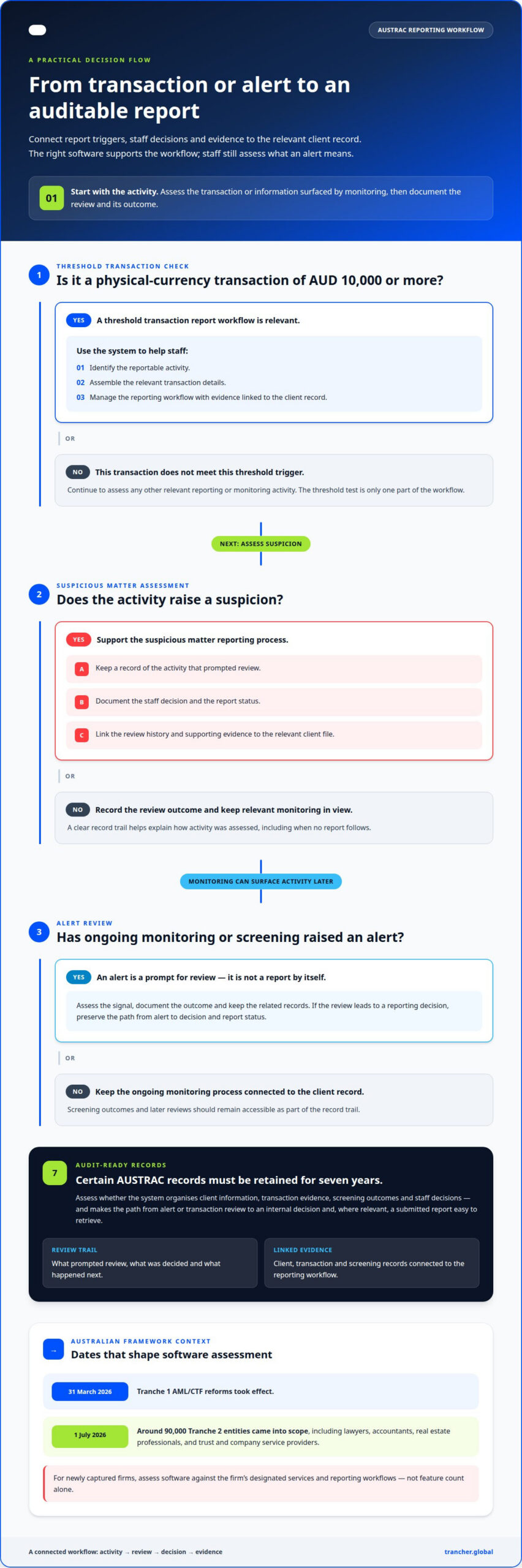
Australian reporting entities must submit threshold transaction reports to AUSTRAC for physical currency transactions of AUD 10,000 or more. A suitable system should help staff identify reportable activity, assemble relevant transaction details and manage the reporting workflow.
Suspicious matter reporting is another key capability to assess. AML software can support businesses in identifying and reporting suspicious matters and threshold transactions to AUSTRAC. Compare whether the platform records the activity that prompted review, the decision and the report status. For example, a transaction flagged during ongoing monitoring should remain linked to its client file and review history.
Audit-ready records and reporting evidence
Reports need a supporting record trail. AUSTRAC requires certain records to be retained for seven years. Assess whether the software organises client information, transaction evidence, screening outcomes and staff decisions.
A clear audit trail helps a firm retrieve the information behind a report instead of searching across separate files. It should show how a case moved from an alert or transaction review to an internal decision and, where relevant, a submitted report. Reporting tools are more useful when they connect these steps.
Reforms, ongoing monitoring and ownership information
Australia’s Tranche 1 AML/CTF reforms took effect on 31 March 2026. Around 90,000 Tranche 2 entities, including lawyers, accountants, real estate professionals, and trust and company service providers, came into scope on 1 July 2026. These changes make it important for newly captured firms to assess whether software supports their designated services and reporting workflows.
Ongoing monitoring can surface activity for review after onboarding. Screening signals, including adverse media, may need assessment and documentation; software should preserve the review outcome and related records. An alert is not a report by itself. Staff decisions and relevant facts should inform the next step.
Ownership details also matter in client due diligence. Compare how a platform records an entity’s beneficial ownership information and links it to the client file. This supports a coherent review when ownership details inform a risk assessment or reporting decision, without confusing ownership records with a report submission.
Automated sanctions, PEP and adverse-media screening
Screening adds context to customer due diligence by checking client details against sanctions, politically exposed person (PEP) and adverse-media records. For an Australian firm, an automated check can surface a potential match during onboarding or later monitoring. The result still needs assessment: a name match is a prompt for review, not a conclusion about the client.
Sanctions screening checks client and entity details against relevant lists. Australia’s DFAT Consolidated List combines United Nations Security Council listings with Australia’s autonomous listings under the Autonomous Sanctions Act 2011. A suitable workflow should retain the list match, the details compared and the reviewer’s decision. For example, a real estate firm can link a screening result to the relevant client file and transaction.
PEP screening checks whether a client’s details match a politically exposed person record. Adverse-media screening searches for relevant negative news connected with a person or entity. These checks serve different purposes: a sanctions match concerns a listed party, a PEP match identifies a public-role connection, and adverse media highlights reporting that may warrant review. A combined workflow should keep each result distinct.
Automation can identify possible matches and send them for staff assessment. How well that process works depends on the details compared, such as names and other available identifiers. A shared name may generate a potential match, while a spelling variation may affect search results. Screening software should let reviewers document why a result was cleared or escalated, rather than treating an automated flag as a final decision.
For ongoing checks, assess how the system handles new alerts and links them to earlier decisions. If a client’s screening result changes, staff need a clear way to review the new information against the existing customer due diligence record. A useful AML/CTF workflow keeps the alert, review rationale and outcome together, so another staff member can understand the decision later.
Compare screening tools by list coverage, match handling, review queues and audit evidence. Ask how the system records the check date and type, the relevant client or entity, the potential match and its resolution. For example, a file showing an adverse-media alert, its assessment and the resulting action is clearer than an unannotated screening result. Also assess whether screening fits the firm’s onboarding and transaction workflows, rather than operating as a disconnected step.
How does AML KYC software help with customer onboarding?
AML KYC software can connect client information, risk assessment and review steps in one onboarding workflow. The key is to match each client’s due diligence process to the risks identified, then record decisions and follow-up.
Australian businesses should assess privacy, data security and overseas data handling when selecting KYC software. According to the Federal Register of Legislation, Australian AML software providers must account for the Privacy Act 1988 and Australian Privacy Principle 8 when handling personal information disclosed to overseas recipients.
Customer Due Diligence and Risk-Based Approaches
Customer due diligence gathers information about a client and uses it to assess risk. A risk-based approach helps staff apply review steps according to the client and service, rather than treating every file identically. For example, a workflow can record the information considered, the risk assessment outcome and any follow-up needed before onboarding proceeds.
Compare how software connects that assessment to client records. A useful process makes the rationale visible, so staff can understand why a file followed a particular review path.
Enhanced Due Diligence and Senior-Manager Approvals
Enhanced due diligence adds deeper review when a client’s circumstances or risk assessment warrant closer scrutiny. Software can route a file for additional information, record the review and capture senior-manager approval where the firm’s process requires it. Routine due diligence, by contrast, follows the standard checks assigned to an ordinary onboarding case.
Assess whether the workflow records who reviewed the case, what informed the decision and when the outcome was entered. That record supports consistent handling when another staff member later reviews the client file.
Monitoring matters after onboarding, too. A client’s activity or circumstances may change, so ongoing review should connect new information with the original risk assessment. For example, a change in ownership or transaction behaviour can prompt a fresh review under the firm’s procedures. Software that links onboarding records and monitoring gives staff a clearer history than separate records.
A useful audit trail records the assessment, supporting information, review outcome and any escalation. For a possible money laundering concern, staff need to see how the case moved from an observation to a decision. Compare whether a platform preserves that sequence and makes relevant records available for internal review.
Data security also deserves a practical assessment. Consider where personal information is stored, who can access it and how access is recorded. APRA-regulated Australian entities must comply with CPS 234, which includes information security requirements and incident notification. These considerations help firms assess whether a platform’s controls and data handling align with their operating context.
Software suitability for Australian professional firms
Australian firms must determine AML/CTF coverage by the designated services they provide, not simply their industry or professional title. Lawyers, accountants, real estate professionals, and trust and company service providers are among the Tranche 2 entities brought into scope on 1 July 2026.
Around 90,000 Australian Tranche 2 entities came into scope on that date. This makes service-based assessment central to software selection: two firms with the same professional title may have different workflows if they provide different services. For a firm assessing its position, the starting point is the service performed, followed by the client information, identity checks, screening and records needed for that work.
Software should reflect the shape of each firm’s client base. A law practice may handle individuals, companies and trust structures, while an accounting practice may onboard business entities and associated people. Real estate professionals may need a process that links client checks to the relevant engagement. These examples help define the workflow; they do not determine whether a particular business has obligations.
Compare platforms against the work they need to support, not a generic feature checklist. Assess whether the software organises client and entity records, links identity verification with screening, and makes review outcomes accessible to relevant staff. For example, a workflow that links a company record to its directors provides more useful context than isolated identity checks.
- For lawyers: consider how client onboarding records connect with entity details and screening outcomes.
- For accounting firms: assess whether workflows accommodate business clients and the individuals associated with them.
- For real estate professionals: consider how client checks fit into the firm’s engagement process.
- For agents and other professional services: map the services performed to the records and review steps the software supports.
Integration matters when compliance work sits alongside existing business systems. A well-matched workflow can reduce repeated data entry and help staff follow a consistent process. Assess what information moves between systems, how verification results are recorded and whether audit evidence remains easy to retrieve. These details can matter more than a long feature list.
Also consider who needs to act on a screening alert or incomplete client record. Clear review queues, accessible decision histories and consistent record keeping help teams create a usable account of each case. Compare the platform’s workflow against a real onboarding example from your firm, including an entity with several associated people.
Choose software that fits your designated services, client types and staff processes, while supporting connected verification, screening and record keeping. Discuss compliance workflows to assess how a coordinated approach could support your firm.
Trancher: Compliance Billing Support & Revenue/ROI Tracking
Trancher helps Australian firms connect compliance activity with billing support and revenue/ROI tracking. This is a practical next step when your firm has assessed its onboarding, screening and reporting needs and wants to manage compliance processes in a coordinated way.
Trancher’s End-to-End AML/CTF Program Management brings together Client Verification & Due Diligence (KYC/CDD + Screening) and Ongoing Risk Monitoring & Client Activity Tracking. Compliance billing support and revenue/ROI tracking can also help firms understand how compliance activity relates to business operations, rather than treating compliance as a disconnected administrative task.
If your firm is ready to discuss a more coordinated approach, contact Trancher.
Make your next compliance step a considered one
Choose a platform that can support your firm as its client base and workflows evolve, not just meet today’s onboarding needs. The right KYC compliance software in Australia should sit within a practical operating framework, keeping responsibilities, review processes and records connected.
For firms seeking that broader structure, Trancher’s end-to-end AML/CTF program management brings client verification and due diligence together with ongoing risk monitoring. This can help make software selection part of a coordinated approach to compliance operations, rather than a technology decision in isolation.
Start by identifying the processes your firm wants to strengthen, then discuss how they can fit into a workable compliance framework. Contact Trancher to discuss your needs and take the next step with confidence.
Frequently Asked Questions
Which KYC software provider should you choose?
Choose a provider that supports your firm’s designated services, client types and compliance workflows. AUSTRAC does not approve AML/CTF software providers, so approval status is not a useful way to shortlist platforms. Instead, compare how each system handles identity checks, screening, ongoing monitoring, reporting support and records. For example, a firm onboarding individuals and companies may need workflows that link each person’s checks to the relevant entity.
How should a KYC provider verify your client?
A provider should collect relevant client details, verify identity and preserve the result for review. For an individual, this may include checking document details through Australia’s Document Verification Service (DVS). A possible mismatch should prompt appropriate review, not an automatic assumption about the client. For a company, the process should also capture entity information and distinguish checks on associated individuals, such as directors or beneficial owners.
How does AML software integrate with my existing client onboarding process?
AML software can connect compliance tasks with the stages your firm already uses to open a client file. Map where identity details are collected, where screening occurs and who reviews incomplete or flagged information. For example, an onboarding workflow could create a review task when a required check has no recorded outcome. Assess what information transfers between systems and whether staff can find the compliance record from the relevant client file.
How does AML software support audit readiness?
AML software supports audit readiness by organising evidence and decisions so staff can reconstruct how a case was handled. A useful file might link the client record, check outcomes, reviewer rationale and later follow-up. Look for a clear history of changes and decisions, not just a folder of uploaded documents. AUSTRAC requires certain records to be retained for seven years, so record access and retention processes matter.
Is AML software equipped for all AUSTRAC obligations like SMRs and TTRs?
Software can support reporting workflows, but its features should be assessed against the obligations relevant to your firm. Check whether it supports suspicious matter reporting and threshold transaction reporting, and how staff review reportable activity before submission. AUSTRAC requires threshold transaction reports for physical currency transactions of AUD 10,000 or more. A platform’s reporting tools support compliance work; they do not by themselves establish that every obligation has been met.
Which AML software providers suit lawyers, accountants and real estate agents in Australia?
Platforms suited to professional firms reflect the services and client relationships each practice handles. Lawyers, accountants and real estate agents should consider whether workflows support relevant client and entity records, screening, review and ongoing monitoring. Trancher provides an AML/CTF platform with KYC/CDD screening and ongoing risk monitoring. The fit depends on how those capabilities align with the firm’s designated services and internal processes.
What is KYC compliance software, and what should Australian businesses look for in a provider?
KYC compliance software helps organise client identification and due diligence within a broader AML/CTF workflow. When assessing KYC compliance software in Australia, useful selection criteria include identity verification, screening, risk assessment, monitoring, reporting support and accessible records. Also consider how the workflow handles exceptions, such as incomplete client information. A system should make responsibilities and review outcomes visible so staff can apply the firm’s process consistently.
How do Australian KYC software providers compare on features, integrations and customer reviews?
Compare providers using the same practical workflow, such as onboarding a company with associated individuals and recording a screening review. Assess identity checks, reporting support, monitoring, record keeping and how information connects with your existing systems. Customer reviews can add context about user experience, but they do not establish suitability for your firm’s obligations. Consider review themes alongside documented capabilities and your client base’s specific needs.