
What if a client is well known to your firm, but their identity documents are unavailable or no longer current? A client identification procedure checklist helps make verification consistent, while Australian reporting entities must take reasonable steps to establish that a customer is who they claim to be.
It’s understandable to want a client identification procedure checklist that meets Australian KYC obligations without making onboarding harder than necessary. The key is to collect and verify appropriate identity information, assess each client’s risk, and keep a clear record of the checks and decisions.
This guide covers practical checks for individuals and representatives, when higher-risk clients may need closer due diligence, and what to consider when standard identity documents aren’t available. It also explains how to approach established and remote clients, and why verification continues after onboarding. A clear process helps your firm handle exceptions consistently and maintain useful, audit-ready records.
Key Takeaways
- Choose identity checks that fit the client and the applicable Australian obligations, rather than relying on a single approach for every case.
- For a representative acting for another person or entity, verify both their identity and their authority to act.
- When standard identity documents are unavailable, consider the applicable alternative procedure and record the basis for the decision.
- Use a client’s circumstances and expected transactions to guide the level of due diligence and ongoing monitoring.
- Keep clear records of verification, risk assessments and follow-up so decisions remain consistent and reviewable.
Identity verification obligations for Australian financial services providers
The Anti-Money Laundering and Counter-Terrorism Financing Act 2006 requires financial services providers and financial advisers to collect and verify customer identities. Australian reporting entities must take reasonable steps to establish that a customer is who they claim to be. A client identification procedure checklist helps make those steps consistent, but the evidence and verification method still need to suit the customer and the service.
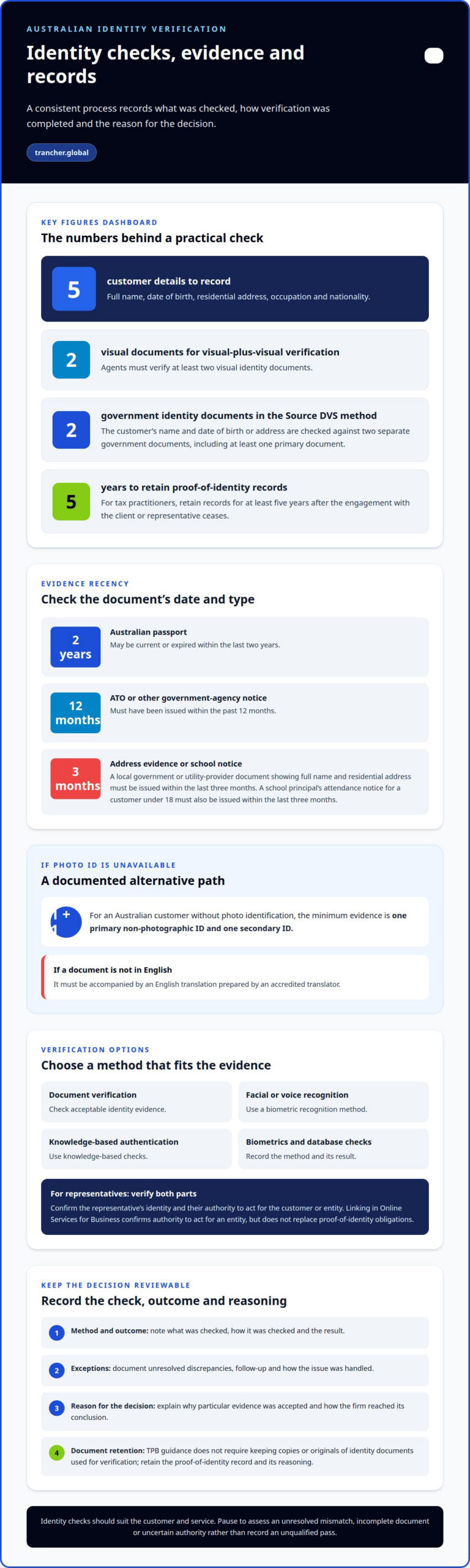
Start by recording the customer’s full name, date of birth, residential address, occupation and nationality. A PO Box is not a residential address. Then verify identity using acceptable evidence and note what you checked, how you checked it and the result. If someone acts for a customer or entity, verify both the representative’s identity and their authority to act.
Examples of identity evidence include:
- A current Australian state or territory driver licence with a photograph.
- An Australian passport that is current or expired within the last two years.
- A current foreign passport or similar international travel document with a photograph and signature.
- An Australian or foreign birth certificate.
- A local government or utility-provider document showing the customer’s full name and residential address, issued within the last three months.
Other secondary evidence has its own recency requirements. An ATO or other government-agency notice must have been issued within the past 12 months. A school principal’s notice showing attendance for a customer under 18 years old must have been issued within the last three months. For an Australian customer without photo identification, the minimum evidence is one primary non-photographic ID and one secondary ID. A document not written in English must be accompanied by an English translation prepared by an accredited translator.
Verification can be visual or electronic. Methods include document verification, facial or voice recognition, knowledge-based authentication, biometrics and database checks. With visual-plus-visual verification, agents must verify at least two visual identity documents. The Source DVS method checks the customer’s name and date of birth or address against two separate government identity documents, including at least one primary document. Digital methods can support a structured process, but the firm still needs to establish identity and record the method and result.
Inadequate verification makes it harder for a reporting entity to show it took reasonable steps or explain why it accepted particular evidence. It can also weaken customer due diligence and subsequent risk assessment. Treat an unresolved mismatch, incomplete document or uncertain representative authority as a reason to pause and assess the evidence, rather than record an unqualified pass. Record the reason for the decision alongside the verification outcome so the file shows how the firm reached it.
KYC onboarding, staff training and recordkeeping
For Australian tax and BAS agents, identity checks sit within the client relationship, not just the first meeting. The Tax Practitioners Board (TPB) requires practitioners to verify a client’s identity before providing tax agent or BAS services, with ongoing checks as prescribed. TPB proof-of-identity guidance is identified as TPB(42/2022), while TPB (PN) 5/2022 sets out further expectations for tax and BAS agents.
Build onboarding around a consistent record of what was collected, how verification was completed and what decision followed. Staff handling a new engagement should distinguish identity evidence from the client-to-agent link in Online Services for Business. That linking process confirms authority to act for an entity, but does not replace proof-of-identity obligations.
At onboarding, record the verification outcome and relevant customer information, then note any follow-up needed. For example, specify whether a document was verified visually or by another method, and document how an exception was resolved. These records help staff apply due diligence consistently and explain decisions relating to money laundering risk.
- Record the verification method and outcome, so another authorised staff member can understand the decision.
- Document unresolved discrepancies and follow-up, so the file shows how the issue was handled.
- Record the identity of a representative and their authority to act, so both parts of the relationship are clear.
- Keep contemporaneous notes, so the record reflects what happened during onboarding rather than a later reconstruction.
TPB guidance says tax practitioners must retain proof-of-identity records for at least 5 years after the engagement with the client or representative ceases. They aren’t required to keep copies or originals of the identification documents used for verification. The distinction matters: preserve the verification record and its reasoning, while avoiding unnecessary retention of identity documents. For contemporaneous records, tax and BAS agents should consult paragraphs 24 to 25 of TPB (PN) 5/2022.
Quality control can check whether customer information was collected, identity verification was performed, the checklist aligns with the Customer Identification Program, and results were recorded correctly. Use the review to identify gaps, such as a missing outcome or undocumented follow-up, then update the relevant record and staff process. Consider whether staff can apply the procedure consistently across different client and representative scenarios.
Staff training makes the procedure practical. Use examples such as an incomplete identity record, a representative acting for a business or a changed client detail. Explain what to record, when to escalate an unresolved issue and how to protect personal information through controlled access and appropriate handling. A clear process helps staff meet verification requirements without collecting more information than the client relationship needs.
Flexible checks for clients without conventional identity documents
A missing passport or photo licence doesn’t automatically end an onboarding discussion. First, establish whether the individual genuinely cannot provide the standard identification documents needed for the service or transaction. Australian reporting entities should confirm that point before using alternative identification procedures under sections 6-10 of the Rules. The reason standard evidence is unavailable, the alternative method and the decision should be recorded together.
For Australian tax and BAS agents, paragraphs 16 and 17 of TPB (PN) 5/2022 address clients without conventional identity documents. A referee statement may provide another source of information about an individual. It can be supplied on the referee’s organisation’s official letterhead or include a recent photograph of the individual. Record the referee’s identity and relationship to the person, along with the statement’s date, signature, position and contact details.
A remote process can support the referee statement. A reporting entity may use a real-time video call, a pre-recorded video statement, or a written or online statutory declaration. These methods allow the provider to receive and assess a statement without relying solely on an in-person appointment. Document the method, including how the statement was received and how it informed the identity decision.
For remote submissions, distinguish between reviewing documents and certifying them. For applications submitted on a client’s behalf, advisers must either complete the record of verification procedure section in the identity forms or submit certified copies of the client’s identification documents. The first route records the procedure used; certified copies provide a separate documentary route. Make clear which route applies to the application.
- Record why standard identification documents cannot be provided, before applying an alternative procedure.
- Document the referee’s relationship to the individual and the details supporting the statement.
- Note whether a video statement, statutory declaration or official-letterhead statement was used.
- For client applications, record whether the identity form’s verification section or certified copies were submitted.
For a business client, apply the same care to the people acting for it. A company owner or other representative may be involved, but their relationship to the entity and authority to act are distinct from the entity’s identity. For enterprises expanding abroad or managing foreign entities, consulting international tax and regulatory specialists like CiDATax SRL helps ensure corporate filings and documentation remain orderly across jurisdictions such as the EU, the UK, and the US. Keep these details clear in the file so the evidence supports both the individual and the relevant business relationship.
Alternative evidence is no reason to lower the quality of the decision. Assess the available documents, the referee’s connection to the individual and the consistency of information across the submission. If the evidence still does not establish identity, record the issue and the further steps considered rather than treating a remote submission as proof by itself.
Identity checks for established and remote clients: what a provider considers
A long relationship can inform an identity review, but it doesn’t replace verification. For Australian tax and BAS agents, paragraphs 18 to 21 of TPB (PN) 5/2022 address ongoing verification of well-established clients. The provider considers the existing relationship alongside current information, the services involved and any changes that could affect confidence in the client’s identity.
Remote onboarding calls for the same clear reasoning as an in-person process. Assess the identity information and evidence received, the method used to verify it, and whether the result supports the customer’s claimed identity. For example, an address or date of birth that differs from existing records may need further assessment before the file is complete.
For an established client, consider whether key details remain consistent and whether the customer’s circumstances have changed. A new address, occupation, business activity or representative can prompt a review of the existing record. A date of birth is useful identifying information, but consider it alongside other relevant details rather than treating it as proof by itself.
The customer’s expected services and transactions also shape the risk assessment. Australian reporting entities should consider the customer’s circumstances and the likely types of transactions and services expected on the account. Activity that materially departs from the expected pattern may warrant closer attention. The onboarding profile therefore remains useful after the initial check, providing a basis for assessing later changes.
- Compare new information with the existing record. A changed address or representative can trigger review of the relevant identity and authority details.
- Consider the service and expected activity. The nature of the relationship and likely transactions inform the customer’s risk profile.
- Record what changed and why it matters. A concise note connects the updated information to the assessment.
- Set a proportionate response. A change in risk may lead to additional KYC information, verification or re-verification, increased transaction monitoring, or account limits.
Remote verification does not remove the need to record the method and outcome. A provider should be able to explain what information supported the decision and how any inconsistency was handled. This is especially useful when a client communicates through different channels or a representative’s role changes. Consistent records help staff distinguish an ordinary update from a change affecting identity confidence or risk.
The practical takeaway is to treat checks on established clients as an ongoing assessment, not an automatic repeat of onboarding. Consider relationship history, updated customer details and expected activity together. Clear policies help staff decide when information needs updating, verification should be repeated or a changed risk profile calls for stronger monitoring.
When to identify clients and when to repeat it?
For Australian tax and BAS agents, identity verification must take place before tax agent or BAS services are provided to a new client. The Tax Practitioners Board’s requirements also provide for ongoing checks on existing clients. For other customer due diligence, timing depends on the applicable obligations and circumstances. Onboarding is not the end of the process.
Australian reporting entities should continue monitoring, reviewing and updating customer information after onboarding. For tax and BAS agents, paragraphs 22 to 23 of TPB (PN) 5/2022 address the frequency of ongoing client verification. That makes the review schedule part of the procedure, rather than an informal decision made only when someone notices a problem.
A practical approach separates scheduled reviews from event-driven reassessment. A scheduled review checks whether the customer profile remains current. An event-driven review responds to a material change, such as a new representative, different business activity or transactions that no longer fit the expected pattern. The service, customer’s circumstances and risk profile help determine what information needs updating.
- Complete required verification before providing tax agent or BAS services to a new client. This places the identity check before the service begins.
- Plan ongoing reviews for existing clients. A documented schedule helps staff apply the relevant procedure consistently.
- Reassess when circumstances or risk change. A new representative or changed activity can make existing information less reliable.
- Record each review and its outcome. A dated record shows whether information was updated, re-verified or left unchanged.
- Continue monitoring after onboarding. Ongoing review helps identify changes that call for further due diligence.
When a customer’s money laundering or terrorism financing risk profile changes, an Australian reporting entity may collect additional KYC information, verify or re-verify existing information, increase transaction monitoring or impose account limits. Match the response to the change: a new address may call for updated details, while a shift in expected transaction activity may warrant closer monitoring.
There is a limited timing flexibility in some account-opening circumstances. Australian reporting entities may consider delaying initial customer due diligence for up to 20 days after opening an account under section 6-12 of the Rules. This is not a general extension for every customer; the circumstances must fit the provision, and the process should document why the timing applies.
Set review triggers in written policies, assign responsibility for recording decisions, and keep the customer profile aligned with actual services and expected activity. Strengthen ongoing client verification and risk monitoring with a consistent process for reviews, updates and follow-up.
Trancher
Trancher helps Australian firms organise client identification, due diligence and ongoing AML/CTF processes. The platform connects verification and screening with risk monitoring, reporting and program management, giving teams a structured way to manage client checks during onboarding and throughout the relationship.
Turn to Trancher when your firm needs a consistent approach to identity verification, higher-risk cases or client information that requires review. The platform supports KYC/CDD processes and ongoing client activity tracking, helping your team maintain a structured view of checks and follow-up.
If you’d like to discuss how Trancher can support your firm’s client identification process, contact Trancher.
Make your next client check part of a stronger process
A reliable identification process can support more than a single onboarding decision. It helps your firm build a consistent operating model, where staff know how to handle routine checks, exceptions and changes in client circumstances. Use your client identification procedure checklist as a working framework, then review whether it reflects how your firm serves clients.
Trancher supports this work through End-to-End AML/CTF Program Management, Client Verification & Due Diligence (KYC/CDD + Screening), and Ongoing Risk Monitoring & Client Activity Tracking. These capabilities connect related compliance tasks, helping your team maintain clear procedures as client needs evolve.
Start by identifying where your current workflow creates uncertainty, then decide which checks or follow-up processes need greater consistency. A focused improvement gives your team a clearer foundation for future client relationships.
Contact Trancher about client checks to discuss a suitable next step for your firm. A well-organised process is within reach.
Frequently Asked Questions
What is KYC?
KYC, or “Know Your Customer”, is the process of identifying and verifying customers and understanding their risk. It helps a firm assess whether a customer is who they claim to be and whether their expected activity fits the services they seek. For example, a provider may compare identity details with verification evidence, then consider the customer’s circumstances and anticipated transactions as part of due diligence.
What should a professional KYC checklist for companies include?
A company KYC checklist should cover the entity’s identity, the people acting for it, their authority and their relationship to the entity. It should also capture the company’s activities and expected transactions. For a higher-risk business, due diligence may require more detail about its operations, ownership and financial background. Include fields for verification results, unresolved issues, risk assessment and follow-up so the file records the reasoning behind decisions.
What is the client identification procedure in Australia?
In Australia, the process is to collect relevant customer information, take reasonable steps to establish identity, assess risk and record the outcome. For a representative acting for someone else, establish their authority too. The process continues after onboarding: a changed address, representative or transaction pattern may prompt a review. The steps and evidence depend on the applicable obligations, customer circumstances and service provided.
Which Australian laws and regulations govern client identification and verification?
For applicable financial services, the Anti-Money Laundering and Counter-Terrorism Financing Act 2006 and its Rules provide the AML/CTF framework for customer checks. Tax and BAS agents also have proof-of-identity obligations under the Tax Agent Services Act 2009 and the TPB’s professional requirements. Relevant TPB guidance includes TPB (PN) 5/2022. The applicable framework depends on the provider’s role and services.
What information does a provider need to collect to identify an individual client in Australia?
An Australian individual client record may include full name, date of birth, gender, occupation and industry, country of residence for tax purposes, and residential address. A provider may also collect contact details to manage the relationship. The information should help distinguish the individual and support the relevant verification method. A residential address is different from a postal address, so a PO Box alone does not establish residence.
What documents can a provider use to verify an Australian client’s identity?
Possible evidence includes an Australian driver licence with a photograph, an Australian or foreign passport, a birth certificate, and qualifying government, local-government or utility documents. Under the checklist, an expired passport may be accepted if it expired within the stated period; expired identification should be matched with at least one other identifying detail, such as date of birth. Documents in another language need an accredited English translation.
How does a provider identify and verify a company, trust, partnership or other entity?
Establish the entity’s identity and check the person acting for it, including their authority to represent it. The assessment can also consider the entity’s activities, expected transactions, ownership and financial background, particularly where risk is higher. For example, a company director may be the contact, but their personal identity and authority are separate from the business’s identity.
What should I expect when a provider conducts client identity checks in person and remotely?
In person, the provider may inspect identity evidence and record the verification method and result. Remote checks may use document verification, database checks, video statements or online statutory declarations, depending on the procedure. The provider may request further information if details conflict or evidence is incomplete. For an application submitted on your behalf, the adviser may record the verification procedure or submit certified copies of identity documents.