

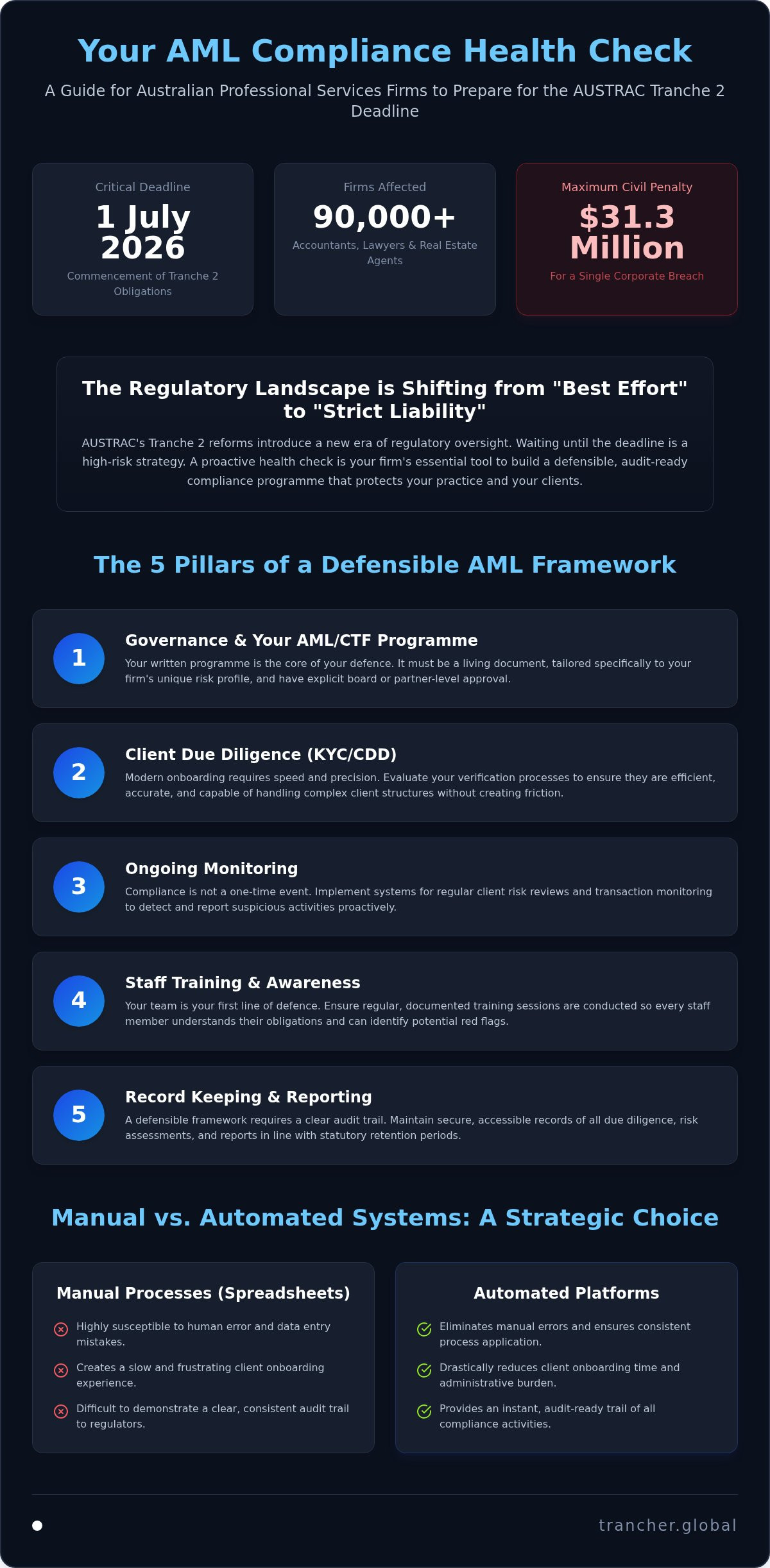
By 1 July 2026, more than 90,000 Australian professional services firms will enter a new era of regulatory oversight that many currently feel unprepared to manage. It’s understandable if you view the looming AUSTRAC Tranche 2 obligations with a mix of anxiety and frustration, especially when compliance often feels like a heavy, non-billable overhead that pulls you away from your clients. You want to protect your practice from staggering civil penalties that can reach $31.3 million for corporations, yet the administrative burden of manual onboarding feels unsustainable.
We’re here to help you navigate this transition with confidence. This guide provides a structured AML compliance health check designed to evaluate your current standing and ensure you’re fully prepared for the July 2026 deadline. You’ll learn how to build a defensible framework that doesn’t just satisfy the regulator but actually improves your internal systems. We’ll explore how to replace manual tasks with smart automation and, crucially, how to transform these mandatory obligations into a recoverable activity that supports your firm’s financial health. From enrolment deadlines to audit-ready documentation, this checklist serves as your roadmap to a more efficient and profitable future.
Key Takeaways
- Understand the critical importance of the 1 July 2026 deadline for Tranche 2 entities and why proactive enrolment is essential to avoid significant penalties.
- Conduct a comprehensive AML compliance health check that scrutinises both your digital systems and human processes across five core defensible pillars.
- Discover why automated platforms outperform manual spreadsheets by eliminating human error and drastically reducing client onboarding times.
- Access a high-impact readiness checklist that separates immediate regulatory actions from long-term systems optimisation for your firm.
- Learn how to transform compliance from a non-billable overhead into a recoverable professional service that generates clear ROI.
The 2026 Regulatory Landscape: Why a Health Check is Non-Negotiable
An AML compliance health check is a proactive gap analysis that compares your firm’s current internal systems against the rigorous standards mandated by AUSTRAC. It’s not a mere administrative exercise; it’s a strategic review that identifies where your processes might fall short of the law. As the global landscape for Anti-money laundering (AML) evolves, Australian firms must ensure their foundations are solid before the regulatory environment shifts permanently.
The 1 July 2026 deadline marks a pivotal change for accountants and lawyers across the country. On this date, the Tranche 2 reforms officially commence, bringing approximately 90,000 professional services businesses under the oversight of AUSTRAC. Waiting until June 2026 to evaluate your systems is a high-risk strategy that leaves no room for error. A genuine AML compliance health check performed now allows you to rectify weaknesses calmly, rather than rushing through a checklist as the deadline looms.
Understanding the AUSTRAC Tranche 2 Impact
The expanded framework captures “designated services” that were previously outside the regulatory net. These include managing client money or assets, acting as a company secretary, and providing certain real estate transaction services. AUSTRAC’s focus has shifted toward “defensibility”. This means having a clear, documented audit trail that proves your firm has actively identified and mitigated risks. Tranche 2 obligations mandate that all newly regulated professional services firms must have a comprehensive AML/CTF programme and reporting framework in place by the 1 July 2026 commencement date.
The regulator’s stance is also moving from “best effort” to “strict liability”. In the past, showing a willing heart might have softened a regulatory blow. Now, the expectation is operational readiness from day one. If your systems aren’t compliant by the deadline, your firm is exposed to immediate risk, regardless of your intentions.
The Hidden Costs of Non-Compliance
The financial stakes are exceptionally high. For corporate entities, a single breach can result in civil penalties of up to $31.3 million. Beyond these fines, AUSTRAC frequently uses enforceable undertakings, which can place your firm’s operations under direct regulatory supervision for years. This is a heavy administrative and financial burden that most SME firms simply aren’t equipped to carry.
Reputational damage is often the silent killer of a professional practice. AUSTRAC enforcement actions are public, and being flagged for compliance failures can erode the trust you’ve built with clients over decades. To start building your foundation today, refer to our AML program checklist Australia for a step-by-step guide to readiness. Taking action now ensures your firm remains a trusted, secure partner for your clients well beyond 2026.
The 5 Pillars of a Defensible AML Compliance Health Check
Achieving a state of “audit-readiness” for July 2026 requires more than a casual glance at your files. A truly robust AML compliance health check examines your firm through a lens of defensibility. It ensures that every decision you make is backed by a clear rationale and documented evidence. We view these five pillars, governance, client due diligence, ongoing monitoring, staff training, and record keeping, as the essential framework for a successful transition. By balancing advanced technology with sound human oversight, you can remove the friction from your daily operations and meet AUSTRAC standards with ease.
Pillar 1: Governance and the AML/CTF Programme
Your written AML/CTF programme is the heart of your compliance framework. It shouldn’t be a static document or a generic template. Instead, it must be specifically tailored to your business risk assessment, reflecting the unique nature of your client base and service offerings. During your health check, verify that you’ve formally appointed an AML Compliance Officer and that your programme has received explicit approval at the partner or board level. This top-down commitment is exactly what the regulator looks for during a review.
Pillar 2: Client Due Diligence (KYC/CDD)
Modern onboarding requires speed and precision. Evaluate whether your current client verification tools are up to the task or if they’re creating a manual bottleneck. Ensuring consistent CDD and KYC requirements Australia across all client types is vital, particularly when dealing with complex trust structures. Your health check must confirm that beneficial ownership is being accurately identified and verified, leaving no room for ambiguity in your records.
Pillar 3: Ongoing Monitoring and Reporting
Identifying “red flags” shouldn’t rely on luck or memory. You need systematic ways to track suspicious activities and a clear process for reporting them. Assess the reliability of your automated SMR reporting AUSTRAC capabilities to ensure you can meet reporting deadlines without the stress of manual filing. Additionally, ensure your team has a firm understanding source of wealth vs source of funds, as documenting this distinction for high-risk clients is a key regulatory expectation.
Pillar 4: Staff Training and Expert Support
A programme is only as strong as the people who implement it. Your health check should verify that all staff members receive regular, relevant training on AML/CTF risks. Providing your team with access to expert guidance ensures they can handle complex scenarios with confidence, reducing the risk of internal errors.
Pillar 5: Audit-Ready Documentation and Record Keeping
If it isn’t documented, it didn’t happen. Ensure your systems automatically capture and store all compliance activities in an organised, easily accessible format. If you’re looking to simplify this process, an integrated AML management platform can help you maintain a permanent, audit-ready trail without the administrative burden.
Manual Audits vs. Automated Health Checks: A Strategic Comparison
For many firm partners, the thought of an AML compliance health check conjures images of endless spreadsheets and lost billable hours. Historically, firms have treated compliance as a manual administrative burden, a necessary evil that drains resources and slows down client onboarding. However, the shift toward Tranche 2 obligations means that “good enough” manual records no longer suffice. Transitioning from a manual cost-centre to an automated, platform-led system isn’t just about avoiding penalties; it’s about reclaiming your time and ensuring your firm’s regulatory standing is beyond reproach.
The Problem with Spreadsheet Compliance
Manual records are notoriously difficult to maintain in a busy professional environment. During a formal AUSTRAC review, spreadsheets often fail because they lack a clear, immutable audit trail. When multiple staff members access the same file, version control becomes a nightmare, leading to inconsistent data and missed red flags. Human error is an inherent risk in manual monitoring; it only takes one missed expiry date or one overlooked PEP check to create a significant breach. AUSTRAC expects a level of precision that manual systems simply can’t guarantee under the pressure of daily operations.
Turning Compliance into a Billable Asset
The most significant advantage of moving away from manual work is the ability to transform compliance from an overhead into a recoverable professional service. While manual audits represent sunk costs, automated platforms allow you to track the exact time spent on due diligence and reporting. This enables the concept of recoverable compliance activity, where your firm can accurately bill for the value provided during the onboarding process. By using compliance ROI tracking software, you shift the narrative from a regulatory hurdle to a revenue-generating asset. This business-minded approach ensures that your commitment to integrity also supports your firm’s financial growth. Real-time reporting capabilities mean you can generate a comprehensive status update for the regulator at the touch of a button, providing ultimate peace of mind for stressed partners.
The Tranche 2 Readiness Checklist: 2026 Edition
The 1 July 2026 commencement date is no longer a distant concern; it’s a firm regulatory milestone that requires immediate attention. Transitioning your practice into this new era doesn’t have to be an overwhelming process. By conducting a structured AML compliance health check, you can break down complex AUSTRAC requirements into manageable, actionable steps. This checklist is designed to help you identify immediate gaps and move toward a system that prioritises operational ease and financial recovery.
Immediate Compliance Gaps to Close
Focusing on these core requirements ensures you meet the absolute minimum standards for regulatory defensibility. If you can’t answer “yes” to these points, these are your primary areas for urgent attention:
- AUSTRAC Enrolment: Have you officially enrolled your firm as a reporting entity? Enrolment opened on 31 March 2026, and you must ensure your details are finalised before the 29 July 2026 deadline to avoid significant daily penalties.
- Documented Risk Assessment: Is there a formal, written Risk Assessment that specifically addresses the services your firm provides? This must be a living document, not a generic template, that reflects your actual client risk profile.
- Real-Time Screening: Are you able to screen clients against PEP (Politically Exposed Persons) and Sanctions lists in real-time during onboarding? Manual searches are no longer considered a reliable or defensible method for busy firms.
- Reporting Protocols: Does your team have clear, documented instructions on when to submit a suspicious matter report? Knowing exactly when the clock starts on a reportable event is critical for staying on the right side of the regulator.
Operational Readiness and ROI
Once your foundational gaps are closed, the next stage of your AML compliance health check involves optimising your systems for efficiency and profitability. Compliance shouldn’t just be about staying out of trouble; it should be an integrated part of your firm’s value proposition.
- Documented Training: Is your staff training up-to-date and, more importantly, fully documented? An auditor will want to see exactly who was trained, when it happened, and what was covered.
- Recoverable Time Tracking: Do you have a system in place to track the time spent on compliance tasks? Capturing these minutes allows you to transform compliance from a cost-centre into a billable activity.
- Rapid Reporting: Can you produce a complete, audit-ready report for any specific client file in under 5 minutes? If it takes hours to gather documentation for a single file, your manual systems are creating a significant administrative bottleneck.
Moving from a state of uncertainty to total readiness is a strategic advantage. You can start your 30-day readiness journey today to ensure your firm is fully compliant and profitable well before the 2026 deadline.
Finding a path through the new regulatory requirements requires more than just a checklist. It requires a partner who understands the unique pressures of the Australian accounting sector. Trancher acts as your expert compliance companion, offering a steady hand to help you move from uncertainty to total readiness. We don’t just point out where your AML compliance health check reveals gaps; we provide the integrated tools and local support needed to close them permanently.
Our platform was built specifically for SME firms that need to balance strict AUSTRAC standards with the realities of running a profitable business. Under the leadership of our founder, Aaron Soh, our team provides the strategic guidance necessary to transform a complex transition into a manageable success. You aren’t just adopting a software platform; you’re gaining access to a local support team dedicated to your firm’s operational ease.
The 30-Day Compliance Guarantee
Time is a luxury that many firms feel they’re losing as the 1 July 2026 deadline approaches. We address this urgency with a unique 30-day compliance guarantee. This fast-track implementation process ensures your firm is fully prepared for Tranche 2 obligations without cutting corners on defensibility. It provides the peace of mind that comes from knowing your systems are audit-ready well before the regulator begins its proactive supervision.
Operational efficiency is at the core of our approach. During the implementation phase, we focus on removing the friction from your client onboarding and ongoing monitoring workflows. We believe that a successful transition should lead to measurable results. To prove this, Trancher provides a formal ROI report at the end of your trial period, showing exactly how much time has been saved and how many compliance hours have become billable assets.
Taking the Next Step with Confidence
There’s no need to wait for a regulatory nudge to begin improving your systems. Starting a conversation now allows you to explore our features through a complimentary 3-month trial tailored specifically for accounting firms. This period gives you the space to integrate our platform into your daily workflows and see the benefits of automation firsthand. Firms that choose to transition from the trial to a full subscription also benefit from a 20% discount, making the move to a more secure future even more advantageous.
Your firm’s reputation and financial health are too important to leave to manual processes. By choosing a partner that guarantees results, you can focus on what you do best: serving your clients. Start your complimentary 3-month trial with Trancher today.
Securing Your Practice for a Compliant Future
The transition to the Tranche 2 regime represents a significant milestone for Australian professional services. By moving away from manual, spreadsheet-based systems and embracing automation, you can protect your firm from the strict liability standards that commence on 1 July 2026. Performing a comprehensive AML compliance health check today ensures that your governance, due diligence, and reporting protocols are not just compliant, but defensible and efficient.
We’re here to act as your expert guide throughout this process. You can secure your firm’s future with a complimentary 3-month Trancher trial, which includes our 30-day compliance readiness guarantee and dedicated local Australian support. Every trial also provides detailed ROI reporting; this helps you see exactly how compliance can be transformed into a billable, revenue-generating activity. Don’t let the administrative burden of new regulations hold your practice back. With the right tools and support, you’ll find that meeting your obligations is a straightforward path to improved operational health and long-term peace of mind.
Frequently Asked Questions
What is an AML compliance health check?
An AML compliance health check is a proactive gap analysis that evaluates your firm’s current systems and processes against AUSTRAC’s regulatory standards. It identifies specific weaknesses in your AML/CTF programme before they become legal liabilities. By scrutinising your client onboarding, risk assessments, and reporting protocols, you can ensure your practice is defensible. This review helps you move from a reactive stance to a position of operational confidence well before any formal audit occurs.
When does the AUSTRAC Tranche 2 deadline take effect?
The official commencement date for AUSTRAC Tranche 2 obligations is 1 July 2026. This deadline is a fixed regulatory fact that requires all newly captured professional services firms to have a compliant programme in place. Enrolment with AUSTRAC opened on 31 March 2026, and firms must complete this process by 29 July 2026. Preparing early ensures your firm avoids the daily penalties associated with non-enrolment and remains fully operational from day one.
Can I perform an AML health check internally or do I need a consultant?
You can perform an internal AML compliance health check using structured frameworks, though many firms find manual reviews time-consuming and prone to human error. While expensive external consultants were once the only alternative, modern platforms provide a middle ground. These systems guide you through the process with expert-aligned workflows, ensuring your review is thorough and defensible. This approach provides the steady guidance of an expert without the high costs of traditional consultancy.
How much does it cost to implement an AML compliance programme in 2026?
The cost of implementation varies based on your firm’s size and whether you choose manual processes, external consultants, or automated platforms. While manual systems appear cheaper initially, they often carry high hidden costs in lost billable time and administrative overhead. Trancher offers a complimentary 3-month trial to help accounting firms assess the platform’s value without an upfront investment. This allows you to evaluate the system’s efficiency and ROI before committing to a subscription.
What are the main “designated services” for accountants under Tranche 2?
Under the expanded framework, designated services for accountants include managing client money or assets, providing real estate transaction services, and acting as a company secretary or director. It also covers the formation of companies or legal arrangements and providing registered office services. If your firm performs any of these activities, you’re required to comply with the full suite of AML/CTF obligations by the 1 July 2026 deadline.
How does Trancher help recover the costs of compliance?
Trancher transforms compliance from a cost centre into a recoverable professional service by tracking the exact time spent on mandatory tasks. Our platform identifies billable compliance hours, allowing you to include these activities in your client billing. At the end of our complimentary trial, we provide a formal ROI report that details the time saved and the revenue potential of your compliance work. This ensures your regulatory obligations actually support your firm’s financial growth.
What happens if our firm fails an AUSTRAC audit?
Failing an AUSTRAC audit can lead to severe consequences, including civil penalties of up to $31.3 million for corporate entities and $6.26 million for individuals per breach. Beyond financial fines, the regulator may issue enforceable undertakings or remedial directions that place your firm under strict supervision. These actions are public, which carries a significant risk of reputational damage. It’s much safer to identify and fix gaps through a proactive review before an auditor arrives.
How long does it take to get AUSTRAC-ready with Trancher?
We guarantee that your firm will be AML/CTF compliance-ready within 30 days of starting with our platform. This rapid implementation is supported by our dedicated local Australian onboarding team, who guide you through every step of the setup. This timeline ensures you meet the 1 July 2026 deadline with plenty of time to spare. Our goal is to remove the stress of complex transitions and get your systems running smoothly and profitably.