

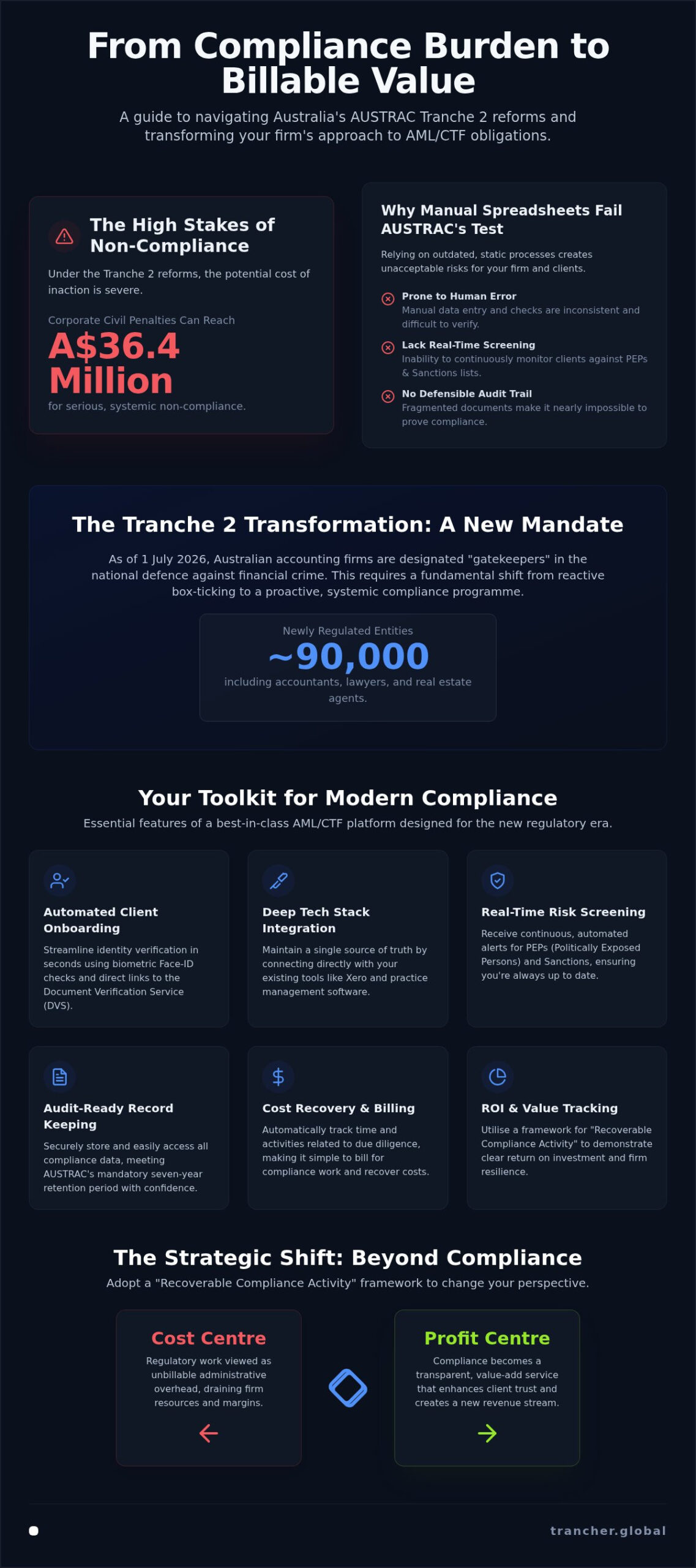
What if the hours your team spends on AUSTRAC paperwork weren’t just a drain on your margins, but a new stream of billable value? It’s a question many firm partners are asking now that the Tranche 2 reforms are fully active as of July 2026. You likely feel the weight of these new obligations, especially with corporate penalties now reaching up to A$36.4 million for serious non-compliance. Identifying the right software for billing AML compliance services is the first step in moving from a reactive state of “getting by” to a proactive position of “getting ahead.”
We understand that the administrative lift of manual verification and fragmented processes is exhausting. This guide promises to help you select an AML/CTF solution that secures your firm’s standing with AUSTRAC while turning regulatory overhead into a profitable, value-add service for your clients. We’ll walk through the essential features of modern compliance platforms, including automated onboarding and ROI tracking, to ensure your practice remains both audit-ready and financially resilient in this new regulatory era.
Key Takeaways
- Understand why manual spreadsheets no longer meet AUSTRAC’s 2026 Tranche 2 standards and how to secure your firm against significant regulatory risks.
- Identify essential software features like automated KYC for complex beneficial ownership and deep integrations with your existing accounting tech stack.
- Learn how to utilise specialised software for billing AML compliance services to recover administrative costs and create a transparent new revenue stream.
- Follow a practical 30-day roadmap to formalise your AML/CTF programme and transition from fragmented manual workflows to a unified digital system.
- Shift your firm’s perspective from compliance as a cost centre to a strategic profit centre using a “Recoverable Compliance Activity” framework for clear ROI.
The 2026 AML/CTF Landscape for Australian Accounting Firms
The date 1 July 2026 marked a definitive shift in how Australian accounting firms operate. With the full commencement of Tranche 2 reforms, approximately 90,000 new entities have entered the regulatory fold. As a practice leader, you’ve likely felt the weight of these changes. You’re no longer just a tax expert or a business advisor; you’re now a vital part of the nation’s defence against financial crime. AUSTRAC, Australia’s financial intelligence agency, now views your firm as a “gatekeeper” with formal obligations to identify and report suspicious activities.
Managing these obligations through manual spreadsheets is no longer a viable “compliance programme.” AUSTRAC expects a level of rigour that static documents simply can’t provide. Manual processes are prone to human error, lack real-time screening capabilities, and make it nearly impossible to maintain an audit-ready trail. Transitioning to dedicated software for billing AML compliance services isn’t just about meeting a requirement; it’s about protecting your firm’s reputation while ensuring every minute of compliance work is accounted for and recoverable.
Why Tranche 2 Changed Everything for SMEs
The transition from voluntary participation to mandatory reporting has been a significant adjustment for many small-to-medium practices. Under the current laws, several common accounting tasks are now classified as “designated services.” If your firm handles company formation, acts as a trustee, manages client funds, or facilitates large asset transfers, you’re legally required to have a formal AML/CTF programme in place. The stakes are high. As of July 2026, the value of a single penalty unit is A$364. This means a corporation could face civil penalties of up to A$36.4 million for serious, systemic non-compliance. Using software for billing AML compliance services helps you mitigate these risks by automating the heavy lifting while creating a transparent framework for cost recovery.
The Shift from “Checking Boxes” to “Systemic Compliance”
AUSTRAC’s expectations have evolved beyond simple “point-in-time” identity checks. They now require a “living, breathing” compliance programme that includes ongoing monitoring and risk reassessment. It’s not enough to verify a client once during onboarding; you must stay alert to changes in their risk profile or transaction patterns over time. A “tick-box” approach fails to capture the dynamic nature of modern financial risk. To remain compliant, your systems must provide a continuous, verifiable record of due diligence activities. In the 2026 Australian context, a Reporting Entity is any person or business providing one or more designated services listed under the AML/CTF Act within Australia.
Essential Features of Best-in-Class AML CTF Compliance Software Australia
Selecting the right technology is no longer a luxury for Australian practices; it’s a strategic necessity. The ideal platform doesn’t just sit alongside your workflow. It weaves itself into your daily operations, removing the friction of manual data entry. When you implement specialised software for billing AML compliance services, you’re not just buying a tool. You’re investing in a system that captures every billable minute of due diligence while ensuring your firm remains beyond reproach during an audit. High-quality solutions prioritised for the 2026 landscape must offer seamless integration with your existing tech stack, such as Xero or your preferred practice management software, to maintain a single source of truth.
Beyond simple connectivity, your software must handle the heavy lifting of real-time PEPs (Politically Exposed Persons) and Sanctions screening. This isn’t a one-off task. It’s a continuous process that requires automated red flag alerts to notify your team the moment a client’s risk profile changes. To meet the mandatory seven-year retention period, your system should provide audit-ready record keeping that is both secure and easily accessible. If you’re looking to streamline these complex requirements, exploring an end-to-end compliance partner can provide the steady guidance your firm needs.
Automated Client Onboarding and Verification
Modern onboarding should feel welcoming for the client and effortless for your staff. Best-in-class software utilises biometric Face-ID checks and direct Document Verification Service (DVS) links to confirm identities in seconds. This is particularly vital when dealing with complex structures like Discretionary Trusts and SMSFs, where identifying ultimate beneficial owners can traditionally take hours of manual searching. By ensuring your CDD and KYC requirements Australia are handled through an automated workflow, you reduce the risk of human error and significantly accelerate your time-to-bill.
Regulatory Reporting and SMR Automation
Filing reports with the regulator shouldn’t be a source of anxiety. Your software should act as a supportive guide, providing prompts that help you complete Suspicious Matter Reports (SMRs) accurately and within the strict 24-hour or three-day windows. Automation is equally critical for Threshold Transaction Reporting (TTR) for physical currency movements of A$10,000 or more. Maintaining Audit-ready compliance records ensures that when the time comes for your AUSTRAC annual report, the data is already organised and verified. For more specific details on your obligations, the AUSTRAC guidance for accountants provides a foundational framework that your software should inherently support.
Comparing the Best AML/CTF Software for SME Firms
When you begin evaluating the market, it’s helpful to distinguish between global platforms and local, specialised solutions. While a large international platform might offer a sleek interface, they often lack the granular knowledge of the Australian Tranche 2 landscape. A tool designed for the US or EU market won’t necessarily understand the intricacies of Australian discretionary trusts or the specific reporting timelines required by AUSTRAC. For an SME firm, the goal isn’t just to have a software login; it’s to have a system that aligns perfectly with your specific regulatory environment without creating more work for your team.
Total cost of ownership is another critical factor that many firms overlook during the initial demo. A “tool-only” solution might appear cost-effective on the surface, but if it requires your staff to manually transfer data between systems or spend hours on training, the hidden costs mount quickly. This is where software for billing AML compliance services provides a distinct advantage. By integrating the compliance activity directly with your billing workflow, you ensure that every minute spent on due diligence is captured and recoverable. This transforms compliance from a sunk cost into a transparent, professional service that adds value to your client relationships.
Trancher vs. Generalist AML Platforms
The primary difference between Trancher and generalist platforms lies in the depth of the partnership. Most generalist tools offer an open-ended implementation period, leaving your firm to figure out the nuances of your AML/CTF programme alone. Trancher provides a 30-day compliance-ready guarantee, ensuring you move from manual processes to a fully digital, audit-ready state in a fixed timeframe. We act as your “Expert Compliance Companion,” providing the steady guidance needed to integrate compliance into your existing engagement letters and workflows. This accounting-specific focus ensures that your staff don’t have to learn a whole new language just to complete a KYC check.
The Importance of Local Australian Expertise
Relying on software that doesn’t strictly adhere to Australian standards can be a risky strategy. Local expertise is essential because AUSTRAC’s guidance for accountants is unique and continues to evolve. You need a partner that understands the Australian context and provides support during your local business hours. Utilising ongoing risk monitoring software tailored to the local market ensures that you’re alerted to changes in the Australian sanctions list or PEP status immediately. This local focus provides the reassurance that your firm isn’t just compliant today, but remains protected as the regulatory landscape shifts in the years ahead.
Implementation: Transitioning from Manual Processes in 30 Days
Moving your practice from a manual, spreadsheet-based system to a modern digital framework shouldn’t take months of trial and error. Many firms find themselves stuck in “compliance limbo,” where they’ve identified the need for change but feel overwhelmed by the setup process. We believe that a structured, 30-day roadmap is the most effective way to secure your firm’s standing with AUSTRAC while ensuring your team remains productive. By utilizing specialized software for billing AML compliance services, you can transition smoothly without disrupting your daily billable work.
Your implementation journey follows five clear, manageable stages:
- Step 1: Risk Assessment. Conduct a firm-wide review to identify exactly which designated services you provide and where your specific vulnerabilities lie.
- Step 2: Formalise Your Programme. Document your AML/CTF policies and officially appoint a Compliance Officer to oversee the system.
- Step 3: Workflow Integration. Embed automated KYC and CDD checks directly into your client onboarding process to capture data at the source.
- Step 4: Team Training. Equip your staff with the knowledge to identify red flags and the confidence to use your new reporting portal.
- Step 5: Lifecycle Management. Establish your ongoing monitoring cycles and prepare for your first annual AUSTRAC report.
Overcoming the Administrative Burden Objection
The biggest hurdle for most partners is the fear of added administrative weight. However, industry data indicates that moving to an automated system can reduce manual data entry by up to 80%. This shift replaces messy, fragmented spreadsheets with a centralised dashboard that provides a single source of truth. It’s an assured transition that moves compliance from a hidden time-sink to a visible, managed process. With the right partner, this 30-day timeline is not just a goal; it’s a guaranteed outcome that protects your practice. To see how this framework fits your firm, start your 30-day compliance-ready transition today.
Staff Training and Cultural Buy-In
Success depends on making compliance part of your firm’s professional DNA. It shouldn’t feel like a separate, burdensome task, but rather a standard part of delivering high-quality professional services. Providing your team with expert, on-call support reduces the anxiety often associated with new regulatory requirements. When your staff understand that the software for billing AML compliance services actually makes their jobs easier by automating repetitive checks, buy-in happens naturally. For a deeper look at managing these transitions, explore our guide on AML CTF compliance costs reduction to see how efficient training pays for itself.
Beyond Compliance: Turning AUSTRAC Obligations into a Profit Centre
It’s time to move past the idea that compliance is merely a sunk cost or an administrative hurdle. While the Tranche 2 reforms certainly bring new responsibilities, they also present a unique opportunity to formalise the high-value due diligence you already perform for your clients. By implementing specialised software for billing AML compliance services, your firm can transition from viewing regulation as an overhead to seeing it as a legitimate revenue stream. This shift in mindset is supported by our “Recoverable Compliance Activity” framework, which ensures that the professional time spent securing a client’s integrity is accurately tracked and billed.
Beyond simple cost recovery, these new obligations allow you to offer AML Advisory as a high-margin service. Your clients often look to you for guidance on their own risk profiles and corporate structures. Providing them with deep insights into their compliance health isn’t just a regulatory requirement; it’s a premium advisory offering. The Trancher ROI report serves as a vital tool here, providing the hard data your partnership needs to see exactly how the platform transforms a perceived burden into a strategic financial asset.
The ROI of Automated Compliance
The financial benefits of automation become clear when you compare the traditional manual approach to a digital-first workflow. Manual onboarding for a complex trust structure can often consume several hours of a senior staff member’s time, whereas an automated system completes the same verification in a fraction of that window. You can utilise compliance ROI tracking software to justify your technology spend by visualising these time savings and billable recoveries in real-time. We’ve seen that firms which embrace this business-minded optimism don’t just survive the transition to Tranche 2; they thrive by creating more efficient internal systems that support long-term growth.
Communicating Compliance Value to Clients
A common concern for practice leaders is how to explain new compliance fees to long-standing clients. We suggest framing these costs as a vital security and integrity measure that protects the client’s business as much as your own. When clients see a professional, digital-first onboarding experience, it builds immediate trust and demonstrates that your firm is proactive and technologically capable. You can use transparent templates to explain that these fees cover the sophisticated screening and monitoring required to maintain their standing in the Australian financial system. We’re here to act as your strategic guide through this process, ensuring you feel confident in every client conversation. To experience this transformation first-hand, we invite you to start your complimentary 3-month trial and begin turning your compliance obligations into a professional advantage.
Securing Your Firm’s Future and Profitability
The transition to the 2026 AUSTRAC standards represents a significant milestone for Australian accounting practices. By moving away from fragmented manual processes and adopting automated systems, you’re protecting your firm’s reputation while enhancing operational efficiency. It’s now clear that compliance doesn’t have to be a sunk cost. Implementing software for billing AML compliance services allows you to capture every billable moment, turning regulatory requirements into a transparent professional service. With a 30-day compliance-ready guarantee and expert support from Aaron Soh, the path forward is both manageable and advantageous.
We’re committed to acting as your steady guide through this evolution, ensuring you have the tools and insights to thrive. At the conclusion of your trial, you’ll receive a full ROI report that proves the financial health and value of your new compliance framework. Start your complimentary 3-month Trancher trial and secure your 30-day compliance guarantee today. We look forward to helping you transform these obligations into a source of growth and confidence for your team.
Frequently Asked Questions
What is the best AML compliance software for a small Australian accounting firm?
The best software for a small firm is one that specifically addresses the Australian Tranche 2 landscape while integrating directly with your existing accounting workflow. Trancher is a leading choice for SMEs because it balances rigorous AUSTRAC alignment with a focus on practice profitability. It provides a structured 30-day path to compliance, ensuring you don’t get lost in complex setup phases or open-ended implementation timelines.
Does AUSTRAC provide approved AML/CTF software for accountants?
No, AUSTRAC does not provide, endorse, or approve any specific software solutions. The responsibility lies with each reporting entity to select and implement tools that satisfy their legal obligations under the AML/CTF Act. You must ensure your chosen platform handles your specific “designated services” and maintains the required audit-ready records for at least seven years.
How much does AML/CTF compliance software typically cost in Australia?
Pricing models in the Australian market generally consist of a monthly platform fee plus a variable cost for individual identity or business verifications. While some tools offer low entry points, they often lack the deep integrations required to automate the process fully. It’s better to evaluate the total cost of ownership, including the staff time saved through automation and the potential for revenue recovery.
Can I use my existing practice management software for AML compliance?
Most general practice management software lacks the specialized functionality required for full AUSTRAC compliance, such as real-time PEPs and Sanctions screening or SMR filing prompts. While these systems are excellent for broad practice tasks, they aren’t built to manage the specific risks of financial crime. The most effective approach is to use a dedicated platform that integrates with your current tech stack to maintain a single source of truth.
What are the risks of using manual processes for Tranche 2 compliance in 2026?
The primary risks of manual processes include human error, fragmented record keeping, and the inability to perform real-time monitoring. In the 2026 regulatory environment, corporate penalties for serious non-compliance can reach up to A$36.4 million. Spreadsheets are static and cannot provide the “living, breathing” compliance programme that AUSTRAC expects from modern accounting firms.
How long does it take to implement AML/CTF software and become compliant?
Implementation timelines vary, but an assured transition should take no longer than 30 days. This period allows for a thorough risk assessment, the formalisation of your compliance programme, and the training of your staff. Choosing a partner that offers a compliance-ready guarantee ensures you move from manual workflows to a fully digital, audit-ready state without unnecessary delays.
Does the software handle PEPs and Sanctions screening automatically?
Yes, high-quality AML software performs these screenings automatically against global and local Australian databases. The system should provide real-time alerts if a client’s status changes, which is a mandatory requirement for ongoing monitoring. This automation removes the need for your team to perform manual searches, significantly reducing your administrative burden.
Can I recover the cost of AML software by billing my clients?
Absolutely, and this is a strategic move for modern practices. By utilizing specialized software for billing AML compliance services, you can track every minute of due diligence as a billable advisory activity. This approach allows you to provide clients with a transparent breakdown of the security measures performed on their behalf, transforming a regulatory obligation into a valued professional service.