

What if the 1 July 2026 AUSTRAC deadline wasn’t a threat to your firm’s profitability, but the catalyst for its most efficient year yet? You likely feel the weight of these new obligations and worry that mandatory reporting will swallow your billable hours. It’s understandable to feel anxious about non-billable administrative bloat, confusion over “designated services”, or the potential for an A$36.4 million corporate penalty. This AUSTRAC compliance guide shows you how to master your new obligations without the administrative headache.
We’ll show you how to transition your firm to Tranche 2 readiness while transforming compliance from a cost centre into a recoverable professional service. You’ll gain a clear roadmap to readiness and learn how to automate the heavy lifting of KYC and due diligence within your AML/CTF programme. We’ll also explore how to ensure your team is audit-ready in just 30 days, turning a regulatory hurdle into a strategic advantage for your practice.
Key Takeaways
- Understand the implications of the 1 July 2026 commencement and how it shifts your firm into the category of a regulated “gatekeeper” profession.
- Learn the structural requirements of a compliant AML/CTF programme, including the critical differences between risk identification and Customer Due Diligence.
- Use this AUSTRAC compliance guide to identify ways to automate verification and reporting, removing the friction of manual administrative tasks.
- Follow a phased roadmap to readiness that ensures your firm is fully enrolled and system-ready before the final deadline.
- Discover how to transform compliance obligations into a recoverable professional service by tracking billable hours and demonstrating value to your clients.
What is AUSTRAC Compliance for Australian Accountants?
AUSTRAC is more than just a regulator. It acts as the Australian Transaction Reports and Analysis Centre (AUSTRAC), serving as our nation’s primary financial intelligence unit. For many years, the AML/CTF regime focused primarily on “Tranche 1” entities like banks, lenders, and casinos. However, the regulatory landscape has evolved. Accountants are now recognised as vital “gatekeepers” to the financial system. Because your firm facilitates capital flow and the creation of corporate structures, you’re on the frontline of preventing money laundering and terrorism financing. This shift, known as Tranche 2, means that from 1 July 2026, SME practices must operate under a formalised framework. This AUSTRAC compliance guide is here to help you view these requirements as operational gains rather than just legal hurdles.
Understanding Designated Services
Your compliance obligations aren’t triggered by every client interaction. They apply when you provide specific “designated services.” While preparing a standard individual tax return typically falls outside the regulatory scope, many business advisory services are captured. If your firm assists with the formation of a company or trust, manages client money, or facilitates the transfer of real property, you’re providing a designated service. It’s a nuanced distinction that requires careful mapping of your service lines. For a deeper look at which of your specific offerings are captured, you can read our detailed breakdown on Defining Designated Services in Your Accounting Practice. Identifying these services early allows you to build specific workflows that capture necessary data without disrupting your firm’s rhythm.
The Consequences of Non-Compliance
The risks of ignoring these changes are substantial, yet they’re entirely manageable with steady guidance. AUSTRAC holds significant enforcement powers to protect the integrity of the Australian economy. Under the rules commencing in 2026, corporations can face civil penalties of up to A$36.4 million per breach. Beyond these heavy financial tolls, the reputational damage of being linked to criminal financial activity can be devastating for a professional practice. Non-compliant firms may also face enforceable undertakings or be required to undergo expensive, mandatory independent audits at their own expense. Following a robust AUSTRAC compliance guide ensures you avoid these pitfalls while building a more resilient, transparent practice. We view these obligations as an opportunity to tighten your internal systems and provide a higher standard of verified, secure service to your legitimate clients.
The Five Pillars of a Compliant AML/CTF Programme
A written AML/CTF programme is the foundation of your firm’s compliance. It’s a living document that outlines exactly how your practice will identify and mitigate the risks of financial crime. This isn’t just a regulatory checkbox. It’s a strategic framework that protects your partners and your brand. For SME practices, the programme is divided into two distinct sections. Part A focuses on your general risk identification and management strategies. Part B details your specific Customer Due Diligence procedures. This AUSTRAC compliance guide emphasises that your programme must be formally approved by your firm’s governing body. Your partners need to lead this transition to ensure compliance is woven into the firm’s culture.
Your programme shouldn’t sit on a shelf gathering dust. It requires regular reviews and updates to remain effective. As your client base evolves or you introduce new advisory services, your risk profile changes. A robust programme adapts to these shifts. If you’re looking for a way to build this foundation without the manual stress, you can explore our end-to-end management platform to streamline the process.
KYC and Customer Due Diligence (CDD)
Knowing your client is the first line of defence. Before providing any designated service, you must verify the identity of your client through a formalised KYC process. This becomes more complex when dealing with trusts or corporate structures. You’re required to identify the beneficial owners, the actual individuals who own or control the entity. It’s about looking through the layers of the structure to see who’s really behind the transaction. For a step-by-step breakdown of these verification stages, refer to our guide on CDD and KYC Requirements Australia. Accuracy here prevents downstream issues with AUSTRAC.
Ongoing Risk Monitoring and Reporting
Compliance doesn’t end once the client is onboarded. You must monitor client activity for “red flags” that might indicate unusual or suspicious behaviour. This includes looking for transactions that don’t match the client’s known business profile. If you encounter a suspicious matter, you’re obligated to file a Suspicious Matter Report (SMR). You must also be aware of “tipping off” prohibitions. It’s illegal to inform a client that you’ve filed a report or that they’re under investigation. Managing this manually is a significant drain on resources. Many firms are now adopting Ongoing Risk Monitoring Software to automate this oversight. This ensures you never miss a reporting deadline while keeping your team focused on billable advisory work.
Manual vs. Automated Compliance: Managing the SME Workload
Choosing how to manage your firm’s workload before the 1 July 2026 deadline is a pivotal decision. For many SME practices, the initial instinct is to rely on manual processes like spreadsheets, photocopied IDs, and manual PEP screening. However, this administrative burden quickly turns into a significant drain on your senior staff’s time. Compliance Automation is the use of software to execute KYC and risk monitoring workflows without manual intervention. By adopting this approach, you move away from administrative bloat and toward a system defined by consistency and speed. While a manual approach might seem cost-effective initially, the hidden costs of lost billable hours usually far exceed the subscription price of a dedicated platform. This AUSTRAC compliance guide helps you weigh these options to find the most sustainable path for your practice.
Reducing Human Error in Risk Assessments
Manual systems are inherently prone to oversight, especially when checking complex global databases. It’s incredibly easy for a busy staff member to miss a Sanctions or Politically Exposed Person (PEP) match when cross-referencing names manually. Automated screening provides a “set and forget” safety net, scanning thousands of data points in seconds with far greater accuracy than any human could achieve. This shift isn’t just about safety. It’s a strategic move for AML CTF Compliance Costs Reduction. By removing the need for constant manual checks, your team can return their focus to high-value advisory work. Accuracy becomes a standard, not a variable.
Creating Audit-Ready Records
AUSTRAC requires firms to maintain comprehensive records for seven years. Relying on fragmented folder structures or physical filing cabinets makes retrieving specific data during an inspection a stressful, time-consuming ordeal. In contrast, a centralised, Audit-Ready Compliance Record system ensures every identity check and risk assessment is timestamped and stored securely. Automation makes AUSTRAC inspections a non-event. Instead of scrambling to find missing documents, you can simply grant access to a digital audit trail that proves your ongoing diligence. Using a structured AUSTRAC compliance guide ensures your firm stays ahead of these requirements without sacrificing internal efficiency. It’s about building a practice that is resilient and transparent by design.
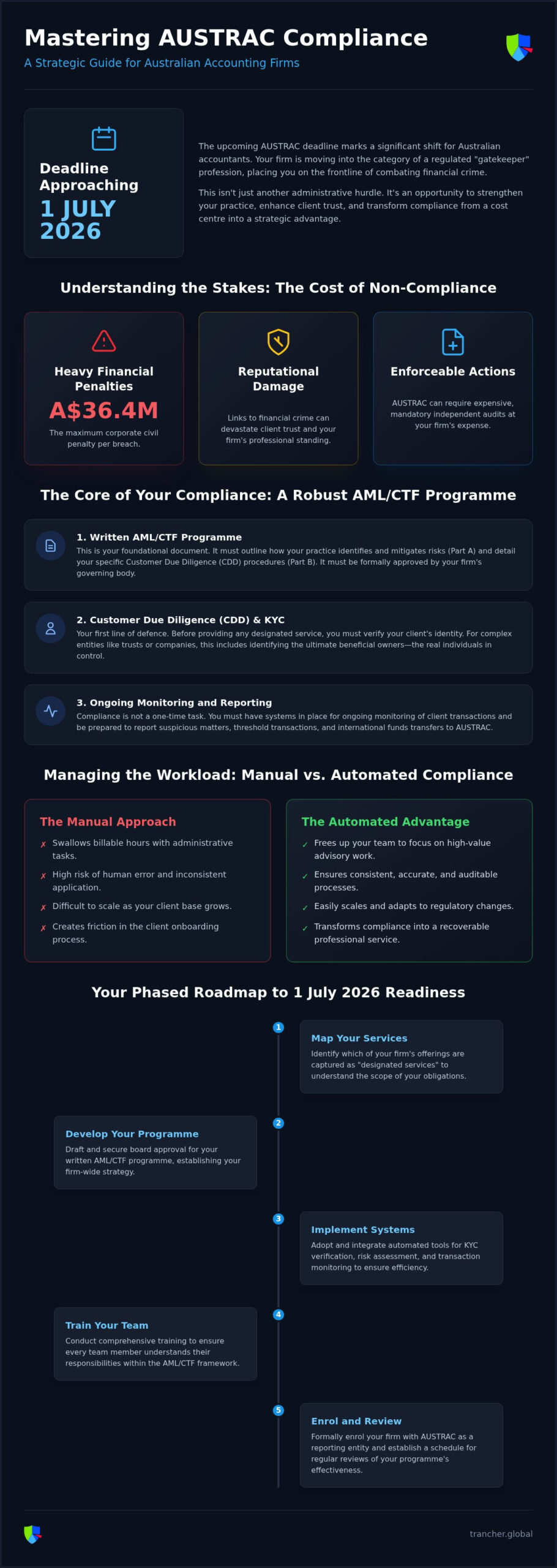
Your Roadmap to 1 July 2026 Readiness
Preparing for the 1 July 2026 commencement date requires more than just good intentions. It demands a methodical approach that balances regulatory precision with your firm’s operational reality. This AUSTRAC compliance guide provides a structured five-phase roadmap to ensure you don’t find yourself scrambling as the deadline approaches. By breaking the transition into manageable stages, you can maintain your billable output while building a resilient compliance framework.
- Phase 1: Awareness & Enrolment. Audit your service lines to identify “designated services” and complete your formal enrolment with AUSTRAC.
- Phase 2: System Selection. Evaluate and choose a technology platform that handles the heavy lifting of identity verification and risk screening.
- Phase 3: Implementation. Draft your written AML/CTF programme, covering both Part A and Part B, and integrate it into your daily workflows.
- Phase 4: Client Onboarding. Begin the process of “back-clearing” existing high-risk clients or implementing new verification standards for every new engagement.
- Phase 5: Go-Live. Achieve full operational readiness well before 1 July 2026 to ensure all reporting systems are tested and functional.
Following this sequence allows your team to absorb new responsibilities gradually. It prevents the “compliance shock” that often occurs when firms attempt to implement everything in a single month. You can start your 3-month trial today to see how automation simplifies every step of this roadmap, giving you the space to refine your processes without immediate financial commitment.
The 30-Day Compliance Guarantee
Many SME practices worry they’ve left their preparations too late. You haven’t. With the right strategic partner, it’s entirely possible to move from a standing start to full readiness in just 30 days. We provide local Australian support to guide you through the specific nuances of the Tranche 2 reforms, ensuring you aren’t left guessing about your obligations. Using a 3-month trial period is an excellent way to iron out your internal workflows early. It gives your staff the chance to become comfortable with the technology in a low-pressure environment before the regulatory regime becomes active.
Staff Training and Governance
Compliance is never just a partner-level responsibility. It’s a whole-of-firm culture that depends on every team member understanding their role. You’re required to train your staff on the specific AML/CTF risks associated with your firm’s unique client base and service offerings. This shouldn’t be a generic exercise. It needs to be practical and grounded in your firm’s specific Part A programme. You’ll also need to appoint an AML/CTF Compliance Officer. In an SME practice, this person acts as your steady hand, overseeing daily operations and ensuring that your “gatekeeper” duties are performed consistently across all departments. They’re the bridge between your firm’s strategic goals and its regulatory duties.
Beyond the Administrative Burden: Compliance as a Professional Service
Many firms view the new regulations as a sinkhole for productivity, but there’s a more optimistic way to frame this transition. While the 1 July 2026 deadline creates a sense of regulatory urgency, it also provides a unique opening to standardise how you charge for complex onboarding and risk assessment. By following a robust AUSTRAC compliance guide, you can shift from reactive compliance to proactive service delivery. This isn’t about adding hidden costs. It’s about transparently valuing the rigorous due diligence you perform to protect your clients and the integrity of the financial system. When you communicate these requirements as a standard professional service, you reinforce your position as a trusted, high-level advisor who prioritises security and excellence.
Tracking Billable Compliance Hours
One of the biggest pain points for SME accountants is the loss of billable hours to non-core tasks. Our platform changes this dynamic by identifying “recoverable compliance activity” within your daily workflow. Our Compliance ROI Tracking Software allows you to monitor exactly how much time is dedicated to each client’s verification and risk monitoring. This data is invaluable when justifying a technology investment to your partners. Instead of seeing a cost centre, they’ll see a clear report on billable assets that were previously invisible. It’s a shift from overhead to income that strengthens your firm’s financial health while ensuring you meet every obligation with precision.
Transforming Compliance into Advisory
The depth of information gathered during a thorough Customer Due Diligence (CDD) process often reveals needs that a standard tax return might miss. As you uncover complex trust structures or beneficial ownership details, you’ll naturally identify opportunities for estate planning, corporate restructuring, or asset protection advice. “Knowing your customer” isn’t just a regulatory phrase. It’s the foundation of proactive advisory work. This deep understanding allows you to offer more tailored advice that truly resonates with your client’s business goals. We invite you to start a conversation about your firm’s readiness today. Trancher acts as your strategic partner, helping you turn these new obligations into avenues for growth and improved internal systems.
Securing Your Firm’s Future Before 1 July 2026
The transition to Tranche 2 regulation represents a significant milestone for the Australian accounting profession. By implementing a structured roadmap and moving away from manual, error-prone spreadsheets, your firm can navigate these changes with absolute confidence. We’ve explored how a robust AML/CTF programme acts as your primary defence while simultaneously uncovering new advisory opportunities through deeper client insights. This AUSTRAC compliance guide provides the foundation you need to turn a regulatory obligation into a streamlined, billable asset for your practice.
You don’t have to navigate this complex regulatory landscape alone. We provide a 30-day compliance guarantee and local expert support specifically tailored for Australian SME accounting firms. Start your 3-month complimentary trial of Trancher today to experience a no-obligation solution designed for your practice’s operational ease. It’s time to replace administrative anxiety with a clear, automated path toward readiness. You’re well-positioned to lead your firm through this evolution, and we’re here to act as your steady guide every step of the way.
Frequently Asked Questions
Does my small accounting firm really need an AUSTRAC compliance programme?
Yes, if you provide “designated services” as defined by the AML/CTF Act. The Tranche 2 reforms recognise accountants as critical gatekeepers against financial crime. Even as a small practice, you’re required to identify risks and report suspicious activity. Following an AUSTRAC compliance guide ensures your firm isn’t exposed to the heavy penalties associated with non-compliance while protecting your professional reputation and your partners.
What are the specific Tranche 2 obligations for accountants starting July 2026?
Your primary obligations include enrolling with AUSTRAC, developing a written AML/CTF programme, and performing Customer Due Diligence. You must also conduct ongoing risk monitoring and submit reports for suspicious matters or cash transactions over A$10,000. These requirements ensure your firm has the systems to detect and prevent illicit funds from entering the economy. Starting these processes early allows your team to adjust to the new rhythm before the 1 July 2026 commencement.
How much does it cost to implement an AML/CTF compliance system?
Implementation costs generally include the time spent developing your programme and the subscription for a compliance platform. While manual systems might seem cheaper, the hidden costs of lost billable hours often make them more expensive in the long run. Many firms now view these costs as a “recoverable compliance activity.” By tracking billable time dedicated to these duties, you can offset the investment while maintaining your firm’s financial health.
Can I manage AUSTRAC compliance using my existing practice management software?
Most general practice management tools lack the specific features required for AML/CTF compliance, such as automated PEP and Sanctions screening. While they’re excellent for workflow, they often don’t provide the audit-ready record keeping needed for AUSTRAC inspections. Integrating a specialist platform with your existing tools is usually the most efficient path. This ensures your AUSTRAC compliance guide is supported by technology that handles the heavy lifting without disrupting your core accounting functions.
What happens if we miss the 1 July 2026 deadline for Tranche 2?
Missing the 1 July 2026 deadline exposes your firm to significant civil penalties, which can reach A$36.4 million for corporations. Beyond financial tolls, you face the risk of enforceable undertakings and mandatory independent audits. AUSTRAC has the power to take legal action against firms that fail to meet their “gatekeeper” duties. Operating without a compliant programme after this date leaves your partners personally and professionally vulnerable to regulatory scrutiny.
How do I identify which of my accounting services are “designated services”?
You should audit your service list against the “designated services” specified in the Act. Common examples for accountants include forming companies or trusts, managing client funds, and acting as a nominee shareholder. While standard individual tax compliance is generally excluded, most business advisory and transactional services are captured. Identifying these early allows you to build specific verification workflows into your client onboarding process, ensuring no service is provided without proper diligence.
Is a 30-day compliance guarantee realistic for a busy accounting practice?
A 30-day guarantee is entirely realistic when you utilise automation to handle the complex drafting and screening tasks. This timeframe focuses on establishing your written programme and setting up your digital verification systems. It doesn’t mean every client is back-cleared in a month, but it ensures your firm is operationally ready to meet the 1 July 2026 requirements. With expert support, you can achieve readiness without overwhelming your staff or losing focus on billable work.
How do I explain new AML/CTF fees and identity checks to my long-term clients?
We recommend framing these checks as a mandatory industry standard designed to protect all clients from financial fraud. Explain that these steps are a legal requirement for all Australian professional services, similar to the protocols used by banks. Most clients appreciate the added layer of security and transparency. By positioning compliance as a standard professional service, you can justify any associated fees as part of your commitment to maintaining the highest regulatory standards.