

On 1 July 2026, the professional landscape shifted, and Australian accountants officially became frontline defenders against financial crime. It’s a significant change that brings a new set of pressures, but this AUSTRAC reporting obligations guide is here to ensure you’re prepared. We understand that the sudden volume of new paperwork and the fear of heavy penalties can feel like an administrative weight you didn’t ask for. It’s often difficult to spot “suspicious” activity when you’re focused on complex tax work, and no one wants the stress of an unexpected audit hanging over their practice.
The good news is that these new requirements don’t have to be a hurdle. You can master your AUSTRAC reporting for Tranche 2 and streamline your compliance processes so they become a seamless part of your daily operations. This article provides a clear roadmap of your reporting triggers and a repeatable workflow for your team. You’ll gain the confidence to manage these obligations with ease, ensuring your firm remains protected and your focus stays exactly where it belongs: on your clients.
Key Takeaways
- Confirm your status as a reporting entity and prioritise your enrolment before the 1 July 2026 deadline to ensure a smooth transition into the new regulatory landscape.
- Utilise this AUSTRAC reporting obligations guide to master the specific submission windows for Suspicious Matter Reports and Threshold Transaction Reports without disrupting your daily workflow.
- Transition from manual spreadsheets to automated systems to eliminate administrative friction and maintain a centralised, audit-ready “single source of truth” for your practice.
- Identify common red flags within standard SME accounting work to detect and report suspicious activity with total professional confidence.
- Transform mandatory compliance into a strategic advantage by positioning AML/CTF processes as a high-value, billable advisory service that strengthens client relationships.
What are Your AUSTRAC Reporting Obligations Under Tranche 2?
Becoming a “reporting entity” is a fundamental shift in how your practice interacts with the Australian Transaction Reports and Analysis Centre (AUSTRAC). Under the Tranche 2 reforms, most Australian accounting firms now fall under this definition because they provide “designated services” to their clients. While full compliance obligations began on 1 July 2026, your immediate priority is ensuring you are enrolled by the 29 July 2026 deadline. This AUSTRAC reporting obligations guide is designed to help you view these changes not as a burden, but as a non-negotiable safeguard for your firm’s professional reputation.
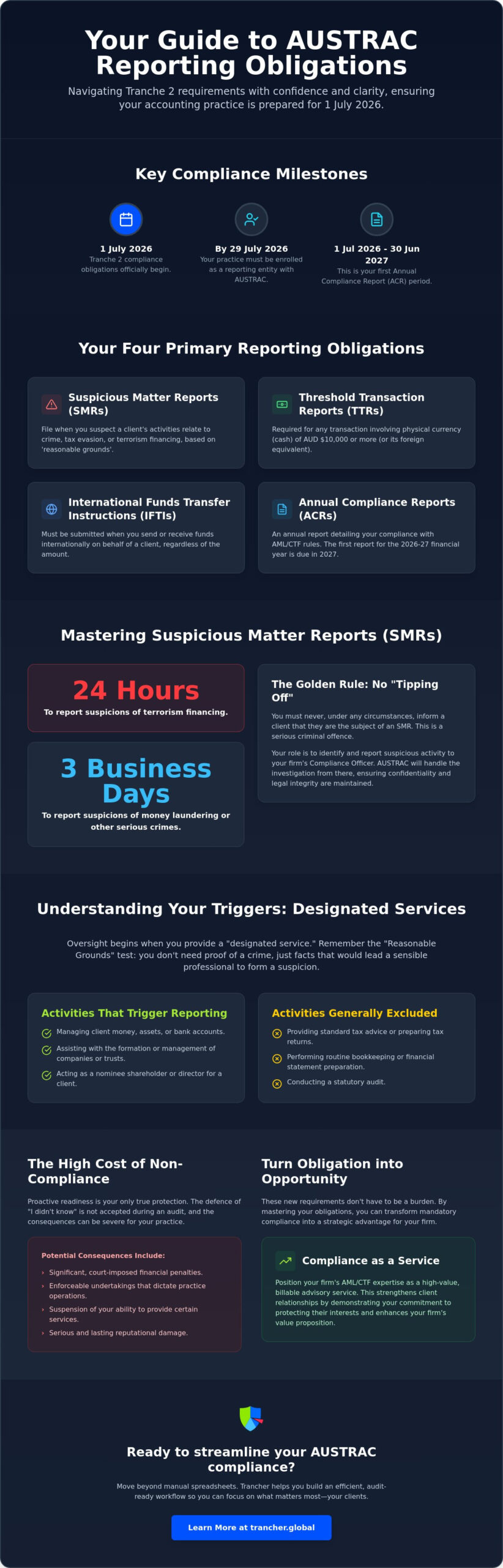
As a reporting entity, you are now responsible for four primary report types. Suspicious Matter Reports (SMRs) must be filed when you suspect criminal activity, while Threshold Transaction Reports (TTRs) are required for physical currency movements of $10,000 or more. If your clients move funds across borders, you’ll need to submit International Funds Transfer Instructions (IFTIs). Finally, the Annual Compliance Report (ACR) has transitioned to a financial year basis. Your first reporting period under this new structure runs from 1 July 2026 to 30 June 2027, with the submission window opening on 1 July 2027.
Identifying Designated Services in Your Practice
Not every task you perform triggers an obligation. Standard tax advice or simple bookkeeping generally sits outside the scope of AML/CTF regulation. However, oversight begins the moment you engage in designated services like managing client money or assets, assisting with the formation of companies or trusts, or acting as a nominee shareholder. The “Reasonable Grounds” test is your benchmark here. It means you don’t need absolute proof of a crime to act; you only need a set of facts that would lead a sensible professional to form a suspicion. Once that threshold is met, your reporting clock starts ticking.
The Consequences of Non-Compliance
The scale of court-imposed financial penalties in Australia is significant and designed to be a deterrent. For a professional firm, the risk extends far beyond the immediate fine. AUSTRAC has the power to issue enforceable undertakings, which can dictate how you run your practice for years, or even suspend your ability to provide certain services entirely. It’s a hard truth of the new regime that “I didn’t know” is never a valid defence during an inspection. Proactive readiness is your only true protection against the operational and reputational fallout of a compliance failure.
How to Submit a Suspicious Matter Report (SMR)
Identifying a potential red flag is only the first step in your compliance journey. As an accountant, you’re uniquely positioned to see patterns that others might miss, such as a client’s sudden reluctance to provide updated identification or a complex business structure that lacks a clear commercial purpose. This AUSTRAC reporting obligations guide is designed to help you navigate the transition from initial suspicion to a formal submission with absolute professional poise. It’s about protecting your firm while fulfilling your role as a gatekeeper of the Australian financial system.
Timing is critical for your SMR obligations, and the windows for submission are strictly enforced. If your suspicion relates to terrorism financing, you must report it within 24 hours. For matters involving money laundering or other serious crimes, you have a slightly wider window of 3 business days. These deadlines begin the moment you form a suspicion, not when you have “proof.” Your primary duty is to report the facts and your reasoning, allowing AUSTRAC to conduct the broader investigation. During this process, you must adhere to the “Golden Rule” of anti-tipping off. You cannot, under any circumstances, let a client know they are the subject of a report. Doing so is a criminal offence that carries significant penalties.
Step-by-Step: From Suspicion to Submission
Moving from a hunch to a formal report requires a methodical approach to ensure no detail is missed. Follow these steps to maintain a clear trail of your actions:
- Step 1: Internal Escalation. Report your findings immediately to your firm’s designated AML/CTF Compliance Officer.
- Step 2: Enhanced Due Diligence. Conduct Enhanced Due Diligence to gather more context and verify the grounds for your suspicion.
- Step 3: Accessing AUSTRAC Online. Log in to the secure portal to complete the new reporting forms released in July 2026.
- Step 4: Secure Documentation. File the submission receipt and all supporting evidence in a secure, centralised system.
Meticulous record-keeping is your best defence during an audit. You need to document exactly why you felt the activity was suspicious, including the specific “red flags” you observed. If you find the manual tracking of these triggers overwhelming, consider how ongoing risk monitoring can automate the detection process for you.
Common SMR Pitfalls to Avoid
A common mistake is “defensive reporting,” where a firm submits reports on everything just to be safe. This creates noise for regulators and can actually hinder investigations. AUSTRAC wants high-quality data, not a high volume of irrelevant reports. Focus on providing a clear, concise narrative in the “grounds” section of your report. Explain the “who, what, when, and why” without using excessive jargon. Finally, remember that filing an SMR doesn’t always mean you must end the client relationship. You can often continue the engagement while maintaining your internal reporting protocols, provided you don’t tip them off.
Managing TTRs, IFTIs, and Annual Compliance Reports
While SMRs rely heavily on your professional intuition, other reporting requirements are strictly objective and data-driven. This part of our AUSTRAC reporting obligations guide focuses on the threshold-based reports that keep your practice aligned with federal standards. Effective management requires a reporting calendar that fits your team’s rhythm, ensuring no deadline is missed in the rush of tax season. Accuracy matters here, as these reports provide the hard data regulators use to monitor financial flows.
Threshold Transaction Reports (TTRs) focus exclusively on physical currency. If a client pays you $10,000 or more in cash for a designated service, or if you handle that amount on their behalf, you must file a report within 10 business days. Similarly, International Funds Transfer Instructions (IFTIs) track money moving across borders. While banks handle the majority of IFTI reporting, the responsibility sits with you if you are the person providing the instruction to move funds into or out of Australia for a client. You have 10 business days from the date of the instruction to ensure AUSTRAC receives this information.
Navigating the Annual Compliance Report
The Annual Compliance Report (ACR) serves as your firm’s yearly self-assessment. From 1 July 2026, the reporting period has officially shifted to a financial year basis, meaning your first new cycle runs until 30 June 2027. You then have a three-month window, from 1 July to 30 September, to submit your data. To make this process painless, you should maintain records of employee training, risk assessment updates, and any independent audit results throughout the year. Don’t leave it until September. Auditors treat the ACR as a primary health check of your AML/CTF program, and a well-prepared report demonstrates your firm’s commitment to high professional standards. Using dedicated AUSTRAC annual compliance report software can help you maintain a structured, year-round record of all required data so the submission process becomes a formality rather than a scramble.
Thresholds and Triggers: A Practical Cheat Sheet
A Threshold Transaction Report is mandatory for any transaction involving AUD $10,000 or more in physical currency. Determining when an IFTI is your responsibility depends entirely on who is providing the instruction; generally, if you use your own accounts or specialised platforms to move client money overseas, the reporting duty belongs to your firm. Staying on top of these triggers across a large client base can be a significant administrative drain. Integrating ongoing risk monitoring into your daily workflow ensures these transactions are flagged automatically, removing the guesswork and manual tracking from your compliance routine.
Building an Efficient Reporting Workflow in Your Practice
Transitioning from understanding your requirements to implementing them shouldn’t feel like a second full-time job. While this AUSTRAC reporting obligations guide has covered the technical report types, the real challenge for most Australian firms lies in the daily execution. Relying on manual spreadsheets to track client activity is a significant risk to your professional licence. Spreadsheets are a liability; they are prone to human error, lack a secure audit trail, and often fail to provide the real-time visibility required during a regulatory inspection. To protect your firm, you need a structured workflow that integrates compliance into your existing service delivery.
Creating a “single source of truth” for all client data is the foundation of an efficient system. When your KYC records, risk assessments, and transaction logs are centralised, you eliminate the friction of searching through disparate folders and emails. This organisation allows you to establish clear Standard Operating Procedures (SOPs) that empower your team. Rather than feeling overwhelmed, staff can be trained to recognise specific triggers through simple, repeatable steps. Role-based access is equally vital. By ensuring only authorised personnel can submit reports to AUSTRAC, you maintain high data integrity and prevent accidental or unauthorised filings.
Automating the Heavy Lifting
The most effective way to remove the administrative headache is through intelligent automation. Regulatory reporting software in Australia can now pre-populate AUSTRAC forms using your existing client data, which significantly reduces the time spent on manual entry. You can set up automated alerts for threshold transactions or when a client is identified as a high-risk Politically Exposed Person (PEP). This proactive approach ensures your record-keeping remains audit-ready 24/7. If you’re ready to move beyond manual tracking, you can explore platform integrations that align compliance with your firm’s growth goals.
The 30-Day Readiness Plan
A phased approach helps your team adjust without disrupting client billables. Follow this logical progression to reach full operational readiness:
- Month 1: Foundation. Complete your AUSTRAC enrolment and conduct an initial risk assessment of your current client base to identify any immediate reporting gaps.
- Month 2: Systems. Implement automated KYC and reporting workflows to handle client verification and activity tracking with minimal manual intervention.
- Month 3: Refinement. Conduct staff training sessions and run a “dry run” of an SMR submission to ensure everyone knows their role and the internal escalation path.
Compliance as a Service: Turning Obligations into Opportunity
While the technical steps in this AUSTRAC reporting obligations guide are essential for staying on the right side of the law, the most successful firms are those that view these requirements as a professional opportunity. You aren’t just ticking boxes; you’re providing a sophisticated layer of security for your clients. Reframing the narrative allows you to position AML/CTF compliance as a high-value advisory service. It’s an extension of your role as a trusted partner, ensuring the integrity of your clients’ financial dealings and the longevity of their business reputations in an increasingly transparent world.
Tracking your billable compliance hours is a critical step in ensuring your firm is fairly compensated for this specialised work. Compliance requires time, expertise, and a meticulous eye for detail, all of which have clear commercial value. By quantifying the effort involved in ongoing risk monitoring and reporting, you can demonstrate the tangible work being done behind the scenes. This transparency helps clients understand that compliance isn’t a hidden tax, but a proactive service that keeps their operations within the law and protected from broader financial risks. It’s about demonstrating the ROI of your expertise through clear, data-driven reporting.
Recovering Your Costs
Communicating AML/CTF costs to your clients shouldn’t be a source of friction. The key is to include clear strategies for compliance fees directly in your engagement letters from the outset. Explain that these measures are a mandatory part of the Australian regulatory framework and that your firm’s oversight provides them with peace of mind. When you use automation to handle the administrative load, you effectively reduce your cost-to-serve. This efficiency allows you to increase your practice margins while still offering a competitive, transparent fee structure that builds client trust and reinforces your professional value.
The Trancher Advantage
Trancher is built to help you navigate the changing landscape of Australian accounting with total confidence. Our platform offers specialised features for compliance billing support, allowing you to track revenue and ROI with ease. We provide local, expert support to help you overcome every Tranche 2 hurdle without the stress of going it alone. We guarantee your practice will be AUSTRAC-ready within 30 days of implementation, giving you a steady hand as you transition to these new standards. To see how we can turn your obligations into a strategic asset, start your complimentary 3-month trial of Trancher today and take the first step toward a more efficient, profitable future.
Future-Proof Your Practice with Confidence
You now have the essential roadmap to navigate the Tranche 2 reforms with clarity and poise. By moving away from risky manual processes and embracing structured, automated workflows, you protect your firm’s professional reputation while creating new billable value for your clients. This AUSTRAC reporting obligations guide has shown that while the deadlines are firm, the transition is entirely manageable when you have the right systems and support in place.
Trancher was designed specifically for Australian SME accounting firms to remove the administrative friction of reporting. We provide a 30-day compliance guarantee and offer local expert support from Aaron Soh and the team to ensure you’re never navigating these changes alone. Our goal is to help you transform these new requirements into a strategic advantage that strengthens your practice and supports your long-term growth.
Secure your practice and start your free 3-month Trancher trial today. We look forward to being your partner in building a more resilient and compliant future for your firm.
Frequently Asked Questions
What is Tranche 2 and how does it affect my accounting firm?
Tranche 2 refers to the legislative expansion of Australia’s AML/CTF regime to include “gatekeeper” professions such as accountants, lawyers, and real estate agents. From 1 July 2026, your firm is considered a reporting entity if you provide designated services like managing client assets or forming companies. This means you must implement a formal AML/CTF program, conduct customer due diligence, and meet strict reporting requirements to help combat financial crime.
How do I know if a client transaction is ‘suspicious’ enough to report?
You should report a transaction if you have “reasonable grounds” to suspect it involves proceeds of crime or relates to terrorism financing. You don’t need absolute proof; you only need a set of facts that would cause a sensible professional to form a suspicion. Common red flags include unusual complexity in a deal, a client’s reluctance to provide identification, or transactions that don’t align with their known business profile.
What happens if I miss an AUSTRAC reporting deadline?
Missing a deadline can expose your firm to significant civil penalties and increased regulatory scrutiny. AUSTRAC has the authority to issue infringement notices or seek court-ordered fines for non-compliance. Beyond the financial impact, persistent delays can lead to enforceable undertakings or the suspension of your ability to provide certain services. Proactive communication with the regulator is always better than silence if you encounter a genuine system issue.
Can I charge my clients for the time spent on AUSTRAC compliance?
Yes, you can and should recover the costs of meeting your obligations by treating compliance as a billable advisory service. Many firms update their engagement letters to include a specific compliance fee or incorporate it into their standard rates. This AUSTRAC reporting obligations guide encourages transparency. Explaining that these measures protect the client’s own reputation helps build trust while ensuring your practice remains profitable and sustainable.
What is ‘tipping off’ and why is it a criminal offence?
Tipping off occurs when you disclose to a client or any unauthorised person that a Suspicious Matter Report has been filed or is being considered. It’s a criminal offence because it can compromise active law enforcement investigations and allow criminals to hide assets or flee. Maintaining strict internal confidentiality is your best defence. You must ensure that only your designated compliance officer and authorised staff are aware of any reporting activity.
Do I need to report international transfers if the bank is already doing it?
You only need to report an International Funds Transfer Instruction (IFTI) if your firm is the one providing the instruction to move the funds. If you simply observe a client making a transfer through their own bank, the bank carries the reporting burden. However, if you use your practice’s trust account or a specialised platform to send or receive money from overseas on a client’s behalf, the reporting obligation sits with you.
How long do I need to keep records of my AUSTRAC reports?
You must keep all records related to your AML/CTF obligations, including reports and customer due diligence data, for seven years. These records must be stored securely and be readily accessible for an AUSTRAC inspection. Maintaining a centralised digital archive ensures you’re always audit-ready. This long-term record-keeping helps demonstrate your firm’s ongoing commitment to compliance and provides a clear history of your risk management decisions over time. For a detailed framework on structuring your documentation to meet this requirement, see our guide on audit ready compliance records for Australian accounting firms.
What is the difference between an SMR and a TTR?
The primary difference lies in the trigger: an SMR is based on suspicion, while a TTR is based on a specific dollar threshold. You file a Suspicious Matter Report (SMR) when you suspect criminal activity, regardless of the transaction amount. A Threshold Transaction Report (TTR) is mandatory for any physical currency transaction of $10,000 or more. This AUSTRAC reporting obligations guide clarifies that both are essential tools for maintaining regulatory transparency in your firm.