

The AUSTRAC annual compliance report isn’t just a year-end task; it’s the final output of an automated, year-round compliance programme. For many Australian accounting firms, the reality of these obligations officially commenced on 1 July 2026, bringing a new level of regulatory scrutiny to daily operations. It’s natural to feel a sense of administrative overwhelm as you identify which designated services trigger reporting while trying to protect your billable hours. By implementing dedicated AUSTRAC annual compliance report software, you can replace manual uncertainty with a structured, confident approach that ensures your firm remains audit-ready without the traditional end-of-year stress.
We understand that the transition into the Tranche 2 regime brings unique pressures, but it also provides an opportunity to strengthen your internal systems. This guide offers a clear, actionable checklist to help you master your reporting obligations with ease. We’ll outline a repeatable process that turns compliance from a cost centre into a strategic advantage, ensuring your documentation is robust and your practice is fully prepared for the first reporting deadline on 31 March 2027.
Key Takeaways
- Understand the annual compliance report as a vital self-assessment of your firm’s AML/CTF obligations following the July 2026 Tranche 2 transition.
- Shift your practice’s mindset from reactive year-end reporting to continuous data hygiene to eliminate the traditional stress of the March submission deadline.
- Recognise the hidden costs of manual tracking and learn how AUSTRAC annual compliance report software protects your billable hours through seamless automation.
- Follow a structured pre-submission workflow to verify that your “designated services” log and suspicious matter reports are complete, accurate, and audit-ready.
- Master a repeatable reporting process that transforms compliance from a mandatory cost centre into a streamlined, strategic advantage for your firm.
What is the AUSTRAC Annual Compliance Report for Tranche 2 Entities?
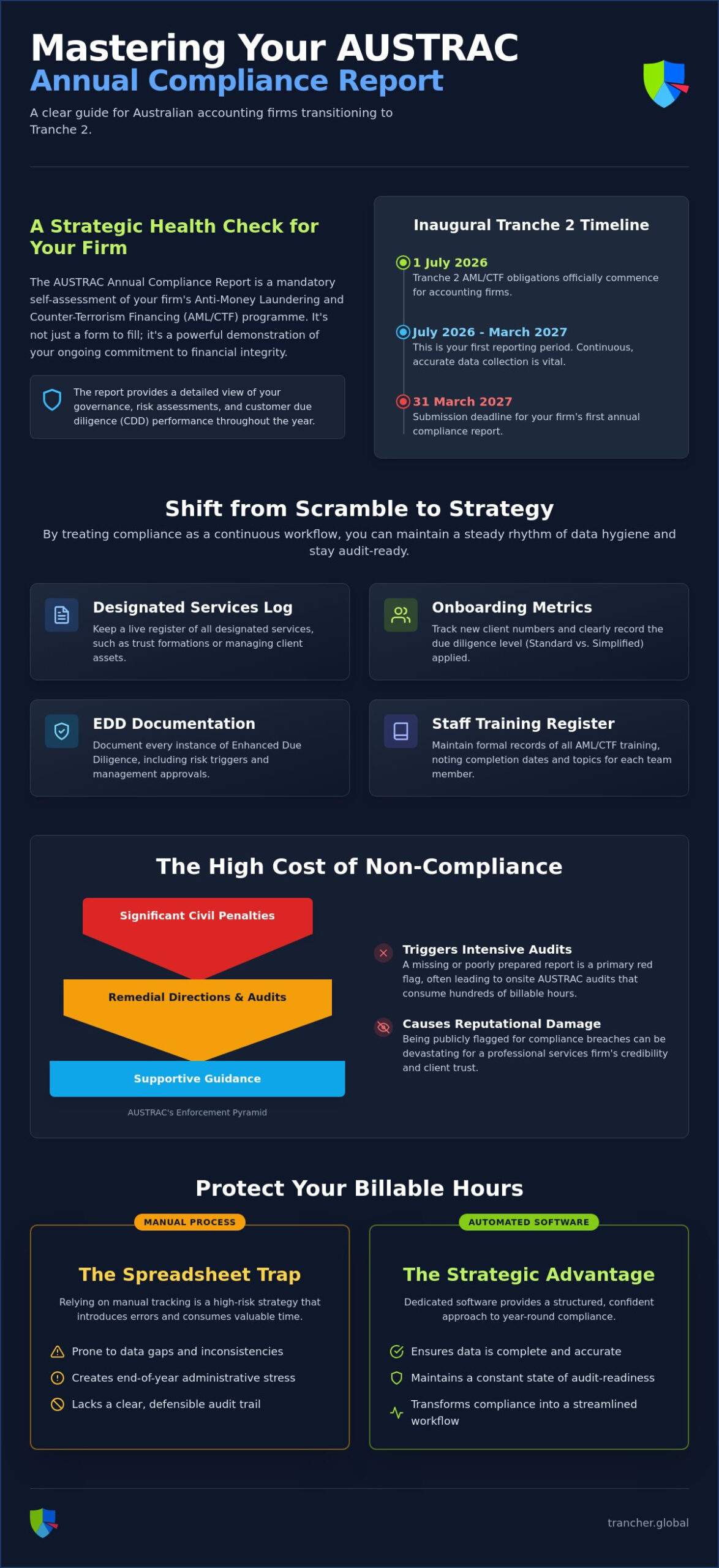
Think of the annual compliance report as a strategic health check for your firm’s regulatory framework. It’s a mandatory self-assessment submitted to the Australian Transaction Reports and Analysis Centre (AUSTRAC), designed to demonstrate how effectively you’ve managed your Anti-Money Laundering and Counter-Terrorism Financing (AML/CTF) obligations. For Australian accounting firms, this requirement became a reality on 1 July 2026. It isn’t just a simple administrative task; it’s a comprehensive account of your firm’s commitment to financial integrity.
The report provides a granular look at your governance structures, your independent risk assessments, and your customer due diligence (CDD) performance. Manually collating this information from disparate spreadsheets or paper files is a high-risk strategy that often leads to data gaps. Integrating dedicated AUSTRAC annual compliance report software into your practice ensures that every relevant data point is captured as it happens. While the standard submission window typically runs from 1 July to 30 September each year, Tranche 2 entities have a unique timeline for their inaugural report. Your first compliance report, covering the period from 1 July 2026, is due by 31 March 2027. Early preparation is vital to ensure your documentation is robust and your processes are defensible.
Who is Required to Submit?
Any firm providing “designated services” as defined under the AML/CTF Act must enrol with AUSTRAC and meet these reporting requirements. These services include common accounting tasks such as acting as a nominee shareholder, managing client assets, or assisting with the creation of legal structures. Whether you operate as a sole practitioner or as part of a larger reporting group, the obligation to report remains. Even if your client base consists primarily of long-term, low-risk local businesses, you still need to prove to the regulator that you have active monitoring and verification systems in place.
The Consequences of Non-Compliance
AUSTRAC maintains a sophisticated enforcement pyramid to ensure industry-wide compliance. This starts with supportive guidance and remedial directions but can escalate to significant civil penalties for systemic or wilful failures. Beyond the immediate financial sting, the reputational damage of being publicly flagged for compliance breaches can be devastating for a professional services firm. A missing or poorly prepared report often serves as a primary trigger for a more intensive, onsite AUSTRAC audit, which can consume hundreds of billable hours to resolve.
The Year-Round Data Collection Checklist
Compliance shouldn’t be a frantic scramble every March. Instead, it’s about maintaining a steady rhythm of data hygiene throughout the year, ensuring that your firm remains audit-ready at every turn. By treating your AUSTRAC obligations as a continuous workflow rather than a year-end hurdle, you avoid the administrative bottleneck that often plagues the professional services sector. This proactive approach relies on capturing specific data points in real-time, a task made significantly simpler when using AUSTRAC annual compliance report software designed for the unique needs of Australian accountants.
To ensure your inaugural report for the 31 March 2027 deadline is both accurate and painless, your practice should focus on maintaining the following records as part of your daily operations:
- Designated Services Log: Maintain a live register of every designated service provided, such as trust formations or managing client assets.
- Onboarding Metrics: Track the total number of new clients onboarded and clearly record the level of due diligence (Standard vs. Simplified) applied to each file.
- EDD Documentation: Document every instance where Enhanced Due Diligence was required, including the specific risk triggers and the senior management reasoning behind the approval.
- Staff Training Register: Keep a formal record of all AML/CTF training sessions, including completion dates and specific topics covered for each team member.
Automating these inputs through AUSTRAC annual compliance report software removes the friction of manual record-keeping and ensures your data is always current.
Governance and Programme Review
Your AML/CTF Program isn’t a static document; it’s a living framework that requires regular oversight. Ensure that your firm’s board or senior management has reviewed and approved the programme within the reporting period. You must also document any updates made to your firm-wide risk assessment, especially if you’ve introduced new services or expanded your client base. Finally, verify that your Compliance Officer’s contact details are current in AUSTRAC Online to avoid missing critical regulatory updates.
Customer Due Diligence (CDD) Metrics
The annual report requires aggregate data on your client risk profiles. You’ll need to record the number of Politically Exposed Person (PEP) and sanctions matches identified during your screening processes. Categorising your client base by risk level (Low, Medium, or High) allows you to report these figures accurately. For those managing complex trust structures, maintaining clear evidence of beneficial ownership checks is essential for proving you’ve looked through the layers of control to identify the natural persons involved.
Why Manual Compliance Spreadsheets Fail the Annual Report Test
It’s tempting to think that a well-organised Excel spreadsheet is sufficient for tracking your AML/CTF obligations. We often hear practice managers suggest they can simply “track this in Excel” to avoid additional overheads. While spreadsheets are excellent for basic arithmetic, they’re fundamentally unsuited for the complex, multi-layered data requirements of a regulatory self-assessment. Relying on manual entry creates a significant hidden cost in lost billable hours. Every minute your senior staff spends cross-referencing client files with a manual register is a minute not spent on high-value advisory work. Over a financial year, these administrative leaks can quietly erode your firm’s profitability.
Beyond the financial drain, manual systems introduce an unacceptable level of human error risk. A single typo in a client’s risk rating or a forgotten entry in your designated services log can compromise the integrity of your entire AUSTRAC filing. When the regulator requests an audit trail, they aren’t just looking for a final number; they want to see the chronological evidence of how you arrived at that data. Proving this “audit trail” is nearly impossible when your compliance information is siloed across disconnected spreadsheets, email threads, and paper folders. This lack of transparency often serves as a red flag for auditors, potentially leading to more intensive investigations.
The Fragmentation Trap
Many firms fall into the trap of using disconnected KYC tools that don’t communicate with their reporting registers. This fragmentation makes aggregate reporting a nightmare, as you’re forced to manually reconcile client activity with AUSTRAC’s specific reporting categories. It’s a slow, prone-to-error process that fails to provide a holistic view of your firm’s risk profile. Most critically, manual systems often lack the sophisticated pattern recognition needed to flag suspicious matter in a timely fashion. Without automated alerts, your firm remains reactive, increasing the likelihood of missing the strict reporting windows for suspicious matter reports (SMRs).
Transitioning to AUSTRAC Annual Compliance Report Software
Modern compliance is about removing friction through intelligent automation. Transitioning to dedicated AUSTRAC annual compliance report software centralises your data, transforming a month-long collation exercise into a one-click reporting task. You gain access to real-time dashboards that show your reporting readiness at any time, allowing you to identify and fix data gaps long before the March deadline approaches. By linking your reporting data directly to audit ready compliance records, you ensure total peace of mind. This integrated approach doesn’t just satisfy the regulator; it builds a more resilient, efficient, and profitable practice.
Preparing for Submission: A Step-by-Step Workflow for Practice Managers
Transitioning from continuous data collection to the final submission requires a methodical approach. It’s the moment where your year-round diligence pays off. Conducting an internal “pre-submission” audit in December is a strategic move to identify any data gaps before the final rush toward the 31 March 2027 deadline. This mid-point check allows your team to rectify missing information within your AUSTRAC annual compliance report software, ensuring a smooth transition into the formal reporting window. It’s about being proactive rather than reactive, giving your firm the space to verify every entry with confidence.
During this preparation phase, you must verify that every Suspicious Matter Report (SMR) identified throughout the year was filed within the mandatory timeframes. If your firm underwent an independent review of its AML/CTF programme, gather the evidence and findings now. You’ll also need to finalise your aggregate numbers, specifically looking at client risk distributions and the volume of designated services provided. Don’t leave the qualitative questions until the last minute; drafting responses about your programme’s effectiveness requires thoughtful input from senior leadership to accurately reflect your firm’s compliance culture.
Navigating AUSTRAC Online
Practicality is key when dealing with the regulator’s portal. Ensure your practice manager has active login credentials for AUSTRAC Online well in advance of the submission period. The portal allows you to “draft” your responses before the final “submit” click, providing a valuable opportunity for a internal peer review. For those navigating the portal for the first time as a Tranche 2 entity, using a comprehensive AUSTRAC reporting obligations guide can help interpret the more technical questions and ensure your answers align with regulatory expectations.
Final Review and Sign-Off
Accountability is the final step in the workflow. Identify who within the firm, typically the Compliance Officer or a senior partner, has the delegated authority to sign off on the report’s accuracy. Once submitted, always download and store a PDF copy of the confirmation for your internal records. This document is your first line of defence during an audit. Finally, set a calendar reminder for the next financial year cycle to keep the momentum going. Streamline your reporting workflow with Trancher to ensure every step is captured automatically, keeping your firm ahead of the curve.
Streamlining Your AML Obligations with Trancher
Trancher stands as the end-to-end solution specifically engineered for the Australian accounting sector. We’ve designed our platform to act as your expert compliance companion, removing the guesswork from regulatory reporting and ensuring your firm remains ahead of evolving requirements. Our AUSTRAC annual compliance report software automates the collection of every required data point, from client risk ratings to staff training logs, ensuring you’re never caught off guard. We provide a 30-day compliance guarantee for firms preparing for the 2026 deadline, providing you with a clear, reliable path to full regulatory readiness.
Support is a cornerstone of our service. Every subscriber gains access to local Australian support and expert guidance, ensuring you have a steady hand to help interpret complex scenarios. We don’t just provide software; we provide a partnership that understands the nuances of the Australian regulatory landscape. By centralising your AML/CTF programme management, you replace fragmented processes with a single, authoritative source of truth that simplifies your annual reporting and strengthens your practice’s integrity.
Turning Compliance into a Profit Centre
Many firms view compliance as a drain on resources, but we help you reframe this obligation as a strategic asset. Trancher tracks billable compliance hours in real-time, ensuring that the work your team performs is accurate, documented, and recoverable. By using compliance ROI tracking software, you can prove the tangible value of your programme to your partners and clients alike. This shift transforms the annual report from a mandatory burden into a strategic review of your practice growth and operational efficiency.
Ready for July 2026?
The transition to the Tranche 2 regime is a significant milestone, and we are here to ensure you’re fully prepared. We offer a complimentary 3-month trial for early adopters, allowing you to experience the benefits of automated compliance without any initial financial commitment. Getting started with Trancher takes under 30 days, meaning your firm can be fully integrated and audit-ready well before the first reporting cycle concludes. Take the first step toward a more efficient, confident, and profitable future. Start your journey toward stress-free AUSTRAC reporting with Trancher today.
Secure Your Practice’s Regulatory Future
The transition into the Tranche 2 regime represents a significant evolution for your practice. By moving away from fragmented manual registers and adopting a continuous data hygiene mindset, you protect both your firm’s reputation and its profitability. We’ve explored how the right AUSTRAC annual compliance report software transforms a complex administrative burden into a streamlined, repeatable process that provides total peace of mind. Compliance is no longer a hurdle to be cleared once a year; it’s a foundation for a more resilient and transparent firm.
Trancher is designed specifically for Australian SME accounting firms, offering a 30-day compliance guarantee to ensure you meet your obligations with confidence. We invite you to explore our platform with a complimentary 3-month trial and see firsthand how automation simplifies every aspect of your regulatory life. Book a demo to see how Trancher automates your AUSTRAC reporting and take control of your firm’s compliance journey today. You don’t have to navigate these changes alone; a more efficient, audit-ready practice is well within your reach.
Frequently Asked Questions
What is the deadline for the AUSTRAC annual compliance report?
The standard submission period for the annual compliance report is between 1 July and 30 September each year. However, for newly regulated Tranche 2 entities, the first compliance report covering the period from 1 July 2026 is due by 31 March 2027. Meeting this specific deadline is essential for demonstrating your firm’s commitment to the new regulatory framework from the outset.
Does every accounting firm need to submit a report in 2026?
Not every accounting firm has a reporting obligation in 2026. Only firms that were already enrolled as reporting entities before the Tranche 2 expansion will submit during the July to September 2026 window. If your firm only became a reporting entity when the reforms commenced on 1 July 2026, your inaugural report won’t be due until 31 March 2027.
How much does it cost to submit the AUSTRAC annual report?
AUSTRAC doesn’t charge a fee to submit your annual compliance report through their online portal. The real cost to your practice is the administrative time spent gathering data and verifying records. Implementing AUSTRAC annual compliance report software helps to mitigate these costs by automating the data collection process, ensuring your staff remain focused on billable client work rather than manual entry.
Can I change my report after I have submitted it to AUSTRAC?
You can’t directly edit a report once the final submission is made in the AUSTRAC Online portal. If you discover an error after the fact, you’ll need to contact the AUSTRAC Contact Centre to request an amendment or have the report unlocked. It’s a good idea to utilise the portal’s draft feature for a final internal peer review before you officially submit.
What happens if I forget to submit my annual compliance report?
Failing to submit your report can lead to AUSTRAC taking enforcement action, ranging from remedial directions to significant civil penalties. A missing report often acts as a primary trigger for a more intensive regulatory audit, as it suggests a lack of internal oversight. Staying organised throughout the year ensures you avoid these preventable risks and maintain a positive relationship with the regulator.
Do I need to report if I didn’t provide any designated services this year?
Yes, you must still submit a report if your firm is enrolled as a reporting entity, even if you provided no designated services during the financial year. The report will simply confirm that no such services were provided. This is a mandatory requirement that tells AUSTRAC your firm is still active and remains compliant with its broader AML/CTF obligations.
How long do I need to keep records of my annual compliance reports?
You’re required to keep all records related to your AML/CTF programme, including copies of your submitted annual reports, for seven years. These records must be stored securely and be readily accessible if AUSTRAC requests an audit. Using AUSTRAC annual compliance report software ensures these documents are organised and protected in a centralised digital environment, making future retrieval simple and stress-free.
What is the difference between an SMR and an annual compliance report?
An annual compliance report is a yearly self-assessment of your firm’s overall compliance framework and performance. A Suspicious Matter Report (SMR) is an event-driven obligation that must be filed as soon as you form a suspicion about a specific transaction or client. SMRs have very tight deadlines, often within 24 hours, while the annual report is a broader summary of your yearly activity.