

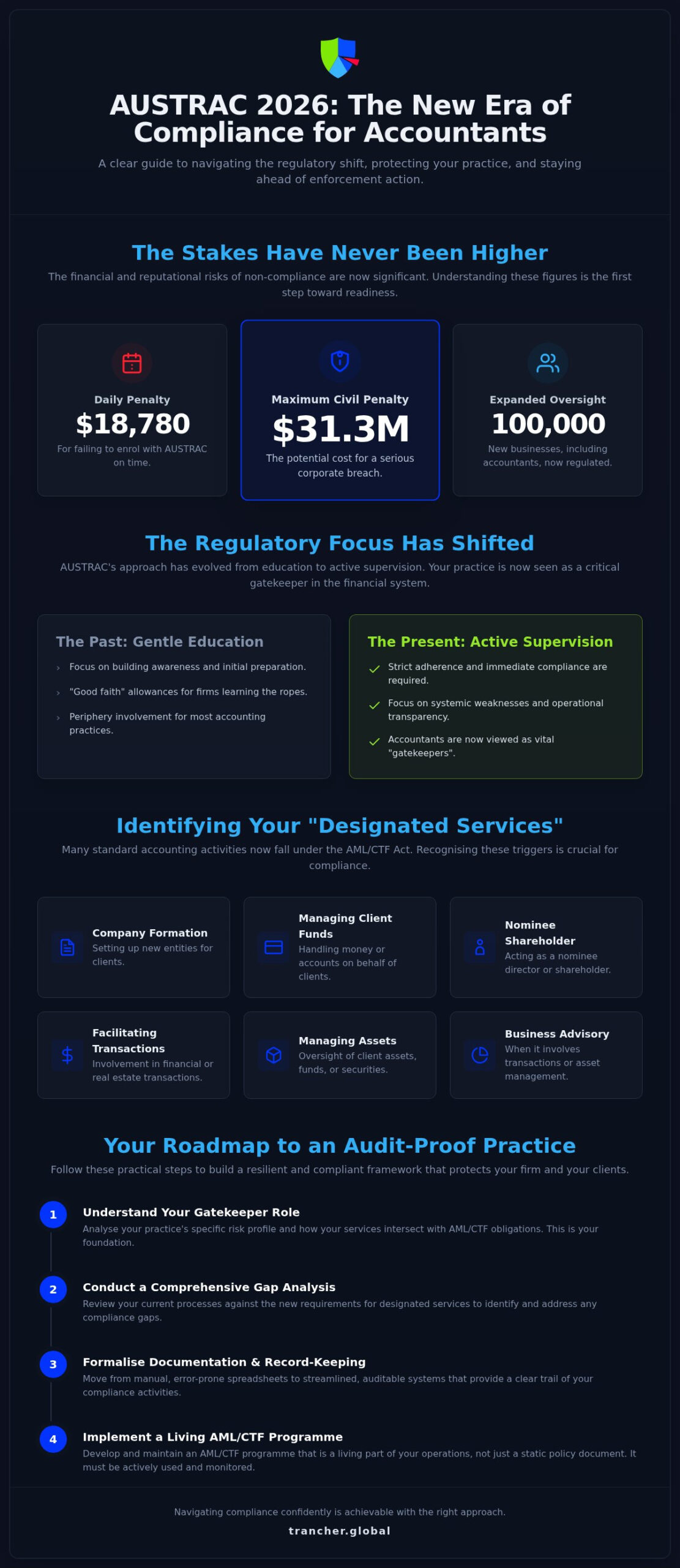
Did you know that failing to enrol with AUSTRAC can now result in a daily penalty of $18,780? With the 1 July 2026 commencement date now in effect, the regulatory landscape for Australian accountants has shifted from theoretical preparation to active, high-stakes supervision. It’s completely natural to feel a sense of urgency regarding these changes, especially when the maximum civil penalty for a corporate breach has reached $31.3 million.
We understand that the administrative burden of manual record-keeping and the complexity of identifying designated services can feel like a heavy weight on your practice. However, meeting these obligations doesn’t have to be a hurdle. This article explores the latest AUSTRAC enforcement actions 2026 trends, providing you with a clear roadmap to protect your firm while improving your internal systems. We’ll examine the regulator’s focus on gatekeeper professions and outline how a risk-based approach can simplify your compliance journey, ensuring you remain a trusted, steady hand for your clients.
Key Takeaways
- Understand why AUSTRAC has shifted its focus to accounting firms as “gatekeepers” and what this means for your practice’s specific risk profile.
- Stay ahead of the regulatory curve by analysing AUSTRAC enforcement actions 2026, including the impact of increased penalty unit values on corporate entities.
- Learn how to conduct a comprehensive gap analysis of your designated services to ensure your AML/CTF program meets the latest regulatory standards.
- Discover strategies to transform compliance requirements into a profitable advisory service by tracking billable hours and demonstrating clear ROI to your clients.
- Identify the practical steps needed to formalise your documentation and record-keeping, moving from manual administrative burdens to streamlined, audit-ready systems.
The 2026 AUSTRAC Enforcement Landscape: A New Era for Accountants
The commencement of Tranche 2 on 1 July 2026 marked a fundamental shift in the Australian regulatory environment. For years, accounting firms operated on the periphery of anti-money laundering (AML) and counter-terrorism financing (CTF) frameworks. Today, the Australian Transaction Reports and Analysis Centre (AUSTRAC) views accountants as vital gatekeepers in the financial system. This pivot means that approximately 100,000 new businesses now fall under the regulator’s oversight. The focus has moved decisively from gentle education to active supervision. Understanding the trajectory of AUSTRAC enforcement actions 2026 is now a commercial necessity for every practice leader.
The transition into this new era began in earnest when enrolment opened on 31 March 2026. Since then, the regulator has made it clear that the time for “learning the ropes” has passed. We’re now seeing a landscape where administrative readiness is the baseline, and operational transparency is the goal. For many firms, this represents a significant cultural shift, but it’s also a chance to refine internal systems and provide even greater value to clients through enhanced due diligence.
Tranche 2 and the Professional Services Pivot
The expanded scope of the AML/CTF Act means your daily operations are viewed through a new lens. Services you’ve provided for decades, such as company formation, managing client funds, or acting as a nominee shareholder, are now classified as “designated services.” It’s a significant change. Even standard business advisory work can trigger obligations if it involves facilitating transactions or managing assets. The regulator’s concern isn’t just with criminal intent; it’s about preventing firms from becoming unwitting facilitators for illicit funds. By identifying these triggers early, you can transform a complex requirement into a streamlined part of your client onboarding process.
The Regulator’s Stance: “Readiness is Not Optional”
AUSTRAC’s 2026 Statement of Intent makes one thing clear: the grace period is over. While previous years focused on building awareness, the current calendar year is defined by strict adherence. The regulator is moving away from “good faith” allowances and toward immediate compliance requirements. They’re specifically looking for systemic weaknesses within SME practices, such as inadequate risk assessments or manual record-keeping that fails to capture suspicious patterns. We see this not as a threat, but as an opportunity to modernise. Highlighting these AUSTRAC enforcement actions 2026 helps firms recognise that readiness isn’t just about avoiding fines; it’s about building a more resilient, professional practice that stands up to scrutiny.
Analysing 2026 Trends: From Casinos to Professional Services
While early headlines often focused on major casinos, the current wave of AUSTRAC enforcement actions 2026 shows a clear expansion into non-bank financial services and professional sectors. The regulator isn’t just looking for criminal syndicates. They’re looking for systemic operational failures. A common thread among recent entries on AUSTRAC’s official list of enforcement actions is the failure to maintain an AML/CTF program that actually functions in a real-world environment. It’s no longer enough to have a policy; you must prove it’s being followed.
Many firms still rely on manual spreadsheets to track client data. In 2026, this is increasingly cited as a primary cause of non-compliance. Spreadsheets are static, prone to human error, and struggle to provide the audit trail required during a regulatory review. This has led to a rise in Infringement Notices for basic record-keeping failures. These aren’t just administrative slaps on the wrist. They’re public signals that a firm’s internal controls aren’t up to standard, potentially impacting your professional reputation with both clients and peers.
Lessons from Recent Enforceable Undertakings
The cases involving bet365 and Sportsbet offer profound lessons for the accounting sector. While the industries differ, the regulator’s focus on risk methodology is identical. AUSTRAC criticised these entities for having “set and forget” KYC processes rather than robust, ongoing risk monitoring. For an accounting firm, this means your obligations don’t end once a client is onboarded. You must have systems that identify changes in client behaviour or risk profiles over time. Without these, gaps in suspicious matter reporting (SMR) become inevitable. Adopting a proactive stance helps you spot these red flags before they become regulatory issues.
The SME Vulnerability: Why Size No Longer Protects You
Believing that smaller firms are beneath the regulator’s notice is a risky strategy in the current climate. In 2026, AUSTRAC is using sophisticated automated data matching to identify unregistered reporting entities. They’re cross-referencing tax agent records with their own enrolment database. If you’re providing designated services but haven’t enrolled, the system flags you automatically. It’s an efficient way for the regulator to ensure a level playing field for all practitioners.
We’re also seeing a crackdown on “copy-paste” compliance policies. Having a manual in a drawer that isn’t operationally active is no longer sufficient. This is why 2026 is becoming the year of the “remedial direction” for small firms. These directions force a practice to fix specific weaknesses within a set timeframe. To avoid these stressful interventions, many forward-thinking partners are choosing to automate their compliance workflows. This transition from manual to digital doesn’t just satisfy the regulator; it creates a more efficient, professional practice that can focus on higher-value advisory work.
The Real Cost of Non-Compliance in 2026
As of 1 July 2026, the Commonwealth penalty unit value stands at $364. This single figure serves as the foundation for all AUSTRAC enforcement actions 2026. For a corporate entity, a serious contravention can attract a maximum civil penalty of 100,000 penalty units, equating to $31.3 million per breach. For individual practitioners, the stakes are equally high, with maximum penalties reaching $6.26 million. These figures are designed to be significant, yet they only represent the visible tip of the financial iceberg. Understanding the nuance between different regulatory responses is essential for every partner.
The regulator employs different tools based on the severity of the issue. An Infringement Notice is often issued for administrative lapses, acting as a fixed-fine warning. In contrast, a Civil Penalty Order involves Federal Court proceedings and is reserved for systemic or serious failures. You can find more detail in the official guidance on the consequences of non-compliance, which outlines how these measures are applied to reporting entities. While the fines capture headlines, the operational and reputational fallout often leaves a more lasting mark on a practice.
Financial vs. Operational Penalties
The immediate sting of a fine is painful, but the operational costs of remedial directions can be even more taxing. AUSTRAC has the power to mandate an “Independent Audit” at your firm’s expense. This effectively forces you to hire a specialist consultant to oversee your entire practice, often costing tens of thousands of dollars in professional fees. You might also be required to back-fill years of KYC records, a process that consumes hundreds of billable hours and diverts your team from revenue-generating work. Enforceable Undertakings can effectively freeze your practice growth, as you may be barred from onboarding specific client types until your systems are verified as compliant.
The Reputation Risk in a Transparent Market
In our profession, trust is the primary currency. AUSTRAC maintains a public register of enforcement actions, adopting a policy of transparency that can be devastating for a local firm. When your practice appears on this list, the impact ripples through your referral networks and client base. Beyond public perception, there are professional consequences to consider. Enforcement actions must be disclosed to professional indemnity insurers, leading to significantly higher premiums or even a refusal of coverage. For individual practitioners, serious breaches risk disciplinary action from bodies like CA ANZ or CPA Australia, putting your very licence to practise at risk. We believe that proactive readiness is the most effective way to safeguard the legacy you’ve built.
How to Audit-Proof Your Practice Before the Next Wave
Preventing an audit from becoming a crisis starts with a clear-eyed assessment of your firm’s current state. The wave of AUSTRAC enforcement actions 2026 has shown that the regulator values transparency and evidence-based decision-making above all else. To stay ahead, you must first conduct a thorough gap analysis of your “designated services.” This means identifying every activity that triggers an obligation under the Act, from trust account management to company formations. Once these are mapped, you can formalise an AML/CTF Program that specifically addresses the risks unique to your client base and service offerings.
Transitioning away from fragmented systems is the next critical step. Relying on paper files or local server folders creates visibility gaps that are difficult to defend during a regulatory review. By migrating to audit ready compliance records, you ensure that every piece of due diligence is timestamped, searchable, and secure. Additionally, implementing ongoing risk monitoring software allows your team to move away from manual checks. Instead, you’ll receive automated alerts for changes in client risk profiles, such as new sanctions or PEP status updates, keeping your practice compliant without constant manual oversight.
Automating the KYC/CDD Workflow
Digital verification is no longer just a convenience; it’s a necessity for meeting the “reasonable excuse” tests expected in 2026. Manual ID checks are prone to oversight and lack the depth required for complex entity structures. By automating your KYC and CDD workflows, you integrate real-time sanctions screening into your standard onboarding process. This creates a “living” risk register for every client, ensuring your data remains current long after the initial engagement. It’s a proactive way to manage AUSTRAC enforcement actions 2026 risks before they escalate.
Staff Training and Governance
AUSTRAC expects every member of your team to understand their specific compliance responsibilities. In 2026, generic training is insufficient; the regulator looks for role-based AML education that reflects a staff member’s actual duties. You must also clearly document the “Compliance Officer” role, even within an SME structure. This doesn’t require a dedicated full-time hire, but it does require a designated individual who oversees the audit trail of every compliance decision. This internal governance demonstrates to the regulator that your firm takes its gatekeeper responsibilities seriously and has the systems in place to support them.
Ready to simplify your practice’s transition to these new standards? You can start your 3-month complimentary trial with Trancher today and secure your 30-day compliance guarantee.
Transforming Compliance into a Profitable Advisory Service
Viewing the shift in AUSTRAC enforcement actions 2026 as a pure administrative burden is a missed opportunity for the modern accounting practice. While the risks are real, the systems required to mitigate them also provide a foundation for a high-value advisory service. By adopting AML CTF compliance costs reduction strategies, you don’t just protect your margins; you create a more resilient business model. Our 30-day compliance guarantee ensures you achieve readiness quickly, avoiding the typical six-month consultant bill that often plagues SME firms.
Positioning these obligations as a value-add service allows you to lead your clients through their own regulatory journeys. Many of your business clients are likely facing similar pressures. By demonstrating your own robust systems, you reinforce your position as their most trusted advisor. It’s a chance to turn a mandatory requirement into a structured, professional service that clients value and respect.
Leveraging Compliance ROI Tracking Software
One of the biggest leaks in a firm’s profitability is unrecovered administrative time. Our specialised software is designed to capture every minute spent meeting CDD and KYC requirements in Australia. Instead of absorbing these costs, you can generate transparent reports that justify compliance fees to your clients. This transforms compliance from an overhead into a billable asset, ensuring your firm remains profitable while staying ahead of the AUSTRAC enforcement actions 2026 wave. It’s about working smarter, not harder, to meet your professional duties.
Starting Your 3-Month Complimentary Trial
We believe the best way to manage change is through practical experience. Our three-month complimentary trial allows you to stress-test your practice’s readiness for the 2026 standards without any immediate financial commitment. During this period, you’ll receive a formal ROI and Efficiency report, showing exactly how much time you’ve saved and how much revenue you’ve recovered. It’s a risk-free way to see how Trancher acts as your expert compliance companion. Should you choose to continue, you’ll also secure a 20% discount for your first year of full implementation, providing even greater value as you modernise your practice.
Securing Your Firm’s Future in the New Regulatory Era
The 1 July 2026 commencement date has redefined what it means to lead a successful accounting practice in Australia. We’ve explored how the landscape of AUSTRAC enforcement actions 2026 targets systemic operational gaps rather than just individual bad actors. By conducting a thorough gap analysis and formalising your AML/CTF program now, you protect your firm’s reputation and long-term financial health. It’s about moving from a reactive stance to a proactive strategy that benefits both your team and your clients.
You don’t have to navigate these complex requirements alone. We’re here to help you move from manual folders to audit-ready systems that actually drive ROI. Secure your practice with a complimentary 3-month Trancher trial today. Our specialised platform for Australian accounting firms offers a 30-day compliance guarantee and local expert support from Aaron Soh and the team. We’re ready to help you transform this regulatory wave into a steady foundation for growth.
Frequently Asked Questions
What is the most common reason for AUSTRAC enforcement actions in 2026?
Systemic operational failures are the leading cause of AUSTRAC enforcement actions 2026. Specifically, the regulator is targeting “gatekeeper” professions that fail to move beyond a “copy-paste” policy. If your firm provides designated services but lacks a functioning, operationally active AML/CTF program, you are at high risk. The focus has shifted from simple enrolment to ensuring every client is screened and monitored against real-world risks.
Can a small accounting firm really be fined millions of dollars?
Yes, the financial penalties for non-compliance are substantial regardless of your firm’s size. For the most serious contraventions, a body corporate faces a maximum civil penalty of $31.3 million per breach. Even individual practitioners can be fined up to $6.26 million. These figures are calculated based on the Commonwealth penalty unit value of $364, which came into effect on 1 July 2026. Proactive readiness is the only reliable way to mitigate this risk.
How does Tranche 2 change my reporting obligations for suspicious matters?
Tranche 2 requires accountants to report any suspicious activity to AUSTRAC within strict timeframes. If you suspect a matter relates to terrorism financing, you must report it within 24 hours; for other matters, the limit is three business days. This is a significant change from the previous unregulated environment. You must have a robust internal system to identify these red flags during your standard client verification and due diligence processes.
What happens if I miss the July 1, 2026, AML/CTF deadline?
Missing the 1 July 2026 commencement date triggers immediate regulatory consequences. A daily penalty of $18,780 applies for failing to enrol with AUSTRAC after your obligations begin. Beyond these fines, the regulator can issue remedial directions or infringement notices for failing to have a compliant program in place. It’s much easier to implement a structured system now than to back-fill records during a high-pressure regulatory review later.
Does AUSTRAC provide a “grace period” for newly regulated accounting firms?
AUSTRAC has made it clear that there is no “grace period” for professional services in 2026. While the regulator provided an educational window before the 1 July commencement, the current focus is on strict enforcement. Enrolment opened on 31 March 2026 to allow firms ample time to prepare. Practices are expected to be fully compliant from day one, with operationally active programs that meet all legislative standards.
Is manual record-keeping sufficient to pass an AUSTRAC independent audit?
Relying on manual spreadsheets or paper files is increasingly risky and unlikely to satisfy an independent audit. AUSTRAC enforcement actions 2026 frequently cite inadequate record-keeping as a primary failure. Digital systems provide a timestamped, immutable audit trail that manual folders simply cannot match. Automated platforms also ensure that your ongoing risk monitoring is consistent, reducing the human error that often leads to regulatory scrutiny and public naming on the register.
How much does it cost to implement an automated AML compliance platform?
While implementation costs vary based on your firm’s size and complexity, the focus should be on the return on investment. Automated platforms eliminate the hundreds of unbillable hours typically spent on manual KYC and record-keeping. By using specialised tools, you can track billable compliance hours and justify fees to your clients. This transforms a regulatory requirement into a profitable advisory service, protecting your practice’s margins while ensuring total readiness.
What is the role of an AML/CTF Compliance Officer in a small practice?
Every reporting entity must appoint an AML/CTF Compliance Officer to oversee their program. In a small practice, this individual doesn’t need to be a new hire; a partner or senior manager can take on the role. Their responsibility is to ensure the firm’s program is followed, report suspicious matters to AUSTRAC, and coordinate staff training. Having a designated officer demonstrates to the regulator that your practice takes its gatekeeper duties seriously.