

Your AML record-keeping isn’t just a regulatory hurdle; it is the most overlooked profit centre in your practice. Since the Tranche 2 reforms came into full effect on 1 July 2026, many firms have discovered that manual spreadsheets simply can’t manage the seven-year retention mandate or the intricate new reporting forms. Transitioning to dedicated AML record keeping software Australia allows you to move beyond the fear of multi-million dollar penalties and start capturing real operational value.
We know that tracking every client verification and suspicious matter report can feel like a mountain of non-billable admin. It’s exhausting to balance these complex AUSTRAC obligations while trying to run a productive, growth-oriented firm. This guide will show you how to master your requirements and transform your compliance workflow into a streamlined, billable advisory service. We’ll explore the essential records you must retain under the 2024 Amendment Act and how modern automation ensures you’re always audit-ready without the manual headache.
Key Takeaways
- Understand why the 1 July 2026 Tranche 2 deadline makes systematic record-keeping a non-negotiable priority for your practice.
- Identify the four essential pillars of mandatory records, including your AML/CTF Programme and customer due diligence, that you must retain for seven years.
- Discover how transitioning from manual spreadsheets to AML record keeping software Australia eliminates administrative friction and secures your audit trail.
- Learn how to implement an audit-ready system in just 30 days to ensure total compliance before regulatory scrutiny intensifies.
- Transform your compliance obligations into a profitable advisory service by using ROI tracking to recover professional costs and add value to client engagements.
The AUSTRAC Tranche 2 Landscape: Why Record-Keeping Matters in 2026
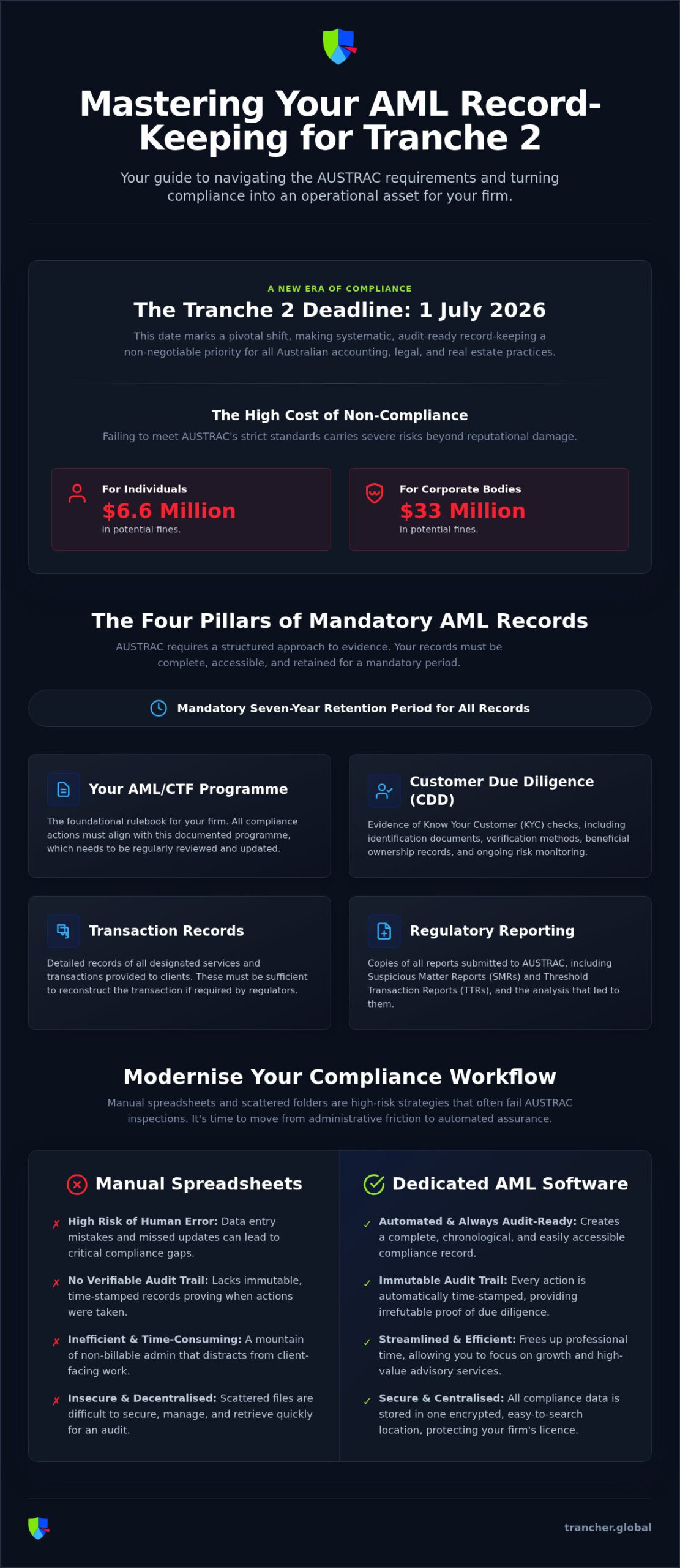
The 1 July 2026 deadline marked a significant turning point for the Australian accounting profession. For the first time, firms across the country are required to operate under the full weight of the Tranche 2 reforms. AML record-keeping is no longer just about filing away a copy of a driver’s licence; it is the systematic creation and secure storage of compliance evidence that proves your firm is actively preventing financial crime. Without a robust system, your practice is exposed. The Australian Transaction Reports and Analysis Centre (AUSTRAC) has clear expectations for “audit-ready” documentation. This gold standard requires that your files are not just present, but easily accessible, chronological, and complete. Failing to meet these standards carries severe risks, including potential fines of up to $33 million for corporate bodies and $6.6 million for individuals, alongside irreparable damage to your professional reputation. We view these obligations as an opportunity to strengthen your internal systems and provide peace of mind.
Understanding Your Obligations Under the AML/CTF Act
The AML/CTF Act operates on a “reasonably necessary” standard. This means you must be able to demonstrate to a regulator that your records are sufficient to show you have complied with your specific AML/CTF programme. Every designated service record must be retained for a mandatory seven-year period. This includes client identification documents, transaction details, and your internal risk assessments. Crucially, these records must be kept in English or be in a format that is readily convertible to English. If an auditor requests information, you must be able to produce these files within a reasonable timeframe. Maintaining these records correctly is the only way to prove you have performed the required due diligence on your clients.
The Shift from Manual to Automated Compliance
Relying on physical filing cabinets or unorganised digital folders is a high-risk strategy. These manual methods often fail AUSTRAC inspections because they lack version control, encrypted security, and searchable audit trails. In the context of Australian accounting practices, a Reporting Entity is defined as any firm that provides one or more designated services, such as assisting with the purchase of real estate or managing client assets, which triggers obligations under the AML/CTF Act. As the volume of client onboarding increases, human error becomes inevitable without the right tools. Transitioning to AML record keeping software Australia reduces this friction significantly. Automation ensures that every step of the KYC process is timestamped and stored correctly, removing the administrative overwhelm that often plagues busy firms. It transforms a scattered collection of documents into a secure, centralised asset that protects your licence.
Essential Records: What Your AML/CTF Programme Must Retain
Effective compliance is built on more than just saving a few PDFs to a server. It requires a structured approach to evidence that demonstrates your firm’s adherence to the law. We categorise mandatory records into four primary pillars: your AML/CTF Programme, Customer Due Diligence (CDD), transaction records, and regulatory reporting. Your written AML/CTF Programme is the foundation of this entire structure. It acts as your firm’s internal rulebook, and AUSTRAC expects every action you take to align perfectly with the procedures you’ve documented there. Without this alignment, even the most detailed client files can be deemed non-compliant during an inspection.
Modern AML record keeping software Australia provides a significant advantage by automatically time-stamping every compliance action. This creates an immutable audit trail, proving exactly when a check was performed and by whom. This level of detail is vital because it distinguishes between “Initial CDD,” performed during onboarding, and “Ongoing Monitoring,” which tracks changes in a client’s risk profile over time. Capturing the evolution of a client relationship is just as important as the first identification check.
Customer Due Diligence (CDD) and KYC Records
For individuals, you must retain evidence of primary and secondary identification, such as passports or driver’s licences. However, for companies and complex trust structures, the requirements are more rigorous. You need to document the full chain of ownership and identify all ultimate beneficial owners. It isn’t enough to simply record the result of a check; you must record the “method” of verification. Whether you used a physical sighting of documents or an electronic data source, the specific method must be logged to satisfy regulatory standards. For a deep dive into these technical requirements, see our guide on CDD and KYC Requirements Australia.
Governance, Training, and Independent Review Records
Governance records are often the first thing an auditor examines to gauge a firm’s compliance culture. You must maintain detailed logs of AML/CTF staff training, including who attended, the date, and the specific topics covered. Equally important are records of senior management oversight. Board minutes or management meeting notes that show the approval of your AML/CTF Programme or the review of risk reports are non-negotiable. Finally, you must handle Suspicious Matter Reports (SMRs) with extreme care. These records must be stored securely and separately to ensure you comply with “tipping-off” rules, which strictly prohibit informing a client that they are under suspicion. Managing these sensitive requirements is much simpler when you partner with an expert compliance companion to automate your firm’s internal workflows.
Manual Spreadsheets vs. Dedicated AML Record-Keeping Software
Choosing how to store your compliance data is one of the most consequential decisions your firm will make this year. While many practices start with basic spreadsheets, the “hidden costs” of manual tracking quickly outweigh the initial convenience. We see firms losing hundreds of billable hours to search time and manual data entry. Beyond the labour, the risk of human error in a manual system is a significant liability that spreadsheets simply can’t mitigate. When you consider the seven-year retention mandate, the fragility of a locally saved file becomes a major point of concern for any partner.
Dedicated AML record keeping software Australia provides encrypted cloud storage that far exceeds the security of a local server folder or a filing cabinet. If AUSTRAC arrives for an unannounced inspection, being able to retrieve a specific record in seconds is the difference between a calm review and a stressful audit. This centralised approach also ensures total consistency across a multi-partner accounting firm. It prevents the common issue where different partners maintain varying standards of documentation, which often leads to dangerous gaps in your firm-wide compliance trail.
The Problem with “Compliance by Spreadsheet”
Managing your obligations via spreadsheet is a fragile strategy. Without robust version control, a single accidental deletion or an overwritten cell can wipe years of mandatory evidence. It’s also nearly impossible to track ongoing monitoring through static documents, as these require constant, proactive manual updates to remain accurate. This fragmentation makes it incredibly difficult to produce a cohesive Annual Compliance Report. Most firms find themselves in a mad scramble at year-end, pulling senior staff away from billable work to reconstruct a compliance history that should have been captured automatically.
Efficiency Gains Through Centralised Software
Transitioning to centralised software unlocks immediate efficiency gains for your entire team. Automated data feeds from IDV providers eliminate the need for staff to manually type in passport numbers or address details, which ensures data integrity from the very first interaction. Features like “One Click Audit Reports” offer total peace of mind, providing regulatory transparency at the touch of a button. By implementing Ongoing Risk Monitoring, your software becomes a continuous record-generating engine. It works quietly in the background, keeping your practice safe and your records current while you focus on high-value client advisory.
Implementing an Audit-Ready System Before the 2026 Deadline
Preparing your practice for the 1 July 2026 deadline doesn’t have to be a source of stress. We’ve developed a clear, 5-step roadmap to ensure your records are compliant well before AUSTRAC begins its post-commencement reviews. This process involves conducting a gap analysis, selecting your platform, back-filling existing client data, training your staff, and performing a final audit-readiness check. To remove any implementation anxiety, we offer a 30-day compliance guarantee. This ensures that your firm can move from administrative uncertainty to total regulatory confidence in just four weeks. Having local Australian support on the ground is essential during this transition, as it allows for a system that is tailored to the specific nuances of your accounting practice.
A critical part of this journey is addressing your existing client base. If you’re providing “designated services” to long-term clients, you must ensure their records are brought up to the 2026 standard. Back-filling this data is a proactive step that demonstrates a commitment to compliance rather than a reactive approach. It’s about protecting the firm’s legacy while securing its future. By addressing these files now, you avoid a bottleneck of work as the deadline approaches.
Step 1: Conduct a Record-Keeping Gap Analysis
Your first move is to review current client files against the rigorous Tranche 2 expectations. Start by identifying which services you offer that trigger AML obligations, such as managing client funds or acting as a trust and company service provider. Many firms find that while they have basic identification on file, they lack the specific “method of verification” logs or ultimate beneficial owner details required under the new regime. You should prioritise your high-risk client files first, such as those involving complex offshore structures or high-value asset management, to mitigate your most immediate exposures.
Step 2: Choosing and Onboarding the Right Platform
When selecting AML record keeping software Australia, your criteria should be uncompromising. Look for a solution that offers deep AUSTRAC alignment, local technical support, and a user interface your team will actually use. Once you’ve chosen a platform, role-based training is vital. Every team member, from your junior associates to the senior partners, must understand their specific recording duties to maintain a consistent audit trail. Smart firms use this opportunity to reduce compliance costs by replacing manual labour with intelligent automation. To see how quickly your practice can reach total readiness, start your 30-day compliance journey with Trancher today.
Trancher: Transforming Record-Keeping into a Profit Centre
Many practitioners view the Tranche 2 reforms purely as a cost centre. We take a different view. Trancher is the only AML record keeping software Australia designed specifically to track your billable compliance activity. It doesn’t just store documents; it quantifies the professional value you provide to your clients. At the end of our complimentary three-month trial, we provide a detailed ROI report that shows exactly how much time and effort your firm has invested in compliance. This transparency allows you to make informed decisions about your service pricing and resource allocation.
Beyond the numbers, the risk assessment process often uncovers deeper advisory opportunities. When you perform a thorough review of a client’s source of wealth or corporate structure, you frequently identify gaps in their estate planning or asset protection. These insights allow you to transition from a reactive compliance checker to a proactive strategic partner. This deeper understanding of a client’s financial ecosystem is a significant professional advantage. We back this transformation with a clear 30-day guarantee: your firm will be audit-ready and fully compliant, or you get your money back.
Recovering Your Compliance Costs
Shifting the psychological burden of compliance starts with visibility. You can use Trancher’s detailed activity logs to justify billing for AML compliance as a professional service. Communicating these fees to clients is much simpler when you can show the rigorous verification and monitoring work performed on their behalf. It’s a move from “compliance as a cost” to “compliance as a value-add” that protects both the client and the firm. This approach ensures your practice remains profitable while meeting the highest regulatory standards. It positions your firm as a premium provider that takes security and integrity seriously.
Start Your 3-Month Complimentary Trial
We invite Australian accounting firms to experience this shift first-hand with a no-obligation, three-month trial. This period allows you to integrate our platform into your workflow and see the ROI results for yourself without any upfront financial commitment. During this trial, you will receive:
- Full access to end-to-end AML/CTF programme management tools.
- Automated client verification and ongoing risk monitoring.
- A comprehensive ROI report detailing your firm’s compliance activity.
- Local Australian support to ensure a seamless transition.
For firms that choose to continue with us after the trial, we offer a 20% discount to support your long-term success and growth. Our local team is ready to guide you through every step of the setup. Don’t let administrative overwhelm dictate your firm’s future. Prepare early. Thrive in 2026. Start a conversation with Trancher today.
Secure Your Practice and Lead with Confidence
The 1 July 2026 commencement of Tranche 2 obligations has redefined the professional standard for Australian accounting firms. By moving beyond the limitations of manual spreadsheets and adopting dedicated AML record keeping software Australia, you’re doing more than just avoiding regulatory penalties. You’re building a more resilient, transparent, and profitable practice. We’ve seen how a structured approach to your AML/CTF programme and client due diligence can shift compliance from an administrative burden into a high-value advisory opportunity that strengthens your client relationships.
It’s time to replace compliance anxiety with operational ease. As an Australian-owned and operated partner, we’re here to ensure your transition is seamless and rewarding. Our platform is strictly AUSTRAC-aligned for Tranche 2 requirements, and we provide a 30-day guarantee to get your firm fully compliant and audit-ready. Take the first step toward a more secure future today. Secure your firm’s future with a complimentary 3-month trial of Trancher and discover how simple regulatory readiness can be. We’re excited to help you turn these new obligations into your next great professional advantage.
Frequently Asked Questions
What are the specific record-keeping requirements for Tranche 2 entities?
Tranche 2 entities must maintain comprehensive records of their AML/CTF programme, customer identification procedures, and transaction details. You’re required to document not just the final verification result but also the specific method used to verify a client’s identity. This includes keeping copies of all reports submitted to AUSTRAC and records of any internal risk assessments performed during the onboarding process to demonstrate your due diligence.
How long must Australian accounting firms keep AML compliance records?
You must retain all AML/CTF compliance records for a mandatory period of seven years. This retention clock typically starts from the date the record was created or the date the designated service was provided. Maintaining these archives is a non-negotiable legal requirement, as AUSTRAC may request access to these documents during any future audit or inspection to verify your firm’s historical compliance with the Act.
Can I keep AML records in a digital format, or do I need physical copies?
Digital records are entirely acceptable and are the preferred method for modern practices. AUSTRAC requires that records are kept in English or are readily convertible to English; digital storage makes this process much simpler. Using AML record keeping software Australia ensures your data is encrypted, searchable, and protected from the physical risks of fire or loss that often affect paper filing systems.
What happens if our firm fails an AUSTRAC record-keeping audit?
Failing an audit can lead to significant civil penalties, which can reach up to $33 million for corporate bodies. AUSTRAC also has the power to issue remedial directions, requiring you to fix specific failures within a set timeframe. Beyond the financial impact, a failed audit can lead to an enforceable undertaking, which involves intrusive oversight and causes substantial damage to your firm’s professional standing and reputation.
Do I need to keep records of clients who were rejected during onboarding?
Yes, you should keep detailed records of any client you decline to onboard due to AML/CTF risks. These records serve as vital evidence that your risk-based approach is functioning correctly and that you’re actively monitoring for suspicious activity. Documenting these rejections proves to regulators that your firm isn’t just “ticking boxes” but is making informed, professional decisions to protect the Australian financial system from illicit flows.
How does AML software help with suspicious matter reporting (SMR) records?
Dedicated software provides a secure, isolated environment for managing sensitive SMR data, which is essential for avoiding “tipping-off” breaches. It ensures that internal reports and final submissions are timestamped and stored away from general client files. This separation protects your staff and ensures that only authorised personnel can access information related to suspicious activity, maintaining the strict confidentiality and legal standards required by the regulator.
Is there a specific format AUSTRAC requires for compliance records?
AUSTRAC doesn’t mandate a specific file format, but they do require that records are “readily accessible” and “audit-ready.” This means your documentation should be organised logically and be easy to retrieve upon request during an inspection. While you can use various digital formats, the key is ensuring the information remains legible and complete throughout the entire seven-year retention period without risk of data corruption.
Can I charge my clients for the time spent on AML record-keeping?
You certainly can, and many forward-thinking firms are already doing so. By using AML record keeping software Australia to track the exact time spent on due diligence and monitoring, you can justify a professional compliance fee. This shift helps transform a necessary administrative task into a recoverable advisory service, ensuring your firm is fairly compensated for the high level of security and integrity you provide.