

What if the most significant regulatory shift in a generation wasn’t a drain on your firm’s resources, but actually the key to unlocking a new, high-margin service line? With the July 2026 AUSTRAC deadline approaching, it’s easy to view the new Tranche 2 requirements as a looming administrative burden. You aren’t alone if you’re worried about manual KYC checks and audit trails becoming a non-billable black hole of time. We recognise that for many Australian practitioners, the fear of penalties is often eclipsed by the stress of managing complex new workflows alongside daily client work.
This guide will show you how to design and implement a robust AML/CTF program that replaces manual friction with a streamlined, profitable framework. By leveraging a dedicated AML compliance platform for accountants, you can move from reactive stress to proactive readiness. We will outline how to achieve “set and forget” automation, ensure you’re always audit-ready at the click of a button, and successfully recover compliance costs through structured client billing. It’s time to transform these regulatory obligations into a strategic advantage that supports your firm’s long-term financial health and operational ease.
Key Takeaways
- Map your practice’s “Designated Services” to the AUSTRAC timeline to ensure full compliance before the July 2026 deadline.
- Understand the essential architecture of Part A and Part B programs required to protect your firm from money laundering and terrorism financing risks.
- Transition from manual, error-prone spreadsheets to a specialised AML compliance platform for accountants to achieve a “set and forget” automated workflow.
- Shift your mindset from viewing compliance as an overhead to seeing it as a profitable, value-add service with clear ROI tracking.
- Implement a 30-day roadmap that integrates regulatory requirements seamlessly into your current practice management tools without administrative overwhelm.
Navigating the Tranche 2 Landscape: Why Your Accounting Firm Needs a Formal AML Program
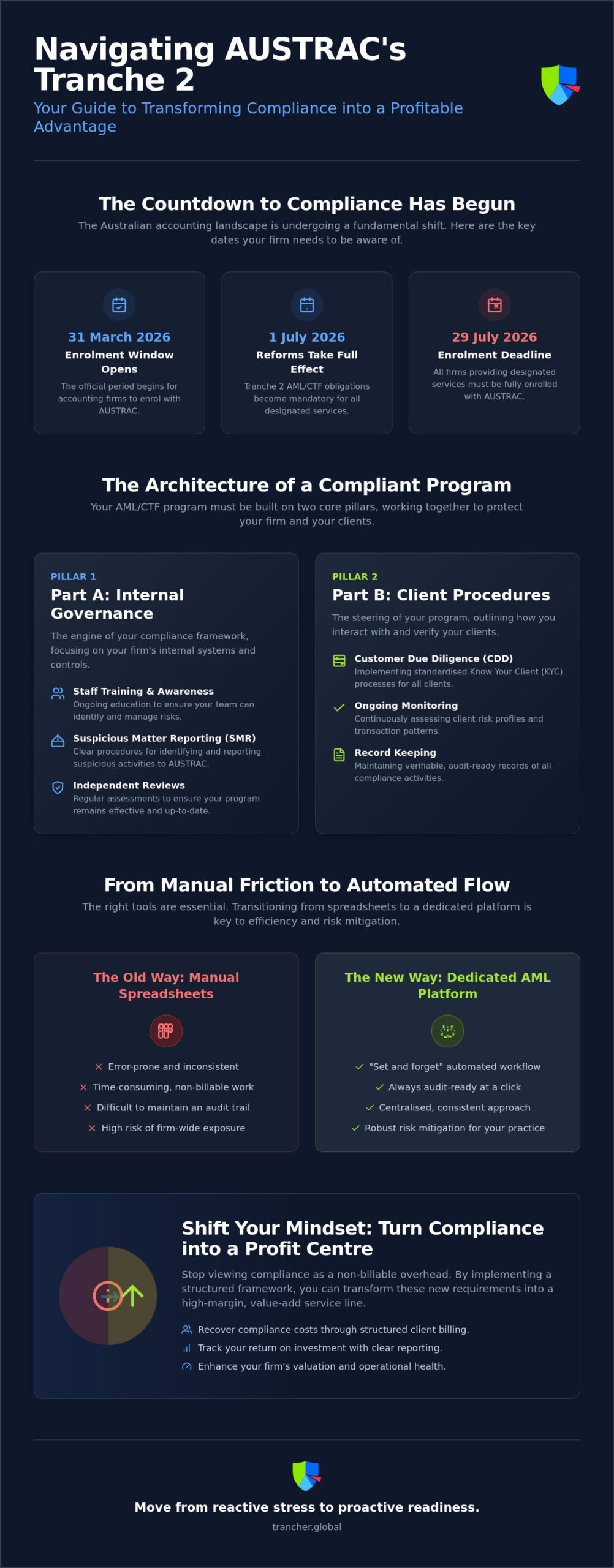
The countdown has officially begun. On 1 July 2026, the Australian accounting landscape changes permanently as the Tranche 2 reforms take full effect. This isn’t just another administrative update; it’s a fundamental shift in how you interact with your clients and manage your practice. By 29 July 2026, every firm providing designated services must be enrolled with AUSTRAC. This includes activities you likely perform daily, such as managing client money, establishing companies or trusts, and providing tax advice on complex financial arrangements. The enrolment window opens on 31 March 2026, giving you a clear window to prepare your systems.
Adopting a dedicated AML compliance platform for accountants is no longer a luxury for the tech-savvy; it’s a baseline requirement for firms that value efficiency and risk mitigation. The stakes are high. While large institutions like Westpac and Commonwealth Bank faced billion-dollar settlements, for a mid-sized Australian firm, the risk is more personal. Non-compliance can lead to severe financial penalties, the loss of your professional license, and irreparable reputational damage in a tight-knit business community. Understanding the global context of Anti-money laundering (AML) helps explain why Australia is finally aligning with international standards. We’re moving from a period of informal trust to a structured, legislated framework where “knowing your client” must be documented and verifiable.
The Regulatory Shift for Australian Tax Agents
For years, many tax agents relied on long-standing relationships as a proxy for security. AUSTRAC now acts as a proactive regulator for “Gatekeeper” industries, meaning your firm is now part of Australia’s first line of defence against financial crime. This shift requires moving away from informal, manual checks toward a formal AML/CTF program. You’ll need to move beyond simple identity verification and implement a risk-based approach that captures potential red flags before they enter your system. It’s about building a shield around your practice that is both robust and easy to maintain.
The Opportunity in Operational Readiness
There’s a significant silver lining to these new obligations. Firms that act early gain a distinct competitive edge. Achieving AML CTF compliance costs reduction isn’t just about saving money; it’s about modernising your entire onboarding process. A digital-first approach to client verification doesn’t just satisfy the regulator; it protects your firm’s valuation and signals to high-value clients that your practice is sophisticated and secure. By transforming compliance from a reactive chore into a proactive client service, you’re not just following rules; you’re improving your firm’s operational health.
The Architecture of Compliance: Key Components of AML Program Design and Implementation
Designing a compliant program isn’t about ticking boxes. It’s about building a scalable framework that protects your firm without slowing down your operations. Under the AUSTRAC regime, your program must be divided into two distinct pillars: Part A and Part B. Part A focuses on your internal governance, including staff training, suspicious matter reporting, and independent reviews. Part B covers the specific procedures you use to verify a client’s identity. Think of Part A as the engine and Part B as the steering; both must function perfectly to keep your firm on the right side of the law.
Standardising CDD and KYC requirements Australia across your entire team is the only way to ensure consistency. Without a unified approach, individual partners might inadvertently expose the firm to risk through inconsistent documentation. Integrating an AML compliance platform for accountants provides the necessary guardrails to keep everyone on the same page. This centralisation ensures that every client, whether a simple individual or a complex discretionary trust, undergoes the same rigorous verification process every single time.
Designing Your Firm-Wide Risk Assessment
This is the foundation of your entire strategy. You can’t mitigate what you haven’t identified. Start by evaluating your client base and identifying high-risk segments, such as politically exposed persons (PEPs) or entities in jurisdictions with weak regulatory oversight. You should also assess your delivery channels. For instance, non-face-to-face onboarding carries a higher inherent risk than meeting a client in person. Documenting your risk appetite and mitigation strategies is a critical step for AUSTRAC review. It demonstrates that you’ve applied a thoughtful, risk-based approach rather than just following a generic template.
Implementing Automated Verification Workflows
Automation is where the perceived burden of compliance disappears. Modern workflows allow you to integrate biometric identity verification, which lets clients verify themselves securely via their smartphones. This removes the friction of physical document handling and improves the client experience. Additionally, an AML compliance platform for accountants can automate PEPs and sanctions screening, providing real-time alerts if a client’s status changes. This is particularly useful for identifying beneficial ownership in complex structures, which is often a manual nightmare for staff. If you’re ready to see how these systems fit together, you can explore our automated workflow solutions to find a fit for your practice.
Compliance doesn’t end at onboarding. You need systems to detect suspicious activity throughout the client lifecycle. Ongoing monitoring involves regular reviews of client activity to ensure their transactions align with their stated business purpose. By setting up automated triggers for unusual activity, you move from reactive panic to a state of calm, audit-ready confidence.
Automation vs Manual Spreadsheets: Choosing the Right AML Compliance Platform for Accountants
Many firms initially view spreadsheets as a cost-effective way to manage their new obligations. However, this manual approach often hides significant operational costs and regulatory risks. Spreadsheets are static, prone to version control errors, and difficult to secure. When an AUSTRAC auditor requests your documentation, presenting a fragmented collection of Excel files can signal a lack of systemic control. A dedicated AML compliance platform for accountants replaces this “compliance by hope” strategy with a structured, digital audit trail that is always ready for inspection.
The true power of a modern platform lies in its ability to integrate with your existing practice management stack. Rather than forcing your team to jump between disconnected applications, a high-performance system pulls data directly from your client records. This connectivity reduces double-handling and ensures that your AML data remains synchronised with your broader business operations. It turns a siloed administrative task into a seamless part of your professional workflow, rather than an external hurdle that slows your team down.
Static “point-in-time” checks are no longer sufficient in a landscape where client risks can change overnight. Implementing ongoing risk monitoring software allows your firm to move away from periodic manual reviews toward real-time oversight. If a client’s risk profile shifts due to new sanctions or a change in beneficial ownership, your system should alert you immediately. This proactive stance ensures you aren’t relying on outdated information when making critical business decisions or filing annual reports.
The Risks of Fragmented Manual Processes
Manual data entry is the primary source of “compliance gaps” in Australian firms. When staff members are required to copy-paste information across multiple documents, errors are inevitable. These inconsistencies make it nearly impossible to maintain a single source of truth, especially across multiple offices or departments. This fragmentation often leads to “audit anxiety,” where partners feel uncertain about their firm’s readiness because documentation is decentralised. A centralised platform eliminates this stress by housing all required 7-year retention records in one secure, accessible location.
Features of a High-Performance AML Platform
An effective AML compliance platform for accountants should do more than just store data; it should actively guide your team through the regulatory maze. Look for features like automated AUSTRAC reporting that includes built-in validation to prevent submission errors. Role-based training modules are also essential to ensure every staff member understands their specific responsibilities under your Part A program. By providing a centralised dashboard, you gain a high-level view of your firm’s total risk exposure, allowing you to manage compliance with the same precision you apply to your clients’ tax affairs.
Turning Compliance into a Profit Centre: Tracking ROI and Billable Activity
The traditional view of regulatory compliance as a “non-billable black hole” is a significant hurdle for many Australian firms. It’s time for a strategic shift. By moving away from the view of compliance as a sunk cost, your firm can begin to recognise these activities as the high-value professional services they truly are. Your clients rely on your expertise to navigate complex financial landscapes; ensuring their entities are secure and compliant is a natural extension of that trust. When you frame AML obligations as a protective service rather than a tax on your time, the path to profitability becomes clear.
To achieve this, you need visibility into the actual resources your firm consumes during onboarding and monitoring. Implementing compliance ROI tracking software allows you to identify exactly how many hours are spent on manual verification versus automated tasks. This data is invaluable for firm partners. It provides the empirical evidence needed to adjust engagement letters and ensure that compliance activities are no longer subsidised by your firm’s profit margins. An AML compliance platform for accountants that includes native time-tracking makes this transition effortless, capturing every minute spent securing a client’s file.
Capturing Billable Compliance Hours
Precision is key when recovering costs. Trancher is designed to track the time spent on specific KYC and CDD tasks, allowing for direct client recovery or more accurate fixed-fee pricing. Beyond simple cost recovery, a robust program often reveals new advisory revenue streams. As you perform enhanced due diligence, you gain a deeper understanding of your client’s corporate structures and risk profiles, which can lead to strategic conversations about restructuring or tax planning. Benchmarking your compliance efficiency against industry standards also helps you identify where automation can further improve your internal margins.
Communicating Value to Your Clients
Transparency is the best tool for reducing client pushback. When you explain that AML is a global professional standard designed to protect the integrity of the Australian financial system, clients generally appreciate the rigour. Use automated notification templates to clearly outline why you need specific documentation and how it protects their business interests. This positions your firm as a secure, compliant partner capable of handling high-value transactions with the necessary oversight. If you are ready to start recovering your costs, you can view our compliance billing support tools to see how we help firms maintain profitability.
Generating regular ROI reports is the final step in proving the efficiency of your automated workflows. These reports show the reduction in manual hours and the increase in billable recovery, providing a clear picture of your firm’s operational health. It turns a regulatory requirement into a measurable business advantage that supports long-term growth.
Getting AUSTRAC-Ready in 30 Days: Your Implementation Roadmap with Trancher
Achieving total readiness doesn’t need to be a multi-month ordeal that distracts from your core accounting duties. We’ve designed a clear, time-bound roadmap that ensures your firm is fully compliant within a single month. This 30-day guarantee provides the certainty you need as the July 2026 deadline approaches. By following a structured implementation process, you can transition from your current state to a fully operational AML/CTF framework with minimal disruption to your daily billable work. It’s about replacing uncertainty with a methodical, supported transition.
The journey begins with Step 1: Onboarding and system integration. During this initial phase, we connect our AML compliance platform for accountants with your existing practice management stack. This ensures a frictionless flow of data, allowing you to pull client information directly into your new compliance environment without manual double-handling. Step 2 moves into the design phase, where we conduct an automated risk assessment tailored to your practice’s specific “Designated Services.” From here, the system generates a bespoke Part A and Part B programme that reflects your firm’s unique risk appetite and operational structure.
The final phase, Step 3, focuses on human readiness. We facilitate staff training and a formal “go-live” of your audit ready compliance records system. This ensures that every team member understands their role in the new workflow and that every client interaction is documented according to AUSTRAC’s strict standards. By the end of day 30, your firm isn’t just compliant in theory; it’s operational, secure, and ready for any future regulatory scrutiny. You’ll have the peace of mind that comes from knowing your documentation is complete and accessible at the click of a button.
The Complimentary 3-Month Trial
We recognise that choosing a new technology partner is a significant decision for any SME firm. That’s why we offer a complimentary 3-month trial, allowing you to test-drive the platform in your real-world accounting environment with zero financial risk. During this period, you’ll have full access to our local Australian expert support to guide you through the setup. At the conclusion of your trial, we provide a formal ROI and Efficiency report, demonstrating exactly how much time you’ve saved and the revenue you’ve recovered through our integrated billing tools. It’s a transparent way to ensure the system delivers genuine value to your practice.
Your Long-Term Compliance Partner
Regulatory landscapes are never static. As an innovator in the field, Trancher provides ongoing updates to keep your programme current with the latest AUSTRAC guidance and legislative changes. We act as your strategic guide, ensuring that your AML compliance platform for accountants evolves alongside your practice. For SME firms looking to thrive in a regulated future, having a dependable partner means you can focus on growing your business while we handle the complexities of your compliance architecture. We’re here to act as a steady hand, ensuring your firm remains proactive rather than reactive in the years to come.
Secure Your Firm’s Future with Confidence
The transition to Tranche 2 compliance represents a pivotal moment for Australian accounting practices. It’s an opportunity to move away from fragmented manual processes and embrace a digital-first approach that protects your firm’s reputation while enhancing your bottom line. By now, it’s clear that a structured AML program doesn’t have to be an administrative burden. Implementing a specialised AML compliance platform for accountants is the most effective way to bridge the gap between complex regulatory requirements and seamless operational efficiency. You’ve seen how automation can turn non-billable overhead into a professional, recoverable service that provides your clients with absolute peace of mind.
We’re here to ensure your journey to compliance is smooth, predictable, and entirely manageable. With our 30-Day Compliance Readiness Guarantee and local Australian expert support, you can navigate these changes with a steady hand. Don’t wait for the July 2026 deadline to create unnecessary administrative pressure. Start your complimentary 3-month trial of Trancher and get AUSTRAC-ready in 30 days. We look forward to being your partner in building a more secure, resilient, and profitable practice.
Frequently Asked Questions
Will all Australian accountants need to comply with Tranche 2 by July 2026?
Compliance is mandatory for any accountant providing “designated services” as defined by AUSTRAC. The enrolment deadline is 29 July 2026 for those providing services on 1 July 2026. This shift impacts approximately 90,000 new entities across Australia. If your firm provides any of the specified activities, you must have a formal AML/CTF program in place to avoid significant penalties.
What are the specific “designated services” that trigger AML obligations for my firm?
Designated services include managing client assets, setting up companies or trusts, and acting as a registered office. It also covers providing tax advice specifically related to complex financial arrangements. If your practice offers these services, you’re required to enrol with AUSTRAC and implement a risk-based compliance framework. It’s essential to review your service list now to identify your exact reporting triggers.
How much does it cost to implement an AML compliance platform for a small firm?
Implementation costs vary based on your firm’s specific needs and the volume of clients you manage. Rather than a flat fee, look for a solution that offers a complimentary trial to assess the value first. Choosing an AML compliance platform for accountants often pays for itself through recovered billable hours and reduced administrative overhead. It’s an investment in your firm’s operational efficiency and regulatory safety.
Can I still use manual spreadsheets for my AML record keeping?
You can technically use spreadsheets, but it isn’t recommended due to the high risk of human error and version control issues. AUSTRAC requires you to maintain record-keeping for seven years and produce documentation quickly during an audit. Manual systems often struggle to meet these rigorous standards under pressure. Transitioning to a digital system ensures your records are secure, organised, and always audit-ready.
Do bookkeepers and BAS agents also fall under the Tranche 2 reforms?
Yes, bookkeepers and BAS agents are captured under Tranche 2 if they provide designated services. This includes managing bank accounts or assisting with the formation of legal entities for clients. It’s vital to assess your service list to determine your exact reporting obligations before the 2026 deadline. Many bookkeepers find that automation is the only way to manage these new tasks without doubling their workload.
What happens if my firm is selected for an AUSTRAC independent audit?
You’ll need to demonstrate that your AML/CTF program is both written and effectively implemented. Auditors look for evidence of your firm-wide risk assessment and proof that you’ve conducted proper customer due diligence. Having a centralised AML compliance platform for accountants ensures your documentation is accessible at the click of a button. This transparency provides the steady guidance needed to pass an audit with confidence.
How does Trancher help me bill my clients for compliance work?
Trancher includes integrated billing support and ROI tracking to identify the exact time spent on each client’s compliance checks. This allows you to transparently recover these costs through your standard invoicing process. It transforms a regulatory requirement into a professional service with a clear value proposition. Your clients will appreciate the rigour you apply to securing their financial entities and protecting the firm.
How long does it take to get my staff trained on the new AML program?
Basic staff onboarding is designed to be completed within a few hours. However, full implementation of your firm’s bespoke program and training on specific risk-based procedures is typically achieved within our 30-day roadmap. This phased approach ensures your team feels confident and capable without being overwhelmed by new requirements. We provide the support needed to make compliance a natural part of your team’s daily workflow.