

What if the spreadsheets currently protecting your firm are actually the single biggest threat to your regulatory standing? For many Australian accounting practices, the debate over AML CTF manual vs automation feels like a choice between a “free” DIY method and an added software expense. However, with the Tranche 2 deadline of 1 July 2026 fast approaching, the hidden costs of manual KYC and administrative heavy lifting are becoming impossible to ignore.
It’s a common sentiment among practitioners that compliance often feels like a non-billable time-sink that pulls your team away from high-value work. We understand that the pressure of meeting AUSTRAC requirements while managing a busy firm is a significant weight to carry. You’ll discover why the transition to automated systems is the critical move for your practice to avoid civil penalties that can reach up to 100,000 penalty units for corporations, which currently equates to millions of dollars in potential exposure.
This article provides a clear understanding of the risks inherent in manual processes and shows you how to transform compliance into a billable service. We’ll outline a 30-day path to ensure your practice is audit-ready and future-proofed for 2026 and beyond, turning a regulatory burden into a strategic advantage.
Key Takeaways
- Understand why the 1 July 2026 Tranche 2 deadline ends the era of “business as usual” for Australian accounting practices.
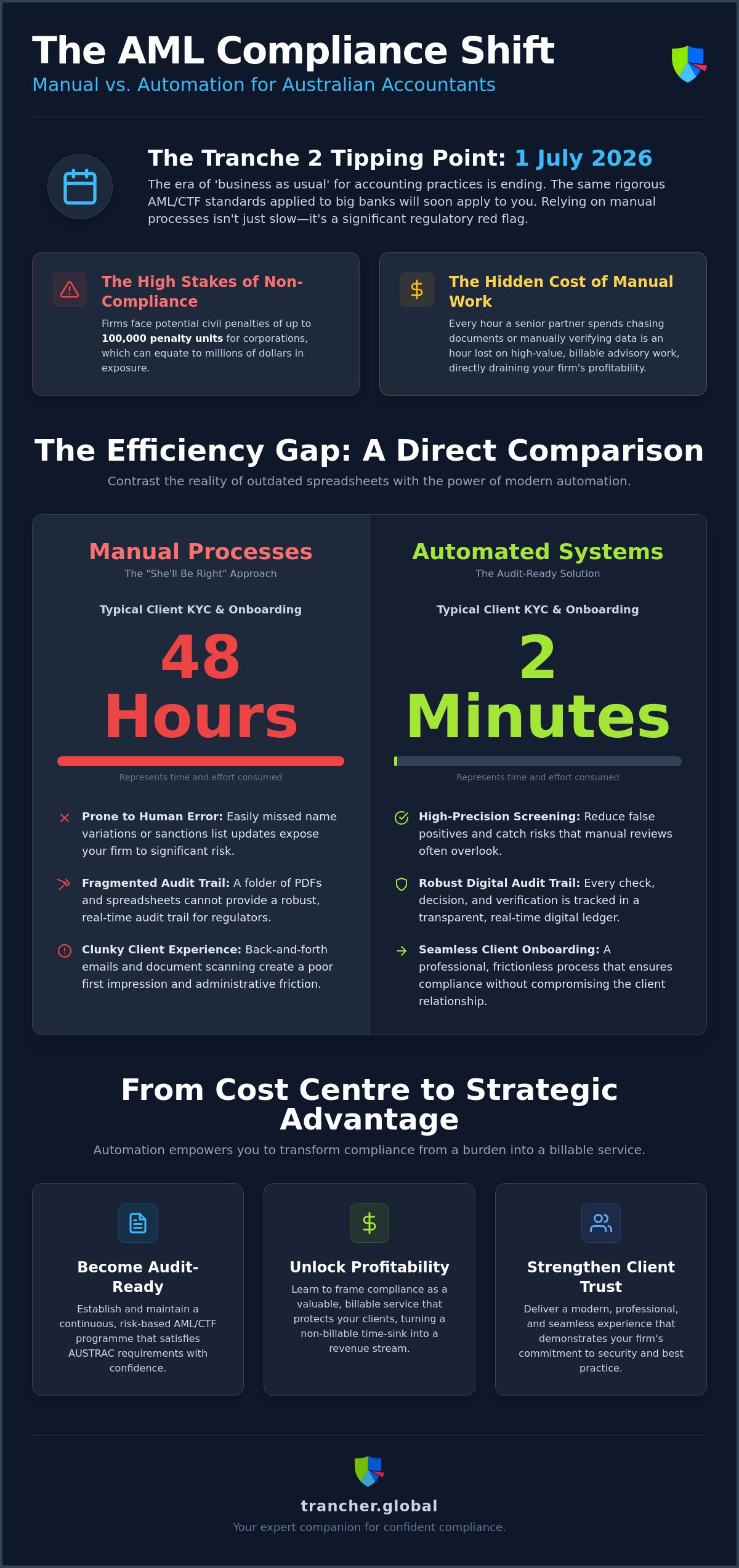
- Evaluate the efficiency gap in the AML CTF manual vs automation debate, contrasting 48-hour manual checks with 2-minute automated screenings.
- Uncover the hidden financial drain of “free” spreadsheets by calculating the true cost of administrative time and the risk of significant AUSTRAC penalties.
- Follow a structured, 30-day roadmap to audit readiness that identifies your firm’s specific risk profile and streamlines your workflow.
- Learn how to transform compliance from a non-billable time-sink into a profitable, value-added service for your clients.
The Tranche 2 Tipping Point: Why 2026 Changes the AML Landscape
The 1 July 2026 deadline is much more than a date on a regulatory calendar. It represents the end of “business as usual” for Australian accounting firms. From this date, your practice will be legally required to meet the same rigorous standards as the big banks. While many firms have historically relied on informal checks, the sheer volume of “designated services” in the accounting sector makes this old-school approach a significant liability. When you compare AML CTF manual vs automation, it’s clear that manual systems are no longer just slow; they’re a massive regulatory red flag.
The “she’ll be right” attitude toward manual record-keeping won’t satisfy AUSTRAC. Regulators are looking for an effective, risk-based AML/CTF programme that operates continuously, not just when you remember to file a form. Transitioning from occasional KYC checks to a persistent monitoring culture is the only way to avoid the heavy civil penalties that now apply to newly regulated entities.
The Scale Problem for SME Practices
For small to medium practices, the primary challenge is one of volume. Tranche 2 brings a vast number of clients under the compliance umbrella simultaneously. If your senior partners are the ones chasing down passport photos or manually verifying addresses, your firm’s profitability will suffer. It’s a classic bottleneck. Every hour a partner spends on administrative heavy lifting is an hour lost for high-value advisory work. Beyond the internal cost, a clunky manual onboarding process creates a poor first impression for your clients. Modern Anti-money laundering (AML) software allows you to maintain a professional, seamless client experience while ensuring your practice remains fully aligned with AUSTRAC requirements.
Defining Your Firm’s Designated Services
Identifying which of your services trigger these new obligations is your first priority. Under the AML/CTF Act 2006, designated services are specific business activities, such as managing client funds, assisting with the purchase of a business, or creating legal entities, that trigger mandatory compliance and reporting obligations. If your firm provides any of these services, you must have a formal programme in place. Relying on AML CTF manual vs automation processes in a fragmented system increases the risk that you’ll miss a reportable matter. A single overlooked threshold transaction or a missed suspicious matter report can lead to devastating consequences, including personal liability for directors and senior management. Automation ensures that every designated service is captured, tracked, and reported with precision, giving you the confidence to focus on growing your practice.
Manual vs Automated AML: A Direct Comparison
A manual Know Your Customer (KYC) process often takes up to 48 hours of back-and-forth emails, document scanning, and physical filing. Automated screening slashes this to just 2 minutes. When evaluating AML CTF manual vs automation, the efficiency gain isn’t just about time; it’s about precision. Manual checks for Politically Exposed Persons (PEPs) and sanctions are naturally prone to human error. Even the most diligent staff member can miss a name variation or an obscure international list, potentially exposing your firm to significant risk.
Digital systems provide a robust audit trail that a folder of fragmented PDFs simply cannot match. An integrated digital ledger tracks every check and decision in real-time, creating a transparent history of your compliance efforts. This level of accuracy is supported by research from the University of Strathclyde, which highlights how automation reduces the noise of false positives while catching risks that manual reviews often overlook. By embedding these checks into your daily workflow, compliance becomes a seamless part of your practice rather than a separate, daunting task.
KYC and CDD Workflows
Verifying complex trust and company structures across Australia is a manual struggle that frequently drains firm resources. Automation handles the intricate details of beneficial ownership and CDD and KYC requirements Australia without the need for tedious manual data entry. By using digital identity verification, you significantly reduce client friction. Your clients can complete their identity checks on their mobile devices in seconds, eliminating the need for them to post or deliver certified copies of documents. This modern approach respects your client’s time while ensuring your practice meets every regulatory standard.
Ongoing Risk Monitoring
Many firms fall into the “set and forget” trap during the onboarding phase. This approach fails AUSTRAC’s standards for ongoing monitoring, as your obligations don’t end once a client is signed. Using Ongoing risk monitoring software ensures you spot suspicious activity or changes in a client’s risk profile as they occur. Automated alerts notify your AML Officer only when a specific risk profile changes, whereas manual file reviews are an unreliable and exhausting alternative. It’s about keeping your team sane while maintaining a high standard of protection. If you’re ready to centralise these tasks, adopting an integrated platform can provide the steady guidance your practice needs.
The Hidden Costs of Manual AML Spreadsheets
Spreadsheets are often viewed as a cost-free solution for compliance. This is a common misconception that overlooks the substantial investment of time required for data entry, manual follow-ups, and physical filing. When comparing AML CTF manual vs automation, the primary difference lies in the hidden drain on your firm’s most valuable asset: billable time. Every hour a senior partner spends reconciling a spreadsheet is an hour that isn’t being billed to a client at a premium rate. This opportunity cost is the ultimate profit-killer for growing practices.
There is also a growing “compliance gap” inherent in manual systems. A spreadsheet is a static snapshot in time, whereas client risk is dynamic. If a client’s status changes or a new sanction is issued, a manual record remains blissfully unaware until the next scheduled review. A study in the Journal of Science, Innovation & Social Impact highlights that automated systems provide a much more reliable framework for catching these shifts in real-time. Relying on manual records means your firm is constantly playing catch-up with a reality that has already moved on.
The Risk of AUSTRAC Inspections
Manual systems frequently struggle to produce Audit ready compliance records when AUSTRAC comes knocking. During a formal review or an independent audit, having your data scattered across different centres and local drives creates immense pressure. It’s difficult to prove a consistent, risk-based approach when your evidence is a collection of disconnected files. Serious breaches of AML/CTF obligations can result in civil penalties for corporations of up to 100,000 penalty units, which, at the current rate of $364 per unit, represents a staggering financial risk for any practice. A centralised digital system removes this stress by providing a single, verifiable source of truth.
Staff Burnout and Administrative Burden
Junior staff often find manual AML tasks demoralising and tedious. Chasing clients for identity documents and manually checking names against lists is a high-pressure, low-reward activity that is ripe for human error. By removing these redundant steps, you achieve significant AML CTF compliance costs reduction while improving team morale. Automation allows your staff to focus on meaningful work, supported by expert guidance built directly into the platform. This shift not only protects your firm from AML CTF manual vs automation risks but also helps you retain your best talent by eliminating the administrative heavy lifting that leads to burnout.
Transitioning to Automation: A Roadmap for Accountants
Moving your practice toward a digital future requires a structured approach. It isn’t just about installing new software; it’s about refining your internal culture to embrace efficiency. When considering AML CTF manual vs automation, the transition is most successful when broken down into manageable milestones. By following a clear roadmap, you can shift from administrative heavy lifting to a streamlined, revenue-positive workflow.
- Step 1: Audit your current manual processes. Identify the specific tasks that consume the most time. This usually includes chasing client ID documents, manually checking PEP lists, and filing paper records.
- Step 2: Define your firm’s specific risk profile. Assess your client base and the “designated services” you provide. This ensures your automated system is calibrated to your actual regulatory exposure.
- Step 3: Choose a platform that integrates. Avoid creating a new data silo. Select a system that connects with your existing practice management tools to ensure a single source of truth for client data.
- Step 4: Formalise your AML/CTF programme. Use your new system to generate audit-ready documentation. This provides the written proof AUSTRAC requires to see that your programme is actually being followed.
- Step 5: Train your team. Shift the narrative from compliance being a “chore” to it being a “value-add.” Show your staff how automation protects them and provides a better experience for the client.
Selecting the Right Tech Stack
General KYC tools often fall short of meeting the specific AUSTRAC Tranche 2 requirements. You need a solution that goes beyond basic identity verification to include ongoing risk monitoring and suspicious matter reporting. Look for features that support your business health, such as revenue tracking and compliance billing support. This allows you to recover the costs of your compliance efforts fairly. Local Australian support is also vital. Having access to an expert team that understands the local regulatory landscape ensures your onboarding is smooth and your queries are answered promptly.
The 30-Day Readiness Goal
You can move from zero to fully compliant in approximately one month without disrupting your daily client work. This goal centres on establishing a “culture of compliance” through incremental changes. Start by setting up automated suspicious matter reporting (SMR) triggers, which alert your AML Officer to potential issues without requiring manual file reviews. This proactive stance ensures accuracy and efficiency from day one. If you are ready to begin this transition, you can book a guided walkthrough of our platform to see how these steps fit into your specific practice workflow.
Trancher: Turning Compliance into a Profitable Service
Trancher was created to solve the specific challenges Australian accountants face. It isn’t a repurposed banking tool; it’s a dedicated platform built specifically for the local accounting workflow. The debate of AML CTF manual vs automation usually ends when a partner sees how much billable time is actually recovered. We provide a 30-day compliance guarantee to ensure your practice is fully prepared for the 2026 Tranche 2 deadline, removing the stress of the unknown and replacing it with operational confidence.
Beyond just meeting requirements, our platform helps you look at compliance through a business-minded lens. By integrating compliance ROI tracking software, you can pinpoint exactly where your team is adding value. This insight allows you to identify new advisory opportunities and ensures that your firm’s expertise is being utilised where it matters most. It’s about transforming a perceived hurdle into an avenue for growth and improved internal systems.
Recoverable Compliance Activities
The traditional view of AML is that it’s a “sunk cost” or a non-billable time-sink. Trancher changes this narrative by allowing you to track and report on every recoverable compliance activity. You can monitor the hours spent on complex KYC or beneficial ownership checks and present this to clients as a professional, value-added service. This level of transparency builds client trust. Instead of a vague administrative fee, you’re providing an itemised account of the professional work performed to protect their financial interests and satisfy regulatory standards. It allows you to turn a mandatory obligation into a service you can proudly invoice.
Steady Guidance for the SME Partner
We know that SME partners wear many hats, and becoming a full-time compliance expert shouldn’t be one of them. You don’t have to navigate these changes alone when you have access to local expert support. We help you stay ahead of AUSTRAC’s evolving expectations, providing steady guidance as the AML CTF manual vs automation landscape shifts. Our audit-ready record keeping ensures that if an inspection occurs, you can produce the necessary documentation in seconds. It’s about maintaining a serious professional standard while remaining focused on your core business.
If you’re still managing your obligations through spreadsheets, it’s time to see how automation can work for you. We invite you to start a conversation with our team to see how we can support your firm’s specific needs. To prove the value, we offer a complimentary 3-month trial so you can experience the transition first-hand without any initial financial commitment. Ready to automate? Start your complimentary 3-month trial with Trancher today.
Ready Your Practice for a New Era of Compliance
The 1 July 2026 deadline marks a definitive shift for Australian accountants. We’ve explored how the choice between AML CTF manual vs automation is no longer just about preference; it’s about safeguarding your firm against substantial civil penalties and administrative burnout. By moving away from “free” spreadsheets, you’re not just avoiding risk; you’re reclaiming billable hours and providing a more professional experience for your clients.
Transitioning to a digital workflow doesn’t have to be a source of stress. With our 30-day compliance guarantee and AUSTRAC-aligned reporting, you can achieve full readiness without disrupting your daily operations. Our local Australian expert support is here to act as your strategic guide every step of the way, ensuring your practice remains resilient and efficient. It’s about moving from a reactive stance to a proactive, revenue-positive future.
Secure your firm’s future with a complimentary 3-month Trancher trial.
We’re here to help you turn these new obligations into a steady advantage for your practice. You have the expertise; we have the tools to protect it.
Frequently Asked Questions
Is manual AML compliance still legal under Tranche 2?
Manual compliance is technically legal, but it must satisfy the “effectiveness” test set by AUSTRAC. You must prove your manual programme can identify, mitigate, and manage money laundering risks. Most firms find that the administrative weight of manual record-keeping makes it nearly impossible to maintain the required standards as their client base grows. It’s a high-risk approach that often leaves practices vulnerable during an audit.
How much time does it actually take to implement an automated AML system?
You can generally implement an automated system within 30 days. This period covers the initial audit of your current processes, software integration, and team training. It’s designed to be a steady, step-by-step transition that doesn’t interfere with your billable work. Starting now ensures your practice is fully operational and compliant before the July 2026 deadline, giving you total peace of mind.
Can I use general KYC software instead of a specific AML platform?
General KYC software often lacks the specific reporting and monitoring triggers required by AUSTRAC. While basic verification tools check identities, they don’t typically handle suspicious matter reporting or ongoing risk monitoring. A dedicated AML platform is built to manage the entire lifecycle of a client relationship. This ensures every “designated service” your firm provides is captured and documented correctly under the Act.
What happens if my manual records are found to be insufficient by AUSTRAC?
If your records are found to be insufficient, your firm could face severe civil penalties. As of July 2026, the value of a penalty unit is $364, and corporations can be fined up to 100,000 units for serious breaches. The debate over AML CTF manual vs automation often highlights that manual errors are the most common cause of these regulatory failures and subsequent financial losses.
How do I explain the switch from manual to automated (and the associated fees) to my clients?
We recommend explaining the change as a necessary step to enhance data security and meet new Commonwealth regulations. Clients appreciate knowing their financial information is handled with the highest level of care. By framing compliance as a professional service, you can transparently communicate the associated costs. It’s about demonstrating your firm’s commitment to integrity and its role as a trusted gatekeeper.
Does automation replace the need for an AML Compliance Officer?
Automation does not replace the Compliance Officer, but it does alleviate their administrative burden. Newly regulated entities must notify AUSTRAC of their appointed officer by 29 July 2026. The software handles the repetitive screening and data gathering, allowing the officer to focus on strategic risk management. It provides the steady hand needed to navigate a changing regulatory landscape with total confidence and ease.
What are the specific Tranche 2 obligations starting in July 2026?
Starting 1 July 2026, accountants must perform customer due diligence and report any physical currency transactions of $10,000 or more. You’re also required to identify and report suspicious matters to AUSTRAC. When comparing AML CTF manual vs automation, it’s important to remember that these obligations are continuous. You must have a formal, written programme in place to manage these risks effectively every day.
Can automated systems help with suspicious matter reporting (SMR)?
Automated systems are vital for suspicious matter reporting because they flag unusual patterns instantly. Manual reviews often occur too late to meet AUSTRAC’s strict reporting timelines. Automation uses risk-based triggers to alert your team to potential issues, ensuring you can file reports without “tipping off” the client. This proactive monitoring keeps your practice safe while fulfilling your legal duties with minimal friction or delay.