

Your firm's heaviest administrative hurdle in 2026 isn't just a box-ticking exercise; it's the most significant opportunity you've had to modernise your practice. As the July deadline nears, it's completely understandable if the shift toward AML compliance for conveyancers Australia feels daunting. You're likely balancing the stress of verifying complex trust structures with the very real concern of losing precious billable hours to manual paperwork.
We agree that the regulatory jargon can be thick, and the fear of AUSTRAC penalties is enough to keep any practice owner feeling a little uneasy. However, we promise that navigating these new Tranche 2 obligations can be a smooth, manageable transition that actually strengthens your internal systems. By moving away from manual spreadsheets, you can protect your firm's reputation while improving your overall operational flow.
This guide offers a practical roadmap to help you get ready for the July 2026 commencement. We'll explore how to implement automated KYC and CDD workflows and, most importantly, how to turn these compliance requirements into a transparent, recoverable part of your client service model.
- July 2026 Readiness: Understand why this deadline is a critical milestone for AML compliance for conveyancers Australia and what it means for your enrolment duties.
- The Four Core Pillars: Master the essential Part A and Part B protocols you'll need to verify complex client structures and remain fully compliant.
- Automation vs Manual: Learn why automated KYC and CDD workflows are far more reliable than spreadsheets for passing AUSTRAC audits and protecting your team's time.
- Implementation Roadmap: Follow a clear, five-step plan to ensure your practice is risk-assessed and ready long before the new regulations commence.
- Profitability and ROI: Discover how to transition compliance from an administrative burden into a billable service that supports your firm's financial health.
What is Tranche 2 AML Compliance for Australian Conveyancers?
Tranche 2 refers to the second phase of Australia's Anti-Money Laundering and Counter-Terrorism Financing (AML/CTF) legislative reforms. For nearly two decades, these regulations focused primarily on banks, casinos, and bullion dealers. Now, the net is widening to include professional "gatekeepers" such as conveyancers, lawyers, and accountants. This means AML compliance for conveyancers Australia is moving from a best-practice suggestion to a mandatory legal requirement that sits at the core of your practice.
Timing is everything. The official commencement date for these new obligations is 1 July 2026. While that might seem distant, the Australian Transaction Reports and Analysis Centre (AUSTRAC) opened the enrolment window for new reporting entities on 31 March 2026. If your firm provides designated services on the commencement date, you must be enrolled by 29 July 2026. Early preparation isn't just about avoiding a last-minute rush; it's about ensuring your team is trained and your systems are tested long before the regulator begins its oversight.
Not every task you perform triggers these rules. The obligations apply specifically when you provide "designated services." In the conveyancing world, this includes:
- Assisting with the purchase, sale, or transfer of real property.
- Managing client funds, savings, or other assets within a trust account.
- Acting as a nominee shareholder or director for a client.
- Preparing for or carrying out transactions for a client related to business entities.
Why Conveyancers are Now in the Regulatory Spotlight
Property is a high-value asset class, making it a natural target for those looking to disguise the origins of illicit funds. Historically, Australia's property market has been seen as a "blind spot" by international observers. By introducing Tranche 2, the Federal Government is aligning our domestic laws with global standards set by the Financial Action Task Force. This shift ensures that conveyancers, who sit at the heart of every property transaction, have the tools to identify and report suspicious activity before it enters the financial system. It's about protecting your firm and the broader Australian economy from financial crime.
Consequences of Non-Compliance with AUSTRAC
The risks of ignoring these changes are substantial. AUSTRAC has the power to impose significant financial penalties, which can reach millions of dollars for serious or systemic failures. Beyond the balance sheet, a compliance breach can lead to devastating reputational damage in a profession built on trust. Your professional indemnity insurance may also be impacted if you're found to be operating outside of federal law. In some cases, the regulator may mandate independent audits at your firm's expense to ensure you've corrected your internal processes. Taking a proactive approach now is the most effective way to safeguard your practice's future.
The 4 Core Pillars of an AUSTRAC-Compliant AML/CTF Program
Achieving robust AML compliance for conveyancers Australia requires more than just a static template. You need a structured framework that scales with your practice. AUSTRAC mandates a written AML/CTF Program divided into two distinct sections. Part A focuses on identifying, managing, and mitigating money laundering and terrorism financing risks specific to your business. Part B focuses on the procedures used to verify the identity of your clients. Together, these form the bedrock of your regulatory defence.
Establishing these pillars isn't just about satisfying a regulator. It's about building a more resilient business. When your team understands how to identify risk, your firm becomes a harder target for financial crime. This proactive stance protects your reputation and ensures your operations remain smooth and predictable.
Know Your Customer (KYC) and CDD Essentials
The second pillar is Customer Due Diligence (CDD). While verifying a local individual is often straightforward, the complexity increases significantly when dealing with discretionary trusts, foreign companies, or self-managed super funds. You must identify the "Beneficial Owners"—the real people who ultimately own or control the entity. Additionally, you need to screen for Politically Exposed Persons (PEPs) who might present a higher risk profile. For a deeper look at these protocols, see our guide on CDD and KYC Requirements Australia: The 2026 Accountant’s Guide.
Effective KYC isn't a one-off task. It requires a clear process for collecting and verifying documents without creating friction for your clients. By using digital verification tools, you can confirm identities in seconds rather than days.
Ongoing Risk Monitoring and Reporting
Pillar 3 involves vigilance throughout the entire client relationship. It's not a "set and forget" process. In conveyancing, red flags often appear during the transaction itself. Unusual settlement patterns, such as a client suddenly requesting to pay via multiple third-party accounts or an unexplained change in beneficial ownership just before settlement, require immediate attention. If you identify suspicious activity, you must file a Suspicious Matter Report (SMR) with AUSTRAC. Utilising ongoing risk monitoring software can help automate these alerts, ensuring you never miss a critical indicator.
Finally, Pillar 4 centres on your team and your history. Your staff must be trained to recognise risks, and you must maintain detailed records of your compliance efforts for seven years. These records must be audit-ready, meaning they are organised and easily accessible should AUSTRAC request a review. Managing these pillars can feel like a full-time job. Many firms find that integrating an end-to-end platform simplifies these duties, allowing you to focus on your clients while the system handles the heavy lifting.
Manual Spreadsheets vs. Automated AML Platforms: A Solution Comparison
Many firms initially consider using basic spreadsheets to track their obligations. While this approach might feel familiar, the hidden costs of manual AML compliance for conveyancers Australia quickly become apparent. Every hour your senior practitioners spend chasing client ID documents or cross-referencing sanctions lists is an hour lost to billable legal work. Manual systems aren't just slow; they're inherently fragile. They rely on perfect human memory and consistent data entry, which are difficult to maintain during a busy settlement period.
The risk of data silos is perhaps the greatest threat to a firm's audit readiness. When client information is scattered across disparate email folders, local drives, and paper files, proving your compliance to AUSTRAC becomes a logistical nightmare. A manual record-keeping system often fails an audit not because the work wasn't done, but because the evidence can't be produced in a structured, chronological format. Moving to a centralised, encrypted platform ensures that every risk assessment and verification step is timestamped and stored securely.
The Administrative Burden of Manual KYC
Chasing clients for high-quality copies of their passports or driver's licences is a common source of friction. It slows down the onboarding process and can frustrate clients who expect a seamless digital experience. Beyond the collection phase, the manual checking of sanctions lists and PEP registers is fraught with risk. These lists are updated frequently by global authorities. A manual check performed today may be outdated by tomorrow, leaving your firm exposed to unintended non-compliance. Relying on manual oversight makes it nearly impossible to maintain a reliable audit trail that satisfies modern regulatory expectations.
Why Automation is the Modern Conveyancer’s Best Friend
Automation transforms these requirements into a background process. Digital verification tools can confirm a client's identity in minutes, using biometric technology to match live photos against government databases. This removes the need for physical document handling and significantly reduces the risk of identity fraud. For a deeper look at how this shift impacts your bottom line, explore our guide on AML CTF Compliance Costs Reduction: A Strategic Guide for Australian Accounting Firms in 2026.
Scalability is the ultimate benefit of an automated approach. As your firm grows, your compliance workload shouldn't grow at the same rate. An automated platform allows you to handle a higher volume of files without the need to hire additional administrative staff. It also provides automated reminders for essential tasks, such as staff training updates and regular program reviews. This ensures your practice remains compliant year-round, allowing you to focus on delivering exceptional service to your clients while the system manages the complexity of the Tranche 2 regime.
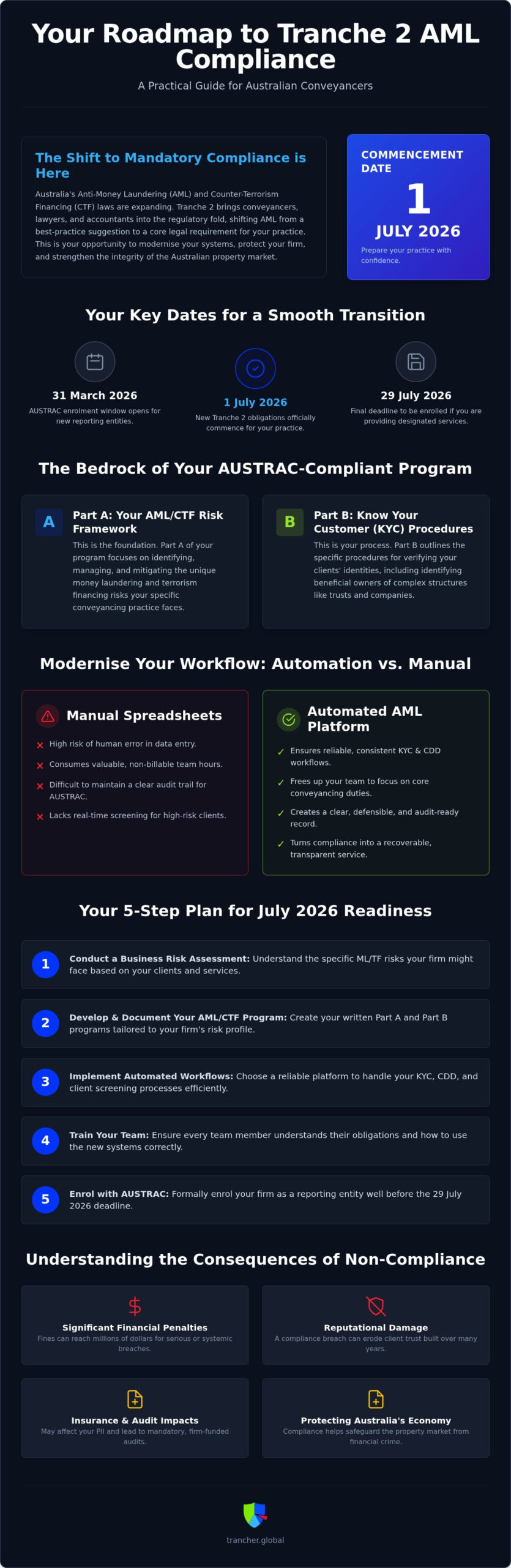
Implementation Roadmap: 5 Steps to AML Readiness by July 2026
The transition to 1 July 2026 doesn't need to be a multi-year project that drains your firm's resources. While the new regulations are comprehensive, they are entirely manageable when broken down into logical phases. By following a structured roadmap, you can ensure your AML compliance for conveyancers Australia is not only robust but also fully integrated into your daily operations long before the deadline arrives.
We've identified five essential steps to guide your practice through this transition:
- Step 1: Appoint an AML/CTF Compliance Officer. This individual, who can be a senior practitioner or director, takes responsibility for overseeing the firm's compliance framework and acting as the primary point of contact for AUSTRAC.
- Step 2: Conduct a firm-wide Risk Assessment. You must identify where your practice is most vulnerable to financial crime, considering your specific client types and service offerings.
- Step 3: Draft and implement a customised AML/CTF Program. This document outlines your internal policies, procedures, and controls for managing identified risks.
- Step 4: Integrate automated KYC tools. Replace manual identity checks with digital verification systems that plug directly into your existing conveyancing workflow.
- Step 5: Train your team. Ensure every staff member knows how to identify red flags and understands their role in maintaining accurate records.
If you're feeling behind, don't worry. You can get your firm audit-ready in just 30 days with the right guidance and support.
Conducting Your Initial Risk Assessment
Your risk assessment is the foundation of your entire program. You'll need to analyse your client base to determine if you deal primarily with local families or if you have significant exposure to international buyers and high-net-worth individuals, who may carry a higher risk profile. Similarly, evaluate your transaction types; a high volume of off-the-plan sales or commercial transfers requires different oversight than standard residential settlements. A Risk Assessment is a live document that evolves with your firm and should be reviewed whenever your service model or client base changes significantly.
Ensuring Audit-Ready Record Keeping
In Australia, you're legally required to maintain all AML/CTF records for seven years. This includes everything from initial identity verification documents to reports of suspicious activity. To satisfy an AUSTRAC inspector, your files must be structured so they are easily accessible and logically organised. For practical tips on how to manage this without drowning in paperwork, read our guide on Audit-Ready Compliance Records: The 2026 Guide for Australian Accounting Firms. Keeping these records in a centralised, digital environment ensures you're always prepared for a regulatory review at a moment's notice.
Transforming Compliance into a Profit Centre with Trancher
Many practitioners view the upcoming Tranche 2 reforms purely as a drain on resources. We see it differently. While the requirements are mandatory, they also provide a clear opportunity to reframe AML compliance for conveyancers Australia as a high-value, billable professional service. Instead of absorbing the administrative costs, you can transition to a model where compliance becomes a transparent and profitable part of your client service agreement.
Trancher is designed to remove the friction from this transition. Our platform doesn't just automate the "what" of compliance; it tracks the "how much." By using our detailed ROI reports, you can measure exactly how much time your team saves and how much revenue you've successfully captured through compliance billing. With our 30-day readiness guarantee, your firm can move from uncertainty to full AUSTRAC alignment without the months of stress typically associated with regulatory shifts.
Recovering Compliance Costs from Clients
Modern conveyancing involves sophisticated risk management. Communicating AML fees to your clients is becoming a standard practice, as most clients understand that protecting their high-value property transaction from financial crime requires specialised oversight. Trancher helps you generate clear evidence of the work performed, such as identity verification and trust structure analysis, making it easy to justify these costs on your final invoice. For more insights on this shift, explore our article on Compliance ROI Tracking Software: Transforming Regulatory Obligations into Billable Assets.
The Trancher Advantage for SME Conveyancers
We've built our platform specifically for the needs of Australian SMEs. This means seamless integration with your existing practice management tools, ensuring that compliance feels like a natural extension of your current workflow rather than an awkward addition. You'll also have access to local Australian expert support, providing you with a knowledgeable partner to answer your specific Tranche 2 questions as they arise. We believe in steady guidance, not just software delivery.
We're committed to your success and want you to feel completely confident in our solution. To support early adopters, we offer a complimentary 3-month trial, allowing you to experience the benefits of automated AML compliance for conveyancers Australia first-hand. It's a risk-free way to modernise your practice and turn a regulatory burden into a strategic advantage for your firm's future growth. Let's work together to ensure your practice remains both compliant and competitive.
Secure Your Practice for the July 2026 Transition
The arrival of Tranche 2 marks a significant shift, but it doesn't have to be a source of stress for your firm. By moving away from manual spreadsheets and adopting automated KYC workflows, you ensure your practice is prepared for AUSTRAC oversight while protecting your billable time. This transition is a unique opportunity to modernise your systems and transform AML compliance for conveyancers Australia into a transparent, professional service that adds value to your client relationships.
Trancher is here to act as your expert companion, offering a 30-day compliance guarantee and audit-ready documentation by design. Our local, Australian-based expert support is always available to help you navigate specific regulatory questions with confidence. You can start building a more resilient, profitable practice today without any upfront risk.
Secure your firm's future with our complimentary 3-month Trancher trial.
We're ready to help you turn these new obligations into a strategic advantage. With the right tools and a proactive mindset, your firm will be well-positioned to thrive long after the July 2026 deadline passes.
Frequently Asked Questions
Do small conveyancing firms really need an AML/CTF program?
Yes, every firm providing designated services must have a formal program regardless of its size. AUSTRAC's focus is on the nature of the transaction rather than the number of staff you employ. Small practices often face higher risks because they lack dedicated compliance teams, making a structured approach to AML compliance for conveyancers Australia even more vital for protecting your professional reputation and avoiding heavy penalties.
When do the Tranche 2 AML obligations actually start for conveyancers?
The official commencement date for Tranche 2 obligations is 1 July 2026. While this is the date the laws take effect, the window for enrolment with AUSTRAC opened on 31 March 2026. If you're already providing conveyancing services, you have until 29 July 2026 to complete your enrolment. We recommend starting your preparations early to ensure your internal policies and staff training are fully bedded in before the deadline.
What is a 'Designated Service' in the context of conveyancing?
A designated service is any professional activity that triggers the AML/CTF Act. For conveyancers, this primarily involves assisting clients with buying, selling, or transferring real property. It also includes managing client funds or assets within a trust account and acting as a nominee shareholder or director. If you're performing these tasks, you're providing a regulated service and must meet the associated customer due diligence and reporting duties.
How much does it cost to implement AML compliance software in Australia?
Pricing for compliance tools typically depends on the volume of transactions and the level of automation your firm requires. Rather than focusing on upfront costs, it's helpful to consider the return on investment through saved billable hours and recovered administrative fees. We offer a complimentary three-month trial so you can see the value first-hand. This allows you to test the workflow and ROI tracking without any initial financial commitment.
Can I use manual spreadsheets for my AML record-keeping?
You can technically use spreadsheets, but they're rarely sufficient for a successful AUSTRAC audit. Manual records are difficult to maintain over the required seven-year period and are prone to human error or data loss. An automated platform provides a secure, timestamped audit trail that spreadsheets simply can't match. This makes it much easier to demonstrate your compliance history whenever a regulator requests a review of your files or processes.
What happens if my firm misses the July 2026 AUSTRAC deadline?
Missing the deadline exposes your firm to significant financial penalties and the risk of a mandatory independent audit at your own expense. AUSTRAC has the power to pursue court-imposed fines for systemic non-compliance, which can be devastating for a small business. Beyond the legal risks, failing to meet the July 2026 deadline can lead to serious reputational damage and might even affect your professional indemnity insurance coverage or premium costs.
Does Trancher provide staff training modules for my team?
Yes, we provide comprehensive staff training and expert guidance to ensure your team feels confident in their new roles. Our platform includes support for identifying suspicious activity and understanding your specific reporting duties. We act as your expert companion, offering the practical resources you need to maintain a high standard of AML compliance for conveyancers Australia. This ensures everyone in your firm understands their obligations from day one.
How do I explain AML compliance fees to my conveyancing clients?
We suggest explaining these fees as a standard security measure designed to protect the client's high-value property transaction. Most clients are happy to pay a small fee when they understand it covers the cost of rigorous identity verification and fraud prevention. By positioning compliance as a professional safeguard rather than a simple tax, you can maintain transparency while recovering the costs of your specialised software and the time spent on administrative oversight.