

What if the hundreds of hours your firm spends on AUSTRAC documentation weren’t a drain on your profit margins, but a structured, billable asset? It’s a significant shift in perspective, yet it’s the only way to thrive under the Tranche 2 reforms that took full effect on 1 July 2026. We understand that the administrative weight of manual record-keeping is exhausting, and the pressure to maintain audit ready compliance records while managing client expectations can feel overwhelming.
You deserve a system that replaces the fear of heavy penalties with the confidence of automated precision. This guide will show you how to transform your record-keeping from a stressful scramble into a professional service that generates clear ROI and operational ease. We’ll outline the specific documentation requirements for the mandatory seven-year retention period and show you how to build a workflow that produces evidence automatically, ensuring your firm remains both compliant and profitable.
Key Takeaways
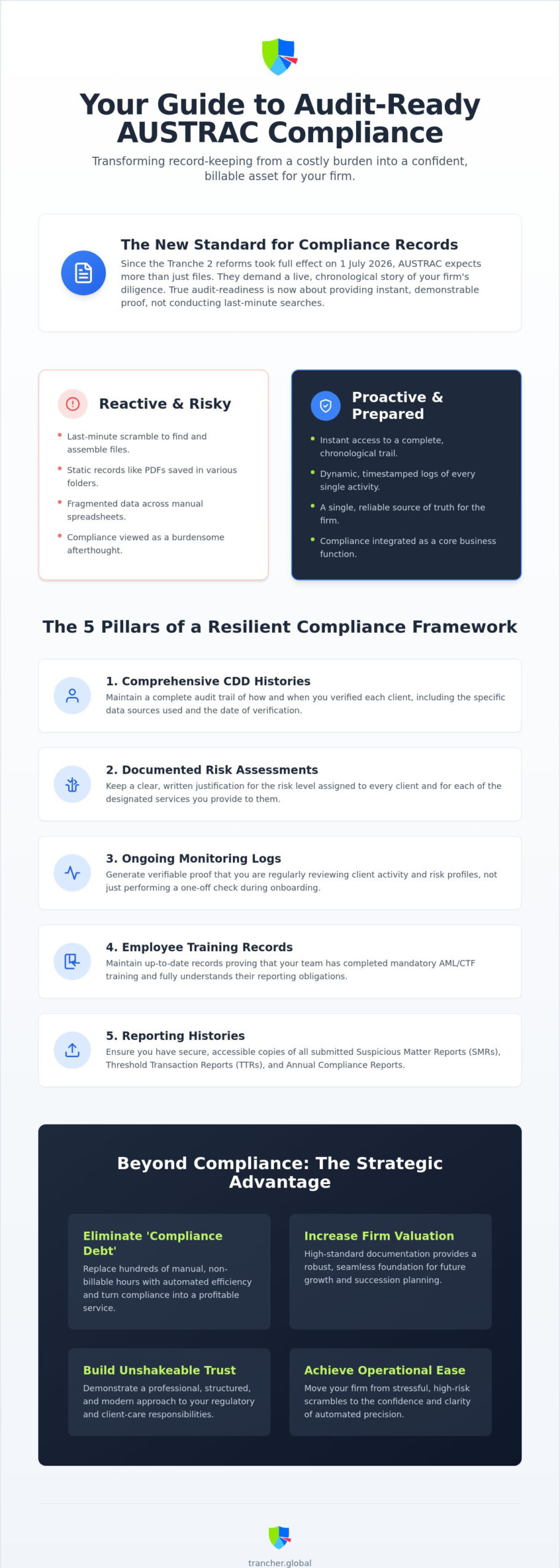
- Define audit-readiness as the ability to produce a complete, chronological trail of activities instantly, moving away from the risky practice of last-minute document retrieval.
- Identify the five essential pillars of AUSTRAC-compliant record keeping, including robust client verification histories and documented risk assessments for every service provided.
- Learn to calculate and eliminate “compliance debt” by replacing fragmented manual spreadsheets with automated platforms that ensure audit ready compliance records.
- Follow a practical, two-step workflow to map your designated services and centralise all KYC data into a single, reliable source of truth for your entire firm.
- Understand how maintaining high-standard documentation increases your firm’s market valuation and provides a seamless foundation for future succession planning.
What are Audit-Ready Compliance Records in the Tranche 2 Era?
Audit-readiness is not a status you claim; it’s a capability you demonstrate. For Australian accounting firms, it means having the power to produce a complete, chronological trail of every AML/CTF activity at a moment’s notice. Regulators don’t just want to see the final document. They want to see the process that led to it. In this new era, your records must tell a story of diligence that is both transparent and immediate.
When an auditor arrives, the speed of your response is their first metric. Scrambling to find files or reconstruct conversations two weeks before a visit is a significant red flag for regulators. It suggests that compliance is an afterthought rather than a core business function. Since the July 2026 deadline, the expectation has shifted from “we have it somewhere” to “here is the live evidence.” Firms that rely on manual retrieval often find themselves exposed during these high-pressure moments.
True audit ready compliance records are dynamic rather than static. While static record-keeping might involve saving a passport scan as a PDF in a general folder, dynamic record-keeping involves a timestamped log of every check performed. It tracks when an identity was verified, who conducted the review, and which specific PEP or sanction lists were screened at that exact point in time. It’s the difference between a grainy snapshot and a high-definition video of your firm’s integrity.
The AUSTRAC Standard: More Than Just KYC
Compliance extends far beyond simple identity checks. You must document the “why” behind every risk rating you assign to a client. If you’ve flagged a high-risk entity, your records must show the specific deliberations and ongoing monitoring activities that justify your continued engagement. Understanding AUSTRAC’s role in financial compliance helps clarify that these records are intelligence assets, not just administrative hurdles. Under the AML/CTF Act, you’re required to retain these detailed histories for a minimum of seven years. This ensures every decision remains defensible long after the engagement has concluded.
Why Your Current Practice Management Software Might Fall Short
Most general accounting software is built for workflow efficiency, not regulatory scrutiny. While these tools are excellent for storing tax returns, they often lack the forensic detail required for reporting. There is frequently a “missing link” between a client file and the specific compliance evidence needed during an inspection. To remain truly prepared, your CDD and KYC requirements Australia must be intrinsically linked to your audit ready compliance records. This integration ensures that every verification step is automatically logged, removing the friction of manual data entry and the risk of fragmented filing systems.
The 5 Pillars of AUSTRAC-Compliant Record Keeping
Establishing audit ready compliance records is about building a framework that supports your firm’s integrity. It’s not enough to simply store a document; you must ensure the context and the timing of that record are preserved. Since the regulatory shift on 1 July 2026, AUSTRAC expects a higher level of detail from accounting practices. To remain fully aligned with regulatory expectations, firms should regularly consult AUSTRAC’s official record-keeping guidelines, which specify exactly how long and in what format these files must be stored. A robust system rests on five essential pillars:
- Comprehensive CDD Histories: A full trail of how you verified every client, including the data sources used and the date of verification.
- Documented Risk Assessments: A written record of the risk level assigned to every client and the specific designated services you provide to them.
- Ongoing Monitoring Logs: Evidence that you’re regularly reviewing client activity, rather than just ticking a box during onboarding.
- Employee Training Records: Proof that your team has completed mandatory AML/CTF training and understands their specific reporting obligations.
- Reporting Histories: Copies of all submitted Threshold Transaction Reports (TTRs), Suspicious Matter Reports (SMRs), and your Annual Compliance Reports.
By focusing on these areas, you move away from administrative guesswork and toward a structured, defensible position. If you’re looking to streamline your record-keeping workflows, starting with these pillars is the most effective approach.
Pillar 1: Verification and Beneficial Ownership
Under current standards, “just a driver’s licence” is no longer sufficient for complex client structures like discretionary trusts or offshore companies. You’re required to identify and verify the ultimate beneficial owners; the individuals who actually own or control the entity. Your records must show the “reasonable measures” you took to uncover these individuals. This includes timestamped logs of PEP (Politically Exposed Persons) and sanctions screening. When an auditor looks at your files, they should see exactly when these checks occurred and what the results were, ensuring there’s no ambiguity about your firm’s diligence.
Pillar 2: The AML/CTF Programme and Independent Reviews
Your Part A and Part B AML/CTF programmes are the most important records you own. These documents shouldn’t sit on a digital shelf gathering dust. You need to record exactly when and how these programmes were last updated to reflect changes in your business or the law. Additionally, you must prepare for mandatory independent reviews. Your records should include the scope of these reviews, the findings, and the specific actions you took to address any recommendations. This proactive documentation demonstrates that your firm isn’t just following a template, but is actively managing its regulatory risks with a steady, assured hand.
Manual Spreadsheets vs. Automated Platforms: The Hidden Costs
Relying on manual spreadsheets often feels like a safe, low-cost starting point, but it quickly leads to “Compliance Debt.” This debt is the accumulated burden of fragmented data and manual entry that your firm will eventually have to settle, usually at the most inconvenient time. When you lack audit ready compliance records, every regulatory enquiry becomes a high-stakes rescue mission rather than a routine check. The cost of maintaining these manual systems is often far higher than the price of a dedicated platform.
Human error is a constant shadow over manual systems. It’s remarkably easy for a version control issue to result in missing ID expiry dates or outdated risk assessments. An automated platform removes this friction by proactively flagging missing information and ensuring no designated service goes untracked. While a manual AUSTRAC report can take days of forensic data gathering, an automated system produces the same result in minutes. This speed allows your team to focus on high-value advisory work instead of administrative archaeology.
The Real Cost of “Free” Spreadsheets
We often see senior partners spending dozens of non-billable hours each month on administrative compliance tasks. This isn’t just a financial drain; it’s a cultural one. The psychological toll of “audit anxiety” can weigh heavily on a firm, creating a reactive environment where everyone is perpetually worried about what might have been missed. Manual systems are also incredibly fragile during staff turnover. If the person who “understands the logic” of the spreadsheet leaves, they take your firm’s compliance history with them, leaving you vulnerable and unprepared.
Automation as a Revenue Enabler
Shifting to an automated system turns a regulatory burden into a clear revenue stream. Because these platforms generate detailed, timestamped logs, you have the concrete evidence required to bill clients for compliance as a professional service. By integrating compliance ROI tracking software, you can demonstrate the exact value of your work to your clients. In a modern practice, being “audit-ready” is synonymous with being “billing-ready.” This ensures your firm’s growth is supported by audit ready compliance records that prove your diligence and justify your fees.
How to Build an Audit-Ready Workflow in Your Firm
Transitioning to a high-standard compliance framework doesn’t have to disrupt your daily operations. In fact, the most successful firms are those that embed regulatory requirements into their existing rhythm. It isn’t about adding more work; it’s about organising the work you’re already doing to ensure it generates audit ready compliance records automatically. By following a methodical five-step process, you can move from a reactive state to one of calm, solution-oriented confidence.
- Step 1: Map Your Services. Start by identifying which of your current offerings qualify as “designated services” under the AML/CTF Act. This allows you to apply the correct level of diligence to the right clients.
- Step 2: Centralise Your Data. Move away from siloed folders and fragmented emails. Establish a single source of truth for all KYC and CDD data to ensure consistency across your practice.
- Step 3: Automate Your Alerts. Set up automated notifications for expiring identity documents and potential PEP or sanctions hits. This removes the need for manual tracking and reduces the risk of oversight.
- Step 4: Log Staff Training. Conduct role-based training and maintain a detailed log of completion dates. This proves to AUSTRAC that your team is competent and aware of their obligations.
- Step 5: Monetise the Process. Implement a “Compliance Fee” model. Use your automated activity logs as evidence of the professional service you’re providing, turning a cost centre into a billable asset.
Following these steps ensures that your firm remains protected while your team stays focused on client outcomes. If you’re ready to secure your firm’s future, explore our end-to-end compliance management solutions today.
Integration: Making Compliance Part of the BAS/Tax Workflow
The secret to zero-stress readiness is integration. Rather than treating compliance as a separate annual task, trigger a risk re-assessment during regular client engagements, such as BAS preparation or tax planning. This ensures that “ongoing monitoring” becomes a natural workflow step rather than a secondary administrative burden. Utilising ongoing risk monitoring software allows you to maintain audit ready compliance records without ever leaving your primary practice environment. It keeps your data live and your firm protected.
The Role of Expert Support
We understand that navigating these changes can feel daunting, but you don’t have to do it alone. Having a “compliance companion” on call provides the steady guidance needed to reduce implementation friction. By using expert-designed templates, you avoid the trap of reinventing the wheel and ensure your documentation meets the highest regulatory standards. For SME firms, the value of a 30-day readiness guarantee cannot be overstated. It provides a clear, time-bound path to full compliance, allowing you to focus on growth with the absolute certainty that your back-office obligations are met.
Future-Proofing Your Practice: Beyond the 2026 Deadline
The transition that took place on 1 July 2026 wasn’t just a regulatory deadline; it was a fundamental shift in the professional standards of Australian accounting. We encourage you to view this era not as a series of administrative hurdles, but as the beginning of a more sophisticated, transparent way of doing business. Maintaining audit ready compliance records is no longer a seasonal task. It’s a permanent capability that defines the modern practice. Firms that embrace this change find they’re not just avoiding penalties; they’re building a more resilient foundation for long-term success.
A “clean” client book is a significant asset that directly impacts your firm’s valuation. When the time comes for succession planning or a potential merger, prospective partners will scrutinise your compliance history with the same rigour they apply to your balance sheet. Having every risk assessment, verification log, and monitoring report organised and instantly accessible makes your practice a far more attractive and secure investment. Trancher is designed to maintain this high standard with zero administrative heavy lifting, allowing you to focus on your clients while we secure your legacy.
Scaling Your Compliance Capability
Robust documentation does more than just satisfy AUSTRAC; it empowers you to grow. With audit ready compliance records at your fingertips, you can safely take on higher-risk, higher-margin clients that you might have previously avoided. You’ll have the evidence to demonstrate your diligence to banks and lenders, positioning your practice as a “Compliant Firm” in their eyes. This level of transparency builds trust and can lead to stronger professional partnerships. Many of our partners are even turning this expertise into a new revenue stream by offering AML advisory services to their own clients, further proving that compliance is a catalyst for growth.
Your 30-Day Roadmap to AUSTRAC Readiness
We’ve streamlined the path to total confidence. The Trancher approach is methodical and effective: Setup, Automate, Bill, and Relax. We take the complexity out of the process, ensuring your firm meets every obligation without the stress of manual tracking. We invite you to experience this shift firsthand with a complimentary 3-month trial, allowing you to see the ROI before making a long-term commitment. For those looking for a practical next step, our AUSTRAC reporting obligations guide provides a clear roadmap for the months ahead. Don’t wait for a regulatory enquiry to test your systems; start the conversation early and secure your practice today.
Securing Your Firm’s Future with Professional Precision
Transitioning from the “Compliance Debt” of manual spreadsheets to an integrated, automated workflow ensures that every designated service your firm provides is documented, tracked, and billable. By centralising your client data and establishing automated alerts for risk monitoring, your practice moves from a state of reactive stress to one of proactive growth. Maintaining audit ready compliance records is no longer just a regulatory necessity; it’s a strategic asset that protects your firm’s valuation and simplifies future succession planning.
Trancher is designed specifically for Australian SME accounting firms, providing a 30-Day Compliance Readiness Guarantee along with automated ROI and billable activity reporting. We invite you to get AUSTRAC-ready in 30 days with a complimentary Trancher trial and see how seamless your record-keeping can truly be. We’re here to support you in turning these obligations into a streamlined professional service that adds value to your practice every day.
Frequently Asked Questions
What are the specific record-keeping requirements under the AML/CTF Act for accountants?
You’re required to maintain detailed records of customer identification and verification, transaction details, and your firm’s written AML/CTF programme. This includes the specific data sources used for verification and any risk assessments conducted for each client. These documents must provide a clear evidence trail of your firm’s compliance activities, allowing a regulator to reconstruct any decision or transaction from start to finish with absolute clarity.
How long do I need to keep AML/CTF compliance records in Australia?
All compliance-related records must be retained for a minimum of seven years from the date the record was made or the service was provided. This retention period applies to customer due diligence, transaction records, and any deliberations regarding suspicious matters. Keeping these as audit ready compliance records ensures that even if a client engagement ended years ago, your firm remains protected and capable of demonstrating its past diligence during any retrospective regulatory review.
Can I store my compliance records digitally, or do I need physical copies?
Digital storage is fully acceptable and often preferred by AUSTRAC for its ease of retrieval and organisation. You don’t need to maintain physical paper copies as long as your digital records are stored in a format that remains readable and accessible for the full seven-year period. The key is ensuring that your digital system provides a reliable, timestamped audit trail that mirrors the original documentation’s integrity and remains secure from unauthorised access.
What happens if AUSTRAC finds my records are incomplete during an audit?
Incomplete records can lead to significant consequences, including remedial directions, enforceable undertakings, or substantial civil penalties. As of 1 July 2026, a single penalty unit is valued at $364; failing to maintain proper documentation can result in fines that scale quickly based on the severity of the breach. Beyond the financial costs, incomplete records damage your firm’s reputation and signal a lack of internal control to the regulator, potentially triggering more frequent inspections.
How does an automated platform help with the AUSTRAC Annual Compliance Report?
An automated platform simplifies the annual reporting process by aggregating all your firm’s compliance activities into a single, structured data set. Instead of spending hours manually tallying transactions or verification checks, the system generates the necessary statistics and evidence logs instantly. Using dedicated AUSTRAC annual compliance report software ensures your Annual Compliance Report is accurate, submitted on time, and backed by the detailed audit ready compliance records required to justify your responses and demonstrate your firm’s ongoing adherence.
Is it possible to bill clients for the time spent on compliance record-keeping?
Yes, many firms now include a specific compliance fee or incorporate these activities into their standard professional service rates. Using a system that logs the time and resources spent on KYC and CDD allows you to provide clients with transparent evidence of the work performed. This transforms a necessary regulatory requirement into a visible, billable service that reflects the high standard of care your firm provides to protect both the client and the practice.
What is the Tranche 2 deadline, and how does it affect my current record-keeping?
The Tranche 2 reforms came into full effect on 1 July 2026, bringing accountants under the same rigorous AML/CTF obligations as banks and financial institutions. This means that from this date forward, every “designated service” provided must be supported by a comprehensive record-keeping trail. While you aren’t required to retrospectively fix records from before this date, your current systems must be capable of meeting these new standards immediately to avoid non-compliance from day one.
Do I need to keep records of clients I have rejected for AML/CTF reasons?
You should definitely maintain records of any prospective clients you have declined to onboard due to AML/CTF concerns. These records demonstrate that your firm’s risk-based approach is functioning correctly and that you’re actively monitoring for potential threats. Documenting why a client was rejected, including any suspicious matter deliberations, is a vital part of proving to AUSTRAC that your compliance programme is robust, effective, and capable of identifying high-risk engagements.