

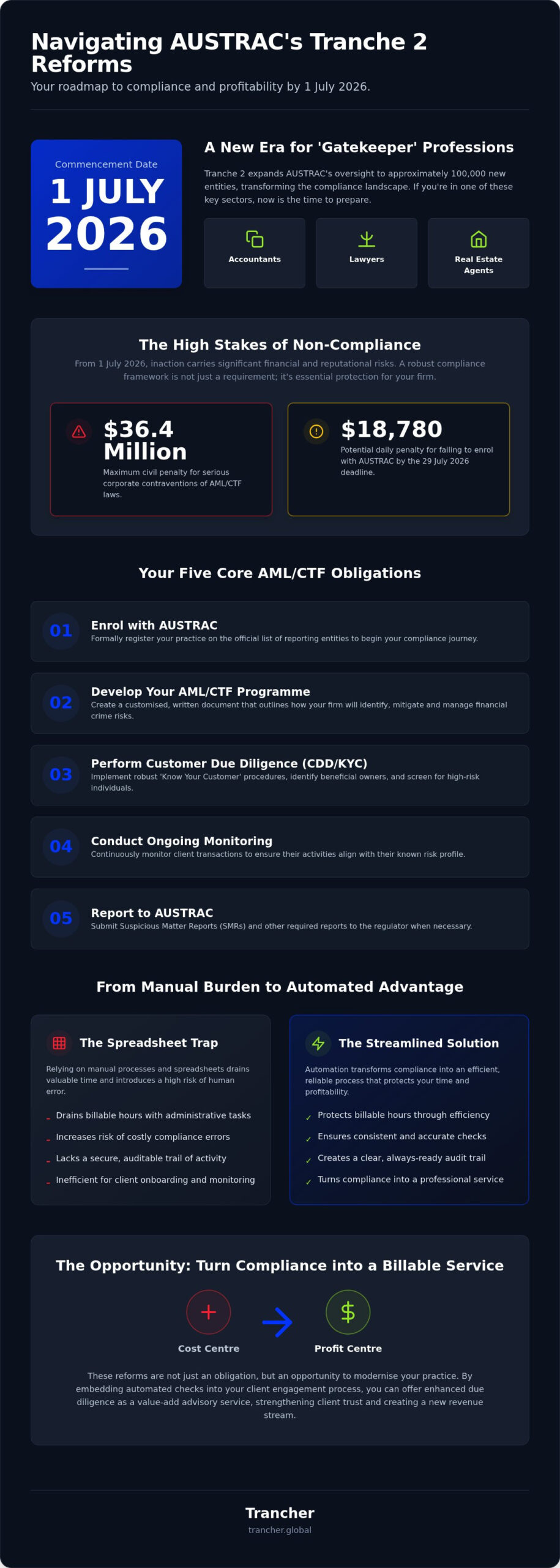
What if the 1 July 2026 AUSTRAC deadline wasn’t a threat to your firm’s profitability, but the single biggest opportunity to modernise your practice? It’s understandable if you feel a sense of unease regarding the upcoming Tranche 2 reforms. For many, aml compliance for small business australia feels like an exhausting, non-billable overhead that creates more paperwork than profit. You’re likely worried about the administrative heavy lifting or the risk of substantial penalties, which can reach up to $36.4 million for serious corporate contraventions.
We believe these new obligations can be managed with confidence and ease. Our goal is to help you transition from regulatory uncertainty to a position of operational strength. By the time you finish this guide, you’ll know exactly how to transform your compliance requirements into a streamlined, billable professional service. We’ll explore how to automate your KYC and CDD workflows, ensure you’re fully prepared for the July 2026 commencement, and turn your mandatory reporting into a value-add advisory tool. This is your roadmap to achieving total regulatory readiness while actually improving your firm’s internal systems and financial health.
Key Takeaways
- Prepare for the 1 July 2026 commencement date by understanding how Tranche 2 reforms affect your specific role as a gatekeeper professional.
- Master the five essential AML/CTF obligations, including correct AUSTRAC enrolment and the development of a customised compliance programme.
- Learn why transitioning from manual spreadsheets to automated workflows is the most efficient way to manage aml compliance for small business australia while protecting your billable hours.
- Identify opportunities to turn mandatory checks into billable advisory services, ensuring your compliance efforts contribute to your firm’s bottom line rather than acting as an overhead.
- Implement a structured 30-day roadmap to achieve full regulatory readiness, moving from an initial gap analysis to a complete governance framework with confidence.
Navigating the AUSTRAC Tranche 2 Reforms in 2026
The 1 July 2026 deadline is no longer a distant date on a regulatory calendar; it’s a pivotal moment for professional services across the country. Tranche 2 refers to a significant expansion of the Anti-Money Laundering and Counter-Terrorism Financing Act 2006. This reform brings approximately 100,000 new entities under the supervision of the Australian Transaction Reports and Analysis Centre (AUSTRAC). If you provide services in accounting, law, or real estate, your firm is likely captured as a “gatekeeper” profession. This means you’ll be required to implement formal systems to detect and report potential financial crimes.
Achieving aml compliance for small business australia is now a core operational requirement. The reforms target “designated services,” which include activities like managing client funds, assisting with real estate transactions, or setting up complex trust structures. By bringing these sectors into the fold, the government aims to close gaps that have historically been exploited for money laundering. While the transition requires initial effort, it’s a genuine chance to refine your internal processes and secure your practice against external threats with the help of a steady compliance partner.
Why Small Businesses are Now in the Spotlight
Professional services are often targeted because they act as the entry point to the financial system. Money launderers frequently seek out smaller practices, assuming they lack the sophisticated screening tools used by major banks. This shift in focus means the regulator is moving away from “big bank” regulation toward a broader national security framework. Your daily operations will now involve higher levels of transparency and record-keeping, ensuring that every transaction you facilitate is verified and legitimate. It’s a proactive approach to national security that relies on your expertise to identify red flags before they become systemic issues. By automating these checks, you can maintain this high standard without sacrificing your firm’s efficiency.
The Consequences of Non-Compliance
The cost of inaction is high. From 1 July 2026, failing to meet your obligations can lead to severe financial penalties. For a corporate entity, maximum civil penalties can reach approximately $36.4 million per serious breach. Even failing to enrol by the 29 July 2026 deadline can attract a daily penalty of $18,780. Beyond the balance sheet, the reputational damage of an enforceable undertaking or a public audit failure can be devastating for a small firm. In the new regulatory environment, “I didn’t know” is no longer a valid defence. Readiness is the only way to protect your firm’s future and maintain the trust of your clients. Setting up a robust aml compliance for small business australia strategy today ensures you aren’t caught off guard when the new laws take effect.
The Five Core AML/CTF Obligations for Your Practice
Success in the new regulatory landscape requires more than just awareness; it demands a structured approach to five fundamental pillars. For many firms, achieving aml compliance for small business australia starts with enrolment. You’re required to register with AUSTRAC by 29 July 2026, which is exactly 28 days after the new obligations begin. This process places your practice on the official register of reporting entities. Following enrolment, you must develop a written AML/CTF Programme. This document acts as the blueprint for your firm’s defence, outlining how you’ll identify, mitigate, and manage the specific money laundering and terrorism financing risks your business might face.
Mastering CDD and KYC Requirements Australia
Onboarding must now move beyond a simple glance at a driver’s licence. Implementing robust CDD and KYC requirements Australia means adopting a risk-based approach to every new engagement. KYC is a risk-mitigation tool for SMEs that ensures you have a clear picture of your client’s identity and their intended business purpose. This involves identifying beneficial owners for complex trust structures and screening for Politically Exposed Persons (PEPs) to prevent unintentional involvement in high-risk transactions. Compliance is a continuous cycle. You must maintain ongoing monitoring of client activities and report suspicious matters (SMRs) to the regulator when transaction patterns don’t align with a client’s known profile.
The Importance of an AML/CTF Compliance Officer
The regulator requires every reporting entity to appoint a specific individual as their AML/CTF Compliance Officer. In a small practice, this isn’t necessarily a new hire. It’s often a senior partner or manager who has the authority to implement change and direct access to the firm’s leadership. This role is pivotal for fostering a culture of compliance across your team. Your officer will lead the charge in training staff to recognise “red flags,” such as clients who provide inconsistent information or attempt to obscure the source of their wealth. By empowering your team with these skills, you ensure that compliance becomes a shared responsibility rather than an administrative burden. If you’re ready to simplify these requirements, exploring an expert compliance companion can help you automate these workflows and stay audit-ready with ease.
Manual vs. Automated Compliance: Avoiding the Spreadsheet Trap
Many firms initially consider using basic spreadsheets to manage their obligations because these tools feel familiar and appear to cost nothing. However, the true cost of “free” manual systems is often measured in hundreds of lost billable hours. If your staff spends hours manually verifying a single trust structure, those are hours of high-value advisory time gone forever. Maintaining aml compliance for small business australia shouldn’t feel like a full-time administrative job. When your KYC records live in one folder and risk assessments in another, your practice faces fragmented processes that increase the likelihood of human error. Spreadsheets also lack an immutable audit trail, making it nearly impossible to prove to a regulator exactly when a record was updated or by whom.
Automation replaces this administrative friction with a single source of truth. By integrating your workflows into a centralised platform, you ensure every action is timestamped and every document is correctly linked. This level of organisation doesn’t just satisfy the regulator; it provides a clear, real-time overview of your firm’s risk landscape. Moving away from manual data entry allows you to reclaim your time and focus on the strategic growth of your practice while staying fully aligned with the 2026 reforms.
Streamlining Ongoing Risk Monitoring
Managing your obligations effectively requires a shift from point-in-time checks to a model of continuous oversight. While point-in-time checks only capture a client’s status at the moment of onboarding, continuous monitoring ensures you’re alerted to changes in real-time. Utilising Ongoing risk monitoring software allows your firm to receive automatic alerts if a client’s risk profile shifts, such as becoming a PEP or appearing on a sanctions list. This proactive approach significantly reduces the administrative burden of periodic reviews by using automated triggers to flag only the cases that truly require your professional attention.
Creating Audit-Ready Compliance Records
AUSTRAC requires that all reporting entities maintain accurate records for a mandatory seven-year period. In the event of an unexpected inspection, having Audit ready compliance records stored in a secure, digital environment is a significant advantage. Digital systems eliminate the stress of searching through physical archives or outdated server folders. These platforms can even automate the generation of your AUSTRAC Annual Compliance Report, pulling data directly from your verified workflows. By moving away from manual filing, you ensure your practice remains transparent, organised, and fully prepared for any regulatory scrutiny that comes your way after 1 July 2026.
Transforming Compliance from a Cost Centre to a Billable Service
Viewing regulatory requirements as a drain on resources is a common perspective, yet the 2026 reforms offer a unique chance to reframe this narrative. For many practices, aml compliance for small business australia has historically been treated as a hidden administrative cost. However, by identifying “Recoverable Compliance Activities” within your standard workflows, you can begin to treat these obligations as a high-value advisory service. Activities such as deep-dive beneficial ownership mapping or complex risk assessments provide significant value to your clients by protecting their own business interests. When you communicate these AML fees transparently, positioning them as a necessary part of a secure, regulated partnership, clients often appreciate the rigour you bring to their financial safety.
This shift in mindset allows you to use compliance data to offer deeper strategic insights. The information gathered during due diligence often reveals nuances about a client’s corporate structure or risk environment that might otherwise go unnoticed. By sharing these insights, you move from being a mere service provider to a strategic partner who understands the client’s business at a granular level. This proactive approach doesn’t just satisfy AUSTRAC; it strengthens the bond between your firm and the businesses you serve.
Tracking ROI and Billable Compliance Hours
Visualising the financial health of your compliance function is essential for long-term sustainability. Using compliance ROI tracking software enables you to see exactly how much time is being dedicated to due diligence and how that translates into billable assets. You can generate reports that prove the value of your work to stakeholders, showing that compliance is no longer a “dead cost.” Additionally, focusing on AML CTF compliance costs reduction through operational efficiency ensures that your profit margins remain healthy as you scale your services.
The Advisory Opportunity in Tranche 2
The Tranche 2 landscape allows you to position your firm as a secure, regulated leader in a high-risk market. By helping your clients understand their own risk environments, you provide a level of security that unregulated competitors simply cannot match. Compliance as a service is the proactive integration of regulatory due diligence into a firm’s core value proposition, ensuring client safety while maintaining practice profitability. This model transforms a mandatory hurdle into a competitive advantage that attracts high-quality clients who value transparency. To start turning your obligations into assets, explore our compliance billing support and revenue tracking tools today.
Your 30-Day Roadmap to Full Regulatory Readiness
Transitioning your practice to meet the new AUSTRAC standards doesn’t have to be a source of stress or administrative gridlock. While the 1 July 2026 deadline might feel significant, a structured, week-by-week approach can break the transition into manageable milestones. By starting now, you avoid the inevitable June 2026 rush and ensure your aml compliance for small business australia is robust, tested, and ready for day one. This roadmap is designed to move your firm from initial uncertainty to a position of total operational confidence in just one month.
- Week 1: Gap Analysis and Service Mapping. Perform a thorough audit of your firm’s offerings to identify exactly which “designated services” you provide. This ensures your compliance efforts are focused precisely where they’re needed most.
- Week 2: Governance and Programme Design. Establish your formal AML/CTF Programme. This involves drafting your firm’s blueprint for risk mitigation and appointing your senior compliance officer to oversee the transition.
- Week 3: Technical Integration. Connect your onboarding workflows with automated KYC and screening tools. This step replaces manual data entry with a streamlined, digital process that ensures accuracy from the very first client interaction.
- Week 4: Training and Documentation. Educate your team on recognising red flags and finalise your audit-ready record-keeping systems. By the end of this week, your firm will have a complete, transparent trail of compliance activity.
The Trancher 30-Day Compliance Guarantee
We understand that small firms need certainty without the heavy lifting. Our structured workflow is designed to guarantee your practice is fully AUSTRAC-ready within 30 days. You’ll have access to 100% local Australian support to help you navigate complex client structures, such as discretionary trusts or foreign-owned entities. This expert guidance ensures you aren’t just meeting a legal requirement, but building a more resilient practice. Proactive readiness protects your reputation and ensures you can continue to serve your clients without the fear of sudden regulatory intervention.
Start Your Journey with a Complimentary 3-Month Trial
We’re committed to acting as your expert compliance companion through this transition. To help you experience the benefits of automated aml compliance for small business australia, we offer a complimentary 3-month trial. This allows you to test the platform in your real accounting environment with no obligation. During this period, you’ll see firsthand how automation saves billable hours and improves your firm’s internal systems. Our trial includes:
- Full access to platform integrations and automated KYC/CDD workflows.
- A formal ROI and efficiency report at the end of your trial period.
- A 20% discount on your first 12-month subscription when you transition from the trial.
Start your conversation with Trancher today and discover how simple regulatory readiness can be when you have the right partner by your side.
Secure Your Practice for the 2026 Transition
The 1 July 2026 deadline represents a fundamental shift in the Australian regulatory landscape, yet it serves as a unique opportunity to modernise your firm’s operations. By mastering your core obligations and abandoning the risks of manual spreadsheets, you protect your practice from substantial penalties and administrative fatigue. We’ve explored how aml compliance for small business australia can be reframed as a high-value, billable advisory service that strengthens client trust and adds to your bottom line.
Proactive readiness is the most effective way to eliminate regulatory stress. Our team is dedicated to acting as your expert compliance companion, providing the local Australian expert support you need to navigate these changes. You can achieve full, audit-ready status without sacrificing your firm’s productivity or profitability. We believe that with the right systems in place, compliance becomes a source of confidence rather than a burden.
Get AUSTRAC-Ready in 30 Days with Trancher and take advantage of our guaranteed AML/CTF compliance and complimentary 3-month trial. We’re ready to help you turn this transition into your firm’s next strategic advantage and look forward to supporting your practice’s growth.
Frequently Asked Questions
What is the Tranche 2 AML deadline for Australian small businesses?
The primary deadline for the commencement of Tranche 2 obligations is 1 July 2026. From this date, newly regulated entities must have their AML/CTF programmes active and operational. You then have a 28-day window to complete your formal enrolment with AUSTRAC, making 29 July 2026 the final cut-off for registration. Missing these dates can result in significant daily penalties, so starting your preparation early ensures a smooth and confident transition.
Do I need an AML compliance officer if I am a sole practitioner?
Yes, every reporting entity must appoint an AML/CTF compliance officer, regardless of the firm’s size. As a sole practitioner, you will typically appoint yourself to this role. This position carries the responsibility of overseeing your compliance programme and acting as the primary point of contact for the regulator. While it adds a layer of responsibility, utilising automated systems helps you manage these duties efficiently without distracting from your billable client work or strategic practice growth.
How much does AML compliance software cost for a small accounting firm?
Industry estimates suggest that adopting a specialised software solution is significantly more cost-effective than relying on manual processes or expensive external consultants. While specific costs vary based on your firm’s size and transaction volume, these platforms help you avoid the high overheads associated with administrative heavy lifting. Investing in technology helps automate aml compliance for small business australia, ensuring you remain audit-ready without the unpredictable expenses of manual data entry or periodic consultant reviews.
Can I use my existing practice management software for AUSTRAC reporting?
Most standard practice management tools are not designed to meet the rigorous technical requirements of AUSTRAC reporting or immutable record-keeping. While they are excellent for general operations, they often lack specific features like automated PEP screening or suspicious matter reporting workflows. To ensure full regulatory readiness, it’s best to integrate your existing systems with a dedicated AML platform that provides a “single source of truth” and maintains an audit trail that satisfies high regulatory standards.
What happens if my business fails an AUSTRAC independent audit?
Failing an audit typically triggers a range of enforcement actions depending on the severity of the non-compliance. AUSTRAC may initially offer educational guidance, but serious or systemic failures can lead to infringement notices, enforceable undertakings, or significant civil penalties. For corporations, these fines can reach approximately $36.4 million per serious contravention. Maintaining audit-ready documentation through an automated platform is the most reliable way to demonstrate your firm’s commitment to meeting its mandatory obligations.
Is my small business exempt from AML laws if I only have domestic clients?
No, being based purely in Australia or serving only domestic clients does not exempt your business from the AML/CTF Act. The Tranche 2 reforms focus on the nature of the “designated services” you provide, such as managing client funds or assisting with property transfers, rather than the location of your clients. Money laundering can involve domestic funds just as easily as international ones, so every reporting entity must implement a risk-based programme to detect suspicious activity.
How do I bill my clients for the cost of AML compliance?
Many firms choose to recover aml compliance for small business australia costs by treating due diligence as a high-value advisory service. You can include a specific compliance fee in your engagement letters or incorporate the cost into your standard project rates. Transparency is key here; explaining to clients that these checks protect their financial security helps justify the cost. Using ROI tracking tools allows you to identify exactly how much time is spent on these activities.
What is the difference between standard and enhanced due diligence?
Standard Customer Due Diligence (CDD) involves identifying and verifying a client’s identity under normal risk conditions. Enhanced Due Diligence (EDD) is required when a client or transaction presents a higher risk of money laundering, such as when dealing with Politically Exposed Persons (PEPs) or complex foreign trust structures. EDD requires you to gather additional information, such as the source of wealth or source of funds, to ensure you fully understand the risks associated with the relationship.