

Did you know that from 1 July 2026, a single oversight in your AML/CTF program could expose your firm to civil penalties of up to $36.4 million? Many Australian practitioners feel a sense of urgency as the Tranche 2 deadline approaches, particularly when evaluating how a client risk profiling tool can help manage these new obligations. We understand that the administrative weight of manual assessments often feels like a non-billable anchor, pulling focus away from your core advisory work and adding unnecessary stress to your daily operations.
The good news is that compliance doesn’t have to be a drain on your resources. By implementing the right systems, you can satisfy AUSTRAC’s stringent standards while actually turning these requirements into a billable asset. We’re here to show you that meeting your obligations can be a manageable, even advantageous, transition for your practice that improves your internal systems and client onboarding experience.
This guide explores how to establish a defensible risk rating methodology and use automated workflows to link KYC data directly to risk levels. You’ll also discover practical ways to recover compliance costs through a “Compliance as a Service” model, ensuring your firm remains both protected and profitable as we move into this new regulatory era.
Key Takeaways
- Understand the critical distinction between AML/CTF profiling and investment risk assessments to ensure your firm meets the specific “gatekeeper” standards required by AUSTRAC.
- Discover how a digital client risk profiling tool with automated PEP and sanctions screening removes the friction of manual checks while maintaining a defensible compliance program.
- Learn the two-step methodology for setting your risk appetite, starting with the identification of your firm’s specific designated services under the AML/CTF Act.
- Avoid the “Spreadsheet Trap” by moving away from static, manual profiles that fail to reflect the dynamic nature of modern financial crime and increase audit risk.
- Explore how to transform compliance into a revenue stream by using ROI reporting to track billable hours and implement a “Compliance as a Service” model.
What is a Client Risk Profiling Tool for AML/CTF Compliance?
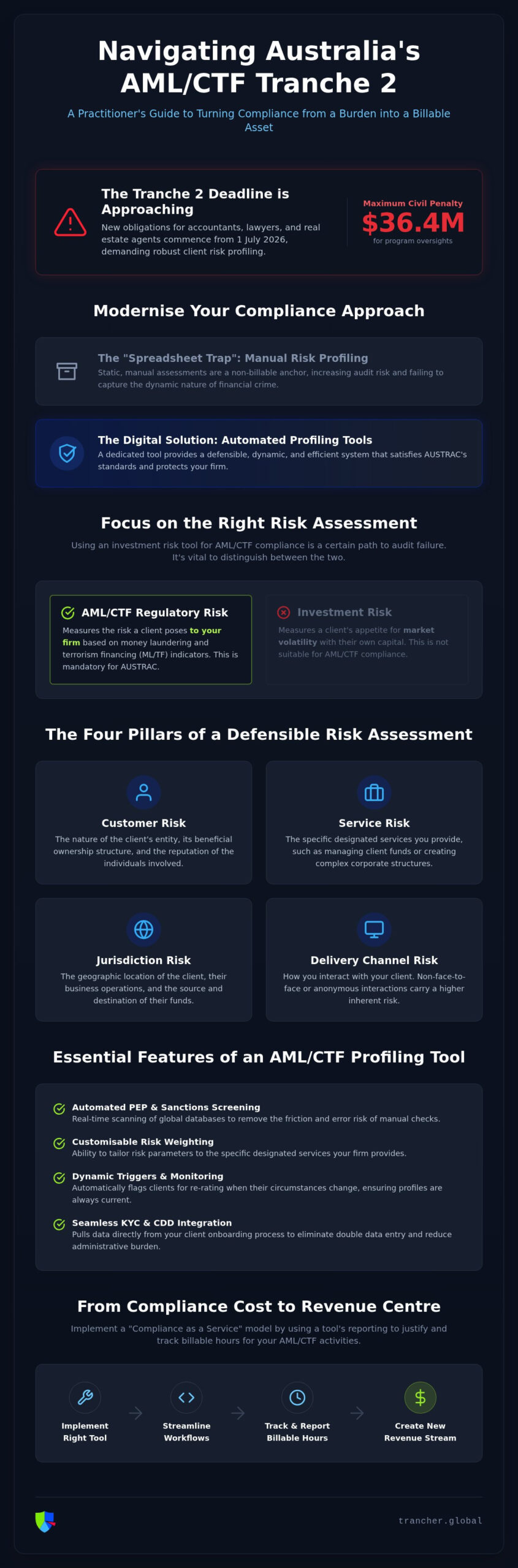
A client risk profiling tool is a digital system designed to categorise your clients based on the specific money laundering and terrorism financing (ML/TF) risks they present to your practice. Unlike tools used to measure a client’s appetite for market volatility, this software focuses on identifying indicators of financial crime. It serves as the engine room for your compliance program, helping you meet the core CDD and KYC requirements Australia mandates for the accounting profession. By following global Know Your Customer (KYC) guidelines, these tools evaluate four critical pillars to ensure no detail is overlooked:
- Customer risk: The nature of the entity, its ownership structure, and the reputation of the individuals involved.
- Service risk: The specific designated services you provide, such as managing client money or creating complex corporate structures.
- Jurisdiction risk: The geographic location of the client, their business operations, and the source of their funds.
- Delivery channel risk: How you interact with the client, with non-face-to-face or anonymous interactions carrying higher inherent risk.
The Regulatory Necessity of Risk Rating
AUSTRAC requires every firm providing a designated service to have a documented, defensible risk rating for every client. With the 1 July 2026 Tranche 2 deadline approaching, this requirement has become the primary driver for firms to modernise their systems. You can’t simply guess a client’s risk level; you must prove your rating is based on a structured methodology. A common mistake is relying on static profiling, where a risk level is set during onboarding and never revisited. Modern compliance demands dynamic monitoring. If a client’s circumstances change, such as moving funds to a high-risk jurisdiction, your client risk profiling tool must reflect that shift immediately to keep your firm protected.
Regulatory Risk vs. Investment Risk
It’s vital to distinguish between regulatory risk and investment risk to avoid costly compliance gaps. Financial planners often use profiling to determine how much market risk a client can tolerate with their capital. In contrast, an AML-focused client risk profiling tool measures the risk the client poses to your firm. Using an investment-style tool for AML purposes is a certain path to audit failure because it fails to capture the criminal indicators AUSTRAC prioritises. An AUSTRAC-aligned risk profile is a mandatory regulatory record that proves your firm has performed objective due diligence based on actual ML/TF threats.
Essential Features of an Australian AML Risk Profiling Tool
A robust client risk profiling tool must do more than just provide an elegant interface. It needs to handle the heavy lifting of automated Politically Exposed Persons (PEP) and sanctions screening by scanning global databases in real-time. When you’re preparing for the 1 July 2026 commencement, manual checks are simply too slow and error-prone. Your system should also support customisable risk weighting. Every accounting firm provides different designated services, and the risk parameters for a simple tax return differ vastly from those involved in managing complex trust accounts or corporate restructures.
Dynamic triggers are the heartbeat of a reliable compliance system. If a client’s business structure changes or they start operating in a new, high-risk jurisdiction, the tool should automatically flag a re-rating for your review. This ensures your risk assessments aren’t just a point-in-time snapshot but a living reflection of your client base. This proactive approach allows you to address potential issues before they escalate into regulatory breaches, keeping your firm’s reputation and licence secure.
Integration with KYC and CDD Workflows
Efficiency is the key to transforming compliance from a non-billable overhead into a strategic asset. Your tool should pull data directly from your onboarding process, eliminating double data entry and reducing the administrative burden on your staff. A critical part of this is identifying and verifying beneficial ownership to understand who truly controls the entity you’re dealing with. Without this link, your risk profile is incomplete and vulnerable to scrutiny. This seamless integration sets the foundation for ongoing risk monitoring software to monitor activity once the client is active.
Defensible Methodology and Record Keeping
If an AUSTRAC auditor visits, they’ll want to see exactly why a client was rated Low, Medium, or High risk. Your tool must generate a comprehensive Risk Assessment Report that details the logic and data points behind every single rating. Maintaining audit ready compliance records for the full 7-year retention period is a mandatory requirement under the AML/CTF Act. A defensible methodology is your firm’s best protection against civil penalties, providing a clear paper trail that demonstrates your good-faith effort to comply with the law. If you’re looking to streamline this process, you might consider how Trancher’s automated workflows can simplify your transition to Tranche 2 standards while you focus on client advisory.
How to Implement a Risk Rating Methodology in Your Firm
Transitioning from theoretical compliance to a practical, day-to-day methodology is often where accounting firms feel the most pressure. It doesn’t have to be a daunting task. The first step is to audit your service list against AUSTRAC’s designated services. If your firm is involved in managing client money, acting as a nominee shareholder, or preparing for real estate transactions, these activities must be mapped within your compliance framework. Once you’ve identified these services, you can begin to set your risk appetite. This involves defining which jurisdictions, industries, or entity structures your firm is comfortable dealing with and which require enhanced due diligence.
Once your parameters are set, you can use your client risk profiling tool to organise your existing client base and run initial screenings. This digital approach replaces the guesswork of manual reviews with objective data. You’ll also need to establish a clear escalation process. If the tool flags a Politically Exposed Person (PEP) or a high-risk jurisdiction match, your staff must know exactly who the designated AML/CTF officer is and what the next steps are for reporting or further investigation. Having these steps documented ensures that your firm’s response to risk is always consistent and defensible.
Defining Your Risk Parameters
Consistency is the backbone of a defensible methodology. You need to decide how to weight specific factors, such as the difference between a cash-intensive local business and an SME with a transparent corporate structure. Standardising this approach ensures that two different partners wouldn’t give the same client two different risk ratings. Utilising a structured AML risk assessment tool Australia provides the methodology templates needed to maintain this uniformity across your entire practice, regardless of its size.
Staff Training and Change Management
The most sophisticated client risk profiling tool is only effective if your team understands how to interpret its findings. Moving from a manual “gut feel” approach to data-driven categorisation requires a shift in firm culture. Your team needs to feel confident that the tool is there to support their professional judgment, not replace it. Providing role-based training reduces the risk of human error in profiling by ensuring every staff member understands their specific obligations under the new 2026 standards. This steady guidance helps alleviate the stress of the transition and ensures your compliance programme remains robust and reliable.
Common Pitfalls: Why Manual Risk Profiling Fails Accountants
Relying on spreadsheets for your AML/CTF obligations is what we often call the “Spreadsheet Trap.” It’s essentially an invitation for an AUSTRAC audit because manual logs are notoriously difficult to version-control, secure, and verify. When different partners in the same firm rate similar clients differently, your practice lacks a unified, defensible methodology. Using a dedicated client risk profiling tool ensures every assessment follows the same rigorous logic, removing the subjectivity that often leads to regulatory scrutiny. Consistency isn’t just about internal order; it’s a primary requirement for a compliant program.
The “Set and Forget” approach is another common failure that places firms at risk. Manual profiles are static snapshots that quickly become obsolete. In the fast-paced environment of 2026, where financial crime tactics evolve rapidly, a profile created six months ago may no longer reflect the actual risk. Risk is dynamic, but manual systems are static. This gap creates a significant liability for your practice, especially as AUSTRAC’s focus shifts toward the accounting profession’s role as a gatekeeper.
The Risk of Inaccurate Reporting
Manual systems frequently lead to missed Suspicious Matter Reports (SMRs) because they lack the real-time data needed to flag unusual activity. Failing to identify a Politically Exposed Person (PEP) or a sanctioned individual isn’t just an administrative error. It’s a breach that can carry maximum civil penalties of up to $36.4 million for a body corporate. Automated tools act as a vital safety net for busy practitioners, providing constant screening that human eyes might miss during a hectic period of client advisory work. Understanding the full spectrum of money laundering red flags for accountants is equally important, as recognising suspicious behaviours early is what enables timely and defensible reporting.
The Cost of Compliance Inefficiency
The hidden cost of manual paperwork is the drain on your most valuable resource: time. Every hour your team spends on manual KYC and risk assessment is an hour that isn’t billed to a client or spent on high-value advisory. By implementing automation, you can achieve a significant AML CTF compliance costs reduction. This shift lowers the “cost-to-serve” for compliance-heavy clients, allowing you to maintain your margins while meeting the highest regulatory standards. If you’re ready to move away from these manual burdens, you can get started with Trancher’s automated platform to secure your firm’s future and recover your billable hours.
Trancher: Turning Risk Profiling into a Billable Asset
Trancher isn’t just another software platform; it’s a strategic partner designed to help you navigate the 1 July 2026 commencement with total confidence. While many systems focus solely on the “check-box” exercise of compliance, we help you transform these requirements into a professional advisory service that your clients value. By implementing our specialised client risk profiling tool, you can automate your entire workflow, from initial PEP screening to complex risk weighting, in under 30 days. This rapid deployment ensures your practice is ready well before the AUSTRAC deadline, allowing you to focus on high-level advisory instead of administrative hurdles.
We believe that compliance should be a source of firm growth, not a drain on your resources. Our platform is built with a business-minded optimism that frames your new obligations as an avenue for improved internal systems. With local Australian support and a deep understanding of the Tranche 2 landscape, we provide the steady guidance you need to move away from manual friction. You’ll find that our solution feels supportive rather than demanding, aiming to alleviate the stress of new regulations through operational ease and reliable automation.
The 30-Day Compliance Guarantee
Aaron Soh and the Trancher team are committed to ensuring your firm is fully prepared for the 2026 regulatory shift. Our onboarding process is methodical and highly organised, taking your practice from a standing start to a fully AUSTRAC-aligned position within a month. This isn’t just a promise; it’s a guarantee that gives you the reassurance you need during a period of significant industry change. Starting this transition early is the smartest move for any proactive firm. It allows your team to settle into new rhythms and ensures that when the 1 July deadline arrives, your firm is already operating at a gold standard of compliance.
Recoverable Compliance Activities
One of the most significant pain points for accountants is the volume of non-billable overhead associated with manual paperwork. Trancher solves this through our unique “Compliance ROI” report, which tracks every minute spent on verification and risk assessment. This feature provides the clear evidence you need to recover costs and justify compliance fees to your clients. When you link your risk methodology to compliance ROI tracking software, you’re no longer absorbing a burden. You’re delivering a transparent, high-value service that protects your clients’ interests. We’re here to help you turn a regulatory hurdle into a sustainable, billable asset for your firm. To experience this shift firsthand, start your 3-month complimentary trial of Trancher today and see how we make compliance work for you.
Future-Proofing Your Firm for the 2026 Regulatory Shift
The transition to Tranche 2 obligations doesn’t need to be a source of administrative stress for your practice. By moving away from the “Spreadsheet Trap” and adopting a dedicated client risk profiling tool, you ensure that your firm’s risk assessments are both dynamic and defensible. You’ve seen how a structured methodology protects your practice licence while turning compliance activity into a transparent, billable service for your clients. It’s about more than just avoiding penalties; it’s about building a more efficient, data-driven firm.
Trancher provides the steady guidance you need to make this shift seamless. With our 30-day compliance guarantee and local Australian expert support, we’ll ensure you’re ready well before the 1 July 2026 deadline. You’ll also benefit from detailed ROI and billable activity reporting to help you recover costs effectively and maintain your firm’s financial health. Take the first step toward a more secure and profitable future today. Secure your firm with a 3-month complimentary trial of Trancher and discover how manageable modern compliance can be. We’re here to support you every step of the way.
Frequently Asked Questions
What is the Tranche 2 deadline for Australian accountants?
Anti-Money Laundering and Counter-Terrorism Financing obligations for the accounting profession officially commence on 1 July 2026. While the enrolment period with AUSTRAC opens on 31 March 2026, firms must be fully enrolled by 29 July 2026. We recommend establishing your compliance framework well before these dates to ensure your practice is operationally ready to handle designated services without the stress of a last-minute rush.
Can I use a simple spreadsheet for my AML risk profiling?
While you can technically use a spreadsheet, it’s a high-risk approach that often leads to what we call the “Spreadsheet Trap.” Manual logs are difficult to version-control and don’t provide the dynamic monitoring AUSTRAC expects. A dedicated client risk profiling tool is far superior because it automates screening and provides a defensible, audit-ready trail. Relying on static spreadsheets increases the risk of human error and potential regulatory penalties.
How often do I need to update a client’s risk profile?
Risk profiling isn’t a “set and forget” task; it’s a continuous obligation. You must update a client’s profile whenever there’s a significant change in their circumstances, such as a shift in beneficial ownership or a move into high-risk jurisdictions. Modern platforms automate this process by using dynamic triggers to flag when a re-rating is necessary. Regular reviews ensure your firm’s risk data remains accurate and reflects the current threat landscape.
What happens if I incorrectly rate a high-risk client as low risk?
Incorrectly rating a client can lead to serious regulatory breaches and severe financial consequences. Under the 2026 standards, the maximum civil penalty for a body corporate is $36.4 million, while individuals can face fines up to $7.28 million. Beyond financial loss, your firm could face mandatory independent audits or the cancellation of your registration. Having a defensible, automated methodology is your best protection against these significant professional and legal risks.
How can I charge my clients for the time spent on AML risk profiling?
You can transform compliance from an overhead into a billable asset by using a “Compliance as a Service” model. Trancher provides ROI reporting that tracks billable compliance hours and recoverable activities, giving you the evidence needed to justify fees to your clients. By framing compliance as a high-value advisory service that protects their interests, you can recover costs and even create a new revenue stream for your practice.
Does a client risk profiling tool include PEP and Sanctions screening?
Yes, a robust client risk profiling tool should integrate automated Politically Exposed Persons (PEP) and sanctions screening as a core feature. These systems scan global databases in real-time to identify high-risk individuals and entities that manual checks might miss. This integration is essential for maintaining an AUSTRAC-aligned program, as it ensures your client verification and due diligence processes are both thorough and efficient without adding to your team’s workload.
Is there a specific AUSTRAC template for risk profiling?
AUSTRAC doesn’t provide a one-size-fits-all template, as every firm’s risk appetite and service list are different. Instead, you’re required to develop and document your own risk assessment framework that is appropriate for your firm’s specific circumstances. Trancher simplifies this by providing AUSTRAC-aligned risk assessment frameworks and methodology templates. These tools ensure your firm meets the regulator’s expectations while saving you the time and complexity of building a system from scratch.