

What if the legislated 1 July 2026 deadline wasn’t a threat to your firm’s productivity, but an opportunity to modernise your entire practice? It’s natural to feel a sense of urgency as approximately 100,000 Australian businesses prepare for the Tranche 2 reforms. You might worry that manual admin will swallow your billable hours or that the complexity of Part A requirements will leave you exposed to AUSTRAC penalties. We understand that the pressure to be audit-ready can feel like a heavy weight on an already busy schedule.
This guide will help you navigate the path forward with confidence, showing you how to transform regulatory obligations into a streamlined, profitable asset. You’ll learn how to implement an AUSTRAC-aligned framework that protects your firm while actually improving your internal systems. We’ll explore how using AML independent review software Australia allows you to automate record-keeping and track billable compliance activity. By the end of this article, you’ll have a clear roadmap to ensure your first independent review in 2029 is a seamless, non-event for your team.
Key Takeaways
- Understand that an independent review is a mandatory assessment of your AML/CTF Programme’s Part A effectiveness, ensuring your governance framework remains robust and compliant.
- Learn how to navigate AUSTRAC’s independence requirements and why the review focuses on your high-level risk management rather than individual client files.
- Discover how to prepare for a stress-free review process by conducting internal gap analyses and organising your documentation into a clear, accessible audit trail.
- Explore how adopting AML independent review software Australia can transform compliance from a cost centre into a revenue-generating asset by tracking billable hours in real-time.
- Gain a clear timeline for your first independent review, typically due by July 2029, and learn how to build a future-proof practice well before the 2026 deadline.
Understanding the AML Program Independent Review in the Tranche 2 Era
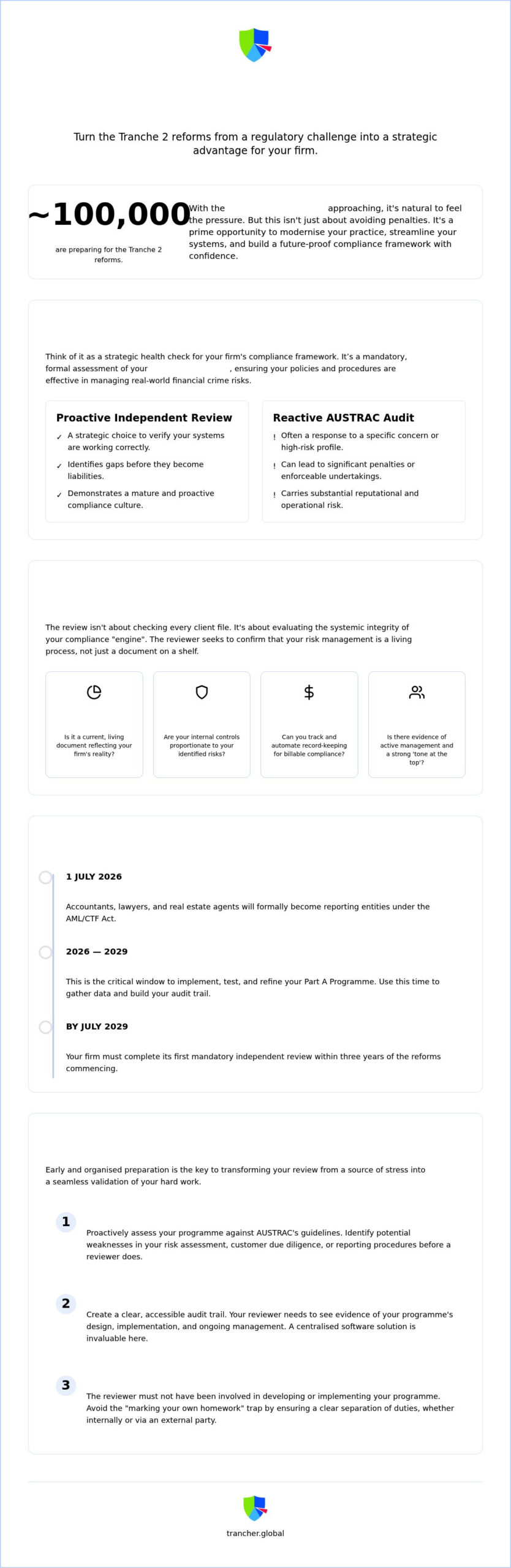
An independent review is a formal assessment of how well your firm manages its anti-money laundering and counter-terrorism financing obligations. It focuses specifically on Part A of your AML/CTF Programme. This is the risk-based portion of your framework designed to identify, mitigate, and manage financial crime risks. Unlike a standard internal check, this review provides a high-level evaluation of whether your policies are actually effective in practice.
The legal mandate for this review comes directly from the Australian Transaction Reports and Analysis Centre (AUSTRAC). Under the AML/CTF Rules, any business providing “designated services” must ensure their program is regularly reviewed. For Australian accountants, the landscape is changing fast. With the Tranche 2 reforms commencing on 1 July 2026, approximately 100,000 businesses will soon fall under these requirements. This means the first wave of reviews for newly regulated firms will become a critical milestone in the coming years.
It’s helpful to distinguish between a reactive AUSTRAC audit and a proactive independent review. An audit is usually a response to a specific concern or a high-risk profile identified by the regulator. A proactive review is a strategic choice you make to verify your systems are working correctly. It’s a health check that ensures your firm stays ahead of regulatory expectations, allowing you to identify gaps before they become liabilities.
Why Independence Matters to AUSTRAC
Regulators place a high value on an objective lens. When you’re deeply involved in the daily operations of a small accounting practice, it’s easy to overlook systemic gaps. AUSTRAC refers to this as the risk of “marking your own homework”. If the person who designed your compliance program is also the one reviewing it, the assessment lacks the necessary neutrality. Independence doesn’t always require a large external consultancy; it simply means the reviewer must not have been involved in the development or implementation of the program. Using AML independent review software Australia helps create this separation. It provides structured data and clear audit trails that an independent party can quickly verify, ensuring your governance is robust and compliant.
The Consequences of Non-Compliance
The risks of ignoring these review cycles are significant. While financial penalties are the most visible deterrent, enforceable undertakings can be equally disruptive to your firm’s daily operations. Beyond the legal costs, the reputational risk in the Australian market is substantial. Clients trust accountants with their most sensitive financial data; a failure in regulatory compliance can erode that trust instantly. Early preparation is your best defence. By leveraging AML independent review software Australia, you can ensure your documentation is always organised and ready for scrutiny, protecting the professional standing you’ve spent years building.
The Scope of an Independent Review: Evaluating Your Part A Framework
An independent review doesn’t involve a line-by-line audit of every individual KYC file you’ve ever processed. Instead, the reviewer’s primary focus is your Part A framework. This is the governance engine of your compliance efforts. The goal is to determine whether your systems, policies, and procedures are robust enough to detect and mitigate financial crime. While individual files might be sampled to test if your systems work, the reviewer is looking for systemic integrity rather than isolated administrative errors.
This process evaluates how your firm identifies risk and whether your controls are actually proportionate to those risks. It’s about proving that your compliance isn’t just a paper exercise. The reviewer will look for a clear connection between your risk appetite and your daily operations, ensuring that your firm’s “tone at the top” reflects a genuine commitment to regulatory standards. Partners must be able to demonstrate active oversight, showing that they don’t just sign off on documents but actively manage the firm’s compliance health.
Reviewing Your ML/TF Risk Assessment
Your Money Laundering and Terrorism Financing (ML/TF) risk assessment is the foundation of your entire program. A reviewer will look for evidence that this is a living document, not a template you filled out once and filed away. It must specifically reflect the risks inherent in your unique client base, whether you’re dealing with high-wealth individuals, complex trust structures, or international transactions. You’ll need to show how your CDD and KYC requirements Australia are logically mapped to these identified risk levels. If your risk assessment says one thing but your client onboarding process does another, it creates a significant gap that reviewers will quickly identify.
Evaluating Training and Governance
The human element is often where compliance frameworks falter. A reviewer will assess whether your team truly understands their obligations. It isn’t enough to say you’ve held a meeting; you need role-based training records that prove specific staff members know how to spot red flags relevant to their duties. They’ll also examine your Employee Due Diligence (EDD) programme to ensure you’ve mitigated internal risks. Managing these moving parts manually is a significant drain on billable time. Many firms find that AML independent review software Australia provides the necessary structure to keep these records audit-ready without the administrative headache. By centralising your risk assessments and training logs, you create a transparent environment that reviewers appreciate. If you’re looking for a way to simplify this process, you might consider how automated workflow tools can help you stay prepared for the 2026 transition.
Independence and Frequency: Navigating AUSTRAC’s Expectations
AUSTRAC’s requirement for independence is non-negotiable. It ensures your compliance framework is assessed by someone with no personal stake in its success or failure. The core Independence Test is simple: the reviewer must not have been involved in the design, implementation, or daily maintenance of your AML/CTF Programme. For many accounting firms, this creates a practical challenge, as the partners and senior staff who understand the business best are often the same ones who built the compliance systems.
Your AML/CTF Compliance Officer plays a vital role in this process. While they cannot conduct the review themselves, they are responsible for facilitating it. This includes preparing documentation, answering the reviewer’s queries, and ensuring that any recommendations are actually implemented. It’s a collaborative effort that requires clear communication and organised record-keeping to be successful.
Internal vs. External Reviewers
Choosing between an internal or external reviewer depends largely on your firm’s structure. Large firms might utilise a staff member from a completely separate department, such as a dedicated internal audit team, to meet the independence criteria. However, for most small-to-medium practices, finding a truly objective internal candidate is difficult. Everyone is usually involved in the business in some capacity. Engaging an external consultant provides a fresh perspective and eliminates potential conflicts of interest. It also signals to the regulator that you’re taking your obligations seriously by seeking expert, unbiased validation of your systems.
Frequency and Timing for Tranche 2 Readiness
While AUSTRAC suggests reviews should be regular, they don’t prescribe a one-size-fits-all schedule. For firms navigating the Tranche 2 era, an annual or biennial cycle is often considered the gold standard. A more frequent cycle allows you to catch minor issues before they escalate into systemic failures. With the 1 July 2026 commencement date approaching, timing is everything. Although the first legislated deadline for reviews for newly regulated entities is 1 July 2029, waiting until the last minute is risky.
Conducting a pre-implementation review shortly after July 2026 allows you to test your systems in a live environment. It helps you identify gaps before they become liabilities. Aligning these review cycles with your Ongoing risk monitoring software reports ensures your reviewer sees a consistent, data-driven story of compliance. Using AML independent review software Australia simplifies this further by providing the reviewer with structured, audit-ready data at the click of a button, making the entire process faster and more cost-effective.
Preparing Your Firm for a Stress-Free Review Process
Preparing for an independent review shouldn’t feel like studying for a final exam at the eleventh hour. Instead, think of it as a routine health check that validates the strength of your practice. The most effective way to ensure a smooth process is to maintain a continuous audit trail. When your documentation is organised and accessible, the reviewer can move through their assessment efficiently, saving your firm both time and money. An audit trail isn’t just a regulatory requirement; it’s your firm’s insurance policy against uncertainty.
Before the formal reviewer arrives, it’s essential to review your audit ready compliance records to ensure no gaps have emerged in your daily operations. This proactive approach allows you to identify and address minor administrative oversights before they are flagged in a formal report. It also demonstrates to the reviewer that your firm maintains active, high-level oversight of its obligations. Partners and Board members should be briefed and ready to discuss how they monitor compliance, showing that the “tone at the top” is one of genuine commitment rather than mere box-ticking.
The Documentation Checklist
Modern reviewers have a clear preference for digital, time-stamped records over manual spreadsheets or paper files. Digital records provide a level of integrity that is difficult to replicate manually. Your checklist should include your current ML/TF Risk Assessment, your Part A Policy, and comprehensive training logs. You’ll also need to present evidence of Ongoing Monitoring and how you’ve handled any red flags. Using AML independent review software Australia allows you to pull these reports instantly, providing a structured narrative of your compliance journey that is easy for any independent party to follow.
The Pre-Review Health Check
Conducting a gap analysis is the best way to remediate issues before the review starts. Use a compliance dashboard to get an instant view of your firm’s health. If you find a gap, draft a self-correction plan immediately. Showing a reviewer that you identified an issue and took steps to fix it is far better than having them discover it themselves. It proves your firm is proactive and dedicated to continuous improvement. To get your firm ready for the July 2026 transition and ensure you’re always audit-ready, start your 3-month complimentary trial with Trancher today. By automating the heavy lifting, you can focus on your clients while your compliance systems work quietly in the background.
How Trancher Simplifies Independent Reviews and Proves Compliance ROI
Transitioning from manual record-keeping to an automated system fundamentally changes the nature of the independent review. Instead of a frantic search for missing documents or reconstructed logs, the process becomes a straightforward verification of existing, time-stamped data. Trancher captures every compliance action in real-time, building a robust audit trail that is always ready for inspection. This systematic approach significantly reduces the time a reviewer needs to spend on your premises. Because the data is organised and accessible, the overall professional fees associated with the review are naturally lowered, making the entire exercise more cost-effective.
Using AML independent review software Australia ensures that your firm isn’t just meeting the bare minimum of the law. It allows you to demonstrate a level of operational maturity that regulators and reviewers value. By centralising your Part A governance, you remove the friction that typically slows down the review process. This proactive stance protects your firm’s reputation and ensures that your first legislated review in 2029 is a calm, routine event rather than a disruptive crisis.
From Administrative Burden to Billable Asset
Most accounting firms traditionally view compliance as a pure cost centre that erodes profitability. Trancher reframes this perspective by helping you reduce AML CTF compliance costs through intelligent automation while identifying new advisory streams. By utilising compliance ROI tracking software and AML independent review software Australia, you can accurately record the time spent on client due diligence and risk monitoring. This data gives you the evidence needed to justify compliance fees to your clients, turning a mandatory obligation into a transparent, billable asset. An independent review then becomes a validation of a profitable, high-quality workflow rather than just a check on a regulatory hurdle.
Get Ready for July 2026 with Confidence
The 1 July 2026 deadline is a significant milestone for the Australian accounting profession, but it doesn’t have to be a source of administrative dread. Our 30-day compliance guarantee ensures your practice is review-ready in record time, providing the framework you need to operate with certainty. As a 100% Australian-owned platform, our local support team acts as your expert companion, offering steady guidance that respects the specific nuances of your practice. We’re committed to helping you succeed, which is why we offer a 3-month complimentary trial to help you get ahead of the curve. Start your 3-month trial and get review-ready today.
Build a Resilient Practice for the Tranche 2 Era
The transition to Tranche 2 regulation represents a significant shift for Australian accountants, but it doesn’t need to be a source of administrative stress. By focusing on robust Part A governance and maintaining a continuous digital audit trail, you ensure your firm is always prepared for scrutiny. Independence is non-negotiable; having an objective lens on your compliance framework builds trust with regulators and protects your professional standing. Embracing AML independent review software Australia allows you to move away from manual admin and redirect your energy toward high-value advisory work.
We’re here to act as your strategic guide, providing the tools and local expert support you need to thrive in this new landscape. Trancher guarantees your firm will be compliance-ready within 30 days, while our exclusive ROI reporting transforms these obligations into a profit centre. You can secure your firm’s future with a complimentary 3-month trial of Trancher today. With the right systems in place, you can turn these requirements into a streamlined, audit-ready asset that supports your firm’s growth for years to come.
Frequently Asked Questions
Does every Australian accounting firm need an independent review?
Yes, any firm providing designated services under the AML/CTF Act must have their programme reviewed to ensure its ongoing effectiveness. This requirement applies to firms assisting with real estate transactions, managing client money, or setting up complex trust structures. While the first legislated deadline for newly regulated Tranche 2 firms is 1 July 2029, maintaining a regular review cycle is a core part of your ongoing enrollment with AUSTRAC.
How much does an AML program independent review typically cost?
The cost of a review depends on the size of your practice and the complexity of the services you offer. Factors such as your client volume and the geographical locations you operate in will influence the scope of the assessment. Firms that utilise AML independent review software Australia often see a reduction in professional fees because their data is already organised, allowing the reviewer to complete their work much faster.
Can my internal accountant perform the independent review?
An internal staff member can only perform the review if they meet AUSTRAC’s strict independence criteria. The person must not have had any involvement in the design, implementation, or daily management of the firm’s AML/CTF Programme. Since most staff in smaller practices are involved in compliance workflows, many firms choose an external reviewer to avoid any potential conflict of interest and ensure a truly objective assessment.
What is the difference between Part A and Part B in an independent review?
Part A focuses on your firm’s high-level governance and risk management framework, while Part B covers your specific customer due diligence and KYC procedures. The independent review is primarily concerned with the effectiveness of Part A. It evaluates whether your overarching policies, staff training, and partner oversight are robust enough to identify and mitigate the financial crime risks your practice faces.
How often should we conduct an independent review of our AML program?
AUSTRAC requires reviews to be conducted on a “regular” basis, but they don’t specify a single timeframe for all businesses. Instead, you must determine a frequency that is proportionate to your firm’s risk profile and document this in your written programme. Many Australian accounting practices adopt an annual or biennial cycle to ensure their systems stay current with evolving regulatory expectations and internal business changes.
What happens if the independent review identifies deficiencies in our program?
Identifying a deficiency is a valuable opportunity to remediate a gap before it leads to a regulatory breach. If your reviewer finds an issue, you should document the finding and implement a formal self-correction plan immediately. Proactively addressing these gaps demonstrates to the regulator that your firm is committed to continuous improvement and takes its role in the Australian financial system seriously.
How does AUSTRAC use the results of an independent review?
AUSTRAC may request a copy of your review report during a compliance assessment to verify that your programme is operating as intended. While you aren’t required to submit the report automatically, you must keep it as part of your official records for seven years. The regulator uses these reports to gauge the maturity of the accounting sector and to identify any systemic risks that need broader attention.
Can AML software like Trancher replace the need for an independent review?
Software cannot replace the legal requirement for an independent human assessment, but it acts as a powerful facilitator for the process. Trancher automates the collection of evidence and maintains a real-time audit trail of every compliance action your team takes. By using AML independent review software Australia, you ensure that your documentation is always organised, which makes the reviewer’s job straightforward and significantly less disruptive to your daily operations.