

What if the administrative weight of new regulation was actually the key to unlocking your firm’s next level of advisory profit? As your practice prepares for the 1 July 2026 commencement of Tranche 2, the most pressing question is likely: what is a reporting entity to AUSTRAC? We know that many SME practices view this shift as a significant administrative hurdle. It’s common to feel concerned about the potential for penalties or the impact on billable hours, but these changes also offer a path to modernising your internal systems and strengthening client trust.
This guide is designed to clear the fog and provide a steady hand. You’ll learn exactly how the regulator defines your status and how to determine if your specific “designated services”, such as managing client funds or trust accounts, place you within this new regulatory perimeter. Our focus is on making these complex requirements accessible and practical. We’ll explore the six core obligations you need to master, from enrolling with AUSTRAC to implementing automated risk monitoring, ensuring your firm is ready to thrive long before the July deadline.
Key Takeaways
- Understand exactly what is a reporting entity to AUSTRAC by identifying which of your firm’s activities qualify as “designated services” under the updated 2026 regulations.
- Secure your practice ahead of the 1 July 2026 commencement date with a practical roadmap that guarantees compliance readiness within just 30 days.
- Simplify the six core pillars of the AML/CTF regime, including how to automate client verification and manage ongoing risk monitoring without losing billable hours.
- Learn to frame these new obligations as a strategic advantage by identifying “recoverable activities” and integrating compliance into your firm’s profitability model.
Defining the AUSTRAC Reporting Entity for 2026
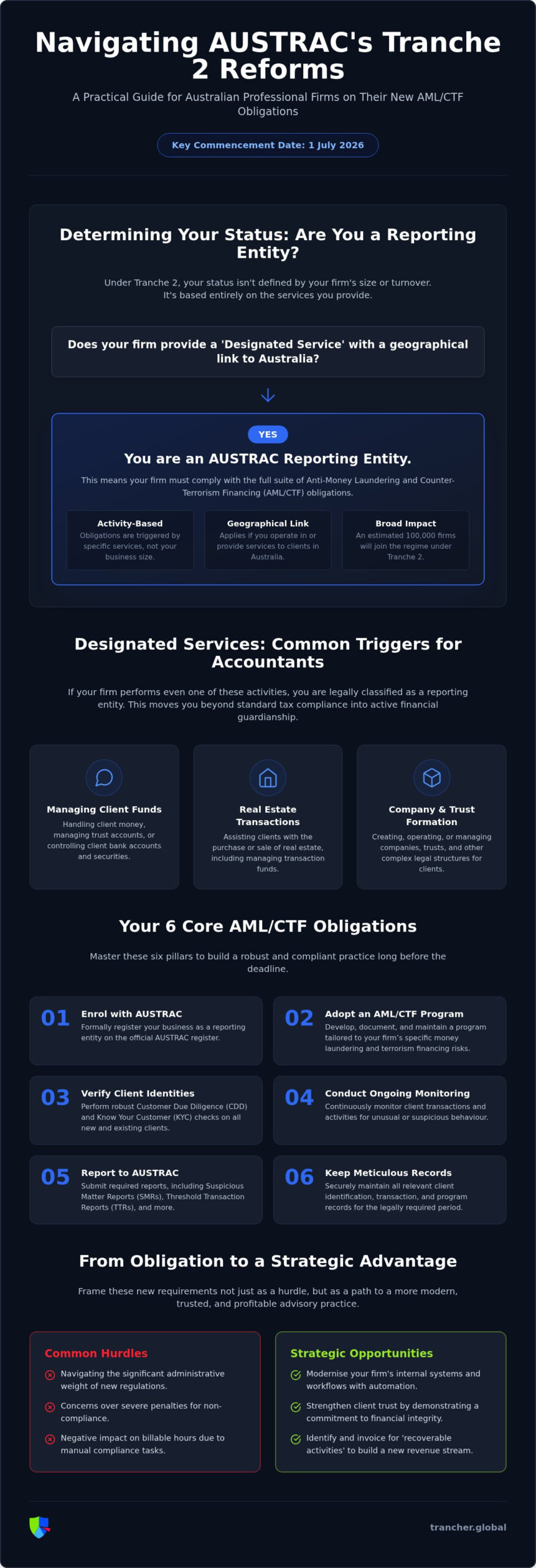
Understanding what is a reporting entity to AUSTRAC starts with looking at the specific activities your firm performs daily. Unlike other regulatory frameworks that might exempt businesses based on their annual turnover or staff count, this definition is strictly activity-based. If you provide a “designated service” as defined by the law, you’re a reporting entity, regardless of whether you’re a sole practitioner or a partner in a mid-tier firm. The Australian Transaction Reports and Analysis Centre (AUSTRAC) uses this classification to identify businesses that act as the front line against financial crime. It’s a shift that moves your practice from a passive service provider to an active guardian of financial integrity.
For most accounting professionals, this status triggers when you move beyond basic compliance and tax preparation into services like managing client funds, assisting with the purchase of real estate, or setting up complex corporate structures. To provide a clear benchmark for your records: An AUSTRAC reporting entity is any individual or business that provides one or more “designated services” defined under the AML/CTF Act with a geographical link to Australia.
The Geographical Link Requirement
A business is considered to have a geographical link if it provides a designated service through a permanent establishment in Australia. This includes traditional office spaces, but it also extends to services provided to Australian residents by offshore entities. If your firm is registered in Australia or operates a local branch, the link is established. Even if you’ve moved to a fully remote model, providing professional services to Australian clients from a home office still places you firmly under the regulatory umbrella. It’s about where the service is delivered and who it serves, ensuring that the integrity of the domestic financial system remains protected across all service delivery models.
Why the Definition is Changing in 2026
The regulatory landscape is undergoing a significant expansion to align Australia with international standards. While Tranche 1 focused on high-volume sectors like banking and gaming, the Tranche 2 reforms officially bring professional services into the fold. This shift formalises the role of accountants as “gatekeepers” of the financial system. Approximately 100,000 previously unregulated businesses will join the regime, making it essential to confirm your status well before the 1 July 2026 commencement date. Identifying your firm as a reporting entity early isn’t just about avoiding penalties; it’s about giving yourself the lead time to integrate these new processes into your workflow with confidence and ease.
Designated Services: Why Your Accounting Firm is Regulated
The core of the AML/CTF regime is the concept of “designated services”. These are specific activities that the law identifies as having a higher risk of being exploited for money laundering or terrorism financing. For an accounting practice, understanding what is a reporting entity to AUSTRAC means looking beyond your firm’s name and focusing on the nature of the work you perform for your clients. If your firm provides even one of these services, you’re legally classified as a reporting entity.
It’s vital to distinguish between standard tax compliance and these regulated activities. Preparing a standard tax return or providing basic bookkeeping services generally doesn’t trigger reporting obligations. However, the moment your advice facilitates a financial transaction or the creation of a legal structure, your regulatory profile shifts. Common triggers for accountants include managing client money, acting as a trustee for a client’s trust, or assisting in the formation of companies and other legal entities.
Professional Services Under the Spotlight
The regulatory focus is sharpest on services that involve significant asset movements. This includes assisting clients with the purchase or sale of real estate, as well as the acquisition of business entities. If your firm manages client bank accounts or securities, you’re performing a regulated activity. Once a designated service is triggered, your firm must implement robust CDD and KYC requirements Australia to verify the identity of your clients and understand the source of their funds. Managing these checks manually can be a significant drain on resources, which is why many firms are looking to workflow automation to maintain efficiency.
The Tranche 2 Expansion
The Tranche 2 reforms, commencing on 1 July 2026, represent a formal expansion of these rules to the broader accounting sector. Services that were once considered routine, such as corporate secretarial work or providing a registered office address, will now carry specific compliance weight. If you’re providing these services after the July deadline without being enrolled with AUSTRAC, your firm faces substantial risk. It isn’t just about the fear of penalties; it’s about the missed opportunity to formalise your role as a trusted advisor. By identifying these services now, you can transition your practice into a more structured, advisory-led model that treats compliance as a high-value, billable activity rather than a burden.
The Six Core Obligations of a Reporting Entity
Determining what is a reporting entity to AUSTRAC is the first step; the second is understanding the operational framework required to remain compliant. For an accounting firm, these obligations aren’t just administrative boxes to tick. They represent a structured approach to risk management that protects both your practice and the broader financial system. Once your firm is identified as a reporting entity, you must adhere to six fundamental pillars of compliance starting 1 July 2026.
- Enrolment and Registration: You must enrol your business with AUSTRAC within 28 days of providing your first designated service. For firms already providing these services on 1 July 2026, the deadline to register is 29 July 2026.
- AML/CTF Program: Your firm needs a written program tailored to your specific risks. This document outlines how you’ll identify and mitigate money laundering threats.
- Customer Due Diligence (CDD): You’re required to verify the identity of your clients before providing services. This “Know Your Customer” process ensures you understand exactly who you’re doing business with.
- Ongoing Monitoring: Compliance isn’t a one-off event. You must continuously monitor client transactions and activities for unusual patterns.
- Reporting Obligations: Reporting entities must notify the regulator of suspicious matters and large cash transactions.
- Record Keeping: Detailed records of your compliance activities, client identification, and transactions must be maintained for seven years.
Establishing Your Governance Framework
A successful compliance program relies on clear leadership. Your practice must formally appoint an AML/CTF Compliance Officer to oversee daily operations. This person acts as the primary point of contact for the regulator and ensures your program remains current. While the officer manages the details, the firm’s senior management holds ultimate responsibility for fostering a culture of compliance. Maintaining audit ready compliance records is the most effective way to demonstrate this commitment to the regulator. It ensures that when AUSTRAC requests information, your firm can respond with confidence and precision.
Ongoing Monitoring and Reporting
Reporting is perhaps the most time-sensitive obligation you’ll face. If you suspect a matter is linked to terrorism financing, you have a 24-hour window to submit a Suspicious Matter Report (SMR). For matters related to money laundering, the window is three business days. In a busy accounting practice, identifying these triggers manually is difficult and creates significant risk. Integrating ongoing risk monitoring software helps bridge this gap. It automates the detection of high-risk activity, allowing your team to focus on high-value advisory work while the system handles the heavy lifting of regulatory oversight.
Preparing for 1 July 2026: A Practical Roadmap
The 1 July 2026 commencement date might feel distant, but the complexity of implementation means that early action is your greatest advantage. Understanding what is a reporting entity to AUSTRAC is only the beginning. The real work lies in embedding these requirements into your practice without disrupting your billable hours. While some firms might spend twelve months overcomplicating their response, a structured approach allows you to achieve full readiness in a fraction of that time. We advocate for a “30-Day Readiness” concept, where you focus on high-impact systems rather than manual checklists.
A practical roadmap starts with a comprehensive audit of your service list. You’ll need to identify every activity that qualifies as a designated service, from trust management to company formation. Once your status is confirmed, don’t wait for the 29 July registration deadline to enrol. Early enrolment with AUSTRAC ensures your firm is visible and compliant before the regulatory spotlight intensifies. Finally, the most critical step is moving from manual spreadsheets to automated compliance workflows. This transition isn’t just about meeting a deadline; it’s about future-proofing your practice against increasing scrutiny.
Avoiding the “Administrative Heavy” Trap
Many practices fall into the trap of treating KYC and CDD as manual, paper-based tasks. The hidden costs of this approach are significant. Every hour spent chasing identity documents or cross-referencing watchlists is an hour lost to high-value advisory work. Automation ensures consistency across your entire client base, removing the risk of human error that often leads to regulatory scrutiny. Trancher’s approach focuses on getting SME firms compliant-ready within 30 days. This accelerated timeline is possible because we replace friction-heavy manual checks with seamless, integrated workflows that fit into your existing business model.
Staff Training and Cultural Shift
Compliance isn’t just a task for your designated officer; it’s a firm-wide professional standard. Briefing your team on their roles as “gatekeepers” is essential for building a resilient culture. They need to understand that verifying a client’s identity isn’t a chore, but a fundamental part of protecting the firm’s reputation and the integrity of the Australian financial system. Implementing role-based training modules ensures that every staff member, from administrative support to senior partners, knows exactly what to look for and when to escalate a concern. When compliance is woven into the fabric of your firm’s operations, it stops being a burden and starts being a mark of professional excellence.
To begin your firm’s transition with confidence, start your complimentary 3-month trial today and see how our platform simplifies your 2026 roadmap.
Transforming Compliance into a Profitable Advisory Service
While the initial focus for many practices is simply determining what is a reporting entity to AUSTRAC, the most successful firms are already looking beyond the technical definition. They recognise that these new regulations represent a catalyst for higher-value client conversations. By moving compliance from the back office to the front line, you can position your firm as a sophisticated partner that prioritises financial integrity and security. This shift allows you to move away from the “compliance as a burden” mindset and toward a model where regulatory readiness is a competitive advantage.
The data gathered during the enhanced due diligence process provides a wealth of strategic insights. When you understand a client’s source of funds and transaction patterns at a granular level, you’re better equipped to offer deeper business advice. You aren’t just verifying an ID; you’re gaining a comprehensive view of their financial health and risk profile. Trancher’s ROI Efficiency & Profitability Reports help you quantify this value, proving that the time invested in these processes contributes directly to the firm’s growth and client retention strategies.
The New Accounting ROI
In a traditional practice model, administrative requirements are often viewed as unrecoverable cost centres. However, the Tranche 2 reforms allow for a more structured approach where you can identify “recoverable compliance activity”. By formalising your “Secure Onboarding” process, you provide a tangible service that protects the client’s own interests. This transparency makes it easier to justify billing for the professional time spent on these essential checks. Significant AML CTF compliance costs reduction is achieved when you replace manual labour with automation. This ensures that your margins remain healthy even as your regulatory obligations increase.
Your Expert Compliance Companion
Trancher is designed to be more than just a software platform; we act as your expert compliance companion through every stage of this transition. We understand the specific pressures SME accounting firms face, from managing billable hours to navigating complex legislative updates. Our goal is to ensure your practice is not only compliant but also more efficient and profitable than before. We provide the tools to automate KYC and risk monitoring, allowing your team to focus on what they do best: providing expert financial guidance.
To help you experience this transition without financial risk, we offer a complimentary 3-month trial of our platform. This period allows you to integrate our workflows, identify billable activities, and see the ROI first-hand before the 1 July 2026 deadline. We guarantee that your firm will be AML/CTF compliance-ready within 30 days of implementation. Start the conversation with us today to secure your firm’s future as a leader in the new regulatory landscape.
Securing Your Firm’s Future Beyond 2026
The shift toward the Tranche 2 regime represents a significant milestone for the Australian accounting profession. By now, you should have a clear understanding of what is a reporting entity to AUSTRAC and how your specific designated services trigger these new obligations. While the 1 July 2026 deadline introduces new responsibilities, it also provides a unique opening to modernise your operations and deepen client relationships through enhanced transparency.
Transitioning to this new standard doesn’t have to be an administrative burden that drains your billable hours. With the right systems in place, you can move from uncertainty to total readiness with ease. We’ve designed our platform specifically for SME accounting firms, ensuring you have the local Australian expert support needed to navigate every regulatory nuance. We’re here to help you turn these requirements into a sustainable, profitable advisory stream.
Take the first step toward a more resilient practice today. Start your complimentary 3-month trial with Trancher today and we’ll guarantee your firm is compliance-ready within 30 days. It’s time to lead your clients into the future with confidence and clarity.
Frequently Asked Questions
How do I know if my accounting firm is a reporting entity?
You are a reporting entity if your firm provides at least one “designated service” listed in the AML/CTF Act. For accountants, this typically includes managing client funds, acting as a trustee, or assisting with company formations. Size and turnover don’t matter; the classification is purely based on activity. To understand what is a reporting entity to AUSTRAC, you must audit your service list against the Act’s definitions before the 1 July 2026 commencement date.
What happens if I fail to enrol with AUSTRAC by July 2026?
Failing to enrol by the 29 July 2026 deadline places your firm at significant regulatory risk. AUSTRAC has the power to issue substantial civil penalties for non-compliance with enrolment obligations. Beyond financial costs, failing to register can damage your professional reputation and lead to increased scrutiny from the regulator. Early enrolment is a straightforward way to demonstrate a good faith effort to meet your new obligations and protect your practice’s integrity.
Do I need to report every client to AUSTRAC?
No, you don’t need to report every client; however, you must conduct Know Your Customer (KYC) checks for all clients receiving designated services. Reporting to AUSTRAC is specifically required for suspicious matters (SMRs) and threshold transactions (TTRs) involving physical currency over $10,000. While not every client interaction is reportable, every client under the Tranche 2 umbrella requires a level of due diligence to ensure your firm remains compliant with the law.
Can a small firm be exempt from reporting entity obligations?
There is no exemption for small firms or sole practitioners based on business size or turnover. If you provide a designated service, you must meet the same core obligations as a larger practice. This is a common point of confusion when asking what is a reporting entity to AUSTRAC. The regulator focuses on the risk associated with the service provided, meaning even small firms must implement an AML/CTF program and conduct regular client due diligence.
What is the difference between a reporting entity and a designated service provider?
In the context of the AML/CTF Act, a reporting entity is the business or individual that provides a designated service. The terms are closely linked; the act of providing the service is what makes you the reporting entity. If your firm offers services like managing trust accounts or facilitating property transfers, you are both a provider of designated services and a reporting entity with specific legal obligations to monitor and report to AUSTRAC.
How much does it cost to maintain compliance as a reporting entity?
Maintenance costs vary depending on your firm’s size and the volume of designated services provided. Costs typically include staff training, software for ongoing monitoring, and the time spent on KYC procedures. While manual compliance can be expensive due to lost billable hours, automation significantly lowers these overheads. Many firms find that using a structured platform makes compliance a recoverable activity, allowing them to maintain healthy margins while meeting their regulatory duties.
What are the penalties for non-compliance for accountants?
Penalties for non-compliance are significant and can include civil penalties reaching millions of dollars for serious or systemic breaches. AUSTRAC also has the authority to issue infringement notices for smaller administrative failures, such as missing report deadlines or failing to maintain accurate records. Beyond financial hits, the reputational damage of being named in an enforcement action can be devastating for an accounting practice that relies on client trust and professional integrity.
Does Trancher help with the actual AUSTRAC enrolment process?
Yes, we provide expert support and guidance to help your firm navigate the enrolment process with ease. While the final submission must be made by your firm’s appointed officer, our platform ensures you have all the necessary documentation and program details ready for a seamless application. We act as your expert compliance companion, removing the friction from registration so you can focus on providing high-value advisory services to your clients.