

An AUSTRAC audit is not a regulatory “gotcha” moment designed to catch you out. It’s a structured systems check to ensure your firm’s integrity remains intact while protecting the Australian financial system. It’s completely normal to feel a wave of anxiety when a notice arrives, especially when you’re trying to understand exactly what happens during an AUSTRAC audit. You might worry about the administrative weight of record-keeping or fear that a minor oversight could lead to significant penalties. With Tranche 2 obligations having commenced on 1 July 2026, we understand those pressures and are here to help you move from apprehension to calm readiness.
This guide provides a clear roadmap of the compliance review. It breaks down the step-by-step process into manageable stages so you can prepare with precision and optimise your internal systems. You’ll discover how to build a defensible AML/CTF programme that stands up to scrutiny without the manual heavy lifting. By the end of this article, you’ll have the insights needed to simplify your obligations. We’ll show you how to transform a perceived burden into a strategic advantage, giving you the confidence to treat your next regulatory interaction as a routine verification of your firm’s operational excellence.
Key Takeaways
- Understand the full regulatory lifecycle from the initial notice to the final report, giving you a clear roadmap of what happens during an AUSTRAC audit.
- Identify and rectify common SME compliance gaps, such as outdated manual procedures or incomplete beneficial ownership details for complex client structures.
- Learn how to move from fragmented spreadsheets to a centralised, automated system that ensures every KYC check is timestamped and ready for inspection.
- Shift your perspective on compliance from an administrative burden to a value-add service that can be tracked for billable ROI and operational efficiency.
- Ensure your firm successfully navigates the Tranche 2 obligations that commenced on 1 July 2026 by maintaining a programme that is consistently “fit for purpose”.
Understanding the AUSTRAC Compliance Review in 2026
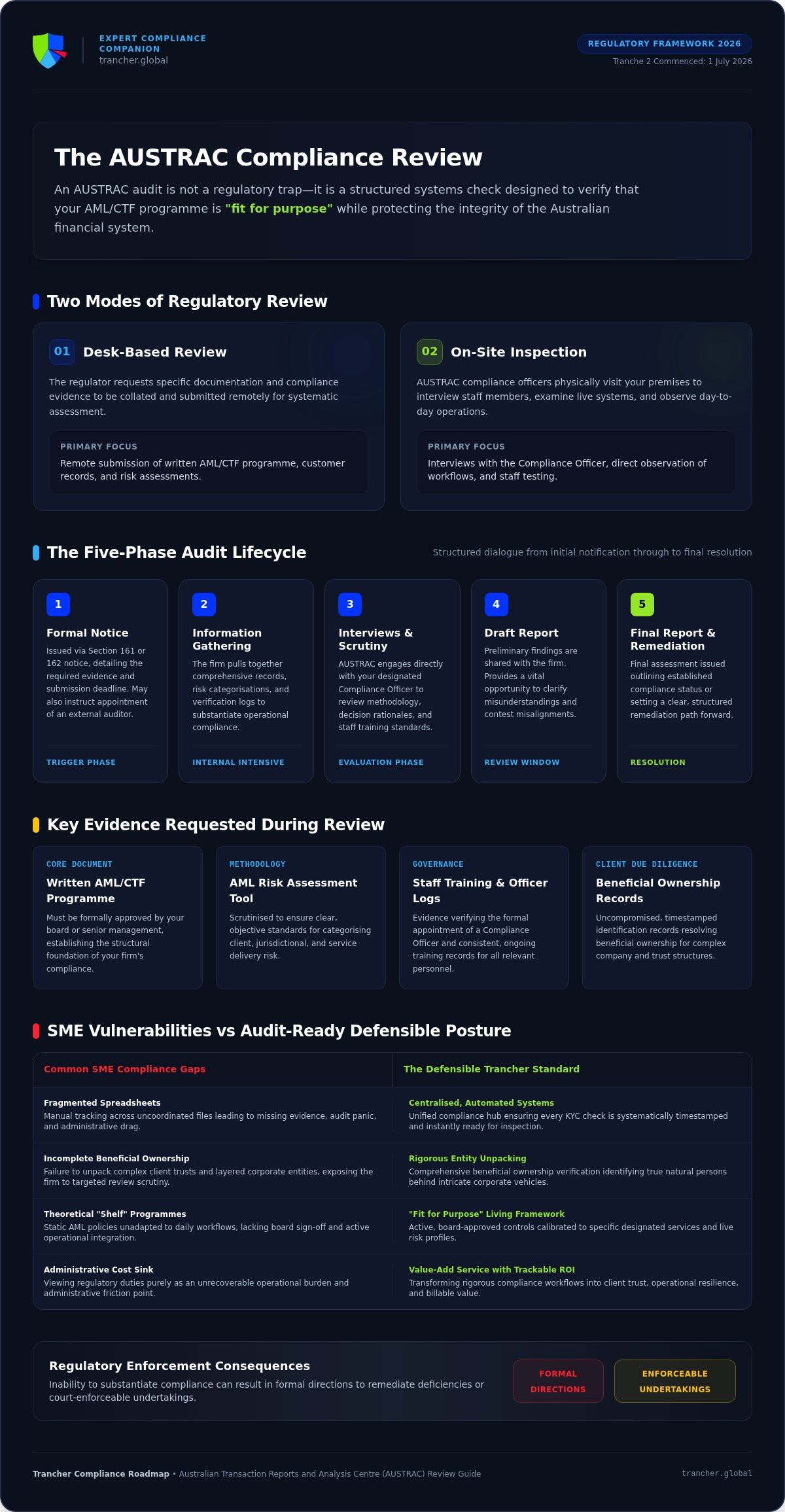
AUSTRAC defines a compliance review as a systematic assessment to verify that your Anti-Money Laundering and Counter-Terrorism Financing (AML/CTF) programme is “fit for purpose”. This isn’t just a tick-box exercise; it’s an evaluation of how well your firm identifies and manages the specific risks associated with your clients and services. When considering what happens during an AUSTRAC audit, you’ll find there are generally two types of reviews. A desk-based review involves the regulator requesting specific documents to be submitted remotely for assessment. In contrast, an on-site inspection involves officers visiting your premises to interview staff and observe your processes in action. Viewing these reviews as a strategic opportunity allows you to identify and rectify gaps before they escalate into regulatory penalties.
Why is AUSTRAC Auditing Professional Services Now?
The regulatory environment shifted significantly when Tranche 2 obligations commenced on 1 July 2026. After an initial period focused on guidance, the Australian Transaction Reports and Analysis Centre (AUSTRAC) has moved into a more proactive enforcement phase. Accounting firms are now under the spotlight because they provide “designated services” that could potentially be exploited to move or hide illicit funds. AUSTRAC uses risk-based targeting to select firms for review, often focusing on those with higher-risk client profiles or those involved in thematic reviews that look at compliance trends across the entire professional services sector. It’s a proactive measure to ensure the integrity of the Australian financial system.
The Legal Basis: Your Obligations as a Reporting Entity
Your firm must maintain a written AML/CTF programme that has been formally approved by your board or senior management. This document is the foundation of your compliance framework, and it must be supported by audit-ready compliance records. Without these records, proving that your programme is actually being followed becomes nearly impossible during a review. When you understand what happens during an AUSTRAC audit, you realise that the focus is on evidence. Failing to meet these standards can lead to serious consequences, such as formal directions to fix specific issues or enforceable undertakings that require your firm to commit to a court-enforceable remediation plan. Staying ahead of these requirements ensures your firm remains a trusted, reliable partner to its clients while maintaining operational ease.
The Audit Lifecycle: From Notice to Final Report
Understanding the timeline of a compliance review is the first step toward maintaining a calm, professional stance. When you’re considering what happens during an AUSTRAC audit, it’s helpful to view the process as a structured dialogue rather than an interrogation. The lifecycle moves through five distinct phases. It begins with a formal Section 161 or 162 notice. This letter specifies what information you must provide and the timeframe for submission. In certain instances, the regulator may issue AUSTRAC notices to appoint an external auditor, which is a more formal requirement to have an independent expert verify your systems.
Once you’ve submitted your data, the information gathering phase begins. This is often the most intensive period for your internal team as they pull together records to support your claims. Following this, the interview phase allows the regulator to discuss your risk assessment directly with your Compliance Officer. After their review, you’ll receive a draft report. This is a critical opportunity to respond to preliminary findings and clarify any misunderstandings before the final report is issued. If gaps are identified, the final report will outline a clear path to remediation, helping you strengthen your firm for the future.
The Information Request: What AUSTRAC Will Ask For
AUSTRAC expects to see evidence that your programme is active and integrated into your daily operations. They will scrutinise your AML risk assessment tool to understand the methodology you use to categorise client risk. You’ll need to provide records of staff training and the formal appointment of your Compliance Officer. The regulator will also request sample client files to verify your PEP screening best practices and ensure your Know Your Customer (KYC) procedures are robust. Having these documents organised in a central digital location, such as through Trancher’s automated record-keeping, ensures you can respond to these requests with speed and accuracy.
The On-Site Visit: What to Expect on the Day
If AUSTRAC conducts an on-site inspection, their goal is to observe your firm’s compliance culture in action. They may physically inspect how you store sensitive records and ask to see your digital systems. Staff interviews are a common feature; the regulator wants to ensure your team understands their obligations and isn’t just following a “dusty manual”. You can manage this presence without disrupting your daily operations by designating a specific meeting room for the officers and having a dedicated point of contact. This professional approach demonstrates that your firm takes its obligations seriously while maintaining its focus on client service.
Common Gaps AUSTRAC Identifies in SME Firms
When exploring what happens during an AUSTRAC audit, many SME owners discover that their primary risk isn’t malicious intent, but rather a series of administrative oversights. The regulator looks for a direct alignment between your written policies and your daily operations. Under the Anti-Money Laundering and Counter-Terrorism Financing Act 2006, firms must demonstrate that their programme is active and effective. Common gaps often include a lack of ongoing monitoring; failing to update risk profiles when a client’s business structure changes or their transaction patterns shift. Additionally, many firms struggle with inadequate reporting, specifically failing to document the logic behind why a Suspicious Matter Report (SMR) was or wasn’t filed. These aren’t just minor details; they’re the benchmarks of a robust, defensible compliance culture.
The “Paper vs. Practice” Disconnect
A frequent finding in compliance reviews is the “Dusty Manual” syndrome. This occurs when a firm adopts a high-quality template but fails to integrate it into their actual workflow. AUSTRAC tests this by interviewing staff to see if they understand the procedures they’re supposed to be following. If your manual says you perform enhanced due diligence for high-risk clients, but your files don’t show the evidence, you’re in a vulnerable position. Using a live system like Trancher bridges this gap by embedding compliance into your existing processes, ensuring your practice always matches your policy. It transforms a static document into a functional, audit-ready asset.
Beneficial Ownership: The Accountant’s Achilles Heel
Documenting CDD and KYC requirements in Australia becomes particularly complex when dealing with trusts and intricate corporate structures. A common mistake is relying on long-term personal relationships as a substitute for formal verification. Saying “we’ve known them for 20 years” doesn’t satisfy the legal requirement to identify the individual who ultimately owns or controls the entity. You must verify beneficial owners using reliable, independent data sources. When dealing with high-risk scenarios, you must also be careful to avoid a “tipping off” offence, where the client becomes aware they are under scrutiny. Proper, timestamped documentation ensures you remain on the front foot without compromising your professional integrity or client relationships.
Practical Steps to Build a Defensible Position
Building a defensible position means moving beyond reactive compliance to a proactive, organised framework. When you understand what happens during an AUSTRAC audit, you realise that the quality of your record-keeping is your strongest shield. Centralising your documentation is essential; fragmented emails and disconnected spreadsheets create gaps that are difficult to defend under pressure. By automating your audit trail, you ensure every KYC check is timestamped and stored securely, creating a permanent, unalterable record of your due diligence efforts.
Regular internal reviews act as a vital health check for your firm. By conducting your own assessments before AUSTRAC knocks, you can identify and resolve minor issues in a low-pressure environment. Utilising a comprehensive compliance officer toolkit ensures your team remains aligned with 2026 standards and has the resources needed to manage Tranche 2 obligations effectively. This proactive stance demonstrates to the regulator that your firm takes its responsibilities seriously and has the systems in place to maintain integrity.
Moving from Manual to Automated Compliance
Manual systems often lead to spreadsheet fatigue during an intense information request. When several years of data are requested at once, the risk of human error or missing files increases exponentially. Automation ensures consistency across the whole firm, removing the reliance on a single partner’s memory or filing habits. It transforms compliance from a manual chore into a seamless background process. This transition is particularly helpful when you consider what happens during an AUSTRAC audit, as the regulator will expect to see a clear, chronological history of your compliance activities. We provide a 30-day compliance-ready guarantee to help firms transition at speed, ensuring you are prepared for scrutiny without the typical administrative burden.
The Role of the AML/CTF Compliance Officer
The Compliance Officer is a strategic leader, not just a name on an organisational chart. For a programme to be truly defensible, this individual needs direct access to the board or principals to ensure compliance is prioritised at every level. This visibility ensures that the firm’s leadership is fully informed and in control of regulatory obligations. Supporting your officer with expert on-call guidance for complex queries helps them make informed decisions with confidence. This partnership approach ensures your firm navigates the regulatory landscape with steady, reliable guidance. To see how your firm can simplify these requirements and achieve audit-ready status, explore Trancher’s end-to-end AML/CTF program management.
Transforming Audit Readiness into Business ROI
Viewing compliance solely as a cost centre is a missed opportunity for the modern accounting firm. By shifting your perspective, you can transform these regulatory requirements into a high-value professional service. While the focus is often on what happens during an AUSTRAC audit, the real business value lies in the systems you build to prepare for one. A robust, automated programme doesn’t just protect you from penalties; it streamlines your onboarding and enhances your firm’s reputation for integrity. This defensible position becomes a significant marketing advantage when engaging with high-net-worth clients who prioritise security and professional rigour.
Recoverable Compliance Activities
Many firms struggle to explain AML/CTF costs to their clients, often absorbing the administrative burden as overhead. However, when you provide “Compliance as a Service”, you’re offering your clients the peace of mind that their financial affairs are being handled within a secure, regulated framework. You can use Trancher to track billable compliance hours and recover costs effectively. By using automated evidence to justify the value of your due diligence, you remove friction from the billing process. You’ll be able to see the direct ROI as you compare the time saved through automation against the manual heavy lifting of previous years. If you’re looking to formalise this approach, building a business case for RegTech can help you secure partner buy-in and turn your AML obligations into an automated, billable service that adds genuine value to your client onboarding.
Next Steps: Your 30-Day Readiness Plan
Preparation is the most effective antidote to regulatory anxiety. Starting a conversation about your systems now ensures you aren’t caught in a reactive scramble when a notice arrives. Our 30-day compliance-ready guarantee is designed to get your firm on the front foot quickly, providing a clear roadmap to a defensible position. We also offer a 3-month complimentary trial for accounting firms, allowing you to test your audit readiness in a real-world environment without an immediate commitment. This structured approach helps you understand what happens during an AUSTRAC audit by simulating the rigour required while we provide the expert support to guide you through.
You don’t have to navigate the complexities of the 1 July 2026 Tranche 2 obligations alone. We’re here to act as your strategic guide, helping you turn a perceived hurdle into a streamlined avenue for growth. By focusing on operational ease and financial health, you can ensure your firm remains resilient, profitable, and fully prepared for whatever the regulatory landscape brings next.
Securing Your Firm’s Future Through Proactive Readiness
Navigating the regulatory landscape doesn’t have to be a source of constant pressure. By understanding what happens during an AUSTRAC audit, you can transition from a reactive posture to one of calm, solution-oriented confidence. The key is to bridge the gap between your written policies and your daily operational reality through automation and centralised record-keeping. This shift not only protects your firm from penalties but also transforms compliance from an administrative overhead into a profitable, high-value service for your clients.
We are here to act as your strategic guide, providing the steady hand you need to navigate these requirements with ease. You can take the first step today with our local Australian expert support and comprehensive ROI reporting. Get Audit-Ready in 30 Days with Trancher’s Complimentary 3-Month Trial and experience how our 30-day compliance-ready guarantee can simplify your firm’s obligations. You have the tools and the partnership available to ensure your systems are defensible and your firm remains resilient. Let’s work together to turn your regulatory duties into a clear avenue for professional growth and operational excellence.
Frequently Asked Questions
How much notice does AUSTRAC give before an audit?
AUSTRAC typically provides between 14 and 28 days’ notice via a formal Section 161 or 162 notice. This timeframe is designed to allow you to gather the necessary documentation and prepare your team for the review. While this window may seem short, having a structured digital system in place ensures you can respond efficiently. Early preparation is essential because the regulator expects a prompt and comprehensive response to their initial information request.
Can I be fined even if I haven’t done anything “wrong”?
Yes, your firm can face civil penalties for failing to meet administrative obligations, even if no actual money laundering has occurred. The AML/CTF Act focuses on the robustness of your systems and your ability to demonstrate what happens during an AUSTRAC audit. If your records are incomplete or your risk assessments are outdated, AUSTRAC may issue formal directions or enforceable undertakings to ensure your programme becomes “fit for purpose”.
What is the difference between a desk-based review and an on-site audit?
A desk-based review is conducted remotely, where AUSTRAC officers request specific documents for evaluation at their own offices. An on-site audit involves officers visiting your premises to observe workflows, inspect physical records, and interview staff. While both formats assess your compliance, the on-site visit is more immersive. It allows the regulator to verify that your “paper” programme matches the practical reality of your firm’s daily operations and compliance culture.
How long does a typical AUSTRAC compliance review take?
A typical compliance review can span several weeks to several months from the initial notice to the final report. The information gathering phase usually takes 14 to 28 days, followed by the regulator’s analysis and the interview phase. You’ll then receive a draft report with preliminary findings, giving you a chance to respond. The final report follows this dialogue, outlining any required remediation steps to strengthen your internal systems for the future.
Do I need a lawyer present during an AUSTRAC interview?
You aren’t legally required to have a lawyer present during an AUSTRAC interview, though you certainly have the right to seek legal counsel. Most SME firms find that having a well-prepared Compliance Officer and audit-ready records is the most effective way to navigate the conversation. The regulator is looking for operational competence and a deep understanding of your own risk-based methodology rather than legal arguments or technical shielding during the process.
What happens if AUSTRAC finds a breach in my programme?
If AUSTRAC identifies a breach, the response depends on the severity and nature of the non-compliance. For minor administrative gaps, they may issue a formal direction to remediate the issue within a specific timeframe. More serious or systemic failures can lead to enforceable undertakings, which are court-enforceable agreements to fix your programme. In extreme cases, civil penalties may apply, which is why maintaining a defensible, automated programme is so vital for protection.
Is my firm too small to be audited by AUSTRAC?
No firm is too small to be audited if it provides “designated services” as defined under the AML/CTF Act. With the commencement of Tranche 2 obligations on 1 July 2026, AUSTRAC has expanded its focus to include small and medium-sized accounting firms. The regulator uses a risk-based approach, meaning they target firms based on their client profiles and service types rather than just their annual turnover or the total number of staff members.
How often does AUSTRAC conduct audits on SME accounting firms?
AUSTRAC doesn’t follow a fixed schedule for auditing specific firms; instead, they conduct reviews based on risk profiles and thematic priorities. For example, they may focus on the accounting sector following the 2026 regulatory shift to ensure widespread adoption of new standards. While you might not be audited every year, the expectation is that you remain audit-ready at all times. This ensures your firm remains resilient whenever the regulator decides to verify what happens during an AUSTRAC audit.