

What if the 1 July 2026 AML/CTF deadline wasn’t a looming threat to your firm’s margins, but the catalyst for your most profitable new advisory service? With the Commonwealth penalty unit now at $364, the maximum civil penalty for corporate non-compliance has reached a staggering $36.4 million per breach. It’s understandable why many firms feel a sense of urgency. However, building a business case for RegTech isn’t just about avoiding these astronomical AUSTRAC penalties. It’s about modernising how your practice handles “designated services” to protect your partners and your profit.
You likely agree that the administrative burden of manual KYC and paper-based tracking is a drain on your senior talent’s time. Compliance shouldn’t be a non-billable overhead that erodes your firm’s efficiency. This guide promises to help you secure partner buy-in by transforming AML obligations into an automated, billable service that adds genuine value to your client onboarding. We’ll provide a clear framework to prove that you can meet the 2026 deadline with confidence, all while maintaining your current headcount and improving your firm’s operational health.
Key Takeaways
- Understand why the 1 July 2026 deadline makes AML compliance for designated services a non-negotiable priority for every Australian accounting firm.
- Discover how building a business case for RegTech allows you to transform compliance from an unbillable overhead into a profitable, recoverable professional service.
- Learn to identify the hidden operational costs of manual workflows and how automation ensures data integrity while eliminating administrative friction.
- Master a structured framework for pitching to partners that emphasises risk mitigation and operational scalability without the need to hire additional staff.
- Explore how a 30-day compliance-readiness guarantee and a complimentary three-month trial can remove the financial risk of transitioning to a modern platform.
The 2026 Regulatory Landscape: Why ‘Doing Nothing’ is No Longer an Option
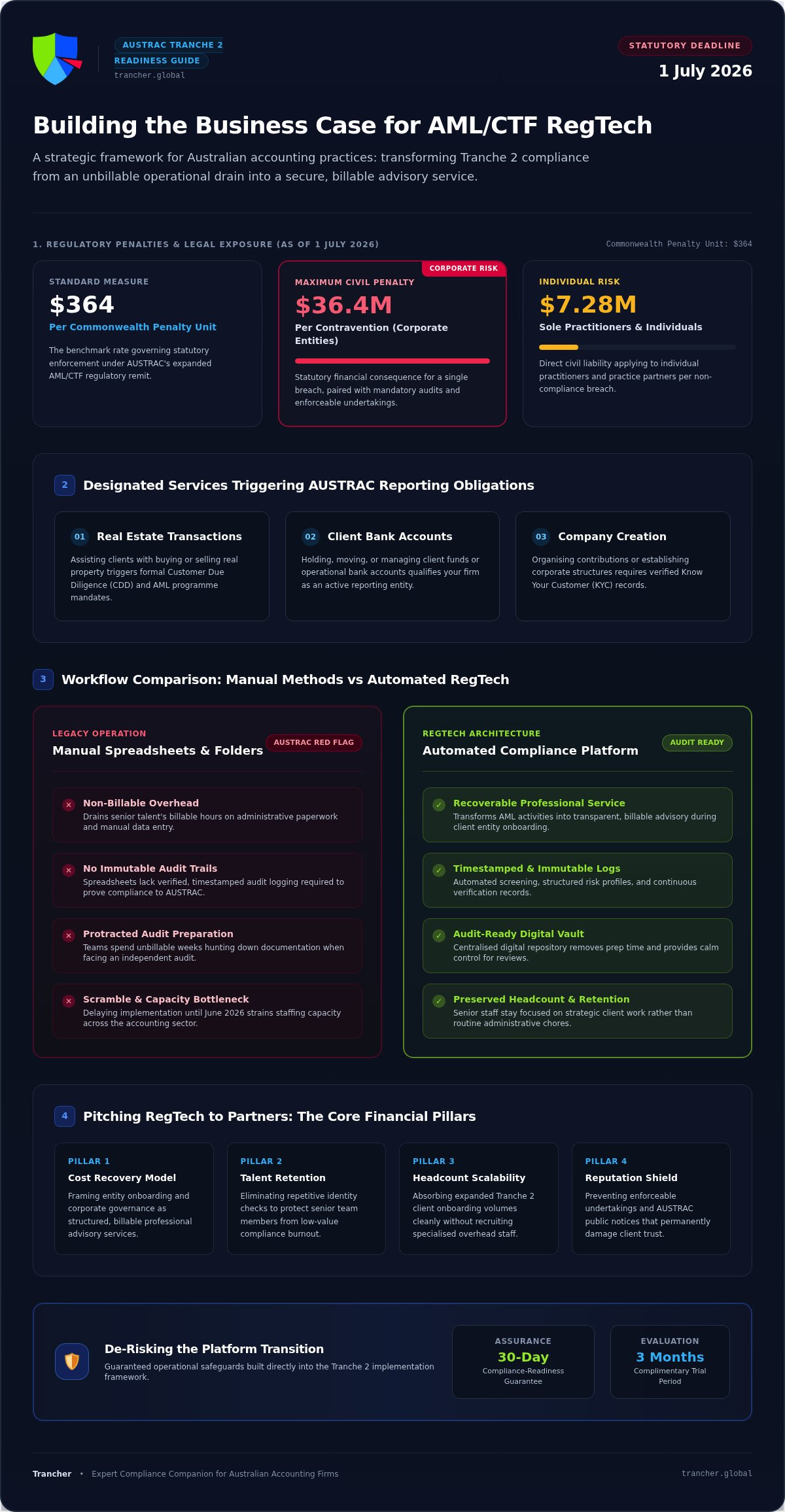
The 1 July 2026 deadline is no longer a distant date on a calendar; it’s the day the regulatory environment for Australian accountants fundamentally shifts. With the expansion of the AML/CTF Act, firms providing designated services are now reporting entities under AUSTRAC’s remit. This isn’t just a minor administrative tweak. If your firm assists with buying and selling real estate, manages client bank accounts, or organises contributions for company creation, you’re likely performing designated services that require a formal compliance programme. Relying on legacy manual workflows in this new era doesn’t just create friction; it leaves your firm exposed.
AUSTRAC’s enforcement model is graduated, yet the financial stakes are higher than ever. As of 1 July 2026, the Commonwealth penalty unit has increased to $364. For corporate entities, a single contravention can lead to civil penalties of up to $36.4 million, while individuals and sole practitioners face up to $7.28 million per breach. Beyond the fines, the risk of court-enforceable undertakings or a mandatory independent audit can cause irreparable damage to a firm’s reputation. Building a business case for RegTech is the most reliable way to transition from a reactive, stressed posture to a proactive, confident one that protects your partners and your clients.
Defining the Tranche 2 Shift
The shift to Tranche 2 requires a rigorous approach to Know Your Customer (KYC) protocols, Customer Due Diligence (CDD), and ongoing risk monitoring. In 2026, manual spreadsheets are viewed as a significant red flag by AUSTRAC auditors because they lack the timestamped, immutable audit trails required for modern accountability. Utilising an AML program checklist Australia helps identify where your current systems fall short. By adopting regulatory technology (RegTech), you replace vulnerable manual folders with structured workflows that ensure every risk assessment is documented and every screening is current.
The Opportunity Cost of Delay
Waiting until the final weeks of June 2026 to address these obligations creates a dangerous bottleneck. When every firm in the country scrambles to find resources simultaneously, the strain on your staff becomes immense. Conversely, firms that achieve readiness early gain a distinct competitive advantage. They can offer clients the peace of mind that their entity structuring is handled within a secure, compliant framework. The 1 July 2026 Tranche 2 deadline stands as the primary driver for technological adoption in the accounting sector this year. Proactive firms aren’t just avoiding penalties; they’re building a more resilient, scalable business model while peers are still struggling with paperwork.
The Financial Pillars of a RegTech Business Case
The traditional view of compliance as a non-billable overhead is quickly becoming obsolete. When building a business case for RegTech, the conversation must expand beyond simply avoiding fines to focus on how automation strengthens your firm’s bottom line. By centralising documentation and automating routine tasks, you reduce the billable hours senior staff spend on administrative “grunt work”. This shift doesn’t just save money; it preserves your most valuable assets: your people. Removing the friction of manual identity verification allows your team to focus on high-value advisory work, which significantly improves staff retention in a competitive market. Having an audit-ready digital vault means your team won’t spend unbillable weeks preparing for an independent review, providing a sense of calm and control that spreadsheets cannot offer.
RegTech as a Revenue Driver
Modern accounting practices treat AML/CTF requirements as a “recoverable compliance activity”. This isn’t about passing on a cost; it’s about providing a transparent, value-add service. By using compliance ROI tracking software, partners can see exactly how much time is captured and billed for designated services. Framing these activities as specialised entity onboarding or corporate governance advisory allows you to recover costs while demonstrating your firm’s expertise. This data often reveals new advisory opportunities, as enhanced client due diligence provides deeper insights into a client’s corporate structure. Aligning your operations with the AUSTRAC AML/CTF reform guidelines ensures this revenue stream is built on a foundation of total regulatory integrity. You can view our ROI tracking features to see how this works in practice.
Efficiency Gains in KYC/CDD
Manual searches that once took hours can now be completed in minutes. Automated screening identifies Politically Exposed Persons (PEPs) and sanctioned individuals with a level of precision that human oversight simply cannot match. Implementing PEP screening best practices accelerates the onboarding process, which is often the first touchpoint a client has with your firm. A seamless, digital-first onboarding experience reduces client friction and positions your practice as a modern, efficient leader. When you’re building a business case for RegTech, remember that speed is a competitive advantage that wins more business. It allows your firm to scale its designated services without a corresponding increase in headcount, ensuring your margins remain healthy as your client list grows.
Manual vs. Automated Compliance: A Comparative Analysis
When you’re building a business case for RegTech, it’s essential to look at the breaking point of your current manual systems. Manual compliance is inherently fragile; it relies on the memory and meticulousness of staff who are already stretched thin. As the volume of designated services increases under Tranche 2, the risk of human error grows exponentially. A single missed passport expiry or a forgotten sanctions check can compromise your entire AML/CTF program. Automated systems don’t suffer from fatigue or oversight. They provide a structured workflow that ensures every client is verified against the same rigorous standards every single time, regardless of how many new entities you onboard.
Documenting the Source of Wealth for complex trusts is another area where manual processes often falter. Tracking the layering of entities across multiple jurisdictions is a complex task that requires deep analysis and perfect record-keeping. In a manual environment, this often results in a fragmented paper trail that is difficult to defend. RegTech platforms standardise this data collection, making it easier to visualise and verify complex structures. This level of data integrity is what separates a firm that is merely “trying to comply” from one that is truly audit-ready. Instead of hunting through physical files or unencrypted emails for weeks, you can generate a comprehensive, single-click audit report that proves your due diligence was performed correctly.
The Spreadsheet Trap
Relying on spreadsheets for compliance creates dangerous data silos and version control issues. If your AML tracker lives on a single partner’s desktop, your firm lacks the transparency required for a defensible program. These silos are the enemies of accountability, especially when you need to prove your risk methodology to an external auditor. Using a dedicated AML risk assessment tool Australia ensures your methodology is defensible and consistent across the entire practice. It removes the hidden cost of manual record-keeping by providing a central source of truth that every authorised staff member can access and update securely.
The Automation Advantage
Automation transforms compliance from a periodic chore into a real-time monitoring system. While manual reviews are often forgotten or delayed, RegTech platforms provide continuous screening against global PEP and sanctions lists. This proactive approach is exactly what regulators expect in a modern financial environment. In fact, regulators are actively encouraging this transition, as seen in the ASIC regtech initiatives and programs, which highlight how technology lowers the ongoing burden of compliance management. While manual risk scoring remains tethered to static, historical snapshots, automated dynamic profiling offers a living assessment of client risk that stays current with 2026 standards. This shift significantly reduces the administrative work required for AUSTRAC reporting, saving your firm days of unbillable labor each year.
Step-by-Step Template: Pitching RegTech to Your Partners
Securing partner buy-in requires a shift from discussing technical features to presenting a clear commercial transformation. When building a business case for RegTech, your executive summary should lead with the 1 July 2026 deadline. Frame the transition as a risk-mitigation strategy that ensures the firm is audit-ready within 30 days. Partners need to know that the expansion into Tranche 2 designated services is manageable and that the firm won’t be left vulnerable to the $36.4 million corporate penalty cap.
Your problem statement must quantify the unbilled hours currently lost to manual KYC and administrative tracking. By presenting compliance as a profit drain, you make the argument for automation undeniable. The solution is a platform that integrates seamlessly with your existing accounting workflows, ensuring that client work continues without disruption. To prove the financial impact, propose a 3-month trial. This allows the firm to generate a formal ROI report for the board, providing hard data on time saved and billable activity recovered before any long-term commitment is made.
Quantifying the Investment
Comparing the cost of a software subscription to a full-time compliance hire often provides the most compelling financial argument. A dedicated platform scales with your client base, whereas a new hire represents a fixed, high-cost overhead. To help partners visualise this, use the compliance officer toolkit to map out the specific resource needs of your practice. Highlighting the 20% post-trial discount also serves as a strategic entry point, lowering the barrier to entry while the firm establishes its new billable workflows.
Addressing Partner Objections
Common objections regarding cost are best met by reframing compliance as a recoverable activity. Provide partners with billing templates that demonstrate how these obligations can be bundled into advisory fees. Much like simplifying client onboarding for law firms and accountants, modernising your intake process improves the overall client experience by removing friction. The 30-Day Readiness guarantee acts as the ultimate risk-mitigation tool for partners, ensuring the firm meets its statutory duties without the stress of a last-minute scramble. To begin building your internal ROI case, you can start your complimentary 3-month trial today.
Future-Proofing Your Firm with Trancher
Trancher stands apart as the only platform engineered specifically for the nuances of Australian SME accounting firms. While larger enterprise tools often feel impersonal or overly complex, our system is designed to integrate seamlessly into your existing workflows. We understand that for an SME practice, the 1 July 2026 deadline represents a significant shift in how you handle designated services. Our 30-day compliance guarantee ensures that your firm moves from uncertainty to audit-ready status with speed and precision. This commitment to your Tranche 2 success is backed by a platform that doesn’t just track data; it protects your firm’s professional integrity.
The cornerstone of building a business case for RegTech is proving value without upfront financial exposure. This is why we offer a complimentary 3-month trial. It allows your partners to experience the operational ease of automated KYC and CDD with zero financial risk. At the conclusion of this trial, we provide a formal ROI Efficiency & Profitability Report. This document delivers the hard data required for permanent buy-in, quantifying the exact time saved and the billable compliance activity captured by your team. It transforms the conversation from a software cost to a strategic investment in firm growth.
The Trancher Difference
Our approach is rooted in local expertise. You receive dedicated Australian-based support and onboarding from AML specialists who understand the local regulatory environment. We don’t just provide software; we help you transform compliance into a profitable professional service capability. By automating the administrative “grunt work”, you join a growing community of firms that are prioritising operational readiness for 2026. This proactive stance ensures your firm remains a leader in the field, attracting clients who value security and efficiency.
Next Steps for Your Business Case
Moving forward is a structured process designed to provide total clarity. You can start a conversation with our founder, Aaron Soh, to tailor ROI projections specifically for your firm’s client base and service mix. We also provide an internal pitch deck for accounting partners to simplify your internal communication. The most effective way to validate the system is to see it in action within your own practice. You can start your complimentary 3-month trial today and begin building a business case for RegTech that is supported by real-world performance data.
Leading Your Practice into a Compliant Future
The transition to Tranche 2 obligations doesn’t have to be a source of stress for your partners. By building a business case for RegTech, you’re choosing to replace administrative friction with a scalable, billable asset. You’ve seen how the 1 July 2026 deadline serves as a catalyst for modernising your designated services and protecting your firm from astronomical penalties. Now is the time to move from theory to implementation. We’re here to guide you through every step of this journey with a steady hand and deep industry expertise.
With our guaranteed AML/CTF compliance within 30 days and local Australian expert support, your firm can navigate these changes with total confidence. You can experience the platform’s impact first-hand with our complimentary 3-month trial for accounting firms. Book a call with our compliance specialists to build your firm’s ROI case and discover how seamless your transition can be. We look forward to helping your practice thrive in this new regulatory landscape.
Frequently Asked Questions
What is the main driver for a RegTech business case in 2026?
The primary driver is the commencement of AUSTRAC Tranche 2 obligations on 1 July 2026. This regulatory shift requires accounting firms providing designated services to establish formal AML/CTF programmes. With corporate penalties now reaching $36.4 million per breach, the financial risk of non-compliance is too high to ignore. Proactive firms are using this deadline as the foundation for building a business case for RegTech to protect their partners and professional reputation.
How can RegTech help an accounting firm generate revenue?
RegTech transforms compliance from an overhead into a billable professional service. Trancher specifically tracks billable compliance activity, allowing firms to recover the costs associated with identity verification and ongoing monitoring. By using structured billing templates, you can frame these obligations as value-add advisory services. This approach identifies new revenue streams while ensuring your clients receive a secure, modern onboarding experience that justifies the professional fee. It turns a mandatory obligation into an opportunity for growth.
What are the risks of using spreadsheets for AML/CTF compliance?
Spreadsheets lack the immutable audit trails and real-time monitoring required for 2026 standards. They create dangerous data silos and version control issues that lead to human error in risk assessments. AUSTRAC auditors view manual trackers as a red flag because they don’t provide timestamped evidence of due diligence. Relying on manual files also increases the unbillable administrative burden, making it impossible to scale your services effectively as your client list grows.
How do I calculate the ROI of a RegTech investment?
To calculate ROI, compare the billable hours senior staff spend on manual KYC against the subscription cost of a RegTech platform. You should also factor in the revenue generated from recoverable compliance fees. Trancher simplifies this by providing a formal ROI Efficiency & Profitability Report at the end of our complimentary 3-month trial. This report quantifies time saved and billable activity captured, giving you the hard data needed for permanent partner buy-in.
Is RegTech affordable for a small accounting firm?
Yes, RegTech is far more affordable than hiring a full-time compliance officer or paying for expensive external consultants. Modern platforms like Trancher are designed for SME firms, offering a subscription that scales with your practice. When building a business case for RegTech, it’s helpful to consider the 20% discount available for the first 12 months after our complimentary trial. This makes it a cost-effective way to secure your firm’s future without a massive capital outlay.
How long does it take to implement a RegTech solution like Trancher?
We guarantee that your firm will be AML/CTF compliance-ready within 30 days of starting. Our structured onboarding process is designed to be efficient and non-disruptive, allowing your team to focus on their core client work. This rapid implementation ensures you meet your Tranche 2 obligations well before the 1 July 2026 deadline. With local Australian support, the transition is smooth, guided, and focused on immediate operational readiness for your practice.
What should be included in a RegTech pitch to partners?
Your pitch should focus on the 1 July deadline and the financial risk of manual oversight. Include a comparison between the cost of a full-time hire versus a scalable software subscription. Highlight the 30-day readiness guarantee as a risk-mitigation tool and use data from a trial to prove profitability. Emphasise that automation removes the administrative grunt work that often leads to senior staff burnout and unbillable hour leakage.
Does AUSTRAC require firms to use specific software?
AUSTRAC doesn’t mandate specific software, but they do require reporting entities to maintain rigorous, audit-ready documentation. You must prove that your KYC, risk monitoring, and reporting processes are consistent and defensible. While you can technically attempt this manually, the complexity of 2026 standards makes it difficult to achieve without a structured system. Using a dedicated platform ensures you meet these statutory expectations while maintaining the data integrity auditors expect during a review.