

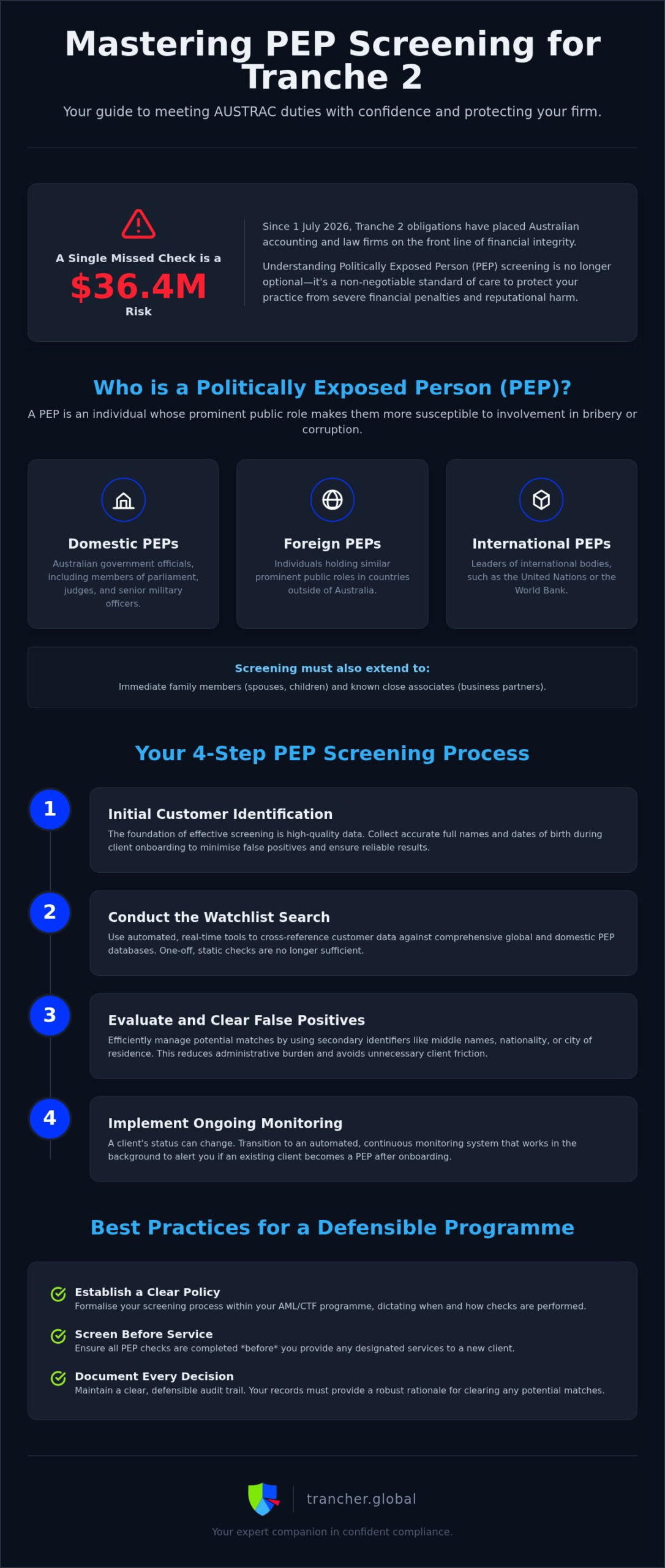
A single missed Politically Exposed Person (PEP) check isn’t just an administrative oversight; it’s a $36.4 million risk to your firm’s reputation and financial stability. Since the 1 July 2026 commencement date, adopting PEP screening best practices has become a necessity for every Australian accounting and law firm. You likely feel the pressure of these Tranche 2 obligations daily, especially when manual background checks stall client onboarding and eat into your billable time. It’s frustrating to see compliance requirements create friction in your professional relationships when you’d rather be focusing on your core expertise.
This guide will help you master the art of screening so you can meet your AUSTRAC duties with absolute confidence and efficiency. We’ll show you how to move beyond tedious manual searches to a sophisticated, automated approach that protects your practice without slowing you down. You will learn how to integrate efficient screening into your existing workflows, ensuring your AML programme is both defensible and supportive of your firm’s growth. We’ll cover everything from identifying domestic PEPs to establishing a continuous monitoring system that works quietly in the background.
Key Takeaways
- Understand the specific definitions of domestic and foreign PEPs to ensure your firm accurately identifies high-risk individuals under the new regulations.
- Implement PEP screening best practices by establishing a clear policy that triggers checks at the right moment during your client intake process.
- Learn to efficiently clear false positives using secondary identifiers like middle names and nationality to reduce administrative burden and client friction.
- Transition to automated ongoing monitoring to ensure your firm remains protected if a client’s status changes after they’ve been onboarded.
- Discover how an end-to-end AML/CTF programme can guarantee your compliance readiness within 30 days while supporting your billable activities.
Understanding PEP Screening Requirements for Tranche 2 Readiness
Since 1 July 2026, the regulatory landscape for Australian professional services has shifted permanently. Accountants, lawyers, and real estate agents are now at the front line of our national financial integrity. A Politically Exposed Person (PEP) is defined as an individual whose prominent public role makes them more susceptible to involvement in bribery or corruption. Under the AML/CTF Act, these individuals are classified as high-risk because their influence can be exploited to launder money or finance terrorism. Implementing PEP screening best practices isn’t just about ticking a box; it’s about protecting your firm from becoming an unwitting conduit for illicit funds. While these requirements might feel heavy at first, they are a manageable part of a defensible AML programme that actually strengthens your internal systems.
Who Exactly is a PEP in 2026?
AUSTRAC identifies three main categories that your firm must recognise. Domestic PEPs include Australian government officials like members of parliament, judges, or senior military officers. Foreign PEPs hold similar roles in other countries, while International Organisation PEPs lead bodies like the United Nations. Your screening must also extend to “close associates” and immediate family members. This includes spouses, children, and even business partners who might benefit from a PEP’s influence. There is often debate about whether someone remains a PEP forever. While some global standards suggest a “once a PEP, always a PEP” rule, the Australian framework allows for a risk-based approach. You’ll need to assess if their former role still carries significant influence today to determine the ongoing level of due diligence required.
Why Screening is Non-Negotiable for SME Firms
The cost of getting this wrong is incredibly steep. As of July 2026, a single contravention can lead to civil penalties of up to A$36.4 million for companies and A$7.28 million for individuals. With the Commonwealth penalty unit now valued at A$364, AUSTRAC has the clear capacity to enforce these rules strictly. Beyond the financial hit, the reputational damage of being linked to a global corruption scandal can be terminal for a boutique firm. Think of compliance as a modern professional standard of care. Just as you maintain professional indemnity insurance, PEP screening best practices act as a shield for your practice. It’s a proactive way to ensure your clients are who they say they are, allowing you to focus on your billable work with total peace of mind and confidence. To build a robust foundation, equipping your team with a comprehensive compliance officer toolkit is one of the most effective steps an SME firm can take.
Step-by-Step: How to Organise an Effective PEP Screening Process
Setting up an effective screening workflow doesn’t need to be an administrative burden. It starts with a clear policy inside your formal AML/CTF programme. This document should dictate that checks occur before you provide any designated services to a new client. By selecting a data provider that covers both global watchlists and specific Australian domestic registers, you ensure your firm’s protection is comprehensive. Every decision must be documented; if an auditor asks why you cleared a specific name, your records must provide a clear, defensible rationale. This methodical approach transforms compliance from a hurdle into a streamlined part of your professional standard of care.
Step 1: Initial Customer Identification
High-quality screening relies entirely on the data you collect at the beginning. You must gather accurate full names and dates of birth during the initial onboarding phase. This precision is your first line of defence against irrelevant “fuzzy” matches that waste your team’s time. For a deeper dive into these standards, review the CDD and KYC Requirements Australia guide. When you maintain high data integrity from the start, the subsequent steps become significantly faster and more reliable.
Step 2: Conducting the Watchlist Search
Once you have clean data, use automated tools to cross-reference names against global PEP databases. Static, one-off checks are no longer sufficient in a fast-moving regulatory environment. Real-time screening is one of the core PEP screening best practices because it captures changes in a client’s status as they happen. If your client has a common name, your system should allow you to filter results by nationality or age to narrow down the field. Automated workflows make it easy to integrate these checks without disrupting your day-to-day billable tasks.
Step 3: Verification and Decision Making
Not every result is a “True Match.” Your team needs a structured process to verify if a hit actually belongs to your client. If a potential match is confirmed, escalate the file to your firm’s AML Compliance Officer for a final review. They will decide whether to proceed with the business relationship or apply enhanced due diligence based on the risk level. Always record the final decision and the evidence used to reach it. This documentation creates an audit-ready trail that proves your firm is acting with due care and steady guidance, ensuring you remain fully compliant with AUSTRAC expectations.
Best Practices for Evaluating Screening Results and Managing False Positives
A false positive occurs when your screening tool flags a person who shares a name with a PEP but isn’t actually that individual. These alerts are common because many names are shared across the globe. Managing these hits effectively is where PEP screening best practices truly matter. To clear a match quickly, you should rely on secondary identifiers. Middle names, nationality, and specific dates of birth are your most reliable tools for sorting the signal from the noise. By adopting a risk-based approach, you ensure your team isn’t over-servicing low-risk matches. This keeps your focus on billable activity while maintaining a high standard of compliance. If you need to ask a client for extra information, keep the conversation warm and professional. Frame it as a standard part of your firm’s commitment to professional standards and national financial security.
The Art of Clearing False Positives
Developing a standard checklist is one of the most effective ways to handle screening results with confidence. Compare your client’s details against the profile’s known associates and previous roles. You can often clear a match by checking public corporate registries or professional networks to see if the person’s career path aligns with the PEP’s history. Once you have cleared a client, maintain a “white-list” within your system. This prevents the same alert from appearing every time you run a periodic check, which saves your staff hours of repetitive work over the long term. It’s a proactive way to keep your workflow moving without compromising on your regulatory duties.
When a Match is Real: Enhanced Due Diligence (EDD)
If a match is confirmed as a “True Match,” your firm must move to Enhanced Due Diligence (EDD). This isn’t a reason to end the business relationship, but it does require a deeper investigation into the client’s financial background. You’ll need to identify both the Source of Wealth, which covers how they built their overall net worth, and the Source of Funds, which identifies where the specific money for the current transaction originated. To help you navigate this complex layer of compliance, you can utilise a structured AML Risk Assessment Tool Australia. This ensures your EDD process is thorough, defensible, and perfectly aligned with AUSTRAC’s expectations for professional service providers in 2026.
Integrating PEP Checks into Your Wider Customer Due Diligence Workflow
PEP screening works best when it’s woven directly into your client intake process rather than treated as a siloed chore. When you make screening a seamless part of your wider Customer Due Diligence (CDD), you ensure that no high-risk individual slips through the cracks during busy periods. This integration also prevents your team from having to jump between different software systems, which saves time and keeps your data consistent. It’s about creating a unified workflow where identity verification, risk assessment, and screening happen in one smooth motion. By training your staff to recognise the significance of PEP status, you move beyond a “tick-the-box” mentality and foster a culture of genuine risk awareness. This proactive stance ensures your firm remains a knowledgeable partner to your clients while upholding the highest professional standards.
The Role of Automation in SME Compliance
For many SME firms, the biggest hurdle to effective compliance is the administrative burden of manual checks. Relying on spreadsheets or manual web searches is not only slow but also highly susceptible to human error. “Compliance fatigue” often sets in when staff are forced to perform repetitive, manual tasks, leading to oversight and increased risk. Automated platforms solve this by running checks instantly and providing clear, actionable results. These tools also handle the heavy lifting of ongoing monitoring. Since a client’s status can change at any time, automation ensures you’re alerted immediately if an existing client becomes a PEP. To see how this fits into your broader obligations, you can review our AML Program Checklist Australia. Adopting these PEP screening best practices through automation allows your team to focus on high-value billable work instead of manual data entry.
Audit Readiness and Record-Keeping
Under Australian law, your firm must maintain comprehensive records of its AML/CTF activities for at least seven years. This isn’t just about keeping a list of names; it’s about being able to prove the “why” behind every decision you’ve made. Your records should include a time-stamped log of every search performed, the results returned, and the rationale used to clear any potential matches. If AUSTRAC ever conducts a review, having a central, organised repository of these logs is essential for a defensible programme. You can find more detail on these requirements in our guide to Audit-Ready Compliance Records. If you’re ready to simplify this process, you can automate your record-keeping to ensure your firm is always prepared for scrutiny without the last-minute stress of gathering paperwork.
How the Trancher Platform Transforms PEP Compliance into a Professional Service
Trancher is built to be the steady hand for Australian firms as they meet the 1 July 2026 deadline. We understand that for a local accounting or legal practice, compliance shouldn’t just be about avoiding a A$36.4 million fine; it should be about operational excellence. Our platform is designed specifically for Australian SME firms, offering a 30-day compliance guarantee that ensures you’re ready for AUSTRAC’s scrutiny without the typical stress of a system overhaul. By automating PEP screening best practices, Trancher removes the friction from your onboarding process, allowing you to focus on client relationships while we handle the regulatory heavy lifting. It’s a solution that respects your time and your professional reputation.
From Administrative Burden to Billable Asset
One of the most significant shifts Trancher offers is the ability to track compliance activity for client billing. Many firms lose hundreds of billable hours to manual background checks and data entry every year. Our Compliance ROI Tracking Software provides clear reporting on the time spent on due diligence, identifying recoverable hours that were previously hidden. This transparency allows you to transition toward offering “Compliance Advisory” as a distinct, high-value service. Instead of seeing these obligations as a hurdle, you can frame them as a professional standard of care that adds tangible value to your client engagements, turning a regulatory requirement into a new revenue stream.
Your Expert Companion for Tranche 2
Navigating Tranche 2 requires more than just software; it requires a partner who understands the local landscape. Trancher provides local Australian expert support, ensuring you’re never left guessing about how to apply PEP screening best practices to a complex client scenario. Our end-to-end automated workflow is simple to implement and integrates seamlessly with your existing systems, making the transition to full compliance feel like a natural evolution of your practice. We invite you to start our 3-month trial today to get ahead of the 1 July 2026 commencement date with total confidence and zero risk. Taking this first step ensures your firm is protected, profitable, and perfectly prepared for the future of professional services in Australia.
Secure Your Practice for a Compliant Future
Adopting PEP screening best practices ensures your firm remains a trusted partner in Australia’s financial landscape. By moving away from manual checks and embracing automated workflows, you protect your practice from the significant risks of non-compliance while reclaiming valuable billable hours. Effective screening is an ongoing commitment; it’s about staying vigilant as client statuses change and ensuring your records are always ready for an AUSTRAC review. You’ve already done the hard work of building a reputable firm, and we’re here to help you keep it that way.
You don’t have to navigate these complex Tranche 2 requirements alone. We act as your steady guide, providing the tools and local expert support you need to thrive. With our guarantee of AML/CTF compliance within 30 days and audit-ready documentation, you can transition to these new standards with total ease. Start your complimentary 3-month Trancher trial today and receive a 20% discount on your first annual subscription. It’s time to transform your regulatory obligations into a strategic advantage for your firm’s growth.
Frequently Asked Questions
What is the definition of a Politically Exposed Person (PEP) in Australia?
A PEP is an individual who holds a prominent public position or function, making them potentially more susceptible to involvement in bribery or corruption. In the Australian context, this includes domestic government officials, foreign leaders, and senior figures in international organisations. The definition also extends to their immediate family members and close associates. Identifying these individuals is a core pillar of PEP screening best practices to ensure your firm remains compliant with AUSTRAC’s 2026 requirements.
Does Tranche 2 require me to screen every existing client for PEP status?
Yes, you must assess all clients who receive “designated services” under the expanded regulations. Since the 1 July 2026 deadline, you need a risk-based approach to screen your current database. This ensures no high-risk individuals were missed during previous onboarding. Automated tools can help process your existing client list quickly, ensuring your firm meets its new obligations without disrupting daily billable activities or causing unnecessary friction with your long-term professional relationships.
How often should my firm perform ongoing PEP monitoring?
Monitoring should be continuous rather than a one-off event. Since a client’s political status can change overnight, static annual checks often leave firms exposed to regulatory risk between reviews. Automated systems provide real-time alerts if a client’s profile matches a new entry on global or domestic watchlists. This proactive approach is much more efficient than manual reviews and provides a defensible audit trail that demonstrates your firm’s ongoing commitment to steady, reliable compliance.
What is the difference between a PEP check and a Sanctions search?
A PEP check identifies individuals with political influence, while a Sanctions search looks for people or entities legally prohibited from financial activity. PEPs aren’t necessarily criminals; they simply represent a higher risk profile that requires enhanced due diligence. In contrast, dealing with a sanctioned individual is often a direct criminal offence. Both checks are vital components of PEP screening best practices and should be integrated into a single, seamless verification workflow to protect your firm’s reputation.
Can I perform PEP screening manually using search engines?
While possible, manual searches are highly discouraged due to the risk of human error and compliance fatigue. Search engines don’t provide the structured data or the audit-ready logs required by AUSTRAC to prove you’ve met your obligations. Manual checks are also incredibly time-consuming and difficult to scale across a growing firm. Professional platforms automate this process, cross-referencing global databases instantly and maintaining the seven-year record-keeping trail mandated under Australian law.
What should I do if a long-term client is identified as a PEP?
You don’t need to end the relationship, but you must apply Enhanced Due Diligence (EDD). This involves verifying their Source of Wealth and Source of Funds to ensure their assets aren’t derived from corruption. You should also escalate the match to your firm’s AML Compliance Officer for formal approval. Documenting this process carefully shows you’re acting as a strategic guide, managing risk while continuing to provide professional services to high-profile clients with confidence. Referencing a dedicated compliance officer toolkit can help your team follow a consistent, defensible process when handling these complex scenarios.
Are family members of politicians always considered PEPs?
Yes, immediate family members are included in the PEP definition because they can be used to hide or move illicit funds. This includes spouses, children, parents, and siblings of the primary PEP. Close business associates are also covered under these rules. Screening these related parties is essential for a complete risk assessment. It ensures your firm isn’t inadvertently facilitating financial crime through a client’s personal or professional network, maintaining your firm’s high professional standards.
How long must I keep records of my PEP screening results?
You are legally required to keep all AML/CTF records for at least seven years in Australia. This includes the date of the search, the specific databases checked, the results found, and the rationale for any decisions made. Having these records stored in a structured, digital format is essential for audit readiness. If AUSTRAC requests a review of your programme, being able to produce a time-stamped log instantly saves your team from significant administrative stress and costs.