

What if the most daunting administrative hurdle of the 2026 Tranche 2 reforms was actually your firm’s next untapped revenue stream? Since 1 July 2026, Australian accountants have faced a steep learning curve with updated AUSTRAC forms and strict three-day deadlines for reporting money laundering suspicions. It’s understandable if you feel the weight of these obligations, especially when the distinction between a client’s unusual transaction and a reportable suspicious matter feels frustratingly thin. Implementing the right suspicious matter reporting software Australia doesn’t just tick a regulatory box; it transforms a high-stakes manual task into a seamless, professional workflow.
We recognise that the fear of hefty penalties for missing red flags is a significant pressure on your practice. This guide will show you how to automate AUSTRAC suspicious matter reporting to protect your firm and turn compliance into a billable professional service. We will explore the nuances of the 2026 reporting landscape, help you distinguish red flags with absolute confidence, and demonstrate how to integrate automation that removes friction from your daily operations while securing your practice’s future.
Key Takeaways
- Understand how the July 2026 Tranche 2 commencement affects your firm’s reporting obligations and why manual processes are no longer sustainable for modern practices.
- Learn to identify common accounting red flags, such as rapid asset movements and offshore transfers, to strengthen your firm’s internal risk assessment methodology.
- Discover how implementing the right suspicious matter reporting software Australia reduces administrative friction and ensures you meet strict AUSTRAC lodgement deadlines with confidence.
- See how to transform the compliance burden into a profitable advisory stream by accurately tracking billable hours for your AML/CTF activities.
- Explore how a specialised platform can get your practice audit-ready within 30 days, providing the steady guidance needed to navigate Australia’s evolving regulatory landscape.
Understanding Suspicious Matter Reporting (SMR) under Tranche 2
An SMR is a formal report submitted to the Australian Transaction Reports and Analysis Centre (AUSTRAC) when a practitioner suspects a transaction or client interaction is linked to criminal activity. For years, this was largely the domain of banks and casinos. However, the 1 July 2026 commencement of the Tranche 2 reforms changed the landscape for SME accounting practices across Australia. You’re no longer just a tax agent or business advisor; you’re a critical gatekeeper in the national effort to combat financial crime. This shift requires a proactive approach to monitoring client behaviour that goes beyond traditional tax compliance.
The “Reasonable Grounds” test is the yardstick AUSTRAC uses to evaluate your professional judgement. It doesn’t require absolute certainty that a crime has occurred. Instead, it asks whether a person with your expertise, given the same information, would also form a suspicion. Failing to meet this standard can lead to severe civil penalties, similar to recent enforcement actions where firms faced fines of A$45,000 or more for compliance failures. Beyond the financial cost, the reputational damage can be permanent, as client trust is the foundation of any successful accounting practice.
The Legal Threshold for Suspicion
Distinguishing between “unusual” and “suspicious” behaviour is a core challenge for many practitioners. An unusual transaction is one that deviates from a client’s normal pattern, such as a sudden large purchase that doesn’t align with their known business model. A suspicious matter arises when that deviation suggests a link to money laundering or tax evasion. Under the AML/CTF Act 2006, you must document the specific basis of your suspicion. Relying on a gut feeling is no longer sufficient for an audit-ready compliance programme. This is why many firms now implement suspicious matter reporting software Australia to ensure every decision is backed by a clear, defensible audit trail that satisfies regulatory scrutiny.
SMR Timelines: When Must You Report?
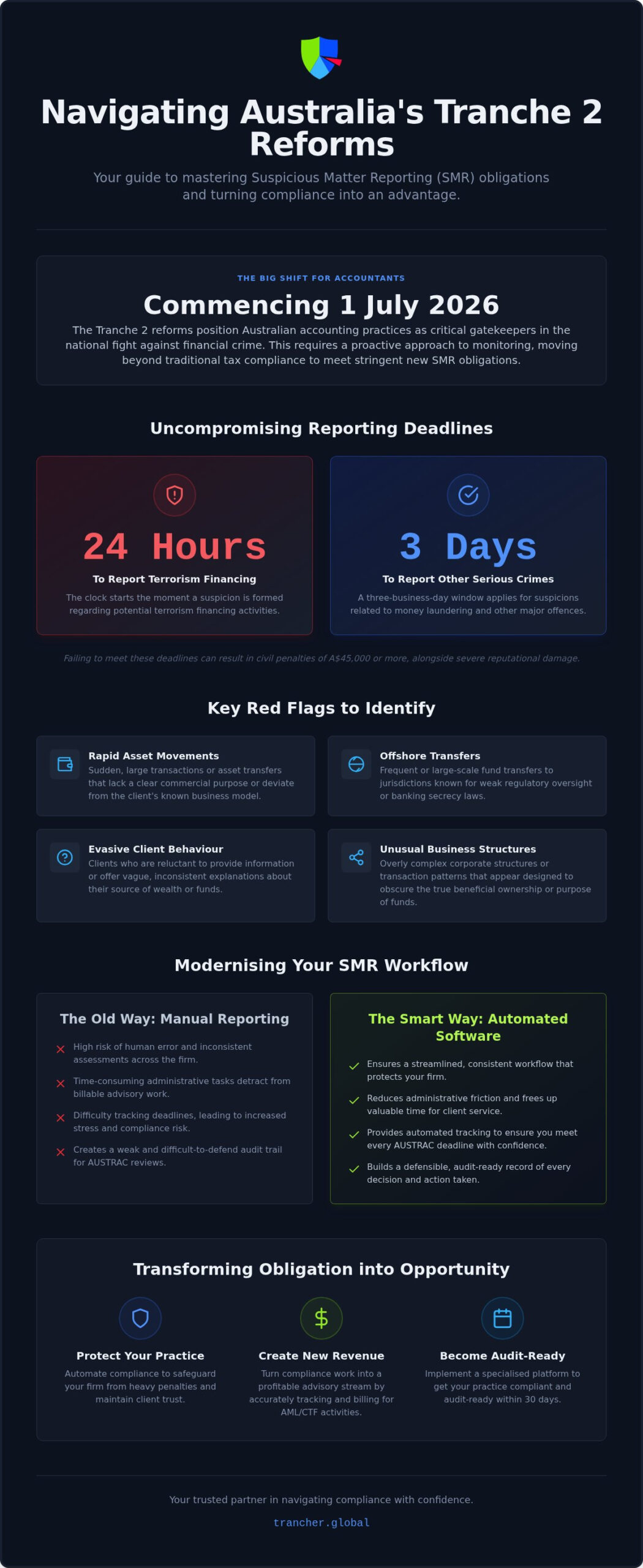
The clock starts ticking the moment you form a suspicion, and the deadlines are uncompromising. If you suspect a matter relates to terrorism financing, you must report it within 24 hours. For suspicions involving money laundering or other serious crimes, the window is three business days. These tight timeframes leave very little room for administrative delays or manual data entry errors. Utilising suspicious matter reporting software Australia helps your firm track these critical windows automatically. Automation ensures your team stays ahead of the clock, providing the steady guidance needed to maintain compliance without sacrificing your firm’s productivity or billable hours.
AML CTF Risk Assessment Methodology: Identifying Red Flags
Establishing a robust AML CTF risk assessment methodology is the cornerstone of a secure Australian accounting practice. It moves your firm from a reactive stance to a proactive one, ensuring you can identify risks before they escalate into regulatory failures. A well-designed methodology evaluates the nature of the “Designated Services” you provide, such as managing client funds, acting as a nominee shareholder, or assisting with real estate transfers. By adopting an “Expert Companion” approach, you act as a strategic guide for your clients, helping them maintain their own financial integrity while safeguarding your practice’s reputation and operational health.
Your methodology should prioritise the identification of unusual activity, such as rapid asset movements that lack a clear commercial purpose or frequent offshore transfers to jurisdictions with weak regulatory oversight. These patterns often serve as the first sign that a client’s profile no longer matches their actual financial behaviour. Implementing suspicious matter reporting software Australia allows you to standardise these assessments across your entire client base, ensuring no red flag goes unnoticed due to manual oversight or human error.
Client Behavioural Indicators
Identifying clients who are evasive about their source of wealth is a critical first step in risk mitigation. When a client provides vague, inconsistent, or overly complex explanations regarding where their capital originated, it warrants closer inspection. You should also be alert to “structuring,” where large sums of physical currency are broken down into smaller transactions to stay below the A$10,000 threshold transaction reporting limit. In the context of accounting designated services, red flags are specific indicators or patterns of activity that suggest a transaction may be linked to money laundering, terrorism financing, or tax evasion. Modern suspicious matter reporting software Australia can automatically flag these behavioural anomalies, providing you with the data needed to make an informed professional judgement.
High-Risk Jurisdictions and Entities
Managing clients with links to Politically Exposed Persons (PEPs) requires a higher level of scrutiny due to the increased risk of bribery, corruption, or the misuse of public funds. Your SMR process should be deeply informed by your CDD and KYC requirements Australia, ensuring you have a transparent view of the beneficial owners behind every corporate entity or trust. Ongoing monitoring is essential for spotting long-term suspicious patterns that may not be obvious during initial onboarding. For a steady hand in navigating these complex requirements, you might consider how to optimise your compliance systems to support both practice safety and billable growth.
Manual AUSTRAC Reporting vs. Automated Compliance Software
The transition from manual spreadsheets to dedicated compliance technology is no longer a luxury for Australian accounting firms; it’s a strategic necessity for operational survival. Manual reporting carries hidden costs that extend far beyond the hours spent on data entry. The emotional toll of second-guessing whether a report was filed correctly, combined with the administrative burden of tracking multiple deadlines, can stifle your practice’s growth. By adopting suspicious matter reporting software Australia, you move your team from a reactive, high-stress reporting cycle to a proactive monitoring environment that actually supports your professional judgement. This evolution allows you to view compliance as a manageable part of your service offering rather than a looming threat.
The Pitfalls of Manual Data Entry
Relying on manual data entry for AUSTRAC filings is inherently prone to error. Common mistakes, such as incorrect entity details or inconsistent transaction descriptions, often trigger time-consuming enquiries from the regulator. Maintaining audit-ready compliance records becomes nearly impossible when information is siloed in static spreadsheets or paper files. Perhaps most critically, manual processes frequently fail the strict 24-hour reporting deadline for high-risk matters like terrorism financing. If a suspicion is formed on a Friday afternoon, a manual system often can’t guarantee a lodgement before the window closes. This gap leaves your firm exposed to civil penalties, such as the A$45,000 fines recently proposed for similar reporting contraventions in the sector.
Efficiency Gains through Automation
Automation transforms the reporting workflow by removing friction at every stage of the process. Effective suspicious matter reporting software Australia allows you to pre-fill SMR data directly from your existing KYC/CDD records, ensuring consistency and saving your staff hours of redundant work. The software provides guided prompts that help your team document their “Reasonable Grounds” clearly and concisely, meeting the high standard AUSTRAC expects. This creates a robust, defensible audit trail for every decision your firm makes. Instead of fearing a regulatory review, you can face it with absolute confidence, knowing that your records are structured, complete, and readily accessible. This shift doesn’t just protect your practice; it allows you to reallocate senior staff time to high-value advisory work, turning a compliance obligation into a driver for firm efficiency.
Key Features of Effective SMR Software for Australian Firms
Selecting the right suspicious matter reporting software Australia involves looking beyond basic form filling to find a solution that integrates deeply with your firm’s existing workflows. A premier system offers direct integration with AUSTRAC’s reporting portal, allowing for seamless lodgement without the need to navigate complex government websites manually. This connectivity ensures that once a suspicion is formed, the technical hurdle of submission is virtually non-existent. Effective software also utilises automated “Red Flag” alerts, which scan client activity against specific risk profiles to highlight anomalies that might otherwise be missed during a standard busy season.
Security is equally paramount when handling sensitive SMR data. Robust software provides role-based access controls, ensuring that only authorised compliance officers or partners can view or edit suspicious matter information. This restriction is vital for maintaining the confidentiality of the reporting process. Additionally, integrated billing support allows your practice to track every minute spent on these critical compliance activities. By capturing this data, you can move away from viewing AML/CTF obligations as a sunk cost and start treating them as a legitimate, billable professional service.
Workflow and Integration
The most effective systems connect your reporting triggers directly to your ongoing risk monitoring software. This creates a unified ecosystem where a change in a client’s risk profile can immediately prompt an SMR evaluation if necessary. To protect your firm, “Tipping Off” protections must be baked into the software workflow, preventing unauthorised staff from accidentally disclosing the existence of a report to a client. Having access to local Australian support and onboarding is also a significant advantage, as it ensures your team has a steady hand to guide them through technical issues or specific regulatory nuances unique to the Australian market.
Revenue and ROI Tracking
Many practitioners overlook the fact that compliance activity is often a recoverable expense when managed correctly. High-quality suspicious matter reporting software Australia helps you identify “recoverable compliance activity” by logging the time spent on risk assessments and report drafting. You can then use compliance ROI tracking software to justify your technology spend to the partnership. SMR software generates a formal ROI report by aggregating time-tracking data against your firm’s billable rates to demonstrate the clear financial viability of your compliance services. To see how these features can protect and grow your practice, you can optimise your firm’s reporting efficiency with a platform built specifically for Australian accountants.
Trancher: Streamlining SMRs and Enhancing Practice Profitability
Trancher is more than just a tool; it’s a strategic partner designed to help your firm navigate the complexities of the 2026 regulatory environment. By implementing our suspicious matter reporting software Australia, you move beyond the stress of looming deadlines and into a position of operational confidence. Designed by AML specialist Aaron Soh, the platform provides guided SMR prompts that are built specifically for Australian accounting workflows. This ensures your team isn’t just filling out forms, but making informed, defensible professional judgements. We’re so confident in our ability to support your firm that we offer a 30-day compliance-ready guarantee, ensuring your practice is fully prepared for AUSTRAC’s Tranche 2 requirements.
Navigating complex reporting decisions doesn’t have to be a solitary task. Trancher provides expert support and guidance to help you evaluate high-risk client matters with clarity. This “expert companion” approach ensures you have a steady hand to rely on when distinguishing between unusual activity and a reportable suspicion. By leveraging our deep industry expertise, you can focus on your core business while we ensure your compliance framework is robust, transparent, and fully aligned with national standards.
Turning Compliance into a Profit Centre
One of the most significant advantages of our platform is the ability to track billable hours for all AML/CTF activities. Instead of viewing compliance as a sunk cost, you can accurately log the time spent on risk assessments, ongoing monitoring, and SMR drafting. This data allows you to communicate AML fees to your clients with confidence, framing them as a necessary part of a premium, professional service. Trancher automates the creation of formal ROI reports by syncing your team’s logged compliance hours with practice billable rates, providing a clear view of the profitability of your AML services. This transformation allows you to turn regulatory data into valuable client advisory insights, strengthening your client relationships and your bottom line.
Getting Started with the Trancher 3-Month Trial
We invite you to experience the benefits of automated compliance first-hand with our complimentary 3-month trial period. During this pilot, you’ll have full access to our automated reporting features, integrated billing support, and expert guidance. It’s the perfect opportunity to see how suspicious matter reporting software Australia can remove friction from your practice. For firms that choose to continue after the initial trial, we offer a 20% discount to support your long-term success. If you’re ready to protect your practice and professionalise your compliance workflow, you can start a conversation with our compliance specialists today.
Secure Your Practice for the 2026 Tranche 2 Era
The 1 July 2026 reforms have fundamentally shifted the reporting landscape for Australian accountants. Moving away from manual spreadsheets isn’t just about avoiding penalties; it’s about building a practice that is resilient and profitable. By implementing dedicated suspicious matter reporting software Australia, you ensure your firm meets strict AUSTRAC deadlines while transforming mandatory compliance into a high-value advisory stream. This transition allows your team to focus on strategic growth rather than administrative friction.
Trancher was designed specifically for Australian accounting firms by specialist Aaron Soh and the team. With our 30-day AML/CTF compliance guarantee and local expert support, you can navigate these changes with absolute confidence. Start your complimentary 3-month Trancher trial and secure your 20% discount to begin professionalising your reporting workflow today.
You don’t have to navigate this transition alone. With the right tools and a steady partner, you can turn regulatory obligations into a strategic advantage for your firm’s future.
Frequently Asked Questions
What is an SMR in the Australian accounting context?
An SMR is a Suspicious Matter Report, a mandatory filing submitted to AUSTRAC when an accounting professional suspects a transaction or client interaction relates to criminal activity. This includes suspicions of money laundering, terrorism financing, or tax evasion. Since the Tranche 2 commencement on 1 July 2026, accountants must lodge these reports whenever “reasonable grounds” exist, ensuring the integrity of the financial system is maintained through diligent professional oversight.
How much time do I have to report a suspicious matter to AUSTRAC?
The reporting deadline depends on the nature of your suspicion. If you suspect a matter relates to terrorism financing, you must lodge the report within 24 hours of forming that suspicion. For all other matters, including money laundering or tax evasion, the deadline is three business days. Using suspicious matter reporting software Australia ensures your firm tracks these strict windows automatically, preventing costly administrative delays or missed lodgement opportunities.
Can I be penalised if I report a matter that turns out not to be illegal?
No, the AML/CTF Act provides legal protection for reporting entities that lodge an SMR in good faith. You’re protected from civil or criminal action for providing information to AUSTRAC, even if the underlying activity is eventually found to be legal. This protection is designed to encourage practitioners to exercise their professional judgement without fear of litigation, provided they’ve documented their “reasonable grounds” clearly within their compliance system.
What is ‘tipping off’ and how does software help prevent it?
“Tipping off” is a criminal offence that occurs when a client is informed that an SMR has been, or may be, filed regarding their activity. This can jeopardise ongoing law enforcement investigations. Dedicated software prevents this by utilising role-based access controls, restricting SMR data to authorised compliance officers only. It also builds internal workflow alerts that remind staff of their confidentiality obligations, ensuring sensitive information remains secure and protected within the firm.
Does SMR software integrate with my existing practice management tools?
Yes, modern suspicious matter reporting software Australia is designed to integrate seamlessly with standard accounting practice management and KYC tools. These integrations allow for the automatic pre-filling of client data, reducing the need for manual entry and lowering the risk of transcription errors. By syncing with your existing ecosystem, the software removes friction from the reporting process, allowing your team to maintain compliance without disrupting their established daily workflows.
Is it possible to bill clients for the time spent on AML compliance?
Yes, many Australian firms now treat AML/CTF compliance as a billable professional service rather than an overhead cost. By using platforms like Trancher to track the exact time spent on risk assessments and reporting, you can provide clients with transparent, data-backed invoices for these essential activities. This approach allows you to recover compliance costs and demonstrates the value of the rigorous due diligence you perform to protect their business interests.
What happens if I fail to lodge an SMR after July 2026?
Failing to lodge a required SMR can result in severe civil penalties and significant reputational damage. AUSTRAC has the power to commence civil penalty proceedings, which have recently led to proposed fines of A$45,000 for specific reporting contraventions in the sector. Beyond financial costs, a failure to report can lead to increased regulatory scrutiny and a loss of client trust, making a robust, automated reporting system essential for every SME practice.
How does Trancher help with the AUSTRAC annual compliance report?
Trancher simplifies the annual compliance report by maintaining a continuous, audit-ready record of all your AML/CTF activities throughout the year. The platform aggregates data on your risk assessments, SMR filings, and staff training into a single, organised dashboard. When the reporting period arrives, you have all the necessary statistics and evidence at your fingertips. This reduces the end-of-year administrative burden and ensures your submission to AUSTRAC is accurate and complete.