

What if the looming 1 July 2026 AUSTRAC deadline wasn’t just another administrative hurdle, but actually the key to unlocking a new, high-margin revenue stream for your practice? Most Australian accountants feel the weight of these upcoming reforms, fearing that compliance will become a permanent, non-billable drain on their resources. It’s a valid concern, especially when manual processes are unlikely to survive a rigorous audit. However, by adopting scalable AML compliance solutions, you can turn this regulatory necessity into a streamlined operational advantage that supports your firm’s growth.
We’re here to help you navigate this transition with confidence and ease. You’ll discover how to implement systems that automate KYC and CDD tasks, ensuring your documentation is always audit-ready without the need for a full-time compliance officer. We will also outline how to structure these activities as billable services, allowing you to recover costs and improve your firm’s financial health. From understanding the 2026 registration requirements to building a future-proof roadmap, this guide provides the practical insights you need to grow your practice securely and profitably.
Key Takeaways
- Understand why manual spreadsheets fail to meet the permanent operational demands of the new Tranche 2 regulatory environment.
- Discover how scalable AML compliance solutions automate the identification of designated services to ensure your practice never misses a reporting obligation.
- Learn to bridge the ROI gap by replacing high-cost administrative labour with standardised, billable compliance workflows that support firm growth.
- Access a practical 30-day roadmap to audit your current service offerings and implement an end-to-end automation platform.
- Achieve audit-ready status with centralised digital record-keeping that allows for instant retrieval during any AUSTRAC review.
Why Scalability is the Missing Link in Your AML/CTF Programme
For many accounting firms, the first instinct when facing new regulation is to treat it as a checkbox exercise. However, the transition to Tranche 2 represents a fundamental shift in how your practice must operate. Compliance is no longer a one-off task completed during onboarding; it’s a permanent, dynamic requirement that must run in the background of every client engagement. Without scalable AML compliance solutions, your firm risks being swallowed by administrative debt as your client base grows. A system that works for ten clients will often buckle under the weight of fifty, leading to inconsistent risk monitoring and potential gaps that an auditor will eventually find.
True scalability is about decoupling your firm’s growth from your administrative headcount. If every new client requires a linear increase in staff hours just to manage Anti-Money Laundering (AML) checks, your profit margins will inevitably shrink. Beyond daily operations, scalability directly impacts your firm’s valuation. A practice where compliance knowledge lives solely in a partner’s memory or a scattered collection of files is difficult to scale and even harder to sell. By embedding a robust “compliance operating system,” you ensure the firm’s integrity remains intact regardless of who is managing the desk.
The 1 July 2026 Deadline: Why “Doing it Later” Won’t Work
The 1 July 2026 commencement date is a hard line in the sand for the accounting profession. AUSTRAC has made it clear that they expect functional, tested systems to be operational from day one. You can’t simply promise to have a plan in place; you need to demonstrate that your risk assessments and reporting triggers are already active. Rushing to implement a manual, non-scalable system at the last minute often leads to “compliance debt,” where you spend the following years fixing errors made during a panicked setup. Starting now allows you to refine your processes while the stakes are still manageable.
Moving Beyond the “Manual Spreadsheet” Trap
Spreadsheets are the enemy of an audit-ready firm. They are static, prone to human error, and suffer from “compliance fatigue” where busy staff might skip a row or forget a follow-up. A manual tracker doesn’t alert you when a client’s risk profile changes or when a document expires. Transitioning to a dynamic system requires a focus on AML compliance workflow integration. This ensures that scalable AML compliance solutions aren’t just separate tools, but integrated parts of your existing client journey, turning a manual burden into an automated, reliable, and billable professional service.
What Defines Truly Scalable AML Compliance Solutions?
Scalability in a regulatory context isn’t just about handling a higher volume of data; it’s about maintaining absolute precision while your practice expands. When we talk about scalable AML compliance solutions, we’re describing a system that removes the friction from your daily operations. A truly effective solution automates the identification of “designated services” at the point of engagement. This ensures that no client or project accidentally bypasses your AML/CTF obligations, which is a common risk when firms rely on staff memory or manual checklists. By embedding these checks into your standard onboarding, compliance becomes a background process rather than a constant interruption.
Centralisation is another cornerstone of scalability. AUSTRAC requires firms to maintain records for seven years, and a scalable system moves away from fragmented server folders or physical files. Instead, it creates a centralised digital repository where every risk assessment, identity check, and activity log is instantly retrievable. This level of organisation is invaluable during an AUSTRAC audit, as it allows you to demonstrate your compliance history in minutes rather than days. If you’re looking to modernise your approach, exploring an integrated compliance platform can help you consolidate these disparate tasks into a single, manageable workflow.
Finally, your framework must be adaptable. A simple individual tax return shouldn’t be subjected to the same depth of scrutiny as a complex discretionary trust with multiple offshore beneficiaries. Scalable solutions utilise tiered risk assessment frameworks that adapt based on client complexity. They also integrate directly with your existing practice management software, which eliminates the double-handling of data and keeps your client records synchronised across all platforms.
Automated KYC and CDD: The Engine of Growth
Automated identity verification is what allows a practice to grow without adding administrative headcount. Manual document collection is a significant bottleneck that often frustrates both staff and clients. By using digital verification tools, you can confirm identities in seconds while simultaneously screening for Politically Exposed Persons (PEPs) and global sanctions. This ensures your firm meets the rigorous CDD and KYC requirements Australia has set for the 2026 deadline, all while providing a seamless professional experience for your clients.
Ongoing Monitoring Without Incremental Effort
Compliance doesn’t end once the client is onboarded. A scalable system provides ongoing monitoring that alerts you to changes in a client’s risk profile without requiring manual checks. These systems use automated triggers for Suspicious Matter Reporting (SMR), ensuring that unusual activity is flagged for your review immediately. By maintaining automated activity logs, you create a continuous audit trail that proves your firm is actively managing its risks, providing you with the peace of mind that your practice remains fully protected.
Comparing Manual vs. Automated Scalability: The ROI Gap
Choosing between manual processes and scalable AML compliance solutions often comes down to a simple calculation of your most valuable resource: time. While a spreadsheet might appear cost-effective initially, the hidden expenses of manual compliance are staggering. When senior partners spend billable hours chasing identity documents or cross-referencing PEP lists, the firm loses significant revenue. Beyond the direct financial impact, manual systems often lead to staff burnout as administrative burdens pile up, particularly during peak tax periods. By contrast, automated software offers a predictable, flat-fee model that remains stable even as your client volume doubles or triples.
Utilising compliance ROI tracking software allows your firm to monitor the efficiency of your internal processes and successfully transform regulatory obligations into profitable, billable assets. This shift allows you to move away from the rising costs of administrative labour and toward a more efficient, technology-driven overhead. Instead of viewing compliance as a drain on your bottom line, you can begin to see it as a standardised component of your service delivery that scales without increasing your headcount.
Interestingly, the data gathered during a scalable risk assessment often reveals untapped advisory opportunities. When you deeply understand a client’s corporate structure and risk profile, you’re better positioned to offer strategic tax planning or restructuring advice. This transforms the compliance process from a defensive necessity into a proactive business development tool. By viewing every risk re-assessment as a chance to add value, you turn a regulatory requirement into a catalyst for deeper client engagement.
Transforming Compliance into a Billable Service
You can easily justify client billing by providing clear evidence of the rigorous compliance activity performed on their behalf. For high-risk clients, AML advisory can be structured as a premium service that provides them with the same protection and peace of mind you enjoy. This strategy is essential for AML CTF compliance costs reduction, as it ensures your resources are allocated toward activities that generate value rather than just absorbing overhead.
Reducing the Risk of Human Error
Manual systems are fragile; they often collapse during periods of rapid growth or staff turnover when institutional knowledge walks out the door. A scalable culture relies on standardised digital workflows that ensure every team member follows the same high standard. This consistency protects your firm’s reputation and creates a professional, reliable onboarding experience that builds long-term client trust. By removing the reliance on memory, you ensure your practice remains audit-ready regardless of internal changes.
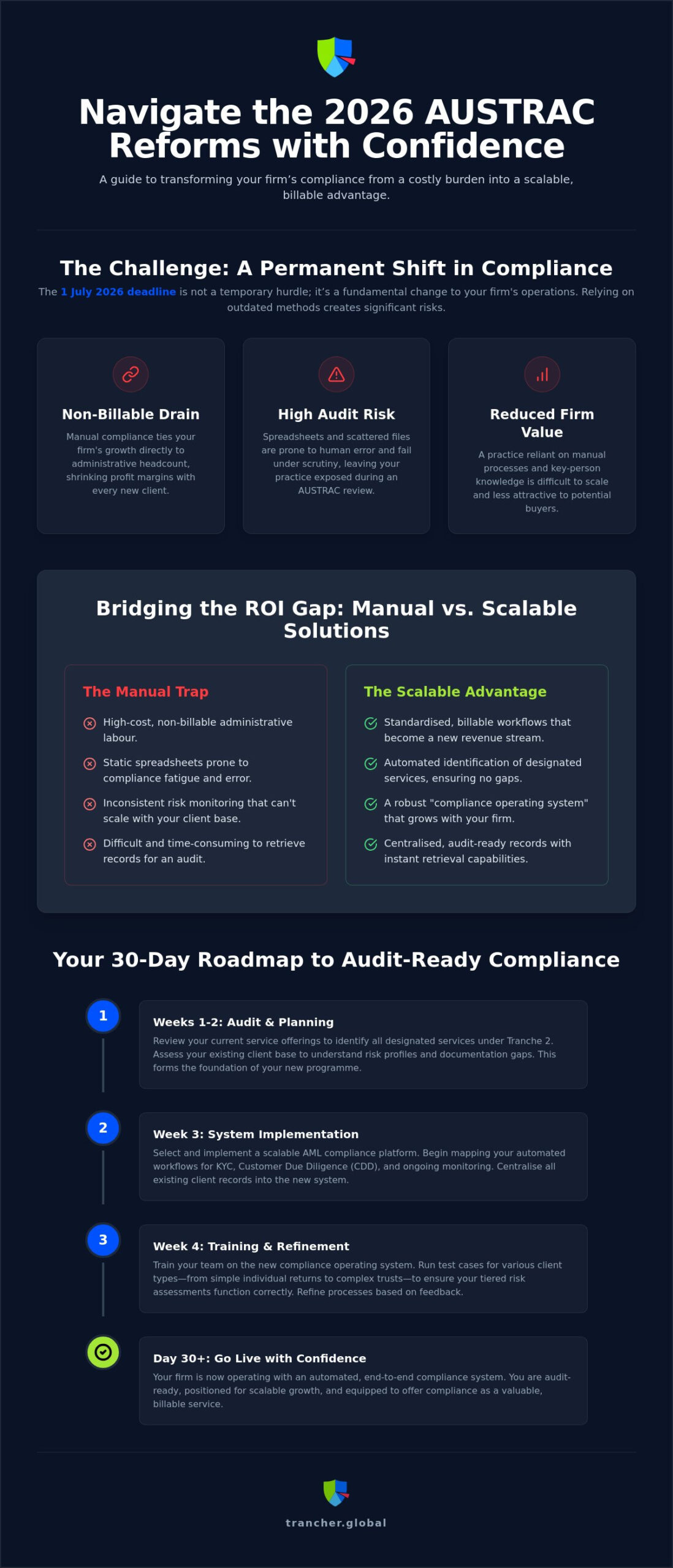
Implementing a Scalable System: Your 30-Day Roadmap
Transitioning your firm to a compliant state doesn’t have to be a multi-year project that drains your internal resources. While some consultants suggest lengthy transition periods, a focused 30-day roadmap allows SME practices to move from uncertainty to absolute audit-readiness. This structured approach ensures that scalable AML compliance solutions are embedded into your firm’s DNA without disrupting your existing client workflows. By breaking the process into manageable weekly milestones, you can transform your regulatory obligations into a standardised professional service with minimal friction.
- Step 1: Audit your current “designated services”. Begin by establishing a baseline of which services you provide that fall under the new regulations, such as business structural advice or certain tax planning activities.
- Step 2: Select an end-to-end platform. Avoid fragmented tools that require manual data transfers. Choose a solution that manages everything from onboarding to ongoing reporting in one place.
- Step 3: Customise your framework. Your AML/CTF Program must reflect your firm’s specific risk profile rather than a generic template. Tailor your risk appetite and red-flag triggers to suit your typical client base.
- Step 4: Role-based staff training. Ensure firm-wide adoption by providing training modules specific to each team member’s responsibilities, from admin support to senior partners.
- Step 5: Go live and track ROI. Switch on your automated workflows and begin tracking the time saved and the compliance fees generated to see immediate financial benefits.
Choosing the Right Tech Stack
Selecting a vendor is a strategic decision that affects your firm’s long-term stability. You should prioritise partners that offer local Australian support and demonstrate a deep alignment with AUSTRAC’s specific expectations for the accounting sector. For many SME practices, the most reassuring feature is a 30-day readiness guarantee, which ensures your systems are fully operational and your documentation is audit-ready from the moment you go live. If you are ready to start this journey, you can book a readiness assessment to see how an integrated platform fits your specific needs.
Onboarding Your Team and Clients
Success relies on clear communication. When introducing new compliance standards to your existing client base, it’s helpful to position these changes as a commitment to their security and the integrity of the financial system. Using automated templates to explain AML fees and obligations helps standardise this conversation, making it a routine part of your professional engagement. Internally, setting up a centralised “Compliance Centre” provides your team with a single source of truth, ensuring that managing your scalable AML compliance solutions remains a simple, high-level oversight task rather than a daily administrative burden.
Trancher: The Scalable Compliance Partner for Australian Accountants
Trancher isn’t just a software tool; it’s a strategic partner designed to help Australian accounting firms navigate the complexities of the 2026 regulatory shift. We understand that SME practices face unique challenges, which is why we’ve built a platform that simplifies end-to-end AML/CTF program management. While other systems might offer fragmented features, our scalable AML compliance solutions consolidate everything from identity verification to ongoing risk monitoring into a single, intuitive dashboard. This ensures your firm remains audit-ready without requiring your partners to become full-time compliance officers.
We prioritise your firm’s financial health as much as its regulatory standing. Our platform includes built-in tools to track recoverable compliance activity, allowing you to monitor ROI in real time. By identifying precisely how much time is spent on due diligence, you can confidently bill for these professional services. To ensure your transition is seamless, we provide local expert support and a 30-day guarantee that your firm will be AUSTRAC-ready before the deadline, removing the administrative stress that often accompanies major operational changes.
Built by Compliance Specialists, for Accountants
Trancher was founded on deep industry expertise, led by Aaron Soh’s commitment to protecting the Australian accounting sector from financial crime. We believe that world-class compliance should be accessible to firms of all sizes. That’s why we offer a complimentary 3-month trial for eligible firms, giving you the space to experience our scalable AML compliance solutions without an immediate financial commitment. For firms that choose to transition from the trial to a full subscription, we also provide a 20% discount to support your long-term growth and stability.
Ready to Secure Your Firm’s Future?
Starting your journey toward compliance doesn’t need to be daunting. With our structured workflows and expert guidance, you can turn a regulatory burden into a sophisticated professional service that adds value to your client relationships. You’ll gain the peace of mind that comes from knowing your documentation is robust and your systems are future-proofed. Don’t wait for the 2026 deadline to force your hand. Start your complimentary 3-month Trancher trial today and see how easy it is to protect and scale your practice.
Leading Your Practice into a Compliant and Profitable Future
The shift toward Tranche 2 compliance doesn’t have to be a source of stress or a drain on your firm’s resources. By moving away from fragile manual systems and adopting scalable AML compliance solutions, you’re choosing a path of operational ease and professional growth. We’ve explored how automation protects your firm’s valuation, ensures audit-readiness, and turns a regulatory burden into a transparent, billable service. This transition is your opportunity to refine your internal systems while strengthening client trust.
Trancher is here to act as your strategic guide through this change. With our 30-Day AML/CTF Compliance Guarantee and local Australian expert support, you’ll have the steady hand you need to meet the 1 July 2026 deadline with total confidence. Our platform’s built-in ROI and billable activity tracking ensures you can recoup costs from day one. It’s time to stop worrying about AUSTRAC penalties and start building a more resilient, future-proof practice.
Secure your firm’s future with a complimentary 3-month Trancher trial and take the first step toward a simpler, more secure way of working. We’re ready to help you thrive in this new regulatory landscape.
Frequently Asked Questions
What exactly are “Tranche 2” AML obligations for accountants?
Tranche 2 refers to the legislative reforms that extend the Anti-Money Laundering and Counter-Terrorism Financing Act to include accountants, lawyers, and real estate agents. From 1 July 2026, your practice must be enrolled with AUSTRAC and have a formal, risk-based compliance programme in place. This involves performing identity verification on clients and reporting certain transactions or suspicious activities to the regulator.
Can I use my existing practice management software for AML compliance?
While basic practice management tools are excellent for workflow, they rarely possess the specialised features required for PEP screening, sanctions checks, or automated risk scoring. Implementing scalable AML compliance solutions that integrate with your current software is a much more effective strategy. This allows you to maintain your existing workflows while the compliance platform handles the complex regulatory requirements in the background.
How does scalable AML software help with AUSTRAC reporting?
Scalable software automatically captures and organises all the data points required for your Annual Compliance Reports and Suspicious Matter Reports (SMRs). It creates a continuous digital audit trail of every verification step and risk decision your firm makes. When reporting deadlines arrive, you can generate accurate summaries in minutes, ensuring your submissions to AUSTRAC are both timely and precise.
Is a 30-day implementation timeline realistic for a small firm?
A 30-day timeline is entirely achievable for small firms that utilise a structured, technology-led onboarding process. By following a week-by-week roadmap that focuses on auditing your designated services and training your team, you can move from zero to audit-ready quite quickly. The key is using an automated platform that provides pre-built frameworks, which removes the need for manual document creation.
What happens if our firm is not compliant by 1 July 2026?
Firms that fail to meet the deadline face significant legal and financial risks, including civil penalties that can reach up to $31.5 million for corporations. Beyond the financial impact, non-compliance can lead to severe reputational damage and enforcement actions from AUSTRAC. It’s much safer and more cost-effective to have your systems operational well before the deadline to ensure a smooth transition.
How do I justify charging clients for AML compliance activities?
You can justify the fee by positioning it as a mandatory professional service that ensures the security and integrity of the client’s financial transactions. Many Australian firms now include a “Compliance and Onboarding Fee” as a standard part of their engagement letters. This transparency helps clients understand that the fee covers the rigorous identity protections and monitoring required by federal law.
What are “designated services” under the AML/CTF Act?
Designated services for the accounting sector include activities such as managing client money or assets, providing business structural advice, and acting as a nominee shareholder. If your practice performs any of these specific tasks, you’re required to follow the full suite of AML/CTF obligations. Identifying these services within your practice is the critical first step in establishing your compliance baseline. For a comprehensive overview of all your obligations under the new framework, our AML compliance for accountants Australia 2026 readiness guide provides a structured breakdown to help you get started.
Does Trancher provide staff training as part of the scalable solution?
Trancher includes comprehensive staff training and expert support as a fundamental part of our scalable AML compliance solutions. We provide role-based modules so that everyone from your admin team to senior partners understands their specific responsibilities. This ensures your firm develops a consistent compliance culture, allowing you to delegate tasks confidently while maintaining high professional standards.