

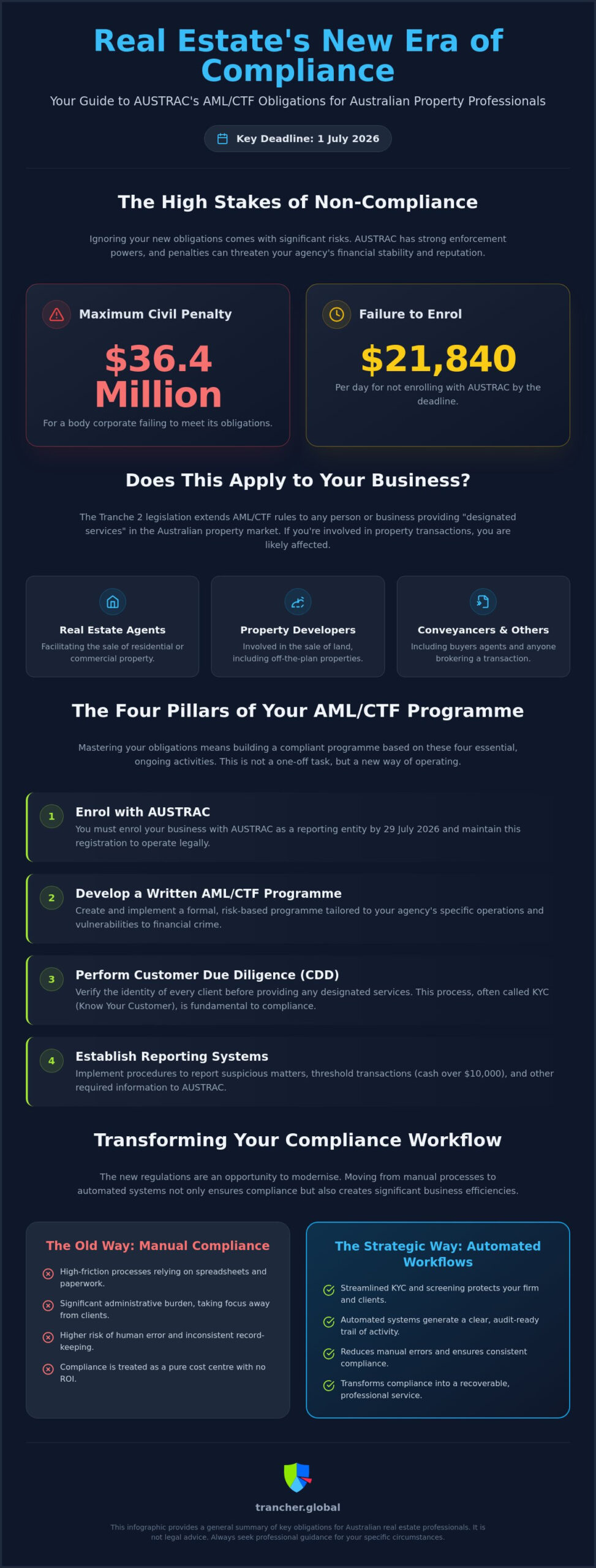
What if the 1 July 2026 deadline wasn’t a looming administrative burden, but the catalyst for your agency’s most efficient year yet? While many professionals view the new real estate AML CTF obligations as a source of friction, forward-thinking firms are already preparing to turn these requirements into a strategic advantage. It’s natural to feel concerned about the administrative heavy-lifting or the risk of substantial AUSTRAC penalties, particularly with the maximum civil penalty for a body corporate now reaching $36.4 million.
We know your primary focus is on property and people, not navigating the intricacies of threshold transaction reports and ongoing risk monitoring. You’ll learn exactly how to master your firm’s new AUSTRAC requirements while transforming regulatory compliance into a streamlined, profitable asset. We’ll walk through the essential steps for full readiness by the 1 July commencement date, including how to automate your onboarding workflows and ensure compliance costs are fully recoverable.
Key Takeaways
- Identify whether your specific sales, brokering, or development activities qualify as “designated services” under the expanded Tranche 2 legislation.
- Master your real estate AML CTF obligations by implementing an AUSTRAC-aligned programme that incorporates a comprehensive risk assessment.
- Transition from high-friction manual spreadsheets to automated KYC and screening workflows that protect your firm and your clients.
- Discover how to transform compliance from an overhead into a recoverable professional service by tracking billable activity and ROI.
- Follow a structured 30-day roadmap to achieve full regulatory readiness and audit-ready documentation before the 1 July 2026 deadline.
Understanding Your Real Estate AML CTF Obligations under Tranche 2
For years, the Australian real estate sector operated largely outside the direct scope of the Anti-Money Laundering and Counter-Terrorism Financing Act 2006. This changes on 1 July 2026. This legislative expansion, commonly referred to as Tranche 2, officially brings real estate agents, property developers, and conveyancers into the regulatory fold. Your new real estate AML CTF obligations represent a significant shift in how property businesses must handle client identification and transaction monitoring.
The Australian Transaction Reports and Analysis Centre (AUSTRAC) acts as both the national regulator and a financial intelligence agency. Their expectation is clear: businesses must take a proactive, risk-based approach to preventing financial crime. This means you don’t just follow a static checklist; you must actively assess the specific risks your agency faces and implement controls to manage them. By 29 July 2026, every regulated business must enrol with AUSTRAC to avoid significant daily penalties.
Mastering these requirements involves focusing on four foundational pillars. First, you must enrol and maintain your registration with the regulator. Second, you are required to develop and maintain a written AML/CTF programme. Third, you must perform Customer Due Diligence (CDD), which involves verifying the identity of your clients before providing services. Finally, you must establish systems for reporting suspicious matters and any physical currency transactions of $10,000 or more.
The Consequences of Non-Compliance
The risks of ignoring these changes are substantial. AUSTRAC has the power to pursue court-imposed financial penalties for businesses that fail to meet their real estate AML CTF obligations. For a body corporate, the maximum civil penalty is $36.4 million. Even failing to enrol by the deadline can cost your business $21,840 per day. Beyond the financial impact, criminal investigations or public audits can cause irreparable reputational damage. This scrutiny can threaten your professional licence and the long-term continuity of your business.
Why Real Estate is a High-Risk Sector
Property remains a primary target for money laundering because it allows criminals to “clean” large volumes of illicit funds through a single, stable asset. High-value transactions, off-the-plan sales, and complex foreign investment structures are particularly vulnerable to exploitation. By implementing these new standards, you aren’t just complying with the law; you’re protecting the integrity of the Australian property market. Professional oversight ensures that your agency remains a trusted partner for legitimate buyers and sellers while deterring those seeking to hide criminal proceeds.
Identifying Designated Services: Is Your Property Business Regulated?
Determining exactly where your business sits within the new regulatory framework is the essential first step toward achieving readiness. The legislation focuses on “designated services,” which are specific activities that trigger your real estate AML CTF obligations. If your firm facilitates the sale or purchase of real property in Australia, you’re likely classified as a reporting entity. This classification isn’t limited to traditional high-street agencies; it extends to any person or entity “brokering” a transaction, regardless of whether they hold a specific real estate licence in their jurisdiction.
The geographical link is a critical trigger for oversight. If you provide a designated service through a permanent establishment in Australia, you must comply with the Act. This remains true even if the client is based overseas or the funds originate from international accounts. As detailed in AUSTRAC’s reforms for new reporting entities, the goal is to close loopholes that previously allowed illicit funds to flow into the local property market without adequate verification.
Designated Services for Agents and Brokers
For sales agents, the obligation begins when you’re appointed to sell residential or commercial property. This includes traditional auctions, private sales, and the brokering of commercial leases that involve a transfer of ownership. Buyers agents are equally regulated. Your role in securing property transfers and negotiating terms on behalf of a purchaser is a designated service. You’ll need to be particularly vigilant when handling transactions involving discretionary trusts or complex corporate structures, as these are often flagged as higher-risk profiles for money laundering.
Obligations for Property Developers
Property developers who sell directly to the public now face the same scrutiny as traditional agencies. If you sell apartments off-the-plan or market blocks of land in new subdivisions without using an external agent, you’re providing a designated service. Residential site operators and those selling house and land packages must also establish robust verification processes. It’s no longer enough to rely on the buyer’s solicitor to perform these checks. The developer holds the primary responsibility for ensuring real estate AML CTF obligations are met during the direct sale process.
It’s helpful to remember that not every real estate activity is covered. Standard residential leasing and property management services, where no transfer of title occurs, generally fall outside these specific AML/CTF requirements. However, if your property management department also handles occasional sales for landlords, those sales activities will trigger the need for compliance. If you’re unsure where your services land, you can explore our compliance assessment tools to clarify your firm’s specific reporting requirements.
Building a Compliant AML/CTF Programme for Real Estate
A robust AML/CTF programme is the operational backbone of your agency’s regulatory defence. It isn’t just a manual sitting on a shelf; it’s a living set of policies, procedures, and controls tailored to your specific business model. To meet your real estate AML CTF obligations, your programme must be approved by senior management and clearly outline how you identify, mitigate, and manage the risks of money laundering and terrorism financing. This documentation serves as your primary evidence of compliance during an AUSTRAC audit.
The first step in building this framework is conducting a comprehensive ML/TF risk assessment. You’ll need to examine your client base, the types of properties you sell, the methods of payment you accept, and the jurisdictions where you operate. For example, an agency specialising in high-end luxury apartments in Sydney faces different risks than a rural developer selling residential lots. Once these risks are identified, you must appoint a designated Compliance Officer. This individual doesn’t have to be a legal expert, but they must have the authority and resources to oversee your compliance efforts and act as the primary liaison with the regulator.
Modern KYC and CDD Requirements
Knowing your customer (KYC) is no longer a simple matter of glancing at a driver’s licence. Under Tranche 2, you must verify the identity of every client before providing a designated service. This includes individuals, but it becomes more complex with companies and trusts. You’re required to identify the “beneficial owners”, the real people who ultimately own or control the entity. For a deeper look at these standards, you can review our guide on CDD and KYC Requirements Australia. If a client is identified as high-risk, such as a Politically Exposed Person (PEP), you must apply Enhanced Due Diligence (EDD) to verify their source of funds and wealth.
Ongoing Risk Monitoring and Reporting
Compliance doesn’t end once the contract is signed. Ongoing monitoring ensures you stay alert to unusual behaviour throughout the business relationship. This might include sudden changes in a buyer’s funding source or a client’s request to make a transaction that doesn’t make commercial sense. Many firms use Ongoing Risk Monitoring Software to automate this process and flag red flags in real-time. If you encounter a situation that raises suspicion, you have a legal duty to lodge a Suspicious Matter Report (SMR) with AUSTRAC. You must also report any physical cash transactions of $10,000 or more within 10 business days. These reports are vital for protecting your agency and the broader Australian financial system.
Reducing the Administrative Burden: Automation vs Manual Compliance
Meeting your real estate AML CTF obligations doesn’t have to mean hiring a new department or drowning in paperwork. Many firms initially react to new regulation by creating complex spreadsheets and manual filing systems. This approach often leads to hidden costs that far outweigh the price of a dedicated solution. Manual records are difficult to search, prone to human error, and notoriously challenging to maintain during an AUSTRAC inspection. They create a “compliance tax” on your staff’s time, pulling them away from high-value sales and development activities.
Digital automation removes the friction that typically plagues the client onboarding experience. Instead of asking a buyer to visit your office with physical documents, you can facilitate secure, remote identity verification in minutes. This speed isn’t just about internal efficiency; it’s about providing the seamless, professional service that modern property investors expect. By digitising your workflows, you ensure that every check is performed consistently and that you maintain Audit-Ready Compliance Records without the need for manual filing or double-handling data.
Transforming Compliance into a Profit Centre
One of the most significant shifts for Tranche 2 entities is moving away from the “overhead” mindset. Compliance is a professional service, much like legal work or conveyancing, and the time spent on it is a legitimate business expense. Forward-thinking agencies are already positioning these activities as recoverable. By tracking the time and resources dedicated to each file, you can achieve significant AML CTF Compliance Costs Reduction while potentially opening new advisory revenue streams. Using compliance data can reveal deeper insights into your client base, allowing you to offer more tailored services to high-net-worth investors.
Integrating AML into Your Existing Tech Stack
Success depends on ensuring compliance isn’t a siloed activity. Your AML workflows should connect directly with your CRM and existing practice management tools. This integration ensures that data flows naturally from the initial enquiry through to the final settlement. To ensure firm-wide adoption, we recommend role-based training that empowers every team member to understand their part in the process. When your systems are integrated, you can generate ROI reports that track exactly how much time is saved through automation. If you’re ready to see how these efficiencies look in practice, you can book a platform demonstration to explore our automation features.
Achieving AUSTRAC Readiness in 30 Days with Trancher
The transition to a regulated environment is a significant milestone for any property firm, but it doesn’t have to be a disruptive one. We’ve built our platform to ensure that meeting your real estate AML CTF obligations is a seamless part of your daily operations. With our 30-day compliance guarantee, we provide the structure and support necessary to move from uncertainty to full AUSTRAC readiness. This isn’t a generic solution; it’s a platform specifically tuned to the pace and complexity of the Australian real estate market.
Our technology handles the heavy lifting of KYC verification, sanctions screening, and risk monitoring, allowing your team to stay focused on closing deals. By automating these essential pillars, you reduce the risk of human error and ensure that every file is audit-ready from the moment of onboarding. To support the industry through this transition, we’re offering a complimentary 3-month trial for early adopters. This allows you to bed down your new processes and refine your workflows well before the 1 July 2026 deadline.
The Trancher Implementation Roadmap
Our roadmap is designed for speed and clarity, ensuring no part of your business is left behind during the transition. The process follows three distinct stages:
- Step 1: Rapid onboarding and system integration. We connect our platform to your existing CRM and practice management tools to ensure data flows without friction and eliminates double-entry.
- Step 2: Customising your AUSTRAC-aligned programme framework. We help you tailor a written AML/CTF programme that reflects your specific agency risks, whether you’re managing high-value commercial sales or large-scale residential developments.
- Step 3: Training your team and launching automated CDD. We provide practical, role-based guidance so your staff can perform customer due diligence with confidence, turning a complex requirement into a standard, professional habit.
Why Real Estate Leaders Partner with Trancher
Success in a regulated landscape requires more than just software; it requires a partner who understands your sector. We provide local Australian expert support, ensuring you’re never navigating complex regulatory questions alone. The Trancher compliance dashboard gives you end-to-end visibility of your firm’s status, highlighting any outstanding tasks or high-risk flags at a glance. We take a proactive approach to regulatory changes, ensuring your real estate AML CTF obligations are met today and in the years to come. By choosing an innovative, steady hand, you can turn a mandatory requirement into a strategic asset for your firm’s future growth and operational excellence.
Future-Proof Your Agency for a Regulated Market
The transition to Tranche 2 regulation is a significant evolution for the Australian property sector, but it’s one your firm is well-equipped to handle. By moving away from administratively heavy manual processes and embracing automation, you ensure your real estate AML CTF obligations are met with precision. This shift isn’t just about avoiding penalties; it’s a strategic opportunity to refine your data integrity and recover compliance costs as a professional service.
You can navigate this change with a steady, expert partner by your side. With our 30-Day Compliance Guarantee and AUSTRAC-aligned programme management, you can step into this new era with complete confidence. Our expert Australian support team is here to guide you through every integration and training requirement, ensuring your team feels supported and ready.
Secure your firm’s future with a complimentary 3-month Trancher trial. We’re ready to help you turn these new requirements into your agency’s next strategic advantage.
Frequently Asked Questions
Is my real estate agency a reporting entity under the new Tranche 2 rules?
Yes, your agency is likely classified as a reporting entity if you assist in brokering the sale or purchase of real property in Australia. This includes residential, commercial, and industrial transactions. Under the Tranche 2 reforms, the definition of a “designated service” is broad, ensuring that anyone facilitating property transfers meets the necessary real estate AML CTF obligations.
What are the specific AML CTF obligations for property developers?
Property developers have the same fundamental obligations as agents when they sell property directly to the public. If you market off-the-plan apartments or residential land subdivisions without an external agent, you must enrol with AUSTRAC, develop a written compliance programme, and conduct full customer due diligence on every buyer. It’s no longer sufficient to rely on the purchaser’s legal representative to perform these checks.
Do I need to verify every client, or only those involved in high-value sales?
You must verify the identity of every client before you provide a designated service, regardless of the transaction value. The law doesn’t distinguish between a small residential unit and a multi-million dollar commercial block. You must perform Customer Due Diligence (CDD) on all buyers and sellers to confirm their identity and, where applicable, identify the beneficial owners of any companies or trusts involved.
How much does it cost to implement an AML CTF compliance programme?
The cost of implementation depends on the size of your firm and whether you choose manual processes or automated systems. While there’s an initial investment in setting up your programme and training staff, many firms find that automation significantly reduces long-term labour costs. We focus on making these costs recoverable by helping you track billable compliance activity as a professional service rather than a sunk overhead.
Can I use manual spreadsheets for my real estate AML records?
While you can technically use manual spreadsheets, they are highly discouraged due to the risk of human error and the difficulty of maintaining audit-ready records. AUSTRAC expects a robust, systematic approach to record-keeping. Manual systems often fail to provide the real-time risk monitoring and secure data storage required to meet modern real estate AML CTF obligations effectively during a regulatory audit.
What happens if I miss the 1 July 2026 AUSTRAC deadline?
Missing the 1 July 2026 commencement date exposes your business to severe civil penalties. If you provide designated services and fail to enrol with AUSTRAC by 29 July 2026, you could face a daily penalty of $21,840. Additionally, the maximum civil penalty for a body corporate for a contravention of the AML/CTF Act is $36.4 million, making early readiness a commercial necessity.
How do I report a suspicious transaction in a property deal?
You report suspicious transactions by lodging a Suspicious Matter Report (SMR) through the AUSTRAC Online portal. If you have reasonable grounds to suspect a transaction involves proceeds of crime or is linked to terrorism financing, you must report it within three business days. Remember, it’s a serious offence to “tip off” the client or any third party that a report has been filed.
Does Trancher offer a guarantee for AUSTRAC compliance?
Yes, Trancher provides a 30-day compliance guarantee to ensure your firm is fully prepared for the new regulations. We guide you through the enrolment process, help you establish an AUSTRAC-aligned programme framework, and automate your KYC and screening workflows. This proactive approach ensures you’re ready for the 1 July 2026 deadline with minimal disruption to your daily sales or development activities.