

What if the hours your team spends on AUSTRAC Tranche 2 requirements weren’t a drain on your profit margins, but a transparent revenue stream? For many Australian firms, the 1 July 2026 deadline feels like an impending administrative burden, leading many partners to ask how to bill for AML compliance without losing client trust. It’s natural to feel that compliance is a sunk cost, especially when you’re worried about pushback or struggling to track the actual time spent on complex due diligence. You aren’t alone in feeling that these mandatory checks often go unrewarded.
This guide will show you how to reframe these obligations as high-value professional risk advisory services. We’ll help you move away from vague admin fees and toward a structured, billable model that reflects the true cost of your expertise. By the end of this article, you’ll have a clear framework to communicate value to your clients, templates to handle fee discussions with confidence, and a system to prove the worth of your compliance work. Let’s transform this regulatory transition into a strategic advantage for your practice’s profitability and operational ease.
Key Takeaways
- Learn how to categorise AML/CTF obligations as a ‘Designated Service’ rather than an administrative overhead to protect your firm’s profit margins.
- Discover how to bill for AML compliance by selecting the right model, such as Fixed Fee, Disbursement, or Value-Based, that aligns with your existing engagement structure.
- Master the ‘Transparency First’ approach to neutralise fee objections by updating engagement letters and leveraging the official AUSTRAC mandate.
- Establish a standardised workflow for capturing recoverable hours by integrating specific compliance activity codes into your practice management software.
- Explore how to use automated ROI reporting and activity tracking to provide clients with tangible evidence of the professional risk advisory work performed.
Why AML Compliance is No Longer a Sunk Cost for Accounting Firms
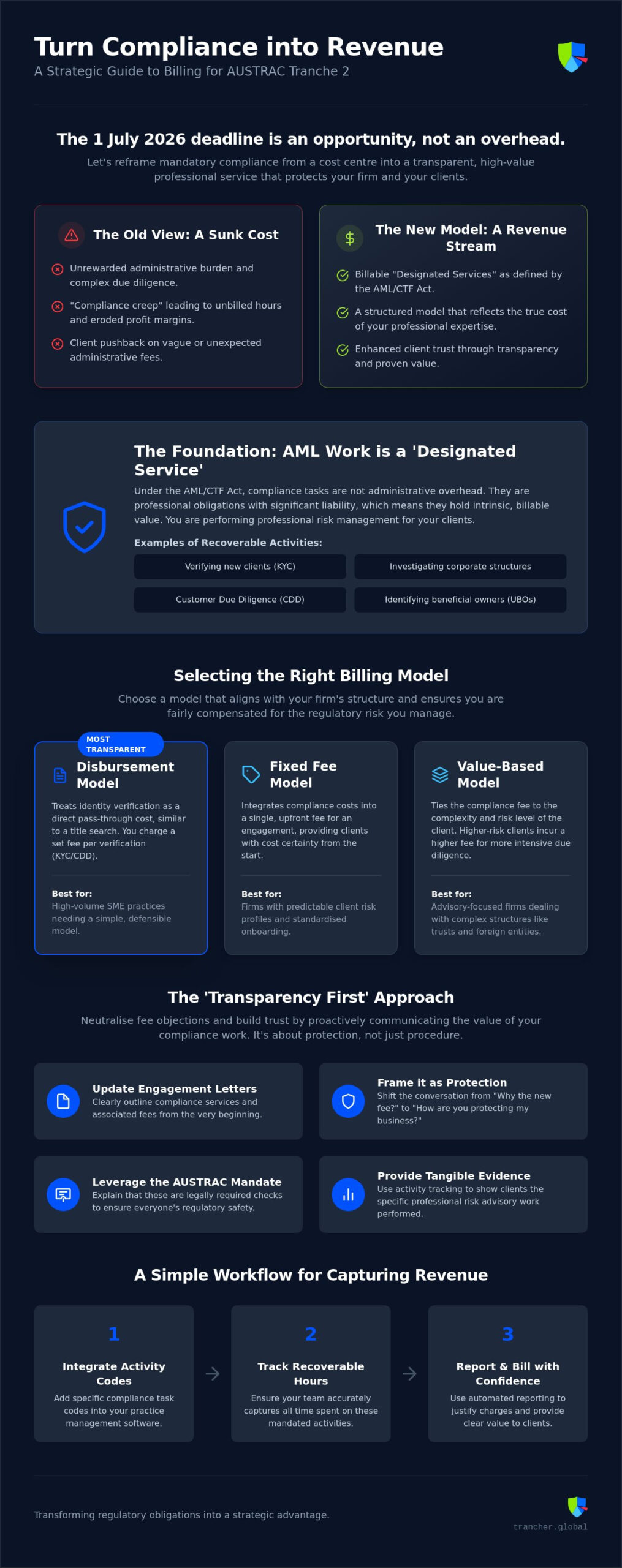
For years, many Australian accounting firms viewed identity checks as a minor administrative hurdle. However, the introduction of Tranche 2 changes the legal status of these tasks. Under the AML/CTF Act, activities such as verifying a new client or investigating a complex corporate structure are classified as “Designated Services.” This means they are no longer just internal admin; they are professional obligations with significant liability. Understanding Anti-Money Laundering (AML) requirements is the first step in recognising that this work has intrinsic value.
Recoverable compliance activity is any task performed specifically to meet these regulatory standards for a client engagement. If your team spends three hours untangling a discretionary trust to identify the ultimate beneficial owner, that is three hours of professional risk management. When you fail to account for this time, you aren’t just losing money on software; you’re eroding your firm’s profit margins through unbilled labour. Learning how to bill for AML compliance is essential for any partner who wants to maintain a healthy practice after the 1 July 2026 commencement date.
The Reality of Tranche 2 Overhead
The sheer volume of work involved in Know Your Customer (KYC) and Customer Due Diligence (CDD) can be surprising. Without a clear billing strategy, “compliance creep” happens quickly. This occurs when standard tax or advisory jobs suddenly require hours of extra verification that wasn’t in the original quote. Effective AML CTF compliance costs reduction starts with accurate time tracking and a refusal to treat these mandated hours as a “gift” to the client.
Compliance as a Professional Service
We should view AML work in the same light as R&D tax incentives or complex audit procedures. It’s a specialised service that protects your client’s regulatory reputation and ensures their business remains viable. You’re moving from simply “filling in forms” to actively managing a client’s risk profile. When you frame the service this way, the conversation shifts from “why is there a new fee?” to “how are you protecting my business?”
By formalising your approach now, you avoid the stress of a last-minute scramble in 2026. It allows you to trial different models and find the one that fits your firm’s culture. You’ll discover that when you are transparent about the work being performed, most clients value the peace of mind that comes with knowing their affairs are being handled by a diligent, compliant partner. Mastering how to bill for AML compliance ensures your firm remains both profitable and prepared for the new regulatory landscape.
Selecting the Right Billing Model for AML Services
Deciding on a fee structure is a strategic choice that directly impacts your firm’s bottom line and client satisfaction. There is no single “correct” way to charge, but the most successful firms prioritise consistency and clarity across their entire portfolio. When considering how to bill for AML compliance, you must account for more than just the time spent on verification. Your model needs to recover the costs of specialised software, ongoing staff training, and the periodic independent audits required by AUSTRAC. Drawing on resources like AICPA AML guidance can help you align your billing practices with international professional standards while maintaining a local focus.
A well-chosen model ensures that your compliance team isn’t viewed as a cost centre. Whether you opt for a flat fee per engagement or a more complex risk-based approach, the goal remains the same: ensuring the firm is fairly compensated for the regulatory risk it manages. If you’re unsure where to start, you might baseline your current activity to see which model captures the most recoverable time for your specific client mix.
The Disbursement Model: Transparency for Clients
The disbursement model treats identity verification as a direct pass-through cost, similar to a title search or a company extract. You charge a set fee per verification (KYC/CDD) performed. This is often the easiest model for high-volume SME practices to implement because it’s easily defended during billing queries. Using disbursements simplifies the “why” for clients by linking the fee directly to a specific, mandatory third-party check performed on their behalf.
The Annual Compliance Levy: Predictable Revenue
For firms with long-term advisory relationships, an annual compliance levy often works best. This bundles ongoing monitoring, data maintenance, and reporting into a single, predictable yearly fee. You can scale this levy based on client risk tiers, charging more for complex trust structures or international entities that require deeper investigation. This approach ensures your team has the resources to meet the CDD and KYC requirements Australia has mandated for 2026. It provides the firm with steady, predictable revenue while giving the client a clear, all-inclusive price for their regulatory peace of mind. By standardising these tiers, you remove the guesswork from the billing process and ensure every partner is applying fees equitably across the practice.
Communicating Value: How to Explain Compliance Fees to Clients
Introducing new fees can feel daunting, especially with long-term clients who have enjoyed a relatively stable pricing structure for years. However, the most effective way to manage this transition is through a “Transparency First” approach. By being open about the changing regulatory landscape in Australia, you position your firm as a proactive partner rather than just another service provider. When you discuss how to bill for AML compliance, the conversation should focus on the protection you are providing. You are securing their business legitimacy and ensuring they meet the federal standards that come into effect on 1 July 2026.
Using the AUSTRAC mandate as the external driver helps to neutralise potential friction. It shifts the narrative from a firm-led price hike to a necessary response to national legislation. Providing “Evidence of Activity” reports alongside your invoices can further justify the cost. These reports show the specific checks, risk assessments, and monitoring activities performed, making the invisible work of compliance tangible and professional.
Updating Engagement Letters and Terms
Your engagement letters are the foundation of a transparent billing relationship. It’s vital to update these documents well before the 2026 deadline to include specific clauses regarding your AML/CTF obligations. These clauses should clearly outline that compliance is a separate, mandated professional service. For clients used to “all-inclusive” fees, a formal Compliance Notification template can be sent during the annual review process. This document explains that while your commitment to their success remains unchanged, the legal framework governing professional services has evolved, requiring a dedicated compliance programme for every engagement.
Handling Common Client Objections
When a client asks why they didn’t have to pay this fee last year, the answer lies in the distinction between simple identity checks and comprehensive risk assessments. Identity checks are a snapshot in time; risk assessments are an ongoing professional evaluation of the client’s business environment. If you’re wondering how to bill for AML compliance while maintaining rapport, honesty is your best tool. You might use a script similar to this during your next partner meeting:
“As of 1 July 2026, federal regulations for the accounting profession have changed significantly. We are now required to perform detailed, ongoing risk management and reporting for all our clients. This isn’t just a paperwork exercise; it’s a critical layer of protection that ensures your business remains compliant with AUSTRAC standards. To maintain the high level of security and professional integrity you expect from us, we’ve introduced a dedicated compliance fee to cover these mandatory risk advisory services.”
By framing the fee as a safeguard for their own reputation, you transform a potential objection into a moment of reassurance. Most business owners value security and will appreciate a partner who takes their regulatory safety seriously.
A Workflow for Capturing Recoverable Compliance Hours
Establishing a robust workflow is the difference between a profitable practice and one that is slowly drained by administrative overhead. If your team isn’t tracking the specific minutes spent on verification, you’re essentially subsidising your clients’ regulatory obligations. Realising how to bill for AML compliance begins with a shift from manual, ad-hoc notes to integrated, systemic tracking. By standardising “Designated Service” codes in your practice management software, you create a clear, professional audit trail that justifies every line item on the final invoice.
Capturing this time shouldn’t be an extra task for your staff. Instead, it should be a natural byproduct of the work they are already doing. When compliance activity is tracked in real-time, you eliminate the “billing amnesia” that often happens at the end of a busy month. This structured approach ensures that no billable hour is forgotten and that every fee is backed by solid evidence of activity.
Step 1: Define Your Billable Compliance Events
You must identify the specific trigger points in the client lifecycle that demand compliance labour. Client onboarding is the most prominent, but don’t overlook the time required for PEP screening, ongoing monitoring, or the detailed investigation of potential suspicious matters. Assign a standard “unit of work” to these tasks to ensure every staff member is billing consistently across the firm. It is useful to distinguish between basic “admin” time, such as filing a driver’s licence copy, and “professional” compliance time, which involves the high-level risk assessment of a client’s complex corporate structure or source of wealth. This distinction helps clients understand they are paying for your professional judgement, not just data entry.
Step 2: Automate the Paper Trail
Manual spreadsheets are prone to error and rarely provide the granular detail needed to defend a fee during a client review. Crucially, they often fall short of being an audit ready compliance record. Instead, modern firms are adopting compliance ROI tracking software to link every screening action directly to a client’s billing account. This ensures that the evidence required to justify the fee is generated automatically as the work is performed, removing the administrative burden from your busy team.
Reviewing “unbilled compliance time” at the end of each month is a vital habit for partners. This oversight reveals exactly where profit is leaking and allows you to adjust your engagement terms well before the 1 July 2026 deadline. When you have the data to show how much time is actually spent on these mandated tasks, the question of how to bill for AML compliance becomes a simple matter of operational efficiency. See how Trancher can help you capture every billable minute of compliance activity.
Leveraging Trancher to Automate Your Compliance Revenue Stream
Transitioning from manual tracking to a systemic revenue model requires a tool built for the specific nuances of the Australian accounting landscape. Trancher isn’t merely a verification platform; it’s a profitability engine designed to capture every billable moment of your compliance workflow. By automatically logging every “Designated Service” action, from initial KYC checks to ongoing risk monitoring, the platform provides the empirical data needed to solve the puzzle of how to bill for AML compliance. You no longer need to guess how much time was spent on a complex file; the evidence is recorded as the work happens.
One of the most powerful features for partners is the generation of granular ROI reports. These summaries show exactly where time is being recovered and how your chosen fee structure is performing against the actual labour cost. This level of transparency allows you to refine your billing model with confidence, ensuring that your “cost to serve” is always lower than the value you capture. It turns a regulatory obligation into a measurable asset for the firm’s financial health.
Turning Compliance into an Advisory Opportunity
Deepening your understanding of a client’s corporate structure often reveals professional needs that go far beyond basic tax compliance. Trancher’s risk assessments can act as a diagnostic tool, highlighting gaps in a client’s governance or complex trust arrangements that require restructuring. When you identify a “Z-tier” client through ongoing monitoring, you aren’t just managing risk; you’re identifying a high-value consulting engagement. This shift moves your firm from reactive compliance to proactive revenue generation, where the initial AML check serves as the gateway to deeper advisory relationships.
The Trancher 30-Day Readiness Guarantee
We understand that the lead-up to 1 July 2026 brings a sense of urgency. To alleviate this pressure, we offer a 30-day compliance-ready guarantee, ensuring your firm’s systems and billing workflows are operational well before the deadline. You’ll also have access to our local Australian support team to help fine-tune your fee communication and internal policies. If you’re still exploring how to bill for AML compliance, our 3-month trial provides a risk-free environment to establish your billing baseline and prove the ROI to your fellow partners. It’s about readiness, operational ease, and the business-minded optimism that comes with a steady hand at the helm.
Start your complimentary 3-month Trancher trial today and transform your compliance obligations into a transparent, professional revenue stream.
Securing Your Firm’s Future Profitability
Reframing AML/CTF obligations from an administrative burden into a professional service is the most effective way to protect your firm’s margins. By selecting a billing model that suits your client base and updating your engagement letters early, you establish a transparent framework for value. Integrating these steps helps you master how to bill for AML compliance while strengthening the trust your clients place in your regulatory expertise. It’s about moving from a reactive stance to a proactive, revenue-positive strategy.
Trancher is specifically designed for SME accounting firms to simplify this transition. With our detailed ROI and billable activity reporting, you can turn every compliance action into a clear, recoverable asset. We stand behind our platform with a 30-day AUSTRAC readiness guarantee, ensuring your systems are fully operational long before the 1 July 2026 deadline. This methodical approach removes the friction of compliance, allowing you to focus on high-value advisory work.
Maximise your practice ROI; start your free 3-month Trancher trial today and move forward with the confidence that your practice is both compliant and profitable. We’re here to guide you every step of the way as you build a more resilient, future-ready firm.
Frequently Asked Questions
Can I legally charge my clients for AML compliance checks in Australia?
Yes, you can legally charge for these services as they are professional obligations under the AML/CTF Act. These activities are classified as “Designated Services” that carry significant regulatory liability and require dedicated resources to perform correctly. Charging for this work is a standard business practice that reflects the professional risk management you provide to your clients.
Should I charge for AML as a separate line item or hide it in the fee?
Transparency is generally the most effective approach for maintaining client trust. Listing compliance as a separate line item or a distinct “Compliance Levy” allows you to clearly explain the specific value of the risk advisory work being performed. This method avoids the perception of a hidden price hike and links the fee directly to the mandatory AUSTRAC requirements.
How much should an accounting firm charge for a standard KYC check?
Your fees should reflect the complexity of the client’s structure and the time required for a thorough investigation. A standard individual verification is usually less resource intensive than untangling a multi layered discretionary trust or an international entity. Many firms choose to tier their fees based on these risk profiles to ensure they recover both labour costs and software expenses equitably.
What happens if a client refuses to pay the compliance fee?
Compliance is a mandatory legal requirement for your firm to provide professional services. If a client refuses to pay for the necessary due diligence, you must carefully evaluate the regulatory risk of continuing the relationship. Most firms include specific clauses in their engagement letters stating that meeting AML/CTF standards is a non negotiable condition of the engagement.
Do I need to update my engagement letters for Tranche 2 billing?
Yes, updating your engagement letters is a vital step in establishing how to bill for AML compliance effectively. Your terms should clearly define the scope of your AML/CTF obligations and the associated fee structure. Finalising these updates well before the 1 July 2026 commencement date ensures that all clients are fully informed and provides a clear legal basis for your invoices.
How do I track time spent on ongoing risk monitoring for hundreds of clients?
Manual tracking for a large client base is inefficient and often leads to significant revenue leakage. Using automated platforms like Trancher allows your firm to log every monitoring action and screening event automatically as it occurs. This system generates the necessary evidence for billing without adding to your team’s administrative burden, ensuring every minute of professional work is captured.
Is software like Trancher considered a tax-deductible expense for the firm?
In most instances, AML compliance software is a deductible business expense for an accounting practice. It’s a necessary tool for meeting your legal obligations and protecting the integrity of your firm. You should confirm the specific treatment of these costs with your tax specialist to ensure they are correctly recorded within your firm’s financial structure.
Can I use the ‘AUSTRAC mandate’ as the primary reason for the new fees?
The AUSTRAC mandate is an excellent and objective reason to share with your clients when introducing these fees. It positions the charge as a necessary response to federal legislation rather than an arbitrary decision by the firm. Explaining how to bill for AML compliance in the context of national law helps clients understand that the work is mandatory for their own regulatory protection.