

The 1 July 2026 deadline for Tranche 2 isn’t just another date on the calendar; it’s the moment the Australian bullion industry undergoes its most significant regulatory shift in decades. If you’re feeling the pressure of managing bullion dealer AML obligations, you’re certainly not alone. Many dealers view the prospect of manual KYC checks and strict AUSTRAC reporting as a heavy administrative burden that could slow down trade. It’s understandable to feel concerned about how these changes might impact long-term client relationships, particularly when you need to explain new compliance fees or manage high-risk cash transactions over $10,000.
We’re here to show you that these requirements don’t have to be a hurdle for your business. You can master your AML/CTF obligations and actually turn them into a streamlined, profitable part of your daily operations. This guide provides a clear roadmap to achieving full regulatory compliance while replacing manual drudgery with automated workflows. We’ll explore how to build a defensible program that protects your reputation, simplifies client verification, and ensures your firm is ready for the new landscape well before the deadline arrives.
Key Takeaways
- Understand the 1 July 2026 Tranche 2 deadline and how these upcoming changes will reshape the Australian precious metals industry.
- Identify the “Designated Service” triggers and the $10,000 cash threshold that define your specific bullion dealer AML obligations.
- Learn the practical steps to enrol with AUSTRAC and build a defensible AML/CTF Program that protects your firm from financial crime.
- Discover how to replace manual KYC burdens with automated workflows that save time and ensure your records are always audit-ready.
- Explore how to transform regulatory requirements into a strategic advantage by tracking compliance-related billing and operational efficiency.
What is Bullion Dealer AML and Why Does it Matter in 2026?
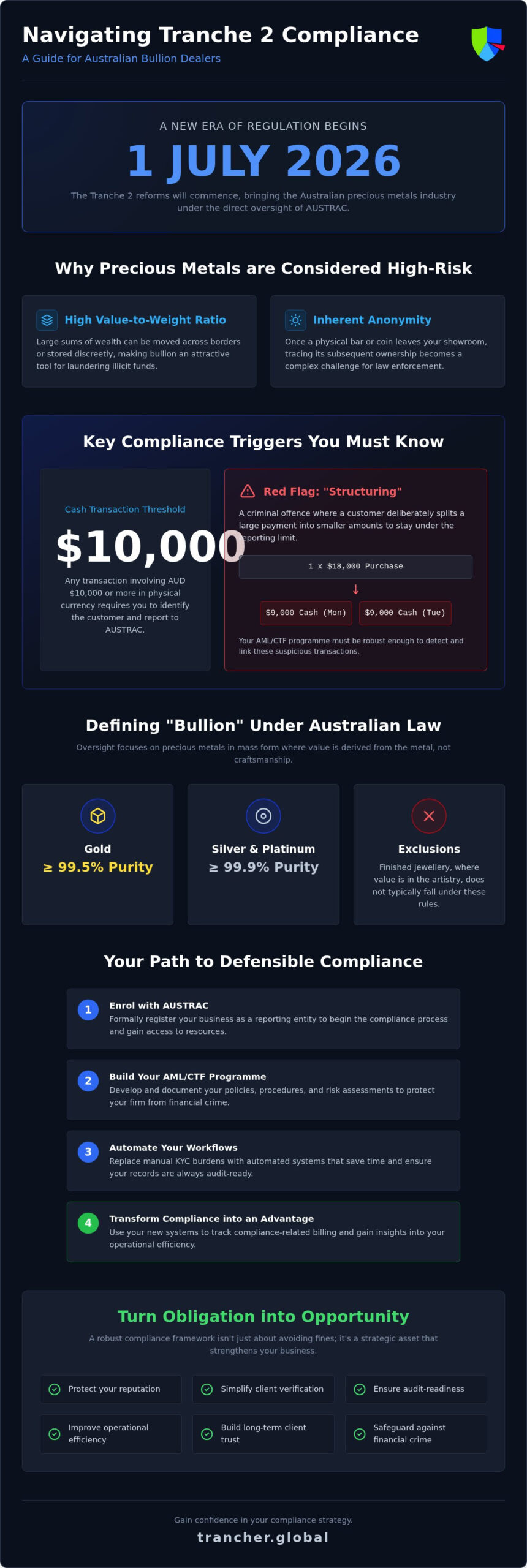
Bullion dealer AML refers to the specific suite of legal obligations mandated by the Anti-Money Laundering and Counter-Terrorism Financing Act 2006. For many years, the regulatory focus in Australia remained primarily on the banking and gambling sectors. This is changing rapidly. On 1 July 2026, the Tranche 2 reforms will fully commence, bringing a wider range of businesses, including many in the precious metals sector, under the direct oversight of AUSTRAC. As the national regulator, AUSTRAC’s role is to ensure that every dealer has robust systems in place to detect and report suspicious activity. This oversight protects the Australian financial system from exploitation and ensures that your business remains a secure environment for legitimate trade.
The High-Risk Nature of Precious Metals
Gold, silver, and platinum possess unique qualities that make them attractive to legitimate investors and criminals alike. Their high value-to-weight ratio and inherent anonymity mean large sums of wealth can be moved across borders or stored discreetly. Criminals often use precious metals to “clean” illicit funds, converting “dirty” cash into a stable, liquid asset that leaves a minimal digital footprint. Once a physical bar or coin leaves your showroom, tracing its subsequent ownership becomes a complex challenge for law enforcement. This is why high-risk cash transactions are a primary focus for regulators. Implementing a strong AML/CTF program isn’t just about avoiding potential AUSTRAC fines; it’s about safeguarding your business reputation and ensuring you don’t inadvertently facilitate financial crime.
Defining “Bullion” Under Australian Law
It’s vital to distinguish between general retail sales and the specific transactions that trigger regulatory oversight. Under Australian law, bullion generally refers to precious metals in a mass form, such as bars, ingots, or coins, where the value is derived primarily from the metal content rather than artistic craftsmanship. Purity levels are often the deciding factor in these definitions.
- Investment Grade: This typically includes gold with a purity of at least 99.5% and silver at 99.9% or higher.
- Tradeable Form: The metal must be in a form that is commonly traded on international bullion markets to meet the definition.
- Exclusions: Most standard jewellery sales do not fall under the bullion dealer AML definitions, provided the item is a finished piece of wearable art.
Clarifying these boundaries is the first step in building an efficient compliance workflow. It allows you to focus your resources on the high-value transactions that matter most while maintaining a seamless experience for your everyday retail customers. By understanding exactly which products trigger your obligations, you can ensure your 2026 readiness is both targeted and cost-effective.
Understanding the $10,000 Cash Threshold and Designated Services
Under the AML/CTF Act 2006, bullion dealers are classified as reporting entities when they provide what the law calls a “designated service.” For most in the industry, this trigger is found in Item 44 of the Act. It’s a common misconception that compliance only matters for massive corporate trades. In reality, the most significant operational impact for local firms involves physical currency. Any transaction involving $10,000 or more in cash requires immediate compliance action. This includes identifying the customer and eventually reporting the transaction to AUSTRAC. While bank transfers provide a clearer digital trail, they don’t exempt you from oversight. You’re still required to perform risk-based monitoring on all trades to ensure the source of funds is legitimate.
A major challenge for dealers is the practice of “structuring.” This occurs when a customer attempts to split a large payment into several smaller amounts to stay under the $10,000 limit. For example, a client might offer $9,000 in cash on Monday and another $9,000 on Tuesday for the same purchase. This is a deliberate attempt to evade bullion dealer AML reporting and is a criminal offence. Your compliance program must be robust enough to detect these linked transactions. Protecting your business from these risks is easier when you utilise automated threshold alerts that flag suspicious payment patterns before they become a liability.
When the Trigger Occurs
You officially become a reporting entity for a specific transaction the moment you agree to provide a designated service, such as selling a gold bar or buying back scrap precious metals from a walk-in client.
- Single Cash Sales: Direct over-the-counter sales of coins or bars exceeding the threshold.
- Scrap Buy-backs: Purchasing scrap gold or jewellery from the public for refining or resale.
- Linked Payments: Multiple smaller cash payments that clearly relate to a single invoice or trade.
The $10,000 limit applies to the total value of the transaction. If a trade-in arrangement involves a physical metal exchange plus a cash component, it’s the cash portion that triggers the specific threshold reporting, though the entire trade still falls under your broader risk assessment duties.
Exemptions and Limits
There are instances where initial customer due diligence (CDD) might feel less intensive, particularly for “occasional” transactions with low-risk profiles. However, a clear distinction exists between a one-off walk-in and an ongoing business relationship. Regular clients require a higher level of “know your customer” (KYC) documentation because the cumulative risk is higher. Even if a transaction sits technically below the reporting limit, your staff must remain risk-aware. There is no such thing as a completely “exempt” transaction in the eyes of the regulator if the circumstances appear suspicious. Maintaining a steady, alert presence ensures your firm stays on the right side of the law while keeping the showroom doors open for honest trade.
Managing ML/TF Risks in the Precious Metals Trade
Managing risk isn’t about avoiding every high-value client; it’s about understanding the specific threats your business faces. A robust Business Risk Assessment is the cornerstone of any effective bullion dealer AML strategy. This document allows you to identify where your firm is most vulnerable, whether through walk-in cash trades or complex international transfers. To get started, you can use a structured AML risk assessment tool Australia to map out your specific risk profile and implement appropriate controls. By identifying these gaps early, you turn a regulatory requirement into a clear operational advantage.
For high-value trades, you must go beyond simple ID checks. Understanding the “Source of Wealth” (how a client accumulated their total net worth) and “Source of Funds” (where the specific money for this trade originated) is essential. A client who is strangely indifferent to the spot price or who becomes defensive when asked for basic documentation is a significant risk. These indicators suggest the transaction may be motivated by something other than legitimate investment. Your bullion dealer AML program should provide clear triggers for when these deeper investigations are required.
Red Flags for Bullion Dealers
Staff training should focus on spotting both behavioural and transactional anomalies. Behavioural red flags often include customers who exhibit unusual nervousness, project an unexplained sense of urgency, or rely on a third party to conduct the talking. Transactional indicators are often more tangible. For instance, a person offering large volumes of scrap jewellery with removed engravings or serial numbers is a classic warning sign of illicit activity. It’s vital that your team knows how to document these observations quietly and accurately. This evidence forms the basis of a Suspicious Matter Report (SMR) and protects your business from being used as a conduit for money laundering.
Ongoing Risk Monitoring
Compliance isn’t a “set and forget” task. Risk profiles change as clients move through different life stages or as their trading patterns shift. Implementing ongoing risk monitoring software allows you to track these changes in real-time, flagging deviations from a client’s established “normal” behaviour. This proactive approach ensures you’re never caught off guard by a sudden spike in transaction volume or frequency. Senior management must take an active role in overseeing this framework. A culture of compliance starts at the top, ensuring that every staff member understands that protecting the firm’s integrity is a shared responsibility.
How to Implement a Defensible AML/CTF Program
Building a defensible bullion dealer AML program is a structured process that moves your business from awareness to active protection. It begins with enrolment. You must register with AUSTRAC as a reporting entity before you provide any designated services. Once enrolled, the core of your framework is a written AML/CTF Program. This document is divided into Part A, which covers your internal policies and risk management systems, and Part B, which focuses on customer identification procedures. To ensure these systems function correctly, you must appoint a dedicated AML/CTF Compliance Officer. This individual acts as the primary point of contact for the regulator and oversees the daily integrity of your compliance workflows.
KYC and CDD for Bullion Customers
Effective identification is the front line of your defence. You need to follow specific CDD and KYC requirements Australia has established for both individual investors and corporate entities. For high-value over-the-counter sales, this involves verifying primary photo identification documents like passports or driver’s licences. When dealing with corporate clients, you must also identify the beneficial owners to ensure full transparency. Your program should include automated PEP (Politically Exposed Person) and Sanctions screening to identify individuals subject to international restrictions. Establishing an Ongoing Customer Due Diligence (OCDD) framework ensures these records remain accurate and that any changes in a client’s risk profile are caught early.
AUSTRAC Reporting Obligations
Transparency with the regulator is non-negotiable. You’re required to submit a Threshold Transaction Report (TTR) for any physical currency transaction of $10,000 or more. If you encounter a situation that feels suspicious, such as a client refusing to provide ID or acting on behalf of an undisclosed third party, you must file a Suspicious Matter Report (SMR). These reports are time-sensitive and must be submitted through the AUSTRAC Online portal, often within 24 hours if the suspicion relates to terrorism financing. Finally, every reporting entity must submit an Annual Compliance Report. This provides AUSTRAC with a snapshot of your business activities and the effectiveness of your internal controls throughout the previous year.
Setting up these systems might seem daunting, but it’s a vital step in professionalising your operations. If you’re ready to secure your firm’s future, you can start building your compliant framework today with expert guidance that simplifies every step of the transition.
Transforming Compliance into a Strategic Asset with Trancher
While the regulatory shift may feel like an administrative weight, it actually presents a unique opportunity to professionalise your operations. Trancher acts as your expert companion, turning the complexities of bullion dealer AML into a streamlined part of your business model. Instead of viewing compliance as a drain on resources, our platform allows you to identify compliance ROI by tracking every billable activity associated with your obligations. This transparency ensures that your internal systems are not only defensible but also contribute to your firm’s overall financial health.
Security and readiness are at the heart of our solution. We provide a 30-day guarantee to ensure your business is fully compliant well before the 2026 deadline. By maintaining audit-ready compliance records, you remove the stress of potential AUSTRAC inspections. Your documentation is organised, accessible, and complete; this allows you to focus on high-value trades rather than digging through filing cabinets or disparate digital folders.
Automation for Efficiency
Manual KYC processes often create friction at the point of sale, potentially frustrating long-term clients. Trancher’s automated screening reduces this friction significantly. When a transaction triggers a threshold, the system provides integrated AUSTRAC reporting prompts that guide your staff through the required steps in real-time. This methodical approach reduces manual errors and slashes the administrative labour typically required for bullion dealer AML management. It’s about working smarter, ensuring that every identity check is as fast and unobtrusive as possible for your customers.
Ready for 1 July 2026
The 1 July 2026 commencement date is approaching, and the most successful firms are those that begin their transition today. Waiting until the final months leads to rushed implementations and operational gaps. We offer a complimentary 3-month trial for eligible firms, allowing you to test our automated workflows in your live showroom environment without initial commitment. This proactive step ensures your team is confident and your systems are battle-tested long before the law changes. You can start your 30-day compliance journey with Trancher today and secure a more efficient, profitable future for your bullion business.
Securing Your Future in the Precious Metals Industry
The shift toward Tranche 2 oversight represents a significant evolution for the Australian precious metals sector. By now, you understand that meeting your bullion dealer AML obligations is about more than just checking boxes; it’s about building a resilient, professionalised business. We’ve explored how to navigate the $10,000 cash threshold, identify red flags in trade patterns, and implement a defensible framework that satisfies AUSTRAC requirements.
You don’t have to face these changes alone. With ROI-focused compliance tracking and Australian-based expert support, you can transform regulatory pressure into operational ease. We guarantee you’ll be AUSTRAC-ready in 30 days, giving you the peace of mind to focus on what you do best: growing your trade. Take the first step toward a more efficient, secure future today.
Secure your bullion business for 2026 – Start your free trial with Trancher. We’re here to help you navigate this transition with confidence and steady guidance.
Frequently Asked Questions
Do I need to enrol with AUSTRAC if I only sell bullion occasionally?
Yes, you must enrol with AUSTRAC if you provide any designated service as defined under the Act. There is no minimum transaction volume required for enrolment; the obligation is triggered the moment you offer a service like selling investment-grade gold or buying back scrap metal. Failing to enrol before providing these services can lead to significant civil penalties. It’s better to be proactive and register your business well before the July 2026 deadline.
What is the exact cash threshold for reporting bullion transactions in Australia?
The exact threshold for physical currency transactions is $10,000. Any trade involving this amount of cash or more requires you to submit a Threshold Transaction Report (TTR) to AUSTRAC within 10 business days. This rule applies specifically to physical cash, including notes and coins. While digital transfers have different monitoring requirements, the $10,000 limit is a hard trigger for bullion dealer AML reporting duties when dealing with physical currency.
What are the penalties for non-compliance with Bullion Dealer AML rules?
AUSTRAC has the authority to issue significant civil penalties for businesses that fail to meet their obligations. These fines can reach millions of dollars for serious or systemic breaches. Beyond the financial impact, non-compliance can lead to court-enforceable undertakings or the loss of your right to trade in certain markets. Protecting your business reputation is just as vital as avoiding these fines, as criminal associations can permanently damage your standing in the industry.
How do I identify a “linked transaction” for threshold reporting?
A linked transaction occurs when a single purchase is split into multiple smaller payments to avoid the $10,000 cash reporting limit. This practice, known as “structuring,” is a criminal offence. You can identify these by looking for multiple cash payments from the same client that relate to a single invoice or trade. Our platform helps you flag these patterns automatically, ensuring you don’t inadvertently miss a reporting obligation that could put your firm at risk.
Can I outsource my AML/CTF Compliance Officer role?
You cannot fully outsource the accountability of the AML/CTF Compliance Officer role. AUSTRAC requires that this individual be an officer or employee of your business who has the authority to oversee your program. However, you can certainly use external experts and automated platforms to support this person. While the internal officer remains the primary point of contact, they can rely on Trancher’s tools for daily monitoring, reporting, and record-keeping to ensure the program remains defensible.
What is the difference between a TTR and an SMR for bullion dealers?
A Threshold Transaction Report (TTR) is a mandatory report for any physical cash transaction of $10,000 or more. In contrast, a Suspicious Matter Report (SMR) is required whenever you have reasonable grounds to suspect a transaction may be linked to criminal activity, regardless of the dollar value. While a TTR is based on a fixed number, an SMR is based on your professional judgment and observations of a customer’s behaviour or unusual trading patterns.
How long do I need to keep records of bullion customer identifications?
You are legally required to keep records of customer identification and transaction details for seven years. This period begins from the date the transaction occurred or the date the business relationship ended. Maintaining these records in an organised, digital format is essential for remaining audit-ready. If AUSTRAC requests a review of your files, you must be able to produce these documents promptly to demonstrate that your bullion dealer AML processes were followed correctly.
Does the Tranche 2 deadline of July 2026 apply to all precious metal dealers?
The 1 July 2026 deadline applies to all dealers who provide “designated services” as defined under the expanded AML/CTF Act. This generally includes any business that buys or sells bullion, including coins, bars, and ingots, or provides scrap gold buy-back services. If your business model involves these activities, you will fall under the new Tranche 2 obligations. It’s important to assess your specific service offerings now to ensure you are fully prepared for the transition.