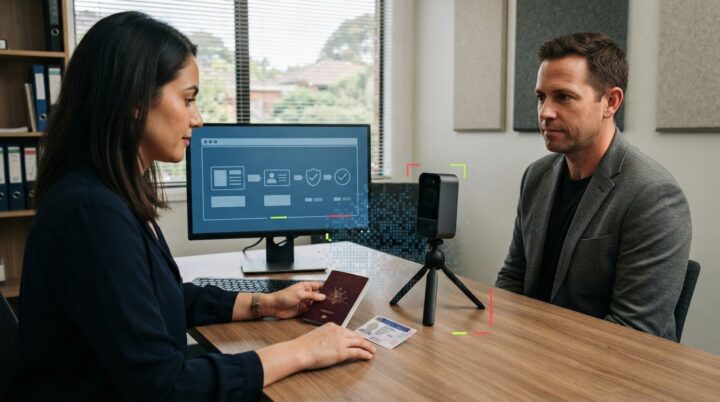
Australian trust and company service providers within scope are subject to AML/CTF obligations from 1 July 2026. A TCSP AML/CTF program needs to do more than collect identity documents: it should support risk assessment, customer due diligence, beneficial ownership checks, ongoing monitoring and suspicious matter reporting. Understanding how TCSP AML rules apply to your services is the first step towards preparing.
It’s understandable to first ask whether your firm’s services bring it within scope. The practical question is what happens next, especially when a client’s ownership structure changes or activity raises concerns. This guide explains how a TCSP AML approach connects covered services with oversight, due diligence, entity workflows, monitoring and reporting. It also shows how to keep the process organised, documented and responsive as client relationships evolve.
Key Takeaways
- Australian TCSPs within scope have AML/CTF obligations from 1 July 2026; whether your work is covered depends on the services you provide.
- Build customer due diligence around the people and entities involved, including those who ultimately own or control a structure.
- Keep entity records current as ownership, control and the purpose of a structure change.
- Make ongoing monitoring part of the client relationship so unusual activity can be assessed and suspicious matters reported to AUSTRAC.
- Connect verification, risk monitoring and reporting workflows to make compliance activity more consistent and easier to document.
AML supervision requirements for TCSPs
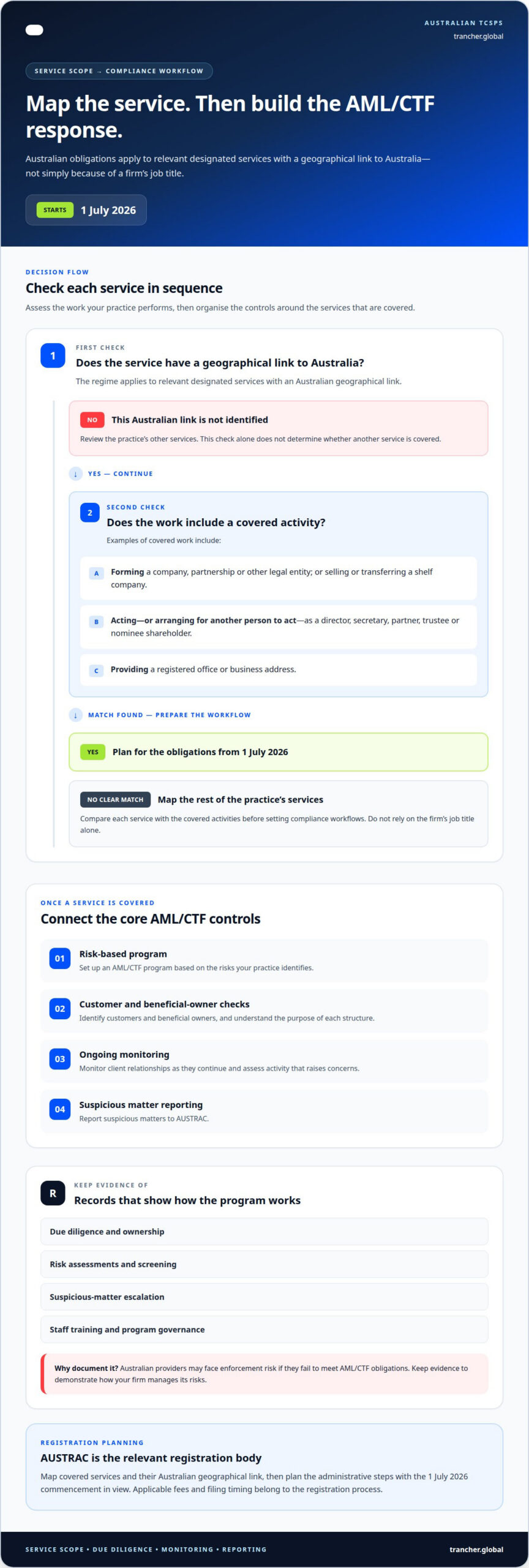
Australian trust and company service providers within scope will have AML/CTF obligations from 1 July 2026. The regime applies to relevant designated services with a geographical link to Australia, not simply to a firm’s job title. A practice should therefore map each service it provides against the covered activities before setting its compliance workflows.
Covered work can include forming a company, partnership or other legal entity, or selling or transferring a shelf company. It may also include acting, or arranging for another person to act, as a director, secretary, partner, trustee or nominee shareholder. Providing a registered office or business address can also bring a service within scope. These activities can create structures that criminals may misuse for money laundering or terrorist financing.
Australian obligations include a risk-based AML/CTF program, customer due diligence, beneficial-owner identification and understanding each structure’s purpose. Providers must monitor ongoing relationships and report suspicious matters to AUSTRAC. Records should cover due diligence, ownership, risk assessments, screening, suspicious-matter escalation, staff training and program governance.
Compared with the UK, Australia’s stated commencement date is 1 July 2026, while UK TCSPs must have supervision before carrying out covered activity. The facts here establish Australia’s covered services and obligations; they do not set out New Zealand’s regime.
In the UK, HMRC maintains a TCSP register under Regulation 54 of the Money Laundering Regulations 2017, except for relevant persons registered with the FCA. A UK firm performing TCSP work may be included when it reports that activity during the previous 12 months. UK providers should check that they have appropriate supervision before undertaking TCSP work. HMRC expects records of potential suspicious activity, the risk assessment and the reasons for submitting or not submitting a report.
Hong Kong uses a licensing model administered by its Companies Registry. Under the updated guideline effective 3 March 2025, TCSP licensees must address customer due diligence and record-keeping requirements in Schedule 2 of AMLO. The regime also requires a Compliance Officer, a Money Laundering Reporting Officer and periodic staff training. Senior management remains responsible for systems that address the firm’s identified risks.
For Australian registration, first map covered services and their Australian geographical link, then plan the administrative steps with the 1 July 2026 commencement in view. AUSTRAC registration and ongoing obligations are also relevant considerations for VASPs. AUSTRAC is the relevant registration body; applicable fees and filing timing belong to that registration process.
Australian providers face enforcement risk if they fail to meet AML/CTF obligations. Keep evidence of program governance, training, due diligence, monitoring and suspicious-matter escalation so your firm can demonstrate how it manages its risks.
Customer due diligence
For a covered company service, customer due diligence means identifying the customer, understanding the structure and assessing its risks. The key is to identify who is instructing you and who ultimately owns or controls the entity.
For an Australian practice, link each check to the service being provided. Someone asking you to form a company may be an intermediary, not the person who will control it. Identify the relevant customers and beneficial owners, verify their information using reliable evidence, and record the structure’s purpose. If a customer chain includes several companies or representatives, map the relationships instead of treating the first contact as the only subject of due diligence.
Customer identity verification deadlines
Hong Kong’s TCSP guideline sets a specific identity-verification timetable: complete verification within 30 working days of establishing a business relationship. If verification remains incomplete after 120 working days, the TCSP must terminate that relationship.
These deadlines apply to Hong Kong, not Australia. They show why service providers need a clear process for outstanding evidence: record the relationship date, track missing documents and escalate delays. Paragraph 4.7.3 of the Hong Kong guideline cites the verification timeline, giving firms a reference point for their administrative workflow.
Supply chains need particular care. Under Regulation 39 of the UK Money Laundering Regulations 2017, a TCSP may rely on another party for CDD only if the Regulations do not prohibit that reliance. UK providers should identify their customer or customers across the chain, then apply due diligence to the right people and entities. A chain may have valid commercial reasons, but it can also signal higher risk. For example, a company secretary acting between a firm and an entity should not obscure who ultimately controls that entity.
Simplified due diligence is a proportionate response to lower risk, not an automatic exemption from understanding the customer. Hong Kong’s guideline identifies potentially lower-risk factors at paragraph 4.8.7 and examples of possible simplified measures at paragraph 4.8.8. For an Australian firm, the practical principle is to document why the assessed risk supports a lighter approach, while retaining enough information to understand the customer and service.
Enhanced customer due diligence
Enhanced due diligence means applying additional checks when customer or service factors indicate higher money-laundering or terrorist-financing risk. Hong Kong’s guideline identifies higher-risk factors at paragraph 4.9.5 and possible enhanced measures at paragraph 4.9.6.
For Australian workflows, record what raises concern, what further evidence or explanation was obtained, and how it affected the risk assessment. The Hong Kong guideline discusses obtaining source-of-wealth information at paragraph 4.9.25. This can help show how enhanced checks address a specific concern rather than becoming a routine document request.
Do trust and company service providers need AML/CTF programs?
Yes. Australian TCSPs providing covered services are subject to AML/CTF obligations, including a risk-based program. The assessment should reflect the services you actually provide and the structures those services help create or manage.
Identifying and mitigating risk
A risk assessment identifies how a firm’s services, clients and structures could be misused for money laundering or terrorist financing. It matters because controls should address risks arising from the work, rather than operate as disconnected administrative tasks.
Start with a clear inventory of covered work. Forming a company, arranging a nominee shareholder or providing a registered office can create different points of exposure. Consider who gives instructions, who exercises ownership or control, and whether the structure’s purpose matches the service requested. A complex ownership chain may call for closer scrutiny than a straightforward structure with clearly explained control.
Link each identified concern to a practical control. For example, if a client’s ownership is difficult to understand, document the control chain and obtain reliable evidence about the people behind it. Record the rationale, decision and any follow-up. Update the assessment when a client changes directors, adds entities or alters the structure’s purpose. This creates a usable record of your response.
Risk-based AML/CTF programs
A risk-based AML/CTF program sets controls in proportion to the risks identified through the firm’s assessment. For Australian TCSPs, it should bring together customer due diligence, beneficial-owner identification, screening, ongoing monitoring, staff training, escalation and suspicious matter reporting.
The firm-wide risk assessment should shape how these elements work in practice. A firm handling company formations and trustee appointments, for example, should consider the risks of each service and how staff can recognise concerns. Document who is responsible for decisions, how concerns reach the appropriate person, and how records stay current. A control that exists only on paper won’t show how staff apply it to a real client relationship.
Use the assessment to set review triggers, rather than create a static document. A change in ownership, a new nominee role or an unexplained change in a structure’s purpose can prompt reassessment. The program should explain what the firm does when risk changes, who acts and what evidence is retained.
TCSP regulation under Australian AML/CTF laws
Australian TCSPs are regulated when their work falls within covered services under the AML/CTF regime. The relevant test concerns the service and its Australian geographical link, not whether a firm describes itself as an accounting or legal practice.
This distinction helps firms assess their actual exposure. A practice that forms entities, arranges nominee appointments or provides a registered office should include those activities in its risk assessment. The same firm may also provide work outside that scope, so its program should link risks and controls to the relevant service lines.
National Risk Assessments provide a wider view of threats, but they don’t replace a firm’s own analysis. The 2025 UK National Risk Assessment, published by HM Treasury and the Home Office, maintained TCSPs’ money-laundering risk rating as high and raised their terrorist-financing rating from low to medium. For an Australian firm, that is comparative context, not Australia’s risk rating. Its own assessment should focus on its clients, services, ownership structures and controls.
Entity and beneficial-owner workflow management
A clear entity workflow links each trust or company service to the people who ultimately own or control the structure. Australian accounting and legal practices providing these services should verify that information using reliable evidence, understand control chains and update records when structures change.
Start with an entity record that distinguishes the customer, the entity receiving the service and the individuals behind it. The person giving instructions may not be the beneficial owner. For a corporate client, record how ownership and control pass through any intermediate entities, and identify the individuals at the end of that chain. For a trust, capture the relevant control relationships and its purpose.
Make the structure visible, not just the names. A practical record can link each person to their role, the entity or trust they relate to, and the evidence supporting that relationship. If a company is owned by another company, record both entities and the link between them. This makes it easier to spot missing information or a control chain that needs further explanation.
Use reliable evidence to verify collected information, and keep a clear record of what you reviewed. Distinguish verified facts from information supplied but not yet substantiated. For example, if a client identifies an individual as the ultimate controller, record the evidence supporting that conclusion and any relevant ownership or control links. This helps staff understand the basis for the entity profile later.
Define how changes feed into the record. A new director, revised shareholding, added corporate owner or altered trust arrangement can change who controls the client structure. Staff receiving that information should be able to update the entity record, reassess the ownership chain and refer material changes for review. Keep previous information and new details traceable, so the file shows what changed and when it was assessed.
- At onboarding: link the customer, service, entity and relevant controllers.
- During verification: capture reliable evidence and map indirect ownership or control.
- When details change: update the structure, record the change and review its effect on the client profile.
- For review: make the supporting evidence and decision history accessible to authorised staff.
Consistent records also help staff work from the same understanding of a structure. If a new instruction conflicts with recorded ownership, flag the difference for assessment rather than silently replacing the existing details. An organised workflow can link client verification, record keeping and internal review, while reducing repeated requests for the same information.
For Australian practices, the goal is a current, explainable picture of each relevant entity and its beneficial owners. A complete structure record supports risk assessment and later monitoring; a stale or fragmented one can obscure who controls the relationship.
Ongoing monitoring and suspicious matter reporting
Client due diligence captures a point in time; monitoring helps a TCSP notice changes in the relationship. For Australian providers, ongoing monitoring and suspicious matter reporting connect client activity to the risks identified in the firm’s AML/CTF program. Focus on changes: new instructions, altered ownership, unexpected funds or activity inconsistent with the stated purpose.
Set monitoring around the service and structure. For a company formation, compare later instructions with the recorded business purpose, ownership and expected activity. If a director changes or the company receives an unexpected movement of funds, consider whether there is a reasonable explanation. A mismatch prompts assessment; it does not prove wrongdoing. Record the facts, context considered and decision made.
Monitoring works best when staff know what to notice and where to raise concerns. Connect client activity to the original risk assessment, then review relevant changes as they arise. For example, consider a request to appoint a new nominee or redirect funds against the client’s established structure and instructions. If the explanation changes your understanding of the risk, update the assessment and supporting records.
- Notice: identify an unexpected instruction, ownership change or movement of funds.
- Compare: assess it against the client’s profile, structure and stated purpose.
- Escalate: send relevant concerns through the firm’s internal suspicious-matter process.
- Record: preserve the information considered, assessment and outcome.
Suspicious matter reporting is the next step. Australian TCSPs should report suspicious matters to AUSTRAC. Staff do not need to treat a concern as a proven offence before raising it internally. The firm’s process should help the right person assess the available information and decide what action follows, while preserving the reasoning behind that decision.
Comparative UK guidance offers an example of what decision records can capture. HMRC expects TCSPs to record potential suspicious activity, their risk assessment and the reasons for submitting or not submitting a suspicious activity report. It also identifies an unusual source of funds or an unexpected movement into a company as factors to consider. These UK examples do not replace Australian requirements, but illustrate how a clear rationale can support consistent decisions.
Keep monitoring records connected to the client file. Note the event, when it came to your attention, who assessed it, what information informed the decision and whether follow-up was needed. If a new director gives instructions that conflict with recorded ownership, preserve both the earlier profile and the concern raised. This makes your response traceable and supports later review.
Strengthen this workflow with ongoing risk monitoring and client activity tracking, so emerging concerns can be assessed alongside client context and records.
Trancher: End-to-End AML/CTF Program Management
Trancher helps Australian trust and company service providers organise AML/CTF work through its end-to-end program management platform. It connects client verification and due diligence, including screening, with ongoing risk monitoring and client activity tracking.
When entity workflows, changing client information and suspicious-matter escalation are hard to manage consistently, Trancher’s regulatory and suspicious matter reporting support can help connect those activities. The platform can support practices preparing for obligations or reviewing how their existing compliance activities fit together. Its tools bring verification, monitoring and reporting into a coordinated process, with documentation to support compliance records.
To discuss how Trancher can support your AML/CTF workflows, contact the team.
Make compliance part of how your firm works
Use your next review to clarify AML/CTF responsibilities in everyday practice. Map who owns each decision, how client information moves between teams and how staff raise concerns. A practical TCSP AML framework should support sound judgement as structures and client relationships evolve, rather than sit apart from the work.
Trancher brings these workflows together through End-to-End AML/CTF Program Management, Client Verification & Due Diligence (KYC/CDD + Screening), and Ongoing Risk Monitoring & Client Activity Tracking. These capabilities support a connected TCSP AML process, from understanding a client to tracking relevant activity over time.
If you’re ready to strengthen how your firm manages these processes, contact Trancher to discuss your AML needs. A considered next step can make compliance workflows clearer and more manageable for your team.
Frequently Asked Questions
How should TCSPs verify beneficial ownership?
Check that ownership information is internally consistent and supported by evidence, rather than relying solely on a client’s declaration. Compare relevant records and note any mismatch, such as a person named as a controller whose role differs across documents. Keep a clear record of how you addressed the discrepancy. If the available evidence does not resolve it, escalate the issue for review before relying on the ownership assessment.
What is TCSP work?
TCSP work is a category of professional activity involving the creation or provision of services for trusts, companies and other legal arrangements. Its AML relevance stems from the provider’s role in enabling or supporting those arrangements. The term describes the nature of the work, not a particular professional qualification, business name or job title. Assess the service your firm performs in context.
What AML records should TCSPs keep?
Keep records that allow someone reviewing a file to understand what happened and why. That includes the information gathered, decisions made, responsible staff and any follow-up. Australian TCSP records should be retained for 7 years. For example, a file should let a reviewer trace how a concern was assessed and what action followed, without relying on staff recollection or separate, unconnected notes.
What does TCSP mean in anti-money laundering (AML)?
TCSP stands for trust and company service provider. In anti-money laundering, it refers to a provider whose work can help establish or administer a legal structure. The label is useful shorthand, but does not by itself determine whether a particular business has obligations. That assessment depends on the services performed and applicable Australian scope.
Which Australian businesses are considered trust or company service providers (TCSPs)?
Businesses may fall within this category when they provide covered services connected with trusts or companies. To assess your firm, review its actual engagements, including what staff do for clients and whether the service has the required Australian geographical link. A professional title alone is not decisive: two practices in the same sector may perform different services and have different scope assessments.
How must Australian TCSPs conduct customer due diligence and beneficial ownership checks?
Apply checks in proportion to the customer and service, and ensure the file supports the conclusions staff reach. If client-supplied information conflicts with reliable evidence, avoid relying on the disputed detail and refer it for assessment. Record the outcome and any remaining risk so later reviewers can understand the decision. A standard form should support judgement, not replace it.
When must Australian TCSPs report suspicious matters, threshold transactions, and international funds transfers?
Australian TCSPs within scope must report suspicious matters to AUSTRAC. Whether threshold transaction or international funds transfer reporting applies depends on the relevant designated service and transaction, not TCSP status alone. Keep these reporting pathways separate in internal procedures: staff should know how to raise a suspicion and identify transactions that trigger other reporting duties. Do not treat one reporting category as a substitute for another.