
An AML/CTF Compliance Officer is a substantive governance role, not just a name on a register. Tranche 1 AML reporting entities’ obligations include appointing an officer who is fit and proper, works at management level, and has the authority, independence, information access and resources to perform the role effectively. Where the entity provides designated services through a permanent establishment in Australia, the officer must be an Australian resident.
It’s understandable to focus first on who can hold the role and what the appointment involves. But effective AML/CTF compliance also depends on how governance, customer due diligence, risk assessment and reporting duties work together, especially when suspicious activity must be reported.
This article explains the AMLCO requirements and the practical responsibilities of Tranche 1 entities under Australia’s reformed AML/CTF regime. It also covers how transitional customer due diligence arrangements apply, what to review in your risk assessment, and why suspicious matter reporting needs clear processes. The aim is to make the obligations easier to understand and put into practice.
Key Takeaways
- An AML/CTF Compliance Officer needs appropriate seniority, independence and access to resources, with Australian residency required in specified circumstances.
- Transitional customer due diligence arrangements have defined conditions and deadlines, so understand how they apply to your existing customers and processes.
- Review your money laundering, terrorism financing and proliferation financing risks, and schedule regular reassessments.
- Current designated business groups cease to exist from 31 March 2026; eligible entities can consider whether an Elective Reporting Group suits their structure.
- Effective suspicious matter reporting depends on clear internal escalation and careful handling of information that could prejudice an investigation.
Responsibilities of governing bodies, senior managers and compliance officers
Under the Tranche 1 AML reporting entities obligations, governance must connect the AML/CTF program with day-to-day decisions. Governing bodies and senior managers oversee the framework, support its implementation and ensure the compliance officer can act effectively. A policy document alone is not enough: entities must operationalise their updated program and related policies for the reformed regime, which commenced for current reporting entities on 31 March 2026.
The AML/CTF Compliance Officer (AMLCO) must meet specific suitability and authority requirements. The officer must be a fit and proper person, employed or engaged at management level, and have sufficient authority, independence, access to information and resources to perform the role effectively. If a reporting entity provides designated services through a permanent establishment in Australia, its AMLCO must be an Australian resident. A sole practitioner providing a designated service may act as their practice’s AMLCO.
Appointment and notification are separate governance steps. Reporting entities enrolled with AUSTRAC on 30 March 2026 must notify AUSTRAC of their AML/CTF compliance officer by 30 May 2026. Under the Transitional Rules, Australian reporting entities can notify AUSTRAC of their AML/CTF Compliance Officer by 30 June 2026. For newly regulated businesses, notification is due by the later of 14 days after enrolment or 29 July 2026. Apply the deadline relevant to the entity’s enrolment and transitional arrangements, and retain a record of the appointment and notification.
To meet updated program requirements, revise the AML/CTF compliance program and related policies, then put the approved procedures into practice. The program should connect governance oversight with customer due diligence, staff responsibilities, record keeping and reporting processes. Senior managers can support this by assigning responsibilities, ensuring relevant staff receive training, and giving the AMLCO access to information needed to escalate issues. These steps turn CTF compliance from a policy statement into a working control framework.
What are the requirements for AML/CTF programs and risk assessments in Australia? Reporting entities must maintain and operationalise an AML/CTF program that reflects their risks and updated requirements. They must review their ML/TF risk assessment at least once every three years and update it to address money laundering, terrorist financing and proliferation financing risks.
Non-compliance can have financial consequences. A reporting entity that fails to follow the procedures in its own AML/CTF Program can face civil penalties in Australia. Practical implementation matters: governing bodies should ensure procedures are assigned, understood and followed, while senior managers support timely corrective action when controls fall short.
Transitional rules for initial customer due diligence
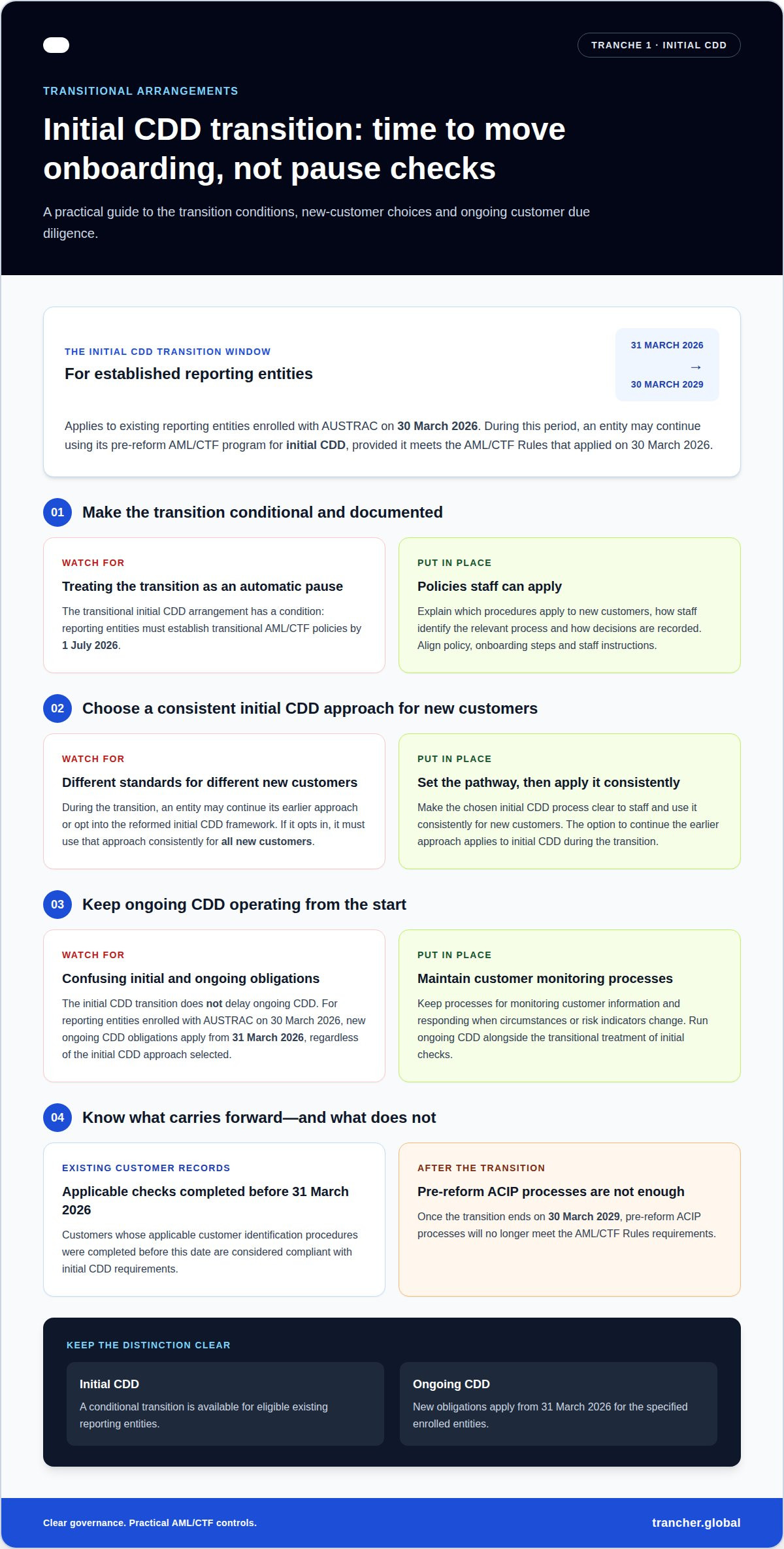
For existing reporting entities enrolled with AUSTRAC on 30 March 2026, the transition separates initial customer due diligence from ongoing obligations. The initial CDD transitional period runs from 31 March 2026 to 30 March 2029. During that period, an entity may continue using its pre-reform AML/CTF program for initial CDD, provided it meets the AML/CTF Rules that applied on 30 March 2026. This gives established businesses time to move their onboarding procedures to the reformed framework.
The transition is conditional, not an automatic pause on customer checks. To rely on the transitional initial CDD arrangements, reporting entities must establish transitional AML/CTF policies by 1 July 2026. Those policies should explain which procedures apply to new customers, how staff identify the relevant process, and how decisions are recorded. The ctf compliance officer can help make the arrangements workable by aligning policy, onboarding steps and staff instructions. Keep the distinction clear: transitional policies support initial due diligence, not a suspension of the wider ctf regime.
Existing customer records also need to be understood in context. Where an entity completed applicable customer identification procedures before 31 March 2026, those customers are considered compliant with initial CDD requirements. For new customers during the transition, the entity can continue its earlier approach or opt into the reformed initial CDD framework. An entity that opts in must apply the reformed approach consistently to all new customers. Applying different initial CDD standards to different new customers would not meet that consistency requirement.
Ongoing CDD has a different timetable. Reporting entities enrolled with AUSTRAC on 30 March 2026 must meet the new ongoing CDD obligations from 31 March 2026, regardless of the initial CDD approach they choose. Ongoing CDD therefore applies alongside the transitional treatment of initial checks. Entities should maintain processes for monitoring customer information and responding when circumstances or risk indicators change. After the transition ends, pre-reform ACIP processes will no longer meet the AML/CTF Rules requirements.
How do Tranche 1 AML obligations differ from the expanded Tranche 2 regime starting in 2026? Tranche 1 covers businesses already regulated, whose reformed requirements apply from 31 March 2026. Tranche 2 brings newly covered designated services into the regime from 1 July 2026, including specified professional services, bullion and cryptocurrency services.
For a practical transition, map each customer journey to its applicable initial CDD procedure, then document how ongoing checks operate from 31 March 2026. A consistent customer due diligence workflow can help bring verification, screening and ongoing monitoring into a clearer process.
ML/TF risk assessments
Australia’s reformed AML/CTF regime requires reporting entities to update their money laundering, terrorist financing and proliferation financing risk assessment. The assessment should guide how the entity implements controls and allocates oversight.
ML/TF risk assessment process
Start by documenting how the business could be exposed to money laundering, terrorist financing and proliferation financing. Consider its services, customers, delivery channels and business relationships, then record the factors that shape its exposure. For example, a remitter can examine how customers access transfer services and what information is available about their activity.
Next, connect each identified risk to the controls in the AML/CTF program. Record who owns each action, how the control operates and what evidence shows it is working. This makes the assessment useful to governing bodies and operational teams, rather than a document disconnected from business decisions.
Check that the assessment covers proliferation financing as well as money laundering and terrorist financing. The amended AML/CTF Act includes an exception allowing an entity to omit direct proliferation-financing coverage from its policies if it reasonably assesses that its risks are low and can be managed through its money-laundering and terrorism-financing policies. Document the basis for that conclusion.
Risk assessment reviews and frequency
Australian reporting entities must review their ML/TF risk assessment at least once every three years. Set a review date in the compliance calendar, assign responsibility and retain the updated assessment with its supporting records. A scheduled review helps ensure changes in services or operating arrangements are reflected in the documented risk picture.
Between scheduled reviews, treat a material change as a prompt to consider whether the assessment remains accurate. Introducing a new service, changing customer access channels or entering a new business relationship may alter the entity’s exposure. Document the review decision and any resulting update, even if the assessment’s conclusions remain unchanged.
Captured Australian real estate businesses must conduct an ML/TF risk assessment to comply with the AML/CTF Act and Rules by 1 July 2026. For other reporting entities, the three-year review requirement still provides a clear minimum schedule. A sound assessment links identified risks to controls, owners and review records, helping the business implement its AML/CTF framework consistently.
Reporting Groups and Lead Entities
Group arrangements can help related reporting entities coordinate AML/CTF responsibilities, but they do not remove the need to identify each entity’s obligations. First establish which business provides a designated service, then assess whether an eligible group arrangement is appropriate.
Businesses covered by Tranche 1
Tranche 1 includes businesses already regulated under Australia’s AML/CTF Act, such as banks, remitters, casinos and lenders. Coverage turns on whether a business provides a designated service, not simply its industry label. A remitter, for example, should identify the particular service it provides and the entity responsible for that service.
Existing designated business groups cease to exist from 31 March 2026. An Elective Reporting Group may instead consist of 2 or more persons who elect to form a group as permitted by the AML/CTF Rules. Businesses considering this arrangement should identify participating entities, their services and how group policies will work across their operations.
A group structure needs clear responsibilities in practice. Set out which entity oversees shared policies, how each member escalates issues, and how the compliance officer receives relevant information. For example, a group with a remitter and a lender should distinguish their designated services while documenting shared AML/CTF processes. The arrangement should support consistent implementation without obscuring each entity’s role.
AUSTRAC enrolment and registration details
Australian reporting entities must enrol with AUSTRAC within 28 days of providing a designated service. Identify the service and the legal entity providing it, then complete the relevant enrolment process. AUSTRAC registration is an additional step relevant only to remittance network providers, independent remitters and virtual asset service providers; other reporting entities do not need to register.
To keep enrolment records useful, assign responsibility for reviewing them when the business changes. For example, a change to the entity’s services, operating structure or nominated compliance officer should prompt an internal review of relevant AUSTRAC records and policies. Record who assessed the change and what action followed. This is a practical control, not a substitute for specific enrolment requirements.
What businesses are Tranche 1 AML/CTF reporting entities in Australia? They include existing regulated businesses such as banks, remitters, casinos and lenders, where they provide designated services. The service provided determines whether the AML/CTF regime applies.
How do Tranche 1 entities enrol with AUSTRAC and keep their registration details up to date? They must enrol within 28 days of providing a designated service; remittance network providers, independent remitters and virtual asset service providers also have a registration step. Assign an internal owner to review relevant records when services, structure or compliance arrangements change.
If considering a group arrangement, document its membership, shared policies and escalation pathways before relying on it operationally. Clear records help a lead entity coordinate oversight while preserving visibility of each member’s designated services and responsibilities.
Suspicious matter reporting
For Tranche 1 entities, suspicious matter reporting is an operational control, not simply a form-filing task. From 31 March 2026, ongoing customer due diligence, transaction monitoring and suspicious matter reporting obligations apply regardless of the initial CDD approach chosen.
Suspicious matter reports
Set out how staff identify concerns, escalate them internally and prepare information for AUSTRAC. A remitter, for example, can ensure frontline staff know how to record unusual activity and refer it to the appropriate decision-maker. The procedure should identify who assesses the concern, documents the reasoning and manages the reporting process.
Keep escalation routes clear for routine operations and urgent concerns. Staff should know which facts to record, how to preserve relevant records and whom to notify internally. These steps help the reporting entity assess suspicious activity consistently, rather than relying on informal conversations or individual memory.
Report deadlines and thresholds
From 31 March 2026, the reformed regime’s ongoing reporting obligations apply to existing reporting entities enrolled with AUSTRAC on 30 March 2026. Cash transactions of AUD 10,000 or more must be reported to AUSTRAC as Threshold Transaction Reports when relevant. That monetary threshold concerns cash transaction reporting, not the assessment of suspicious activity.
Suspicious matter reporting centres on the concern identified, while transaction reporting follows its applicable reporting criteria. Build procedures that distinguish these pathways and route each matter to the correct assessment. Staff should escalate suspicions without treating the cash threshold as a test of whether suspicious activity warrants attention.
Confidentiality matters after a report is considered or submitted. Australia’s amended tipping-off offence applies to disclosing suspicious-matter information to someone other than AUSTRAC when disclosure would, or could reasonably be expected to, prejudice an offence investigation. The Schedule 5 tipping-off offence reforms commenced on 31 March 2025. Internal procedures should therefore limit access to relevant information and guide staff on appropriate communications.
A practical reporting procedure links monitoring alerts to a documented decision. Record the activity considered, the information assessed, the escalation path and the reasoning behind the action. For example, if transaction monitoring identifies activity that staff consider suspicious, the record should show how the concern reached the designated decision-maker. Keep reporting records accessible to authorised personnel and aligned with the entity’s AML/CTF program.
To strengthen this workflow, streamline suspicious matter reporting through structured reporting procedures and documented escalation. Clear ownership, appropriate access controls and distinct handling of suspicious matters and threshold transactions help reporting entities apply their obligations consistently.
Trancher: Regulatory & Suspicious Matter Reporting
Trancher helps Australian reporting entities bring AML/CTF reporting processes into a structured workflow. Its regulatory and suspicious matter reporting support works alongside ongoing risk monitoring and client activity tracking to help identify matters that may need assessment.
For remitters, financial services and gambling providers, the practical value lies in connecting monitoring, escalation and reporting records. Trancher also supports end-to-end AML/CTF program management, client verification and due diligence, including KYC/CDD and screening. Use these capabilities when reporting procedures need to work alongside customer checks and ongoing monitoring, with records organised for review.
Contact Trancher to discuss how its AML/CTF platform can support your reporting workflows.
Build your next compliance improvement
Turn your understanding of the obligations that apply to Tranche 1 AML reporting entities into a focused operational decision. Choose one area where teams need clearer ownership, then define what a sound process should look like and how its performance will be reviewed.
A short internal discussion can surface practical barriers, such as unclear handovers or records that are difficult to retrieve. Use those insights to prioritise a manageable improvement and agree who will lead it. This gives compliance work a clear direction without turning every process change into an immediate project.
For support planning your next step, contact Trancher about your AML obligations. A considered, practical improvement can help your organisation move forward with confidence.
Frequently Asked Questions
Are there any special requirements for an AMLCO?
Beyond the appointment itself, the AMLCO’s role must work in practice. Define how operational teams raise concerns, how the officer can obtain relevant records, and how unresolved issues reach senior decision-makers. For example, document an escalation route for a customer-screening alert that frontline staff cannot resolve. Clear role boundaries help the officer coordinate compliance activity without leaving staff unsure who makes or records a decision.
Can I outsource any of my AML obligations?
Outsourcing can support discrete activities, such as screening administration or preparing compliance records, while internal governance arrangements remain clear. Before assigning work, define its scope, expected outputs, access permissions and review process. For example, establish who checks that a completed customer file contains the required evidence and who handles exceptions. These controls help integrate external work into the organisation’s own procedures.
What are the types of activities AML/CTF compliance requires?
The work spans planned controls and responses to specific events. Routine tasks can include reviewing customer information, checking alerts and maintaining staff guidance. Event-driven tasks may include escalating an unusual transaction or updating a risk decision after new information emerges. A responsibility schedule can show which team handles each task, what records it produces and how unresolved items reach an authorised decision-maker.
What comprises the AML/CTF framework?
A practical framework connects written controls to the people, systems and records used in daily work. For example, a customer-risk decision should have an assigned owner, a documented rationale and a route for later review. Teams can map each control to its operating procedure and evidence source. This makes gaps easier to identify, clarifies how controls work and helps keep the framework aligned with actual business processes.
What is a designated service?
To assess a service, describe what the business actually does for the customer, who performs each part and how the arrangement is structured. A product label or industry description alone may not capture the relevant activity. For example, map the customer journey from instruction through delivery, noting where the business handles funds, arranges a transaction or provides another service. This gives the entity a clearer basis for assessing coverage.
Which services and activities make an Australian business a Tranche 1 reporting entity?
Start with the actual service, then compare its features with the designated-service descriptions in the AML/CTF Act. Document the service provider, customer interaction and transaction flow, especially where related entities share delivery. This analysis can distinguish a business that performs a regulated activity from one that only supports another provider. Keep the reasoning with the service description so future operational changes can be assessed against it.
What are the obligations of Tranche 1 reporting entities under the AML/CTF Act?
Translate the organisation’s obligations into assigned tasks, evidence and review points. A practical register might identify each control owner, the procedure they follow, the record retained and who reviews exceptions. For example, a reporting workflow should show how an alert moves from detection to assessment and a documented outcome. This operational view helps teams identify unowned tasks and focus internal oversight.
How must Tranche 1 entities conduct customer identification and verification (KYC)?
Build a consistent onboarding record that captures the information collected, checks completed, any discrepancy and how it was resolved. Link screening results to the relevant customer file, with an escalation route for potential matches or incomplete information. For example, staff handling an alert should record why it was cleared or referred. Consistent records help teams apply the organisation’s process and explain decisions later.