

Your compliance workflow is no longer just a back-office task; it’s now the front line of your practice’s risk management and professional reputation. With the Tranche 2 reforms in full effect as of July 1, 2026, the administrative burden on accountants has shifted from a minor inconvenience to a critical regulatory requirement. You’ve likely realised that manual document collection is not only time-consuming but also creates unnecessary friction for clients who are wary of sharing sensitive information via email. Adopting automated client verification Australia wide allows you to navigate these changes with confidence, replacing outdated manual processes with a secure, digital standard.
This guide explains how to transform these regulatory obligations into a seamless, billable service for your practice. We’ll show you how to move from clunky ID checks to a secure, audit-ready workflow that protects your firm and impresses your clients. You’ll discover how to achieve total readiness without sacrificing your team’s productivity, turning a complex transition into a clear avenue for growth and operational ease. By the end of this article, you’ll have a clear roadmap to transition from manual hurdles to a streamlined, high-performance compliance culture.
Key Takeaways
- Understand why the July 2026 Tranche 2 deadline makes traditional visual identity checks insufficient for modern accounting practices.
- Discover how automated client verification Australia wide leverages biometric liveness testing and DVS integration to secure your onboarding workflow.
- Recognise the hidden staff costs of manual document collection and learn how automation prevents compliance errors during peak tax periods.
- Follow a practical, two-step roadmap to assess your current processes and select a platform that integrates with your practice management software.
- Learn how to reframe regulatory obligations as a billable advisory service, turning a cost centre into a steady revenue stream.
The Evolution of Client Verification in Australia: Preparing for July 2026
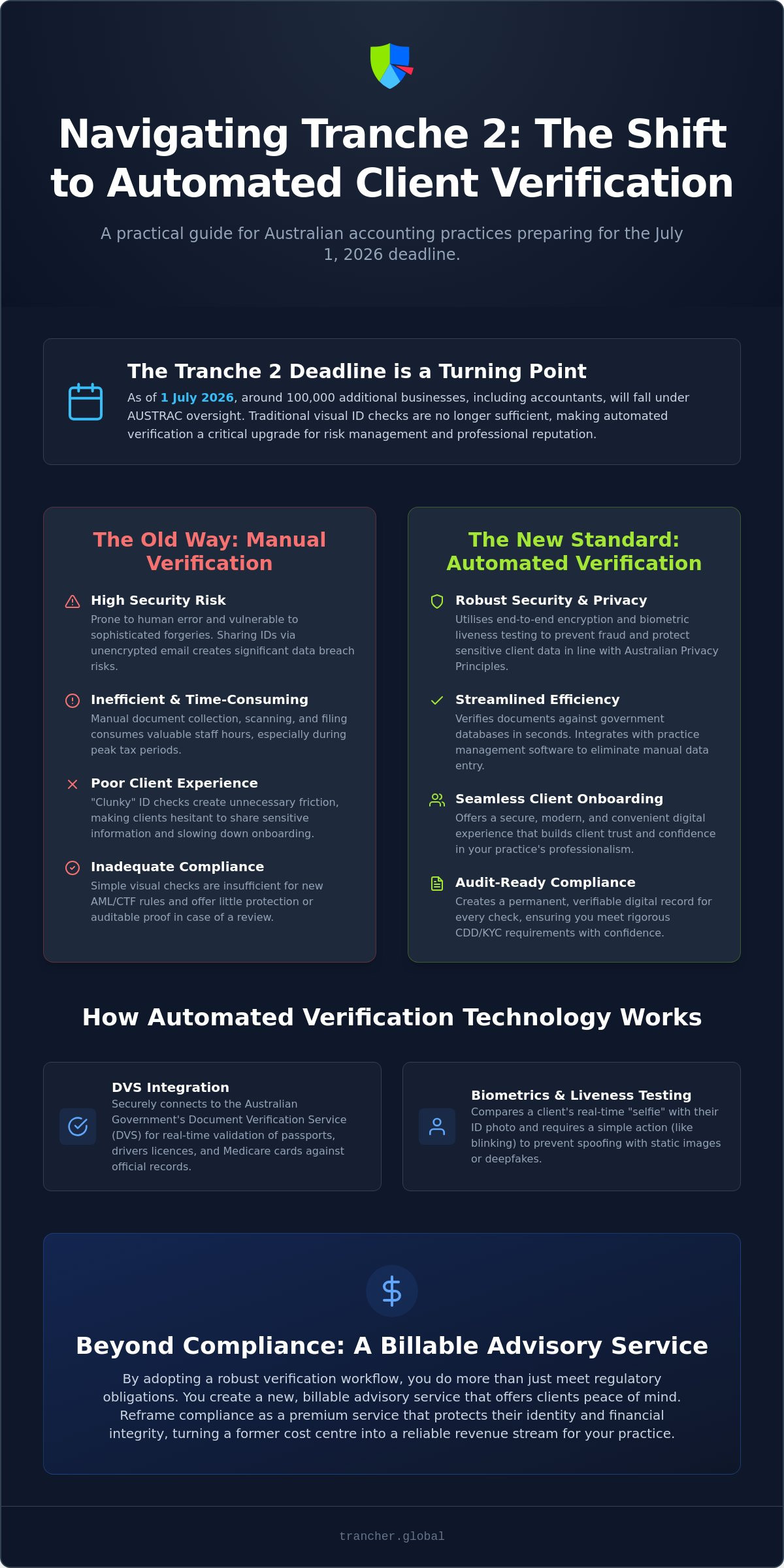
The landscape of professional services in Australia is undergoing its most significant transformation in twenty years. On July 1, 2026, the commencement of Tranche 2 of the AML/CTF Act will bring approximately 100,000 additional businesses under AUSTRAC oversight. For accounting partners, this means the days of simply glancing at a client’s drivers licence are over. Visual checks are prone to human error and offer little protection against sophisticated identity fraud. Adopting automated client verification Australia wide is the logical response to this new regulatory reality.
Automation provides a steady hand. It removes the guesswork and the “compliance anxiety” that often bubbles up as deadlines loom. Instead of worrying about whether a staff member filed a copy correctly, partners can rely on a system that creates a permanent, audit-ready record. This transition isn’t just about avoiding penalties; it’s about building a more resilient practice. It allows you to focus on your clients while the software handles the heavy lifting of regulatory due diligence.
What is Automated Client Verification?
This process represents a move away from manual document handling toward secure, cloud-based systems. These platforms integrate directly with the Australian Government’s Document Verification Service (DVS), allowing for real-time checks against official databases. This is a core component of modern Know Your Customer (KYC) procedures, ensuring that identity data is accurate and current. Essentially, automated verification is a secure digital bridge between government records and firm workflows.
The Tranche 2 Impact on Australian Accounting Firms
Under the new framework, specific “designated services” trigger mandatory obligations. Whether you’re assisting with company formation, managing client funds, or acting as a trustee, you’ll need to meet rigorous standards. This marks a shift from basic tax-related checks to comprehensive CDD and KYC requirements Australia has established for high-risk sectors. A scalable solution is vital. Without automation, the administrative load of verifying every new and existing client could easily overwhelm a mid-sized firm. By integrating these checks into your onboarding, you ensure compliance is a seamless part of your service delivery rather than a bottleneck.
How Automated Verification Technology Works for Modern Practices
Understanding the technical architecture of automated client verification Australia wide helps partners move beyond simple document collection. The process begins with a direct connection to the Australian Government’s Document Verification Service (DVS). This allows your practice to validate passports, drivers licences, and Medicare cards against official records in seconds. It effectively eliminates the risk of accepting forged physical documents that might bypass a visual inspection by a busy staff member.
Security is a central pillar of these systems. Modern platforms utilise end-to-end encryption to ensure that sensitive client data is stored in strict compliance with the Australian Privacy Principles (APP). You aren’t just meeting AUSTRAC standards; you’re protecting your firm from the data breaches that often occur when IDs are sent via unencrypted email. If you’re looking for a way to streamline these checks, you might explore our workflow automation options to see how they fit your specific needs.
Biometrics and Liveness Testing
Facial recognition technology has matured into a vital tool for the accounting profession. The system compares a real-time “selfie” with the photo on a government-issued ID to confirm a precise match. This method is significantly more secure than accepting a static photocopy or a digital scan. The “liveness” component is the real hero here. It requires the client to perform a simple action, like blinking or turning their head, which ensures the person is physically present. This proactive measure blocks identity theft attempts using high-resolution photos or sophisticated deepfakes.
PEPs and Sanctions Screening
Verification doesn’t stop at identity. Automated systems also scan global watchlists to identify Politically Exposed Persons (PEPs) or individuals on international sanctions lists. Implementing PEPs and sanctions screening software allows your firm to detect high-risk indicators instantly. If a match is found, the system flags it immediately within the onboarding flow. This allows you to conduct enhanced due diligence before the professional relationship begins. It’s a reliable way to manage risk without adding hours of manual research to your team’s workload. By automating these background checks, you ensure that high-risk indicators are never missed during the initial onboarding phase.
Manual vs. Automated Verification: Protecting Your Practice and Your Time
Manual verification is often a silent drain on an accounting practice’s resources. While checking a physical ID might seem straightforward, the hidden costs of the “manual chase” quickly accumulate. Your staff spend valuable hours sending follow-up emails, explaining document requirements, and manually filing sensitive data. This administrative friction doesn’t just eat into your margins; it also risks “compliance drift.” During the high-pressure environment of a busy tax season, manual systems are the first to fail. When your team is stretched thin, the consistency of your due diligence can slip, leaving the firm exposed to AUSTRAC scrutiny.
Adopting automated client verification Australia wide replaces these fragmented efforts with a single, repeatable standard. It ensures that every client is screened with the same level of rigour, regardless of how busy the office becomes. This consistency is your best defence against regulatory penalties. By removing the human element from the data collection phase, you eliminate the risk of missed steps or misplaced documents. You aren’t just saving time; you’re building a fortress around your practice’s reputation and operational integrity.
Efficiency Gains and Administrative Relief
The difference in speed is stark. A traditional manual verification process can drag on for two weeks as clients struggle to find scanners or send the correct documents. In contrast, an automated check is often completed in under two minutes. This shift provides an immediate psychological benefit for your staff. Instead of acting as “document chasers,” your team can focus on high-value advisory work that actually moves the needle for your clients. Automation ensures that no new engagement slips through the cracks, even when your practice is operating at peak capacity. It turns a bottleneck into a streamlined gateway.
The Security and Compliance Gap
Security is where the manual approach becomes truly dangerous. Storing copies of passports or drivers licences in unencrypted email folders or physical filing cabinets is a significant liability. If a breach occurs, the fallout for your firm could be devastating. Automated platforms close this gap by providing a centralised, tamper-proof environment for all identity data. These systems generate audit-ready compliance records that are instantly accessible during a regulatory inspection. Having a clear, digital audit trail gives partners immense peace of mind. You can prove exactly when and how each client was verified, demonstrating a proactive commitment to the highest professional standards.
Implementing an Automated Workflow: A Roadmap for Practice Partners
Transitioning to automated client verification Australia wide is a strategic project that yields long-term dividends for your firm’s operational health. It isn’t just about software; it’s about refining your internal culture to embrace a digital-first compliance standard. A successful implementation follows a structured roadmap that ensures your team and your clients feel supported throughout the change. By treating this transition as a practice upgrade rather than a regulatory chore, you position your firm as a forward-thinking leader in the professional services space.
The first step is a thorough gap analysis of your current onboarding journey. Map out every touchpoint, from the initial client meeting to the final document filing. You’ll likely discover hidden bottlenecks where manual follow-ups are draining staff time. Once these gaps are identified, you can move through the following stages:
- Select an integrated platform: Choose a solution that connects directly with your existing practice management software to avoid manual data entry.
- Update your AML/CTF program: Your written compliance programme must accurately reflect your new automated procedures to remain AUSTRAC-compliant.
- Focus on the “Why”: Train your team on the purpose behind these standards, emphasizing how automation protects the firm and the clients from identity fraud.
- Client Communication: Frame the new verification process as a premium security upgrade designed to protect their sensitive personal information.
Choosing the Right Tech Stack
When evaluating providers, prioritise those that are Australian-owned and fully DVS-certified. This ensures the technology is built specifically for the local regulatory environment and offers the highest level of data sovereignty. Fragmented tools often lead to data silos and increased risk. Instead, look for end-to-end solutions that handle everything from identity checks to ongoing monitoring, including enhanced due diligence software Australia firms can rely on to automate complex trust structure verification and beneficial owner checks. Integration with core accounting tools like Xero or MYOB is essential for maintaining a high-velocity workflow. If you’re ready to see how these pieces fit together, you can request a workflow audit to identify the best path forward for your practice.
Staff Onboarding and Culture Shift
The success of your new workflow depends on how your team perceives the change. Position compliance as a high-value professional service rather than a back-office burden. Role-based training is vital here; ensure that every staff member understands their specific responsibilities within the new digital framework. This clarity reduces friction and builds confidence across the organisation. Partners should lead the transition with a clear focus on practice modernisation, demonstrating that these new systems are tools for empowerment and efficiency. When the leadership team champions the digital shift, the rest of the firm will naturally follow suit with a sense of shared purpose.
Beyond Compliance: Turning Verification into a Profitable Advisory Service
Viewing automated client verification Australia wide as a mere cost of doing business is a missed opportunity for the modern accounting firm. While the Tranche 2 requirements represent a significant regulatory shift, they also provide a natural opening to deepen your advisory relationships. By positioning identity verification and risk assessment as a premium security feature, you move the activity from a non-billable overhead to a recoverable professional service. This transition allows you to maintain practice profitability while ensuring your firm remains at the forefront of Australian regulatory standards.
Your expertise in navigating these complex requirements is valuable to your clients. Many business owners are equally concerned about identity theft and financial crime; they appreciate a partner who takes these threats seriously. Using your verification workflow as a gateway, you can offer broader AML advisory services, helping your clients understand their own risk profiles. For clients with complex ownership structures or elevated risk indicators, deploying enhanced due diligence software Australia practices trust can help you conduct thorough investigations without creating an administrative bottleneck. This proactive approach reinforces your role as a strategic guide, turning a mandatory obligation into a high-value touchpoint that strengthens client retention and opens new revenue streams.
Compliance as a Revenue Driver
Transforming a cost centre into a profit centre requires a clear strategy for value communication. Many successful firms now include compliance-related charges in their engagement letters, justifying the fee through the enhanced security and fraud protection provided to the client. Utilising compliance ROI tracking software is essential for this process. These tools allow you to monitor the exact time and resources spent on due diligence, providing the data needed to support your billing. When you can demonstrate the rigour of your onboarding process, clients often view the associated cost as a worthwhile investment in their own protection.
The Trancher Advantage
Our platform is specifically designed to meet the unique needs of Australian SME accounting firms. We provide a comprehensive suite of tools that manage the entire AML/CTF lifecycle, from initial screening to ongoing activity tracking. This isn’t just about software; it’s about a steady partnership. We offer local, expert support to guide you through every stage of the implementation. With our 30-day guarantee, your practice can move from zero to AUSTRAC-ready with minimal friction. We also offer a 3-month complimentary trial to ensure the system integrates perfectly with your existing workflows. If you’re ready to secure your practice and streamline your compliance, we invite you to start a conversation with Aaron Soh today.
Future-Proof Your Practice with Automated Compliance
Adopting a modern approach to automated client verification Australia wide ensures your practice remains resilient and ready for the July 2026 regulatory shift. You’ve seen how removing manual bottlenecks protects your team from burnout and your firm from unnecessary risk. By integrating real-time DVS checks and biometric testing, you secure your clients’ data while establishing a permanent, audit-ready record that meets AUSTRAC’s highest standards. This transition isn’t just about meeting a deadline; it’s about building a more efficient, high-performance practice.
This evolution is an opportunity to modernise your operations and turn a regulatory requirement into a profitable advisory pillar. We’re here to guide you through every step of that journey. Secure your practice for 2026 with a complimentary 3-month trial of the Trancher platform. Our system is designed specifically for Australian SME accounting firms, and we guarantee you’ll be AML/CTF compliance-ready within 30 days. We even include comprehensive ROI reporting at the end of your trial so you can see the tangible value for yourself.
You don’t have to manage these changes alone. With the right technology and a steady partner, you can lead your practice into this new landscape with absolute confidence and professional ease.
Frequently Asked Questions
Is automated client verification mandatory for Australian accountants under Tranche 2?
While AUSTRAC doesn’t strictly mandate a specific technology, it does require the outcome of rigorous identity verification and due diligence. Meeting these Customer Due Diligence (CDD) standards manually is increasingly difficult given the volume of checks required from July 1, 2026. Adopting automated client verification Australia wide is the most reliable way to ensure your practice remains compliant and avoids the significant civil penalties associated with the new reforms.
How does automated verification protect my practice from identity fraud?
Automated systems utilize biometric liveness testing and facial recognition to confirm that a client is physically present and matches their ID. This proactively blocks attempts by criminals to use stolen photographs or sophisticated deepfakes. By validating credentials against official records in real-time, you remove the human error inherent in visual inspections and ensure your firm isn’t vulnerable to forged documents.
What is the Document Verification Service (DVS) and why is it important?
The DVS is a secure national online system that allows organisations to compare identity document information against the original government records. It is a critical component of modern compliance because it provides an instant, authoritative confirmation of a document’s validity. This ensures your practice relies on verified data rather than potentially altered digital scans or physical photocopies.
Will my clients find the automated verification process difficult?
Most clients find the digital experience significantly more convenient than traditional manual methods. It eliminates the need for them to visit your office in person or find a Justice of the Peace to certify their documents. They simply follow a secure link on their smartphone, capture a photo of their ID, and complete a quick liveness check in under two minutes.
How long does it take to implement an automated verification system?
Your practice can be operational with a basic setup almost immediately, though we ensure you are fully AML/CTF compliance-ready within 30 days. This period includes the necessary staff training and the formal updating of your compliance programme. The focus is on a methodical transition that integrates the new technology into your existing onboarding workflow without causing operational friction.
Can I charge my clients for the cost of automated verification?
Yes, many Australian firms choose to recover these costs by including a compliance or security fee in their engagement letters. When you frame the verification as a premium protective measure for the client’s own identity, they typically accept the charge as a standard professional standard. This shift helps transform a regulatory obligation into a recoverable activity for your practice.
What happens if a client fails the automated verification check?
A failure doesn’t automatically mean you must reject the client, but it does serve as a flag for enhanced due diligence. You should review the specific reason for the failure, such as an expired document or a biometric mismatch, and attempt to resolve the issue through further inquiry. This structured approach ensures your firm makes onboarding decisions based on clear, documented risk assessments.
How does Trancher ensure my client data is stored securely?
We utilise advanced end-to-end encryption to protect all sensitive information, ensuring strict adherence to the Australian Privacy Principles (APP). Data is stored in secure, Australian-based environments to maintain data sovereignty and professional standards. This provides a far more secure alternative to the common, risky practice of storing ID documents in unencrypted email folders or physical filing cabinets.