

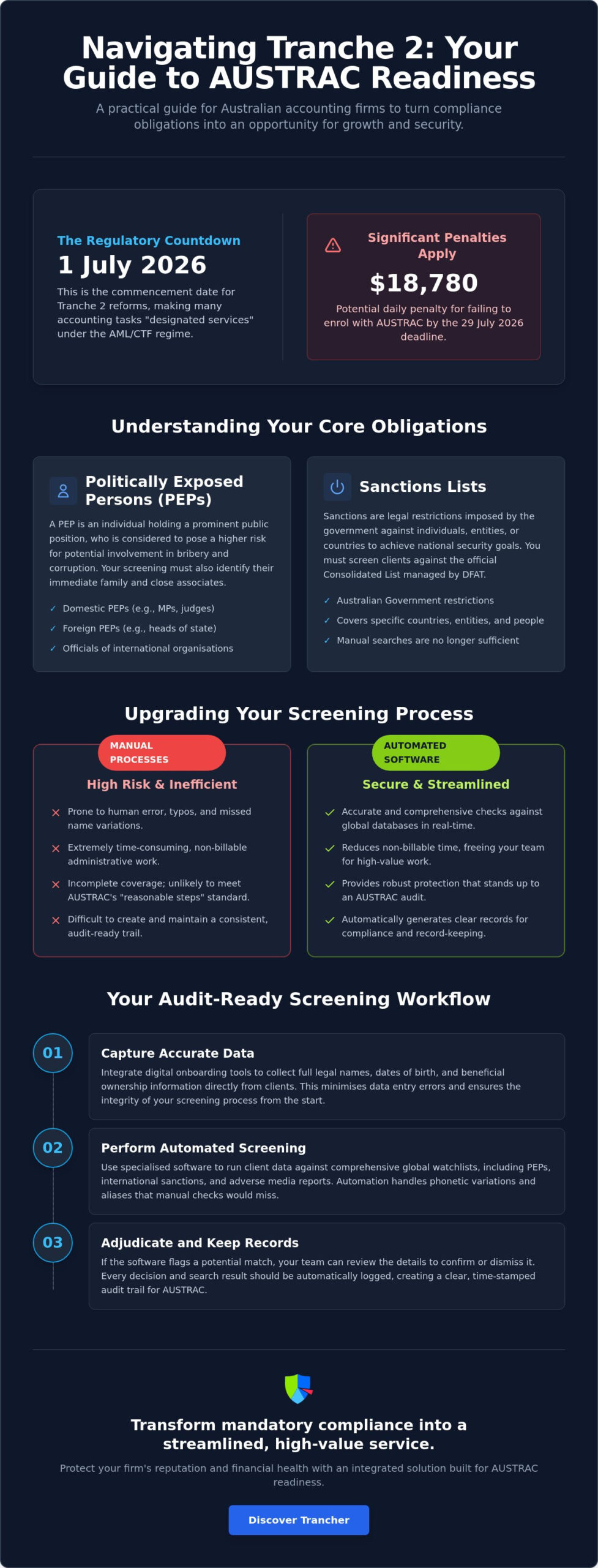
Did you know that failing to enrol with AUSTRAC by 29 July 2026 can result in a daily penalty of up to $18,780 for your accounting firm? Adopting reliable PEPs and sanctions screening software is the most effective way to manage this risk before the 1 July 2026 commencement date. It’s understandable if the weight of Tranche 2 readiness feels like a significant administrative hurdle, especially when manual data entry and complex trust structures already consume so much of your time. Many practitioners worry that these new requirements will simply become a permanent, non-billable overhead that eats into their margins.
We’re here to show you that meeting your obligations can be a catalyst for growth rather than a burden. You can transform these mandatory checks into a seamless, automated part of your client onboarding that protects both your practice and your reputation. This guide will walk you through the process of integrating screening into your firm to ensure you’re audit-ready while maintaining your profitability. You’ll learn how to replace friction with efficiency and turn compliance into a high-value, recoverable service for your team.
Key Takeaways
- Understand why the 1 July 2026 Tranche 2 deadline necessitates a shift from manual processes to automated, high-integrity regulatory workflows.
- Learn how to embed PEP and sanctions checks into your existing onboarding journey to identify potential risks before an engagement begins.
- Identify the critical features to look for in PEPs and sanctions screening software, prioritising data accuracy and practice management integration.
- Establish clear internal protocols and assigned roles to ensure your firm maintains audit-ready records while minimising non-billable administrative time.
- Discover how to transform mandatory AML/CTF obligations into a streamlined, recoverable service that strengthens your firm’s internal systems and financial health.
Understanding PEPs and Sanctions Screening in the Tranche 2 Era
For many years, Australian accounting firms operated outside the formal AML/CTF regime. That changes on 1 July 2026. The Tranche 2 reforms classify many common accounting tasks, such as tax planning and the creation of trusts or companies, as “designated services.” This means your practice must now proactively identify and manage financial crime risks. At the heart of this requirement is the need to verify whether your clients are high-risk individuals or entities before you provide any professional advice.
What exactly are PEPs and Sanctions?
A Politically Exposed Person (PEP) is an individual who holds, or has held, a prominent public position. Because of their influence and access to public funds, these individuals are considered at a higher risk for potential involvement in bribery or corruption. In the Australian context, you’ll need to distinguish between domestic PEPs, like members of parliament or high-ranking judges, foreign PEPs, and officials from international organisations. It is also vital to identify their immediate family members and close associates.
Sanctions are legal restrictions imposed by the Australian Government against specific countries, entities, or individuals to achieve foreign policy or national security goals. You must check your client base against the Consolidated List managed by the Department of Foreign Affairs and Trade (DFAT). Relying on a quick Google search or a manual scan of a spreadsheet is no longer enough to meet the AUSTRAC standard of taking “reasonable steps.” Modern PEPs and sanctions screening software is designed to provide the depth and accuracy that manual searches simply cannot match, ensuring you don’t miss a match due to a spelling variation or a name change.
The Regulatory Urgency for 2026
The countdown to July 2026 is about a fundamental shift in how SME firms manage client risk. Previously, screening might have been a voluntary best practice for larger firms. Now, it’s a mandatory pillar of your professional licence. If your firm provides advice on business structures or handles client money, you are captured by these reforms. The transition from voluntary to mandatory means your internal systems must be robust enough to withstand an AUSTRAC audit.
The consequences of overlooking these checks are significant. Beyond the potential for substantial financial penalties, the reputational damage of being linked to a sanctioned entity or a corrupt foreign official can be irreparable. Implementing PEPs and sanctions screening software early allows you to transition your workflows without the stress of a last-minute scramble. It’s a proactive step that protects your firm, your staff, and your professional standing in the Australian market. Just as you protect your reputation through compliance, maintaining your physical office space with professional services like JBM Custom Contracting ensures your firm always presents a polished and trustworthy image to visiting clients.
How to Perform Effective Screening: A Step-by-Step Workflow
Establishing a reliable screening process does not have to disrupt your firm’s productivity. A structured workflow ensures that compliance becomes a repeatable, high-quality part of your service delivery. It begins the moment a new prospect engages your firm. By leveraging specialised PEPs and sanctions screening software, you can automate the heavy lifting, allowing your team to focus on high-value advisory work while maintaining a robust safety net.
Capturing the Right Data
The integrity of your screening depends entirely on the quality of the data you collect. For individual clients, you must obtain full legal names, dates of birth, and their primary country of residence. When dealing with the complex trust and company structures common in Australian accounting, the task becomes more detailed. You are required to identify and screen the “beneficial owners”—the individuals who ultimately own or control the entity. Manual data entry is often where errors creep in, so using digital onboarding tools to capture this information directly from the client is a practical way to reduce friction and improve accuracy.
Once you have this data, your PEPs and sanctions screening software should run it against global databases. This includes international sanctions lists, domestic watchlists, and adverse media reports. Automated systems are far superior to manual searches because they can account for phonetic variations and different naming conventions, ensuring you don’t miss a match due to a simple typo or a translated name.
Adjudication and Record Keeping
If the software identifies a “hit,” there is no need for immediate concern. Most matches are false positives, where your client simply shares a name with someone on a watchlist. This is where you apply a risk-based approach, as outlined in the AUSTRAC guidance on PEPs. You must review the match and determine if it is a “true hit” or a false positive based on the additional data points you have collected, such as date of birth or occupation.
For high-risk matches, we recommend the “Four Eyes” principle. This involves having a second senior staff member or your compliance officer review the adjudication to ensure objective decision-making. Documentation is the final, critical step. AUSTRAC requires more than just a passing result; you must maintain a clear, audit-ready trail that shows why you cleared a match or what steps you took if a PEP was identified. Storing these records within a secure, integrated platform like Trancher ensures that your compliance history is always organised and accessible during a regulatory review.
Finally, remember that risk is not static. A client who is “low risk” today could become a PEP or be added to a sanctions list next year. Setting up ongoing monitoring allows your software to re-screen your client base periodically, alerting you to changes in their profile without requiring you to restart the onboarding process from scratch.
Evaluating PEPs and Sanctions Screening Software for SME Firms
Selecting the right PEPs and sanctions screening software is a strategic decision that affects your firm’s operational flow and regulatory safety. For a busy SME practice, a standalone tool that requires manual data re-entry is often more trouble than it’s worth. You should prioritise solutions that offer seamless integration with your existing practice management software. When your screening tool “talks” to your client database, you eliminate the friction of double-handling data and significantly reduce the risk of human error during the onboarding process.
Data quality is the next non-negotiable factor. Your software must draw from reputable, frequently updated global databases that include the DFAT Consolidated List and various international watchlists. Beyond the data itself, consider the user experience. Your junior staff should be able to initiate a check and understand the results without needing a degree in financial crime. Finally, ensure the platform generates detailed, date-stamped reports. These records are essential for demonstrating your compliance during an AUSTRAC independent audit, providing the evidence needed to show your firm has taken reasonable steps.
Must-Have Features for Australian Accountants
Australian accounting involves complex company and trust structures that can be difficult to screen manually. Effective software must offer automated Ultimate Beneficial Ownership (UBO) unravelling for proprietary companies. This feature saves hours of manual searching through ASIC extracts by identifying the individuals behind the corporate veil. Additionally, look for adverse media screening. Knowing if a client is mentioned in connection with financial irregularities is just as important as their official PEP status. Ongoing monitoring is equally vital; it prevents the trap of “one-and-done” compliance by alerting you to status changes throughout the client lifecycle.
The Total Cost of Ownership
When weighing up the cost, look beyond the monthly subscription fee. The true value lies in the time saved per staff member and the removal of manual bottlenecks. A manual check might take 30 minutes of billable time, whereas an automated system completes the task in seconds. The cost of a single manual oversight can be devastating, making the precision of automation a sound investment for any practitioner. By using compliance ROI tracking software, you can actually measure these efficiencies. This allows you to transform what was once a non-billable overhead into a transparent, recoverable asset for your practice. Investing in precision today prevents the stress of regulatory scrutiny tomorrow, ensuring your firm remains both profitable and protected.
Integrating Screening into Your Daily Accounting Practice
Successful compliance isn’t just about the tools you choose; it’s about how you weave them into your firm’s natural rhythm. You need to map your client journey to find the most logical point for these checks. For most Australian firms, this occurs during the initial discovery phase. By running PEPs and sanctions screening software before you’ve even had your first deep-dive meeting, you protect your most valuable asset: your team’s time. This proactive approach ensures you aren’t investing hours into a client who may ultimately pose an unacceptable regulatory risk.
Assigning clear roles within your practice is vital for accountability. You must determine who is responsible for the initial data collection and who has the authority to approve a risk assessment if a match occurs. Using standardised templates to document these decisions ensures that every “hit” is handled with the same level of professional rigour. It removes the guesswork from the process and gives your team the confidence to act decisively without waiting for partner intervention at every step.
The Pre-Engagement Check
Screening before you sign an engagement letter isn’t just a regulatory hurdle. It’s a reputational shield. You can easily integrate screening links into your digital engagement letters, making the process feel like a standard part of your professional security protocol. When clients ask why you’re requesting ID or PEP status, frame it as a commitment to maintaining the integrity of the Australian financial system. Most premium clients will appreciate the thoroughness of a practice that takes its obligations seriously, viewing it as a sign of a high-quality, secure firm.
Staff Training and Culture
Even the most sophisticated PEPs and sanctions screening software works best when supported by a vigilant and informed team. Training your staff to spot red flags, such as unusual urgency or opaque ownership structures, is an essential layer of protection. Compliance should never be viewed as a partner-only task; it’s a shared responsibility that protects everyone in the building. Developing a “compliance-first” culture means valuing accuracy over speed and integrity over easy wins. When your team understands the “why” behind the checks, they become your strongest line of defence against financial crime. Beyond software, supporting your staff’s well-being and mental focus—perhaps by exploring health resources like Fantastic Nutrition—ensures they have the energy to maintain this high standard of vigilance.
Ready to simplify your daily workflow and protect your firm’s future? Learn how to automate your practice’s screening workflows with Trancher.
Why Trancher is the Choice for AUSTRAC Readiness
As the 1 July 2026 deadline approaches, Australian accounting firms need more than just a generic search tool. They require a partner that understands the specific nuances of the Tranche 2 reforms. Trancher provides a specialised ecosystem where PEPs and sanctions screening software is just one component of a total compliance solution. We’ve built our platform from the ground up to serve the Australian market, ensuring that every feature aligns with AUSTRAC’s rigorous expectations while respecting the operational realities of a busy SME practice.
Our commitment to your firm’s success is backed by a 30-day compliance guarantee. We’ll help you get your AML/CTF program and screening workflows ready for the 2026 commencement with absolute confidence. You won’t have to deal with overseas call centres or generic advice; our local Australian support team consists of experts who understand our unique regulatory environment. We’re here to act as your steady hand, providing the guidance you need to navigate these changes without the stress of administrative overload.
More Than Just Screening
Effective compliance involves more than a simple name check. Trancher offers an end-to-end platform that handles KYC, risk assessment, and reporting in one centralised hub. This integrated approach ensures that your audit-ready documentation is generated automatically as you work. When it’s time for an independent review, you won’t be scrambling for records. Everything you need to prove your due diligence is organised and accessible. Our automated workflows are designed to remove friction, letting your team focus on high-value advisory work rather than getting bogged down in manual data entry.
The Trancher Profitability Advantage
We believe that compliance shouldn’t be a drain on your firm’s resources. Trancher is designed to transform what is traditionally a cost centre into a visible profit centre. Our unique ROI reporting shows you exactly how much billable activity your compliance work generates, providing the evidence you need to support client billing for AML/CTF activities. It’s about creating a sustainable model where your regulatory obligations actually contribute to your firm’s financial health. You can see this efficiency in action for yourself. Start your complimentary 3-month trial today and take the first step toward a more secure, profitable, and ready practice.
Secure Your Firm’s Future Before July 2026
The transition to Tranche 2 compliance doesn’t have to be a source of stress or administrative friction. By embedding the right PEPs and sanctions screening software into your daily operations, you can meet your AUSTRAC obligations while actually improving your firm’s internal systems. You’ve seen how a structured workflow protects your professional licence and how automated reporting simplifies the audit process. Most importantly, you now have the tools to transform compliance from a perceived burden into a transparent, recoverable service that reflects the high standards of your practice.
We’re here to support you every step of the way with a platform designed specifically for Australian SME accounting firms. You can take advantage of our 30-day compliance guarantee and see the difference for yourself with a complimentary 3-month trial. Join the Trancher trial and be AUSTRAC-ready in 30 days to ensure your practice is protected, profitable, and prepared for the road ahead. You have the expertise to lead your clients. Let us provide the steady guidance to secure your firm’s growth.
Frequently Asked Questions
Is PEP and sanctions screening mandatory for Australian accountants under Tranche 2?
Yes, screening is a mandatory requirement for all reporting entities providing designated services from 1 July 2026. Under the AML/CTF Act, you must identify and verify your clients, which includes determining if they are a Politically Exposed Person (PEP) or subject to financial sanctions. This is a critical part of your Customer Due Diligence (CDD) obligations to ensure your practice isn’t inadvertently facilitating financial crime.
How often should I re-screen my existing client base for sanctions?
You should re-screen your clients whenever there’s a change in their circumstances or a significant update to global watchlists. For most firms, manual annual reviews are insufficient and risky. Modern PEPs and sanctions screening software provides ongoing monitoring, which automatically alerts you to any status changes in real-time. This proactive approach ensures you remain compliant without the need for constant manual intervention.
What is the difference between a PEP and a Sanctioned individual?
A Politically Exposed Person (PEP) is someone whose prominent public role makes them a higher risk for corruption, but it’s not illegal to do business with them. You simply apply enhanced due diligence. In contrast, a sanctioned individual is subject to legal restrictions that generally prohibit you from providing any services to them. While PEPs require risk management, sanctions require immediate regulatory action and reporting to AUSTRAC or DFAT.
Can I perform PEP and sanctions screening manually?
While you can manually search the DFAT Consolidated List, it’s highly discouraged for a modern practice. Manual searches are prone to human error and fail to account for spelling variations or name aliases. AUSTRAC requires you to take “reasonable steps” to identify risks. Relying solely on manual checks often falls short of this standard, whereas using automated PEPs and sanctions screening software provides a defensible, audit-ready record of your compliance.
What happens if I find a match during a PEP or sanctions check?
Finding a match is a prompt for further investigation, not an immediate reason to terminate a client relationship. You must first adjudicate the hit to determine if it’s a true match or a false positive based on secondary data like date of birth. If it’s a true PEP match, you apply a risk-based approach and enhanced due diligence. If it’s a true sanctions match, you must stop work immediately and follow AUSTRAC reporting protocols.
Do I need to screen the directors of a company or just the entity itself?
You’re required to screen the entity and any individual who exercises significant control over it. This includes beneficial owners who own 25% or more of the company and often includes directors or senior managing officials. Screening only the corporate entity leaves a significant gap in your risk management. A comprehensive check ensures you’ve identified the real people behind the corporate structure.
How does automated screening software reduce false positives?
Automated systems use sophisticated fuzzy matching algorithms that look beyond simple name strings. By cross-referencing names with dates of birth, nationalities, and previous addresses, the software can quickly filter out individuals who happen to share a name with a high-risk person. This precision saves your team hours of manual adjudication, allowing you to focus on legitimate risks rather than clearing irrelevant alerts.
Will my clients find the screening process intrusive?
Most clients view these checks as a sign of a professional and secure practice. When you frame the process as a standard security measure to protect the firm and the broader financial system, it becomes a value-add rather than an intrusion. Using digital onboarding tools makes the data collection feel seamless and integrated, maintaining a premium experience while fulfilling your regulatory obligations with confidence.