

The 1 July 2026 deadline for Tranche 2 entities isn’t just another regulatory hurdle; it’s a strategic opportunity to professionalise your firm’s internal operations. While the potential for a maximum civil penalty of A$36.4 million for corporations is sobering, the real challenge for most Australian accountants is the daily administrative burden of manual record-keeping. You’ve likely spent hours wondering which of your services qualify as “designated” under the aml ctf act or how you’ll find the time to manage ongoing risk monitoring without hiring a full-time team.
We understand that the transition feels overwhelming, especially when you’re focused on delivering value to your clients. This guide offers a clear, step-by-step roadmap to ensure you’re fully prepared well before the enrolment window closes on 29 July 2026. You’ll learn how to transform these complex obligations into a streamlined, profitable part of your practice by using automated systems that reduce manual work. We’ll explore practical ways to recover compliance costs from clients and establish a robust programme that protects your firm while supporting its growth.
Key Takeaways
- Understand the critical milestones leading up to the 1 July 2026 commencement date and how to navigate the AUSTRAC enrolment process with confidence.
- Identify exactly which “designated services” trigger your obligations under the aml ctf act to ensure your compliance efforts are targeted and efficient.
- Build a structured AML/CTF programme that separates risk management from identity verification, creating a seamless experience for both staff and clients.
- Learn to recognise and report suspicious matters effectively, fulfilling your role as a gatekeeper of the Australian financial system without administrative strain.
- Shift your perspective from cost-centre to profit-centre by integrating compliance activity into your billable advisory services and client value propositions.
What is the AML/CTF Act and Why it Matters to Your Practice
The Anti-Money Laundering and Counter-Terrorism Financing Act 2006, commonly referred to as the aml ctf act, is the cornerstone of Australia’s strategy to protect our financial system from illicit activity. It’s designed to create a transparent environment where money laundering and terrorism financing are difficult to hide. For many years, these regulations primarily affected large financial institutions. However, the passing of the Anti-Money Laundering and Counter-Terrorism Financing Amendment Act 2024 has changed the landscape for the accounting profession.
The 1 July 2026 deadline marks a significant shift in your professional responsibilities. From this date, your firm is formally recognised as a “gatekeeper” of the Australian economy. You’re no longer just managing numbers; you’re identifying risks that could compromise the integrity of the financial system. While this adds a new layer of responsibility, it also reinforces your position as a trusted, high-value advisor who operates with the highest standards of integrity.
The Role of AUSTRAC as Your Regulator
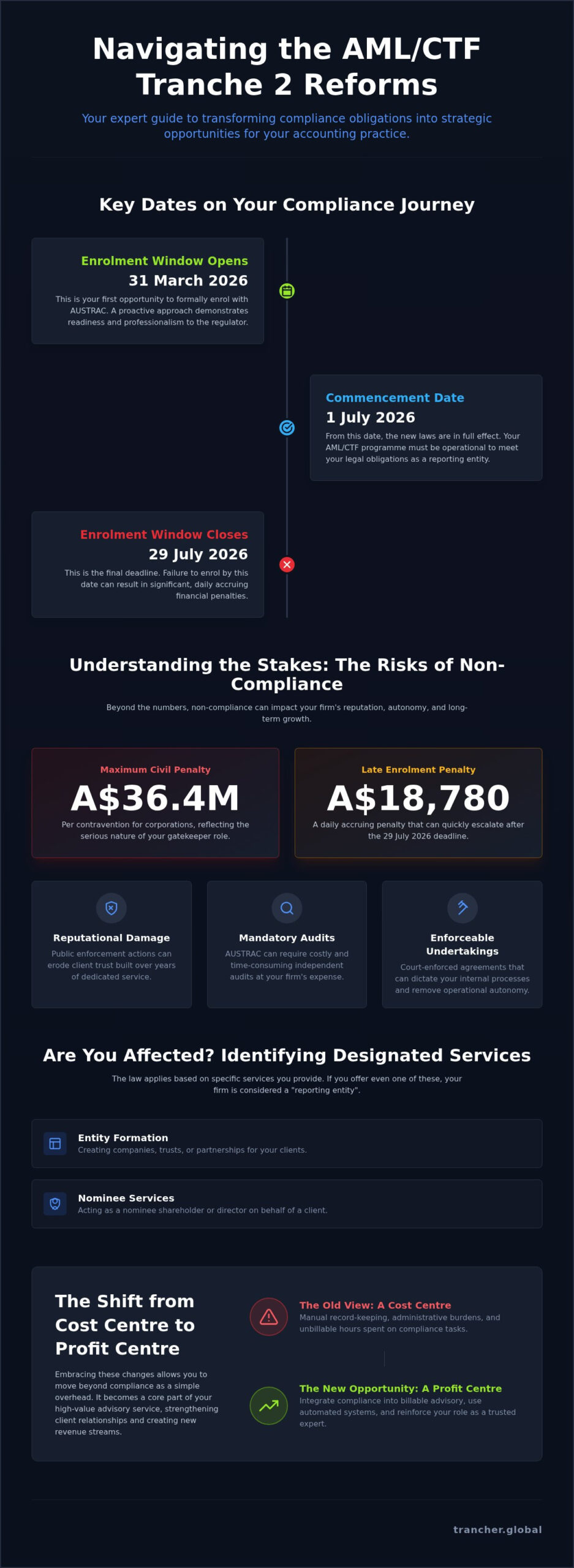
The Australian Transaction Reports and Analysis Centre (AUSTRAC) is the federal agency responsible for overseeing compliance. Their role is to ensure that reporting entities meet their obligations under the aml ctf act. AUSTRAC’s approach is increasingly proactive, shifting from simple technical checks to a risk-based model. They expect firms to understand their specific vulnerabilities rather than applying a one-size-fits-all solution. Enrolling early, with the window opening on 31 March 2026, shows the regulator that your firm is prepared and professional. This proactive stance helps build a constructive relationship with AUSTRAC, moving you away from the stress of last-minute compliance rushes.
The Risks of Non-Compliance in 2026
Understanding the consequences of non-compliance is essential for protecting your firm’s capital and reputation. The financial stakes are significant; as of July 2026, a corporation can face civil penalties of up to A$36.4 million per contravention. Even a delay in enrolment after the 29 July 2026 deadline can lead to a daily accruing penalty of A$18,780. These figures are designed to reflect the seriousness of the gatekeeper role.
Beyond financial penalties, non-compliance introduces operational friction that can hinder your firm’s growth.
- Reputational Damage: Public enforcement actions can quickly erode the trust you’ve built with your clients over years.
- Mandatory Independent Audits: AUSTRAC may require you to undergo an audit at your own expense, which is both costly and time-consuming.
- Enforceable Undertakings: These are court-enforced agreements that can dictate your internal processes, removing your autonomy over firm operations.
By implementing a structured compliance programme now, you ensure these risks remain theoretical, allowing you to focus on growing a resilient and profitable practice.
Defining Designated Services: Is Your Firm a Reporting Entity?
The aml ctf act operates on a functional basis. It doesn’t regulate “accountants” as a broad category; instead, it triggers obligations based on the specific “designated services” you offer to clients. This means your compliance journey begins with a thorough audit of your service menu. If you perform even one designated service, your firm becomes a “reporting entity” under the law. It’s a binary status that changes your relationship with the regulator immediately.
Waiting until the 1 July 2026 deadline to assess your offerings is a risky strategy. Many firms discover that services they consider “standard” or “administrative” are actually high-risk triggers in the eyes of the law. It’s best to identify these early so you can integrate necessary checks into your existing workflows without disrupting client delivery. Proactive identification allows you to turn a potential bottleneck into a smooth, professional onboarding experience.
Common Accounting Activities Under the Act
Several core accounting functions are now classified as designated services. If your practice engages in any of the following, you’ll need to establish a compliance framework:
- Entity Formation: Creating companies, trusts, or partnerships for clients.
- Nominee Services: Acting as a nominee shareholder or providing a director for a client’s entity.
- Asset Management: Managing client money, securities, or other physical assets.
- Registered Office: Providing a registered office or business address for a third party.
These activities are viewed as potential gateways for financial crime. By regulating these services, AUSTRAC aims to close gaps that could be exploited by illicit actors. Recognising these triggers helps you protect your firm from being inadvertently used in complex money laundering schemes.
The “Threshold” Myth: Why Size Doesn’t Matter
A common misconception is that the aml ctf act only applies to large firms with high transaction volumes. This is incorrect. The legislation is size-agnostic. Whether you’re a sole practitioner or a mid-tier firm, the same rules apply if you provide a designated service. Even if you only facilitate one company formation per year, you’re required to have a full AML/CTF programme in place. There’s no minimum volume exemption to shield you from these requirements.
This underscores the importance of understanding CDD and KYC Requirements Australia: The 2026 Accountant’s Guide to ensure your verification processes are audit-ready from day one. To simplify this transition, you might consider how automated workflow tools can help you identify these service triggers automatically during the onboarding process. By removing the guesswork, you can maintain your focus on billable advisory work while remaining fully compliant and secure.
Core Obligations Under the AML/CTF Act: Building Your Programme
Adopting a written programme is the primary requirement for any firm providing designated services. This document shouldn’t be a generic template; the aml ctf act requires it to be specifically tailored to your firm’s unique risk profile. Your programme is divided into two distinct sections. Part A focuses on your internal processes for identifying and mitigating money laundering risks, while Part B covers the specific procedures for identifying and verifying your clients. It’s a strategic framework that ensures everyone in your firm knows exactly how to handle high-risk scenarios before they escalate.
In a smaller practice, the role of the AML Compliance Officer often falls to a senior partner. This isn’t merely an administrative title. It’s a leadership position responsible for overseeing the programme’s effectiveness and acting as the primary point of contact for AUSTRAC. By appointing a dedicated officer, you demonstrate to the regulator that your firm takes its obligations seriously, providing a steady hand to guide your team through new operational requirements. It’s about building a culture of readiness rather than just reacting to rules.
Know Your Customer (KYC) and Due Diligence
Client verification has evolved beyond simply checking a driver’s licence. You must now identify beneficial owners, particularly when dealing with complex trust structures or corporate shells. Standard due diligence is sufficient for most, but you’ll need to perform Enhanced Due Diligence (EDD) when a client’s risk profile increases. Moving toward digital verification is essential; keeping manual paper copies is increasingly seen as a security liability. Automated systems can verify identities against global databases in seconds, ensuring your onboarding remains fast, professional, and audit-ready.
Ongoing Risk Monitoring and Record Keeping
Compliance isn’t a “set and forget” task. You’re required to monitor client relationships continuously to spot changes in behaviour or transaction patterns that might signal illicit activity. This includes maintaining detailed records of all compliance checks for a minimum of seven years. To manage this without drowning in paperwork, many firms are turning to integrated platforms that centralise documentation. For more on how to stay prepared for a potential AUSTRAC check, see our guide on Audit-Ready Compliance Records: The 2026 Guide for Australian Accounting Firms.
Staff Training and Governance
Your team is your first line of defence. Effective training should be role-based, helping your tax accountants spot “red flags” within the financial data they handle every day. Generic compliance slides often miss the mark; practical examples from your own practice area are far more effective. Governance starts at the top; the partners or board members carry the ultimate legal responsibility for the firm’s compliance. When the leadership team is actively involved in oversight, it fosters a culture of integrity that protects the firm’s reputation and its long-term health.
Managing ML/TF Risk and Reporting Suspicious Matters
As an accountant, you possess a unique vantage point over your clients’ financial health and transaction flows. Under the aml ctf act, this position comes with the responsibility to detect and report potential Money Laundering (ML) and Terrorism Financing (TF). Money laundering is the process of disguising the proceeds of crime to make them appear legitimate, whereas terrorism financing involves providing funds for illicit activity. In your practice, these risks don’t always look like “dirty money”; they often hide within complex trust structures or opaque business dealings that lack a clear commercial purpose.
Your primary tool for managing these risks is a documented risk assessment for every designated service you provide. This isn’t a one-off task but a living document that evolves as your client’s circumstances change. When a risk is identified, you may be required to file a Suspicious Matter Report (SMR) with AUSTRAC. It’s vital to understand the “Tipping Off” offence during this process. You must not disclose to a client that you’ve formed a suspicion or filed a report. Doing so is a criminal offence that can lead to significant legal consequences, so maintaining strict internal confidentiality is essential for your firm’s protection.
Identifying Suspicious Activity in Standard Services
Spotting “red flags” requires a healthy level of professional scepticism. You aren’t expected to be a private investigator, but you are expected to ask questions when things don’t add up. Common indicators of suspicious activity include:
- Unusual Transaction Patterns: Large, frequent cash deposits or rapid movements of funds between unrelated entities.
- Opaque Structures: Clients who insist on using multiple layers of companies or trusts without a logical tax or asset protection reason.
- Source of Wealth Secrecy: Clients who are hesitant or evasive when asked to explain how they acquired their initial investment capital.
By staying alert to these signs during your regular tax and advisory work, you act as a vital shield for the Australian financial system.
The AUSTRAC Reporting Workflow
When you identify a suspicious matter, the clock starts ticking immediately. For most suspicions related to money laundering or other crimes, you have three business days to submit an SMR to AUSTRAC. However, if the suspicion relates to terrorism financing, the deadline is much tighter at just 24 hours. Managing these windows manually is difficult, which is why Ongoing Risk Monitoring Software: A Guide for Australian Accounting Firms in 2026 is becoming a staple in modern practices.
In addition to SMRs, you’ll need to submit an Annual Compliance Report to AUSTRAC each year. This report gives the regulator a high-level overview of your firm’s compliance health and the effectiveness of your aml ctf act programme. You can automate your SMR preparation and risk tracking to ensure you never miss these critical windows. This proactive approach ensures your reporting is accurate, timely, and, most importantly, stress-free for your partners and staff.
Transforming Compliance into a Profitable Advisory Service
Many firms view the aml ctf act as a purely administrative drain on resources. However, when you shift your perspective, these new obligations become a powerful engine for professionalising your practice. By integrating compliance into your standard service delivery, you move from an “administrative burden” to a model of “recoverable compliance activity.” This transition allows you to protect your firm’s margins while providing clients with the high-level security and integrity they expect from a leading accounting practice.
Transparency is the foundation of this new approach. When communicating AML fees to your clients, it’s best to frame them as a value-add service rather than a hidden tax. Explain that these checks protect their business interests and ensure the legitimacy of the financial structures you’re building together. Most clients appreciate the rigour involved in safeguarding their assets, especially when you demonstrate that your firm uses sophisticated tools to keep the process fast and frictionless.
Tracking Billable Compliance Hours
One of the biggest challenges for accountants is “time leakage,” where minutes spent on verification and risk assessment go unrecorded. Automation solves this by capturing every second spent on compliance tasks, ensuring they’re accurately reflected in your billing. You can then generate detailed reports to show the exact return on investment for your firm. To see how this works in practice, explore our Compliance ROI Tracking Software: Transforming Regulatory Obligations into Billable Assets. This data doesn’t just help with billing; it provides insights into client risk profiles that can lead to deeper, high-value advisory conversations.
Getting Started: The 30-Day Roadmap
There’s no reason to wait for the July 2026 deadline to start modernising your workflows. Achieving operational readiness today gives your team time to adjust without the pressure of a looming regulatory cutoff. We’ve designed a clear 30-day roadmap to get your firm compliance-ready, backed by a 30-day guarantee to give you total peace of mind. To make the transition even smoother, we offer a complimentary 3-month trial that includes full ROI reporting, allowing you to see the financial benefits before making a long-term commitment.
Aaron Soh, our founder and a dedicated compliance specialist, often reminds partners that leading a firm through this transition is about more than just rules; it’s about building a more resilient business. By embracing these changes now, you position your firm as a proactive leader in the Australian market. You aren’t just meeting a requirement; you’re setting a new standard for excellence and profitability in the accounting profession. We’re here to act as your steady guide, ensuring every step you take adds tangible value to your practice.
Future-Proof Your Practice for the July 2026 Milestone
Navigating the aml ctf act doesn’t have to be a source of administrative stress. By identifying your firm’s designated services early and establishing a structured, automated programme, you protect your reputation while unlocking new avenues for advisory growth. You’ve seen how shifting from manual record-keeping to a digital-first approach ensures you’re audit-ready without sacrificing your billable hours.
We’re here to act as your steady guide through this transition. With our 30-day compliance guarantee and Australian-based expert support, you can move forward with total confidence. You’ll also receive a free ROI and efficiency report to track exactly how your new systems contribute to your firm’s bottom line. Don’t wait for the regulatory rush; start building a more resilient, profitable practice today.
Join the Trancher 3-month trial and get your firm compliance-ready in 30 days
The road to July 2026 is a journey we can take together, ensuring your firm remains a trusted leader in the Australian accounting landscape.
Frequently Asked Questions
What is the Tranche 2 deadline for Australian accountants?
The Tranche 2 deadline for Australian accountants to commence their full obligations is 1 July 2026. While the rules become active on this date, the enrolment window with AUSTRAC opens earlier on 31 March 2026. It’s essential to complete your enrolment by 29 July 2026 to avoid a daily failure to enrol penalty of A$18,780. Starting your preparation now ensures your internal systems are ready before the mid-year cutoff.
Which accounting services are considered “designated services” under the Act?
Designated services include any activity where you act as a gatekeeper to the financial system, such as company formation or trust creation. Other triggers include providing a registered office address, acting as a nominee shareholder, or managing client assets and securities. If your firm provides even one of these services occasionally, you are classified as a reporting entity under the aml ctf act and must maintain a compliant programme.
Does my small firm need a dedicated AML Compliance Officer?
Yes, every reporting entity must appoint an AML Compliance Officer, though this doesn’t need to be a new hire. In a small practice, a senior partner usually takes on this role. The officer is responsible for overseeing the firm’s compliance programme and acting as the primary liaison with AUSTRAC. It’s a leadership position that ensures your team understands their obligations and follows the firm’s risk-based procedures consistently.
What are the penalties for non-compliance with the AML/CTF Act?
The penalties for non-compliance are substantial, with corporations facing civil penalties of up to A$36.4 million per contravention as of July 2026. Individuals can be fined up to A$7.28 million. Beyond these court-imposed figures, AUSTRAC can apply daily administrative penalties for enrolment failures. There are also significant hidden costs, such as the expense of mandatory independent audits and the long-term impact of public enforcement actions on your firm’s reputation.
Can I charge my clients for AML compliance work?
You can and should charge clients for the work required to meet your obligations under the aml ctf act. Many firms now treat compliance as a recoverable advisory service rather than an overhead cost. By using automation to track billable hours spent on KYC and risk assessments, you can transparently pass these costs on to clients. This ensures your practice remains profitable while maintaining the high standards required by federal law.
How long do I need to keep AML/CTF records in Australia?
You are required to keep all AML/CTF records for a minimum of seven years in Australia. This includes customer identification documents, risk assessments, and records of any suspicious matter reports filed. These records must be stored in a way that allows them to be retrieved quickly in the event of an AUSTRAC audit. Moving to a digital storage system is highly recommended to ensure your documentation remains secure and easily accessible.
What is a Suspicious Matter Report (SMR) and when do I lodge one?
A Suspicious Matter Report (SMR) is a notification sent to AUSTRAC when you suspect a transaction or client interaction relates to illicit activity. You must lodge an SMR within three business days of forming a suspicion regarding money laundering or general crime. If the suspicion involves terrorism financing, the deadline is much tighter at 24 hours. Remember that tipping off a client about a report is a criminal offence with serious consequences.
Is manual compliance via spreadsheets still acceptable for AUSTRAC?
While spreadsheets aren’t explicitly banned, they are increasingly considered a high-risk liability by regulators. Manual record-keeping is prone to human error, lacks a robust audit trail, and makes ongoing risk monitoring incredibly difficult. AUSTRAC expects firms to have effective, reliable systems in place. Transitioning to automated platforms reduces the administrative burden and ensures your firm meets the modern standards of readiness expected of professional gatekeepers in 2026.