

What if your firm’s biggest regulatory headache was actually its most untapped revenue stream? Since the Tranche 2 obligations commenced on 1 July 2026, many Australian accounting firms have felt a sense of anxiety about the mounting administrative burden. You’re likely finding that tracking time spent on KYC and CDD feels like a drain on your productivity, especially when it’s viewed as a non-billable overhead. It’s a common frustration; however, it doesn’t have to stay that way. By implementing specialised AML cost recovery software, you can move away from manual tracking and start treating compliance as the high-value professional service it truly is.
In this guide, you’ll learn how to transform your approach to AML/CTF obligations from a costly requirement into a transparent, recoverable asset. We’ll show you how to use automation to generate ROI reports and integrate compliance checks seamlessly into your existing workflows. We also address the practical side of things, such as how to explain these new fees to long-term clients without the awkwardness. With a 30-day compliance-ready guarantee as your foundation, you’ll have a clear roadmap to achieving transparent billing and operational ease, ensuring your firm remains both compliant and profitable in this new regulatory era.
Key Takeaways
- Understand why the 1 July 2026 Tranche 2 commencement makes manual compliance a significant profit-killer for Australian accounting firms.
- Discover how specialised AML cost recovery software transforms non-billable administrative tasks into a transparent, recoverable professional service.
- Identify the essential criteria for selecting a solution that integrates with your existing workflows while providing real-time ROI reporting.
- Master a communication framework to confidently reframe AML compliance costs as a value-add service that protects your clients’ businesses.
- Learn how to achieve a 30-day compliance-ready status to alleviate regulatory pressure and secure your firm’s long-term financial health.
Navigating the Financial Realities of AUSTRAC Tranche 2 in 2026
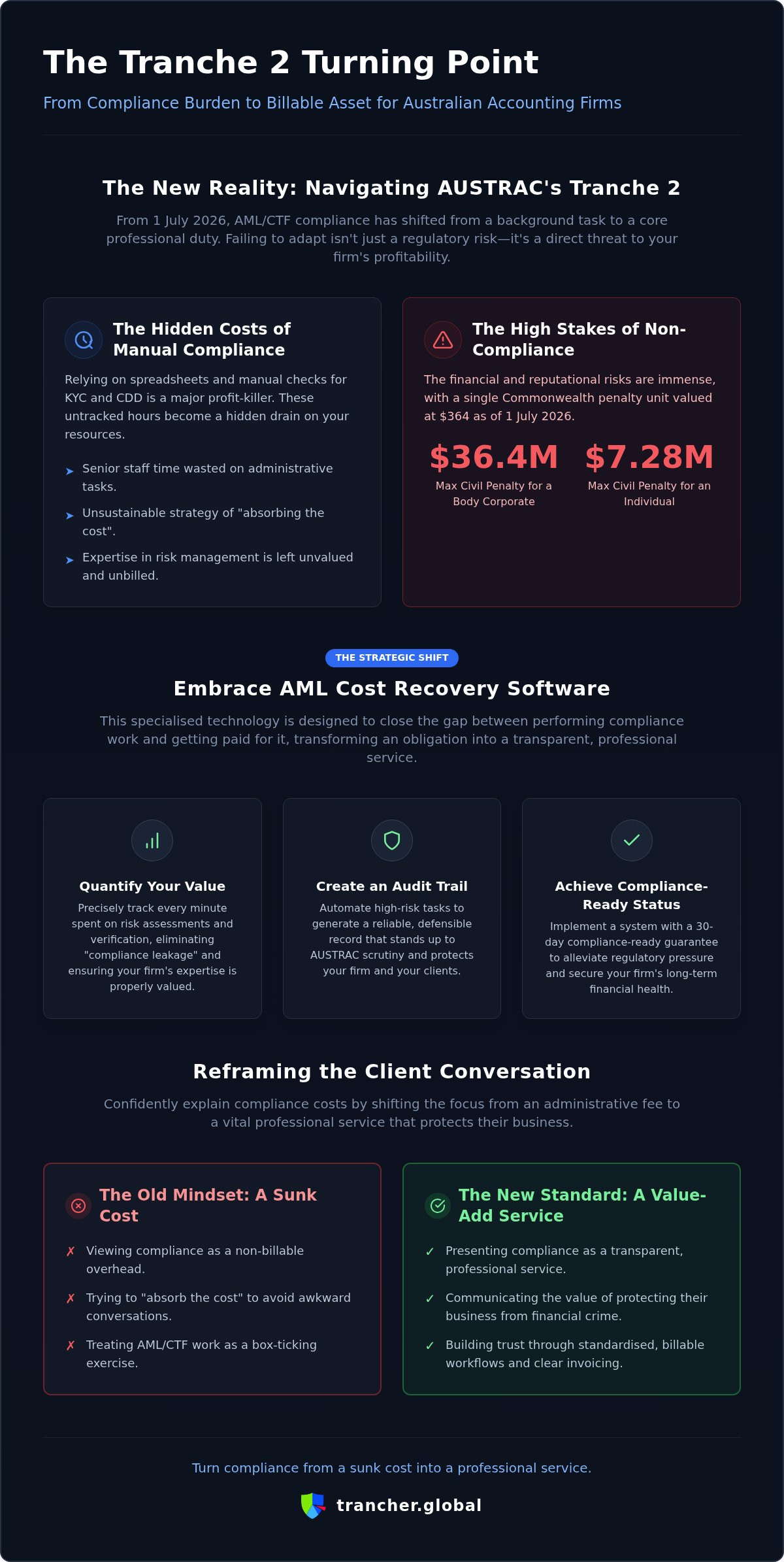
The 1 July 2026 commencement date has redefined the operational floor for Australian accounting firms. If your firm provides designated services, you’re no longer just an advisor; you’re a reporting entity with specific AUSTRAC obligations. This transition has moved AML/CTF compliance from the “nice to have” list directly into the core of your professional duties. Failing to adapt isn’t just a regulatory risk. It’s a threat to your firm’s profitability. You need to view these requirements as a standard part of your service delivery rather than an occasional hurdle.
The Hidden Costs of Manual Compliance
Relying on spreadsheets and manual checks to manage Know Your Customer (KYC) and Customer Due Diligence (CDD) is a significant profit-killer. Every hour your senior staff spends chasing identity documents or running manual PEP screenings is an hour not billed to a client. When these activities remain untracked, they become a hidden drain on your resources. Many firms mistakenly try to “absorb the cost” to avoid difficult conversations, but this strategy is unsustainable under the new regime. It’s vital to recognise that your expertise in managing these risks has intrinsic value.
The stakes for getting this wrong are incredibly high. As of 1 July 2026, a single Commonwealth penalty unit is valued at $364. For serious contraventions, a body corporate could face maximum civil penalties of $36.4 million. Even for individuals, the risk reaches $7.28 million. Beyond the financial hit, the reputational damage from an AUSTRAC audit can be permanent. To mitigate these risks, many firms are turning to Anti-money laundering (AML) software to automate these high-risk tasks and create a reliable audit trail that stands up to scrutiny.
Opportunities in the New Regulatory Landscape
While the 2026 deadline brought pressure, it also created a unique opportunity to modernise your practice. By viewing AML/CTF compliance as an extension of your advisory services, you can add genuine value to your client relationships. You aren’t just ticking boxes; you’re protecting their business and yours from financial crime. This shift requires a move toward structured, billable workflows where every minute of compliance work is accounted for and justified.
Early adopters are already gaining a competitive edge by implementing AML cost recovery software. This technology allows you to move away from the “administrative burden” mindset. Instead, you can present compliance as a transparent, professional service. By standardising your workflows, you ensure that compliance activity is tracked with the same precision as tax planning or audit work. This transparency builds trust with clients and ensures your firm remains profitable while meeting its legal duties. Before you can begin recovering costs, however, your firm must first be properly registered — following a thorough AUSTRAC enrolment checklist ensures you’ve completed every required step on the Reporting Entities Roll. Transitioning to a model of AML cost recovery software usage ensures that your firm’s growth isn’t hampered by the very regulations designed to protect the industry.
Defining AML Cost Recovery Software: More Than Just a Billing Tool
While most accounting firms are familiar with general practice management, AML cost recovery software represents a distinct category of professional technology. It’s designed to solve a specific problem: the invisible erosion of billable time caused by mounting regulatory requirements. Generic billing tools often fail to capture the complexity of AML/CTF tasks, leading to what we call “compliance leakage.” By using a specialised tool, you can precisely track every minute spent on risk assessments and verification, ensuring your firm’s expertise is properly valued and recovered.
The goal of this technology is to close the gap between performing the work and getting paid for it. Compliance isn’t a side task; it’s a core professional service that carries significant responsibility. When you use a system that treats every identity check as a trackable event, you move away from the “administrative burden” mindset. You’re no longer just ticking boxes. You’re quantifying the professional risk management you provide to every client, turning a regulatory obligation into a sustainable part of your business model.
Automated Time and Activity Tracking
Manual tracking is often the first thing to fail when a firm is busy. Senior partners might spend significant time reviewing complex corporate structures or verifying foreign beneficial owners without ever recording the effort. Dedicated AML cost recovery software eliminates this oversight by capturing these activities as they happen. It links every KYC check and screening directly to the relevant client file, removing the guesswork from your end-of-month billing. When your activity tracking is automated, you aren’t just guessing how long a risk assessment took; you have the data to prove it.
Generating Audit-Ready Evidence for Fees
Clients in 2026 are increasingly aware of their own risks, but they still expect transparency regarding professional fees. Providing a vague “compliance fee” on an invoice often leads to awkward pushback. Instead, you can provide a detailed breakdown of the specific regulatory actions performed. This clarity transforms the conversation. You’re no longer charging for “admin”; you’re charging for professional risk mitigation that protects the client’s own standing. If you’re looking to bridge the gap between regulatory duty and firm profitability, exploring specialised billing support is a logical next step for any modern practice.
This data serves a vital secondary purpose. It integrates directly with your audit-ready compliance records to create a unified system of truth. If AUSTRAC conducts a review, you can demonstrate a clear link between your compliance program, the work performed, and your professional fees. This level of organisation provides immense peace of mind, ensuring that your billing practices are as robust as your regulatory reporting.
Essential Criteria for Selecting an AML Billing Solution
Choosing the right platform to manage your firm’s regulatory obligations is a strategic decision that impacts both your staff’s daily rhythm and your firm’s bottom line. It’s not simply about finding a tool that ticks a box; it’s about selecting a system that integrates seamlessly with your existing accounting software and CRM platforms. When your AML cost recovery software talks directly to your practice management tools, you eliminate the friction of double-handling data. This connectivity ensures that every client verification is logged against the correct engagement without manual intervention, allowing your team to focus on high-value advisory work.
Scalability is equally vital for firms managing diverse client portfolios under the Tranche 2 regime. Whether you are dealing with simple individual tax returns or complex corporate structures with offshore beneficial owners, your solution must adapt to varying levels of risk. User-friendly dashboards are essential here, providing partners with a high-level view of firm-wide compliance health while giving administrative staff the granular tools they need to complete daily tasks. A well-designed interface reduces the learning curve and ensures that compliance becomes a natural part of your firm’s culture rather than a disruptive chore.
Compliance-First Feature Sets
Your chosen solution must be built with the Australian regulatory environment as its foundation. It’s essential to verify that the software explicitly supports CDD and KYC requirements Australia, as these standards are specific and rigorous. The platform should allow you to track “designated services” as defined by AUSTRAC, ensuring that you only apply recovery fees where appropriate and legally defensible. Security is another non-negotiable factor. Role-based access controls are necessary to protect sensitive client data, ensuring that only authorised personnel can view or edit identity documents and risk assessments.
Billing and Revenue Reporting
The true power of modern AML cost recovery software lies in its ability to quantify the value of your compliance efforts. Look for a system that offers customisable templates for fee disclosure. This allows you to present compliance costs to your clients with total clarity, reinforcing the professional nature of the service. Automated generation of ROI efficiency reports provides the data you need to see exactly how your compliance team is performing. In the current landscape, the importance of compliance ROI tracking software cannot be overstated. It provides the financial transparency required to prove that your AML program is a self-sustaining professional service rather than a drain on your firm’s capital.
Explaining AML Compliance Costs: Communication Framework
Introducing new fees to long-term clients can feel uncomfortable, but it’s a necessary step in our shared regulatory environment. The key is to move away from defensive explanations and toward proactive partnership. By framing compliance as a protective measure for the client’s own interests, you change the dynamic of the conversation. You aren’t just passing on a cost; you’re providing a sophisticated risk-management service that ensures their business remains beyond reproach.
Effective communication starts with absolute transparency. When you utilise AML cost recovery software, you have the hard data needed to justify these professional fees. It allows you to move from vague estimates to precise, activity-based billing that clients can easily understand and respect. This clarity builds trust and demonstrates that your firm is managing its obligations with professional rigour.
Step 1: The Initial Disclosure
Updating your engagement letters is the first practical step. It’s best to be direct about the 1 July 2026 Tranche 2 commencement and what it means for your professional relationship. Explain the “why” behind the changes: this is a national effort to combat financial crime and protect the Australian economy. By setting expectations early regarding KYC data collection and the associated recovery fees, you eliminate surprises later in the engagement. This proactive approach shows you’re organised and prepared. For clients who are themselves business owners, pointing them toward a complete AUSTRAC enrolment checklist for Australian SMEs can help them understand their own parallel obligations under the new regime.
Step 2: Demonstrating Value through Data
Clients often don’t see the complexity of the work happening behind the scenes. Sharing high-level results of risk assessments can help them understand the depth of your due diligence. When you use AML cost recovery software to generate detailed reports, the fee feels fair and reasonable because the effort is visible. You’re showing them the specific regulatory activities performed to secure their standing, turning an abstract rule into a tangible professional service. For clients involved in property transactions, this is particularly relevant, as the new mandate for a source of funds declaration for real estate Australia means the depth of due diligence required has increased significantly.
Step 3: Managing the “Why Me?” Objection
When a client asks why they are being screened, handle the objection with confidence and warmth. Remind them that these are industry-wide obligations affecting every accountant and client in Australia. Focus on the benefits: these checks protect the security and integrity of their own financial identity. By positioning your firm as a “safe pair of hands” in a heavily regulated environment, you reassure them that their compliance is being handled by experts who value their business safety.
If you are ready to streamline these client conversations with data-backed transparency, explore our compliance billing support to see how we can help your firm stay profitable.
Trancher: Turning Compliance from a Sunk Cost into a Professional Service
Trancher isn’t just another tech platform; it’s a solution forged in the specific pressures of the Australian accounting sector. We understand that since the 1 July 2026 deadline, your focus has likely shifted from “how do we comply?” to “how do we sustain this?”. By using our AML cost recovery software, you move beyond the anxiety of administrative overhead. Our platform was built from the ground up to ensure that every regulatory action you take is tracked, verified, and ready to be recovered as a professional service fee. It’s about ensuring your firm stays profitable while meeting its legal duties.
We offer a 30-day compliance-ready guarantee because we know the pressure firms are under. This isn’t a vague promise; it’s a commitment to getting your systems, staff, and workflows up to speed within a month. This rapid transition ensures you’re protected from the severe AUSTRAC penalties while immediately starting the process of cost recovery. Our goal is to provide a steady hand as you navigate these new requirements, turning a perceived burden into a manageable and advantageous part of your practice.
A System Designed for Profitability
Many firms view compliance as a drain, but Trancher reframes this through automated AML CTF compliance costs reduction. Our platform identifies new advisory revenue streams by highlighting the high-value risk mitigation work you’re already doing for your clients. Instead of drowning in manual spreadsheets, you generate structured evidence that justifies your professional fees. This transparency builds trust with your clients and proves the worth of your advisory role in a complex financial world.
Getting Started with Confidence
We believe you should see the value of a solution before you commit. That’s why we provide a complimentary 3-month trial, which includes a formal ROI report. This report gives you a clear, data-driven look at how the AML cost recovery software has impacted your firm’s bottom line during the trial period. If you decide to continue after the trial, we support your transition with a 20% discount on your first 12 months. It’s a low-risk path to securing your firm’s financial health.
You’re never left to navigate these changes alone. Our onboarding process is led by Australian compliance specialists who understand the nuances of the local market and the specific pain points of accounting firms. You have direct access to Aaron Soh and our expert team, providing a knowledgeable resource whenever you need a hand. We act as your strategic partner, ensuring your team is on the front foot, confident in their duties, and ready to provide a superior level of professional service.
Building a Sustainable Practice in the Post-Tranche 2 Era
The shift toward a regulated landscape doesn’t have to be a drain on your firm’s resources. By reframing your AUSTRAC obligations as a high-value professional service, you protect both your margins and your clients’ integrity. We’ve explored how AML cost recovery software provides the transparency needed to turn administrative work into billable activity. This isn’t just about ticking boxes; it’s about quantifying the expert risk mitigation you provide every day. Moving away from manual processes ensures your team remains focused on advisory work rather than getting bogged down in unrecorded paperwork.
You can take the first step toward a more profitable model with total confidence. We provide a 30-day compliance guarantee to ensure you meet your duties quickly, along with a formal ROI report after your trial period to prove the value of our platform. Early adopters of Tranche 2 solutions also benefit from a 20% discount on their first year. Start your complimentary 3-month Trancher trial and transform your compliance ROI today. We’re here to act as your steady guide, ensuring your firm remains a safe and profitable pair of hands for years to come.
Frequently Asked Questions
Can I legally charge my clients for AML compliance costs in Australia?
Yes, you can recover costs for professional services related to your regulatory duties. It’s standard practice to charge for compliance activity just as you do for tax or audit work. AUSTRAC requires the work; how you bill for your time is a commercial decision. Using AML cost recovery software ensures these charges are transparent and defensible. You aren’t just passing on a cost; you’re billing for the expertise required to manage risk.
How much should an accounting firm charge for a standard KYC check?
There’s no fixed industry rate for a KYC check. Charges typically depend on the complexity of the entity, such as whether you’re verifying an individual or a multi-layered corporate structure. Instead of a flat fee, focus on recovering the professional time spent on due diligence. Most firms find success by setting a rate that reflects the seniority of the staff involved and the depth of the risk assessment required for that client.
What is the best way to introduce AML fees to long-term clients?
Transparency is your most valuable tool. Start by updating your engagement letters to reflect the new Tranche 2 obligations that commenced on 1 July 2026. Explain that these checks are an industry-wide requirement designed to protect the integrity of the Australian financial system. By reframing the fee as a protective measure for their business, you move the conversation from “paying for a rule” to “investing in business security.”
Does AML cost recovery software integrate with Xero or MYOB?
Trancher is designed to fit seamlessly into your existing practice. It offers platform integrations and workflow automation to ensure your compliance data flows directly into your management systems. This connectivity reduces double-handling and ensures that every identity check is logged against the correct client engagement. By removing the friction between compliance and billing, you can maintain a high standard of professional service without disrupting your team’s established daily rhythm.
What happens if a client refuses to pay the compliance fee?
If a client refuses to cover compliance costs, you must consider the commercial and regulatory risks. You can’t waive your AML/CTF obligations just because a client objects to the fee. If you can’t perform the required due diligence, you may be unable to provide the designated service legally. It’s often helpful to explain that these checks are mandatory for all Australian accountants, ensuring the client understands the necessity of the process.
How does Trancher help track billable hours for compliance work?
Trancher utilises automated activity tracking to log every compliance event in real-time. Whether it’s a PEP screening or a complex beneficial ownership review, the system captures the effort as it happens. This data feeds into our revenue and ROI tracking features, providing a clear picture of your compliance team’s profitability. By using specialised AML cost recovery software, you eliminate the “leakage” of billable hours that often occurs with manual spreadsheets and untracked time.
Is there a specific AUSTRAC rule about disclosing compliance costs?
AUSTRAC doesn’t prescribe how you should bill your clients, but they do require you to maintain a robust AML/CTF program. Professional standards in Australia generally require that any fees are clearly disclosed and agreed upon in your engagement letter. While the regulator focuses on your compliance outcomes, your clients will focus on transparency. Providing a detailed breakdown of the regulatory work performed is the best way to meet professional expectations and build trust.
How long does it take to see an ROI on AML software investment?
You’ll likely see a return on investment within the first few months of implementation. We provide a 30-day compliance-ready guarantee to ensure you’re operational and recovering costs quickly. To give you absolute certainty, Trancher offers a 3-month complimentary trial that includes a formal ROI report. This report demonstrates exactly how much revenue has been recovered through automated tracking, allowing you to make a data-driven decision about the long-term financial health of your practice.