

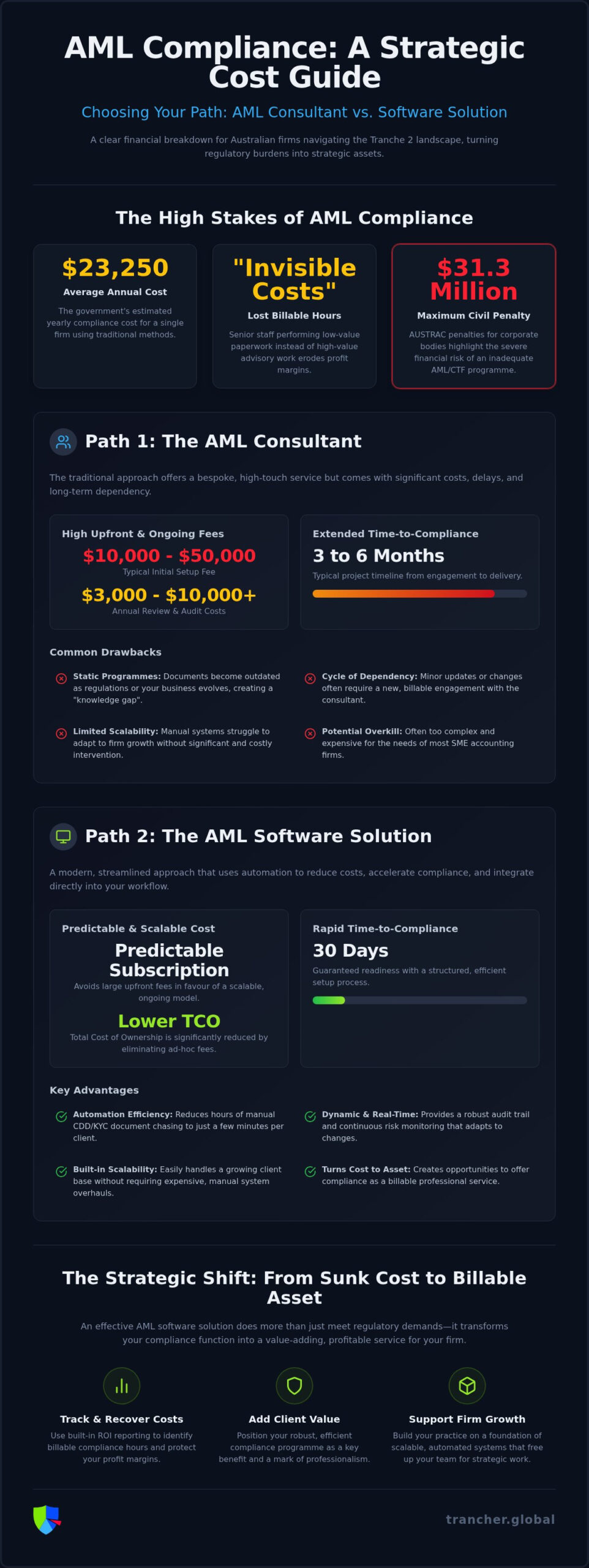
The Australian Government estimated the average annual cost of AML compliance for a single firm at $23,250. It’s a figure that understandably causes some anxiety for practice partners trying to protect their profit margins after the July 2026 deadline. Whether you’re still refining your approach or looking to optimise your current systems, the choice between AML software vs consultant cost Australia is no longer just a regulatory hurdle; it’s a strategic business decision.
You likely feel the pressure to maintain a defensible AML/CTF programme that passes AUSTRAC scrutiny without drowning your team in manual paperwork. We understand that balancing high consultant fees against the administrative weight of new software can feel like a lose-lose situation. This guide provides a clear, financial breakdown of both paths to help you secure a cost-effective solution. We’ll explore how to avoid the common consultant customisation trap and instead implement a streamlined, software-led workflow that turns compliance into a billable professional service. By the end of this guide, you’ll have a clear path to maintaining a robust programme that supports, rather than drains, your firm’s growth.
Key Takeaways
- Understand how to transition from viewing regulatory requirements as a “sunk cost” to positioning them as a billable professional service that adds value to your practice.
- Evaluate the total investment required for AML software vs consultant cost Australia by comparing upfront project fees against predictable, scalable subscription models.
- Learn how automation can streamline your CDD and KYC processes, reducing administrative labour from hours of manual document chasing to just a few minutes.
- Compare the “Time-to-Compliance” for your firm, contrasting a 30-day guaranteed software setup with the typical three-to-six-month timeline of traditional consultancy.
- Discover practical ways to track and recover compliance expenditure using ROI reporting that identifies billable hours and ensures your profit margins remain protected.
Navigating the Tranche 2 Cost Landscape in 2026
Since the 1 July 2026 deadline passed, Australian accounting firms have entered a new era of regulatory oversight. The Australian Government previously estimated that traditional compliance methods would cost the average business roughly $23,250 per year. For many SME practitioners, this figure initially felt like a “sunk cost”; a necessary tax on doing business that offers no tangible return. When you evaluate AML software vs consultant cost Australia, it’s vital to look beyond the initial invoice. You must distinguish between direct professional fees and the heavy indirect cost of lost billable hours. The Tranche 2 framework has shifted the goalposts, making internal resource allocation a primary concern for firm owners who want to remain profitable while staying compliant.
The “Invisible” Cost of Manual Compliance
Manual verification is rarely just a “quick check”. It involves hours of chasing identity documents, verifying source of wealth, and cross-referencing watchlists. This leads to “administrative creep”, where senior partners perform low-value paperwork instead of high-value advisory work. Relying on spreadsheets is a false economy. They lack the robust audit trail required for modern compliance and cannot provide the real-time risk monitoring found in Anti-money laundering (AML) software. Every hour your team spends manually cross-referencing data is an hour that isn’t being billed to a client. When partners are bogged down in the minutiae of client due diligence, the firm loses its strategic edge and its profit margins begin to erode.
AUSTRAC Expectations for SME Firms
AUSTRAC expects more than just a static document kept in a bottom drawer. A “defensible” AML/CTF programme must be risk-based, active, and tailored to your firm’s specific client profile. With civil penalties for corporate bodies now reaching up to $31.3 million, the financial risk of an ad-hoc approach is untenable. The regulator rewards firms that demonstrate proactive, structured systems rather than reactive responses. We guide firms away from administrative panic toward a structured, 30-day readiness plan. This methodical approach ensures you meet every obligation while protecting your firm’s reputation and ensuring your internal systems are built for long-term efficiency.
The True Cost of Engaging an AML Consultant
When weighing up AML software vs consultant cost Australia, many practice partners initially gravitate toward the bespoke nature of a consultancy engagement. It feels reassuring to have an expert build a manual specifically for your firm. This high-touch model comes with a significant price tag. For an initial setup, Australian firms typically see quotes ranging from $10,000 to $50,000. This fixed fee usually covers the drafting of your AML/CTF programme and a risk assessment tailored to AUSTRAC’s national risk assessments. While the resulting documents are comprehensive, they often remain static, leading to a “Knowledge Gap” the moment the consultant finishes their contract. If your firm grows or regulations shift, these bespoke systems struggle to scale without further expensive interventions.
The Setup vs. Maintenance Divide
Many firms find that an initial $20,000 engagement is merely the tip of the iceberg. Beyond the setup, annual reviews and independent audits required by AUSTRAC can add another $3,000 to $10,000 to your yearly overheads. This creates a cycle of dependency where every minor regulatory update or internal change necessitates a new, billable engagement. Without an automated platform, your team is left to manually update records and monitor client activity; this increases the friction of daily operations and pulls staff away from billable work.
When a Consultant Makes Sense
Consultants certainly have their place, particularly for firms managing complex, multi-entity structures or those requiring a “second pair of eyes” on a high-risk portfolio. If your practice deals with standard designated services, however, this model is often overkill. Most SME accounting firms benefit more from a structured, automated approach that integrates expert support directly into the workflow. If you are looking for a way to manage these obligations without the consultant overhead, exploring an end-to-end AML platform can provide the steady guidance you need. A structured system ensures that your compliance remains a living process rather than a forgotten PDF in a digital folder.
Evaluating AML Software: Efficiency and Investment
Shifting from traditional consultancy to a digital platform changes the financial profile of your compliance programme. Instead of facing a heavy upfront capital expense that strains cash flow, firms move toward a predictable operating cost. This subscription model allows for better budgeting and removes the fear of the “surprise invoice” often associated with bespoke professional advice. When you analyse AML software vs consultant cost Australia, the primary value lies in its ability to scale. A software platform doesn’t charge you more just because your client list grew; it simply provides the framework to manage that growth without adding more administrative staff to the payroll.
The most immediate benefit is the drastic reduction in manual labour. Meeting CDD and KYC requirements Australia has historically involved hours of chasing identity documents and verifying source of wealth. Automation reduces this process to minutes. By using integrated screening, your firm can conduct PEP and Sanctions checks instantly, lowering your risk profile without the need for manual cross-referencing. This “Audit-Ready” design ensures that every action is captured in time-stamped logs, providing a level of transparency that manual systems simply cannot match.
The Software “Sweet Spot” for Accountants
Consistency is often the first casualty of a manual system. Software standardises workflows across your entire firm, ensuring every staff member follows the exact same compliant path regardless of their experience level. This is where ongoing risk monitoring software becomes indispensable. It acts as a digital safety net, flagging changes in client risk profiles that might otherwise be missed in a busy practice. We believe that local Australian support and founder-led guidance are essential components of this “sweet spot”, providing you with a knowledgeable partner who understands the specific nuances of the local regulatory environment.
Comparing Software Features to Consultant Deliverables
While a consultant provides a bespoke report, modern software offers risk assessment templates that are equally defensible and far easier to update as your business evolves. Consider the reporting process: manual Suspicious Matter Reporting (SMR) is a high-stakes task that can lead to reactive panic. Digital platforms streamline this, making the filing process with AUSTRAC methodical and less prone to human error. Even staff training is improved; software-led education modules are repeatable, trackable, and easily updated whenever the law changes. This ensures your team remains competent and confident without the need for recurring, expensive training seminars.
The Comparison: Upfront Fees, Maintenance, and Hidden Overheads
Analysing the AML software vs consultant cost Australia requires a 12-month perspective rather than just looking at the initial invoice. For many firms, the cost of implementing AML program via a consultant involves a long, drawn-out process. A consultant often requires three to six months to interview staff, assess risks, and draft bespoke manuals. In contrast, an expert-led platform can achieve a “Time-to-Compliance” in just 30 days. This speed is not just about ticking boxes; it’s about protecting your practice from the daily $18,780 penalty for non-enrolment that applies after the July 2026 deadline.
Maintenance is another critical differentiator. When AUSTRAC updates its guidelines, a firm using a consultant must re-engage that expert for another round of billable hours. A software platform manages these updates centrally, ensuring your system evolves alongside the regulations without additional financial strain. As your firm scales and takes on more designated services, the cost per client verification actually decreases through automation, whereas a manual, consultant-led system becomes increasingly expensive to manage. This is particularly relevant when dealing with complex corporate structures, where beneficial ownership verification software Australia firms rely on can dramatically reduce the time spent tracing multi-layered entities to identify ultimate beneficial owners.
Financial Comparison Table
| Feature | Consultant Model | Trancher Platform |
|---|---|---|
| Initial Setup | High upfront fees; months of manual drafting. | Low setup cost; 30-day compliance guarantee. |
| KYC Checks | Manual execution; high staff time cost. | Automated execution; minutes per check. |
| Audit Readiness | Static documents; manual record keeping. | Real-time logs; audit-ready by design. |
| Regulatory Updates | Expensive re-engagements required. | Included in subscription; updated centrally. |
Trial participants can currently access a 20% discount, further reducing the initial investment required to secure their practice.
The “Customisation Trap” vs. Best-Practice Workflows
Many firms fall into the “customisation trap”, believing that a bespoke programme is superior. In the regulatory world, “bespoke” often just means “complex” and “difficult to maintain”. Using an AUSTRAC-aligned framework that is already proven across hundreds of firms is a safer, more efficient path. You don’t need to pay for custom coding when standard integrations already exist to handle your workflow. By adopting a best-practice model, you ensure your programme is defensible and scalable from day one. If you are ready to move away from manual overheads, you can start your 3-month complimentary trial and begin your 30-day transition today.
Beyond Costs: Turning AML Compliance into a Billable Asset
Most discussions regarding AML software vs consultant cost Australia focus exclusively on the expense. This perspective treats regulatory obligations as a “cost centre” that erodes firm profitability. We encourage a strategic mindset shift: viewing AML/CTF compliance as a professional service rather than a tax on doing business. Just as you provide value through tax advisory or auditing, performing robust client due diligence protects your clients and the broader financial system. When you frame these requirements as a value-add service, the conversation moves from “how much does this cost” to “how can we deliver this efficiently and profitably.”
Early preparation for the Tranche 2 landscape is the most effective way to protect your firm’s margins. By establishing a structured workflow now, you avoid the premium fees associated with last-minute consultant engagements. Modern compliance ROI tracking software allows you to identify exactly how much time is spent on every client verification. This transparency makes it significantly easier to justify compliance fees to your clients. You aren’t simply charging for a “check”; you’re charging for the professional expertise and sophisticated systems that secure their transactions and protect their reputation.
The Trancher ROI Framework
Generating evidence for client billing is often the hardest part of manual compliance. Our framework utilizes automated activity tracking to provide clear data on the labour invested in every file. This allows you to recover hours that would otherwise be lost to administrative overhead. To help you test this billable model without financial risk, we offer a complimentary 3-month trial for a limited number of firms. During this period, you can receive a formal ROI report that proves the efficiency gains of the platform to your partners. It’s a practical way to see exactly how automation transforms a regulatory burden into a streamlined, professional asset.
Your 30-Day Readiness Guarantee
The transition to a new regulatory environment doesn’t have to be a multi-month project. We provide a “guaranteed compliant” promise that brings your practice up to standard within 30 days. This rapid implementation gives you the peace of mind that your firm is fully protected against AUSTRAC scrutiny without the delay of a bespoke consultant report. Our local expert support acts as a strategic guide, effectively replacing the need for a full-time compliance officer and reducing your long-term salary overheads. If you’re ready to secure your firm’s future and turn these obligations into an advantage, start a conversation with Aaron Soh today to organise your transition before the 2026 requirements become a critical issue.
Securing Your Firm’s Regulatory Future
Deciding between AML software vs consultant cost Australia is a pivotal choice for any practice partner focused on long-term profitability. While consultants provide bespoke documentation, they often leave firms with static systems and recurring maintenance fees. Digital platforms offer a more scalable alternative, replacing manual labour with automated workflows and providing the audit-ready transparency that AUSTRAC expects. By shifting your mindset and treating compliance as a billable professional service, you can protect your margins while ensuring your firm remains fully defensible.
We are here to act as your strategic guide through this transition. With founder-led local Australian support, we help you remove the friction of regulatory obligations so you can focus on high-value advisory work. Secure your complimentary 3-month trial and 30-day compliance guarantee with Trancher today. You’ll also benefit from a 20% discount on your first 12-month subscription. It’s time to transform your compliance requirements from a complex hurdle into a streamlined, profitable asset for your practice. We look forward to helping you navigate this landscape with confidence and ease.
Frequently Asked Questions
How much does a typical AML consultant cost for an Australian accounting firm?
The Australian Government previously estimated that traditional compliance methods would cost the average business roughly $23,250 per year. When you evaluate AML software vs consultant cost Australia, you’ll find that consultant fees typically involve high upfront project costs for manual drafting and risk assessments. These engagements often require recurring advisory fees for every regulatory change. An automated platform removes this friction by providing a scalable, predictable cost structure that evolves alongside AUSTRAC requirements.
Is AML software enough to satisfy AUSTRAC Tranche 2 requirements?
Yes, a comprehensive platform like Trancher is designed to meet the full spectrum of AUSTRAC obligations. It manages end-to-end programme requirements, including client verification, ongoing risk monitoring, and suspicious matter reporting. Unlike fragmented tools, our solution provides a structured workflow that ensures your firm remains compliant with the Tranche 2 framework. We support this with local expert guidance to ensure your programme is both defensible and operationally efficient for your specific practice needs.
What are the hidden costs of manual AML compliance?
The most significant hidden cost is the loss of billable hours as senior partners get bogged down in administrative paperwork. Manual KYC and CDD verification can take hours per client; this pulls your team away from high-value advisory work. These inefficiencies often exceed the direct AML software vs consultant cost Australia when calculated over a full financial year. Using automated systems prevents “administrative creep” and ensures your records remain consistent and audit-ready at all times.
Can I charge my clients for the cost of AML compliance checks?
You certainly can, and we encourage firms to view compliance as a recoverable professional service. Our platform includes specialised features for compliance billing support and ROI tracking. By using automated activity logs, you can generate clear evidence of the work performed for each client. This transparency allows you to justify compliance fees as part of your standard engagement, transforming a regulatory burden into a legitimate revenue stream for your practice.
How long does it take to become AML compliant with software vs a consultant?
Traditional consultancy engagements often take between three and six months to complete the necessary interviews, risk assessments, and manual drafting. In contrast, we provide a 30-day compliance-ready guarantee for firms using our platform. This rapid implementation ensures you meet your obligations quickly without the long lead times associated with bespoke projects. It allows your firm to move from reactive planning to active compliance in a fraction of the time.
What happens if our firm is not compliant by the July 2026 deadline?
Since the 1 July 2026 deadline has passed, firms providing designated services must already be enrolled with AUSTRAC. Non-compliance carries severe risks, including a daily penalty of $18,780 for failing to enrol. Beyond these immediate fines, AUSTRAC can impose civil penalties of up to $31.3 million for corporate bodies. Proactive preparation is essential to avoid formal directions, enforceable undertakings, or the reputational damage associated with a regulatory audit.
Does AML software include staff training and audit-ready records?
A complete solution like ours includes integrated staff training modules and automated record-keeping systems. These features ensure that every member of your team understands their specific role in maintaining compliance. All client activity and verification steps are captured in time-stamped logs, creating an audit-ready trail by design. This centralised documentation is vital for demonstrating to AUSTRAC that your firm has a robust, active, and well-managed AML/CTF programme in place.
Is there a way to test AML software before committing to a full subscription?
We offer a complimentary 3-month trial to a limited number of accounting firms. This allows you to test the platform in a real-world environment and see the efficiency gains first-hand. At the end of the trial, you’ll receive a formal ROI report detailing your billable compliance hours and time saved. If you choose to continue, you’ll also receive a 20% discount on your first 12-month subscription as a trial participant.